

American Patriot, Nathan Hale
Few figures from the American Revolution occupy such a powerful place in the American imagination as Nathan Hale. Remembered as a young patriot who willingly gave his life for the cause of independence, Hale became one of the Revolution’s earliest martyrs — a symbol of courage, sacrifice, and devotion to a nation that did not yet fully exist.1
Yet the real story of Nathan Hale is more complicated, human, and tragic than the famous quotation most Americans know by heart.2
Best remembered for the line, “I only regret that I have but one life to lose for my country,” Hale’s final days reveal not only the dangers faced by Revolutionary spies, but also how legends are created in moments of national crisis.3
A Young New England Scholar
Nathan Hale was born on June 6, 1755, in Coventry, Connecticut, into a large and deeply religious farming family.[1] Bright and ambitious from an early age, Hale attended Yale College at just fourteen years old. At Yale, he excelled academically, participated in debate societies, and developed a reputation for intelligence, athleticism, and charisma.2
After graduating in 1773, Hale became a schoolteacher in Connecticut. Friends and students remembered him as energetic, optimistic, and deeply committed to learning.2 Like many educated young colonists of his generation, however, Hale soon found himself swept into the escalating conflict between Great Britain and the American colonies.
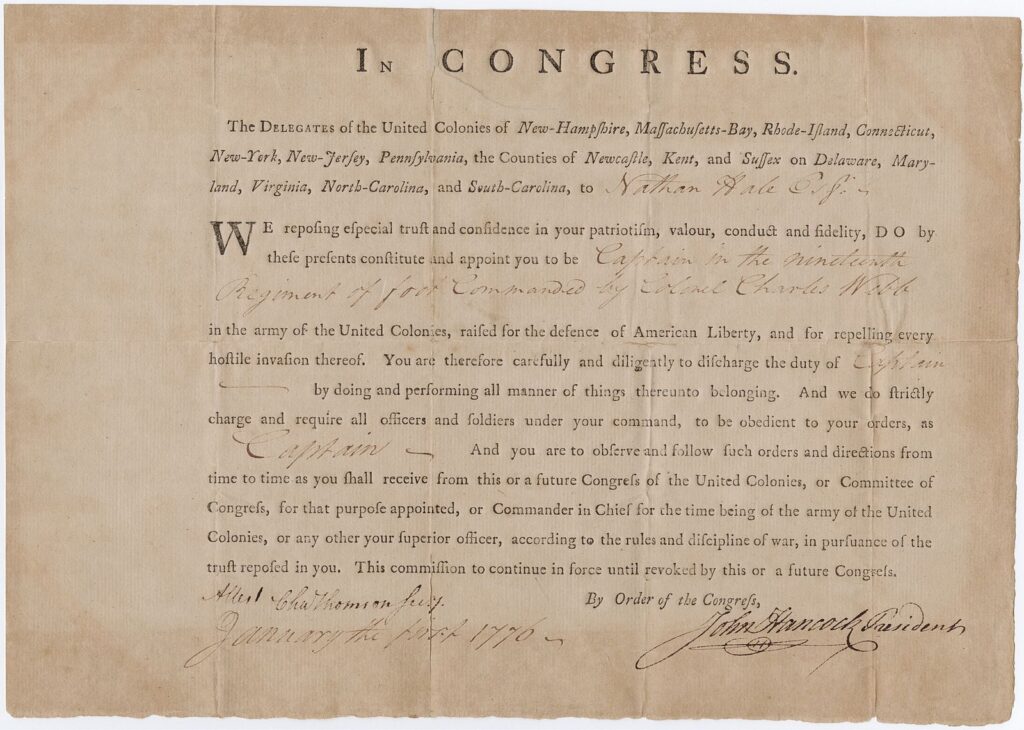
When fighting erupted at Lexington and Concord in 1775, Hale joined the patriot cause and enlisted in the Continental Army.1 By early 1776, he had earned a commission as a captain.
Washington’s Desperate Need for Intelligence
The summer of 1776 proved disastrous for the Continental Army. British forces captured New York City after the devastating American defeat at the Battle of Long Island. General George Washington urgently needed reliable intelligence about British troop movements, fortifications, and military plans.1
At the time, spying was considered dishonorable by many soldiers. Captured spies were not treated as prisoners of war; they were typically executed immediately.2 Even so, Hale volunteered for the assignment.
Disguised as a Dutch schoolmaster searching for work, Hale crossed into British-controlled territory in September 1776.1 Carrying forged papers and traveling alone, he spent several days gathering observations about British defenses around New York.
Historians still debate exactly how Hale was captured.2 Some accounts suggest a Loyalist relative betrayed him. Others point to the possibility that British forces became suspicious of his movements and papers.2 Whatever the cause, Hale was arrested near Flushing Bay on Long Island and brought before British General Sir William Howe.
British officers reportedly found sketches, notes, and military observations hidden in Hale’s possession — enough evidence to condemn him as a spy.1
The Night Before the Execution
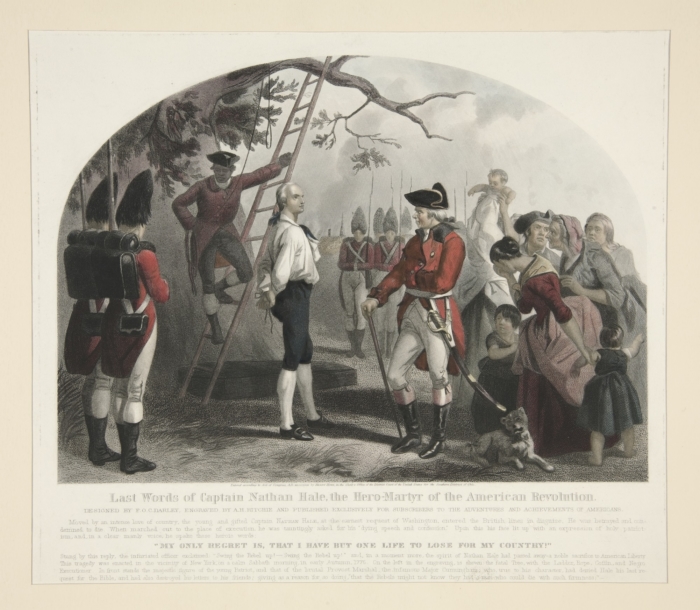
Nathan Hale was sentenced to death almost immediately.1
Unlike many later retellings, Hale did not receive a formal trial. According to historical accounts, he was denied both legal counsel and a clergyman.2 His execution was scheduled for the following morning, September 22, 1776.
What happened during Hale’s final hours helped transform him from a captured spy into a national legend.
Multiple witnesses later described Hale as calm, composed, and remarkably courageous in the face of death.2 British officer Frederick Mackenzie wrote in his diary that Hale behaved with “great composure and resolution,” adding that the young American believed it was the duty of every good officer to obey the commands of his commander-in-chief.3
But Hale’s famous last words remain one of the great historical uncertainties of the Revolution.
Did Nathan Hale Really Say His Famous Quote?
The quote most associated with Nathan Hale —
“I only regret that I have but one life to lose for my country.”
— likely was never recorded exactly as Americans repeat it today.3
No known eyewitness wrote down those precise words at the execution itself. Instead, versions of the statement emerged later through secondhand recollections.3 Historians believe Hale may have been paraphrasing a line from the popular 18th-century play Cato by Joseph Addison, a work widely admired by Revolutionary leaders.3
Some historical accounts suggest Hale spoke at greater length before his execution, expressing sorrow only that he could not do more for the patriot cause.2 Others indicate British officers themselves were impressed by his dignity and patriotism.3
Over time, the shorter and more dramatic version of the quote became embedded in American memory — not necessarily because it was exact, but because it captured the spirit Americans wanted to remember.2
A Body Never Recovered
One of the most haunting aspects of Hale’s story is what happened after his death.
Nathan Hale was hanged near what is now Manhattan on September 22, 1776, at just twenty-one years old.1 His body was never formally identified or recovered by his family.2 Historians remain uncertain about the exact location of his burial site.
For years after the execution, Hale’s story circulated primarily through oral retellings, newspaper accounts, and patriotic memory. During the 19th century — as the young United States sought national heroes and unifying symbols — Hale increasingly came to represent idealized Revolutionary virtue: youthful courage, self-sacrifice, and unwavering devotion to liberty.2
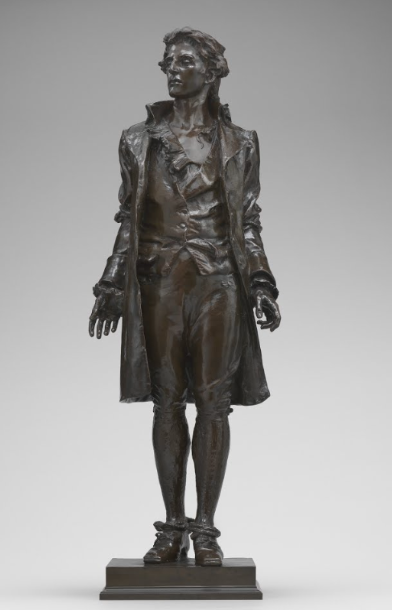
Statues, schools, towns, and memorials across the country were later dedicated to him. One of the most famous sculptures, created by Frederick William MacMonnies in 1890, helped cement the image of Hale as the fearless young martyr of the Revolution.2
Why Nathan Hale Still Matters
Nathan Hale’s military mission technically failed. The intelligence he gathered never reached Washington, and his espionage career lasted only days.1
Yet his legacy endured because Americans saw something larger in his story.
Hale represented a generation willing to risk everything for principles they believed were essential: self-government, liberty, and independence. His death also revealed the harsh realities of the Revolutionary War — a conflict fought not only on battlefields, but through espionage, divided loyalties, and personal sacrifice.1
Today, Nathan Hale remains a reminder that the American Revolution was carried forward not only by famous generals and statesmen, but also by ordinary young people who made extraordinary choices during uncertain times.
The legend of Nathan Hale may have grown over the centuries, but the courage behind it was real.