
Boston Massacre: A Snowy Night That Ignited Colonial Resistance
A City on Edge
In early March 1770, Boston was a city simmering with tension. British soldiers had been stationed among the townspeople for nearly two years, enforcing unpopular taxes and trade regulations imposed by the British Parliament. Colonists resented Redcoats billeted in private homes and patrolling the city streets, often clashing with locals over minor disputes. Life in Boston was already challenging—narrow streets crowded with merchants, dockworkers, and apprentices became hotbeds of political discussion and daily grievance.¹

The Stamp Act of 1765, followed by the Townshend Acts of 1767, had heightened unrest. Many colonists saw these measures as illegitimate taxation without representation, while merchants struggled under trade restrictions. The presence of armed soldiers in the city, intended to enforce these laws, made Boston a flashpoint for conflict. Ordinary interactions could escalate into violent confrontations, and by 1770, hostility toward British troops had become routine.¹
March 5, 1770: Tensions Boil Over
On the evening of March 5, snow blanketed the streets of Boston. A lone sentry, Private Hugh White, stood guard outside the Boston Customs House on King Street, tasked with protecting government property. When a young apprentice, Edward Garrick, insulted the soldier, White struck him. The incident quickly drew a crowd of curious and angry residents, many armed with snowballs, ice, and sticks.²
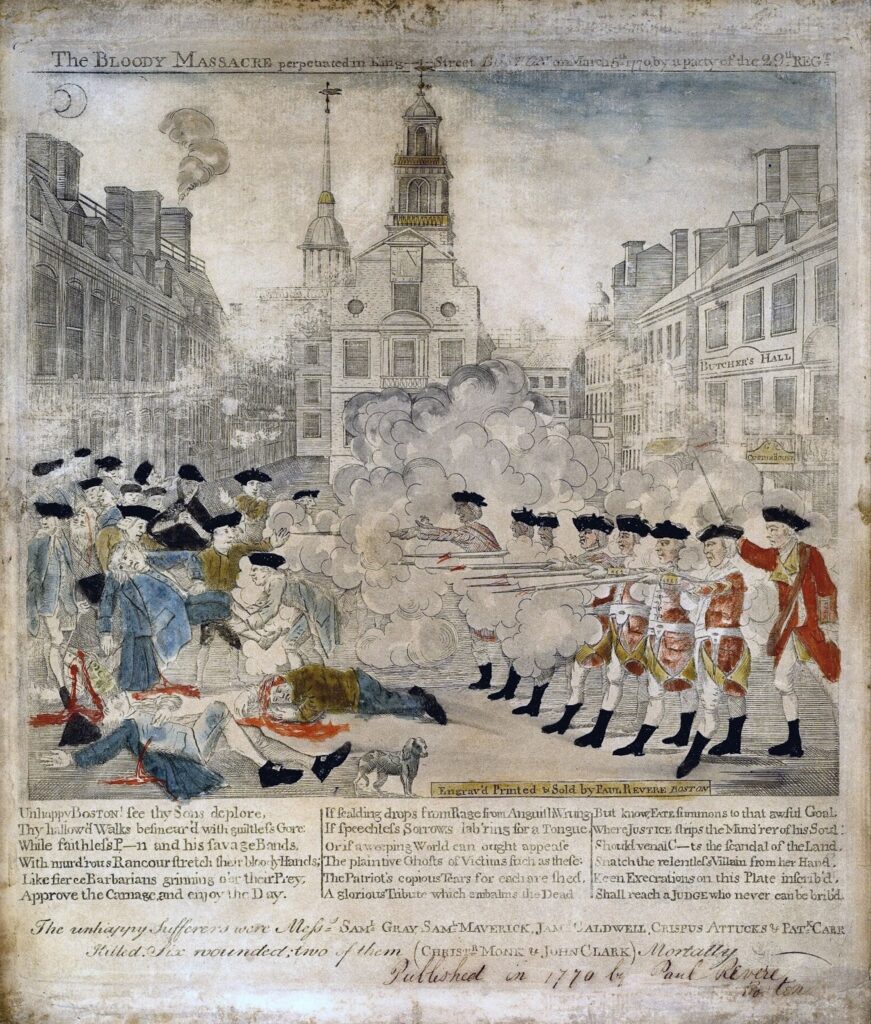
Captain Thomas Preston arrived with eight additional soldiers from the 29th Regiment to support White. The soldiers formed a semi-circle in the snow, facing a crowd that continued to taunt and threaten them. Witnesses later described both confusion and fear, with snow and debris striking the soldiers and the crowd shouting demands, insults, and threats.³
Amid the chaos, an unknown shot rang out. Historians debate whether it was accidental, a reflexive response to the crowd, or deliberately fired, but the effect was immediate: the soldiers opened fire. When the smoke cleared, five colonists lay dead or mortally wounded, including Crispus Attucks, a sailor of African and Native American descent widely remembered as the first to fall. Two more colonists, including Patrick Carr, would die of wounds in the days following.³
A Contested Narrative
The aftermath of the shooting was as heated as the event itself. Patriot leaders such as Samuel Adams and Paul Revere framed the killings as a “massacre,” distributing broadsides and engravings that portrayed the soldiers as merciless aggressors. Revere’s engraving, depicting British troops firing in unison into an unarmed crowd, became one of the most influential pieces of colonial propaganda, though it simplified and dramatized the chaos of that night.⁴
The Boston Massacre became a rallying point for anti-British sentiment. Colonial newspapers emphasized the story repeatedly, turning the deaths into a symbol of oppression and injustice, and helping to unify Bostonians in resistance against British authority. The event highlighted the power of public opinion, civic discourse, and media in shaping political life in colonial America.⁵
Trial and Rule of Law
Governor Thomas Hutchinson ordered the arrest of Captain Preston and the eight soldiers involved. Their trial, held later that year, became a landmark for colonial legal practice. Future President John Adams agreed to defend the soldiers, not because he condoned their actions, but because he believed that even unpopular defendants deserved a fair trial under the rule of law. Six soldiers were acquitted, while two were convicted of manslaughter and punished by having their thumbs branded.⁴
The trial emphasized principles that would later resonate in American law: the importance of due process, impartiality, and the idea that even those in positions of authority could be held accountable under the law. It also reinforced the growing civic engagement of ordinary citizens, who watched and participated in public debates about justice, authority, and governance.
Legacy and Civic Awareness
The Boston Massacre had enduring consequences. Annual commemorations in Boston reinforced collective memory and civic identity, and the event became a symbol of the broader struggle for colonial rights. It revealed the tension between local communities and centralized authority, highlighting how ordinary citizens could influence political outcomes through protest, organization, and the spreading of information.⁵
For historians and civic educators, the Boston Massacre illustrates that civic engagement is not limited to formal office or legislative action. Public response, organized protest, and the deliberate use of media all shaped political outcomes in early America. Citizens’ participation, whether through debate, commemoration, or advocacy, remains a core element of civic learning and responsibility.
To explore more about the roots of the Constitution, visit:
Civics for Life | Historical Foundations
Civics for Life | The Constitution
Footnotes:
- John and Abigail Adams Education Program, “The Boston Massacre,” https://www.jyfmuseums.org/learn/teacher-resources-programs/classroom-resources/the-boston-massacre
- John J. Curley, “The Boston Massacre: Primary Documents and Resources,” Boston Public Library, https://guides.bpl.org/c.php?g=800717&p=10389852
- Library of Congress, “Today in History: Boston Massacre,” https://www.loc.gov/item/today-in-history/march-05/
- John J. Curley, “The Boston Massacre: Primary Documents and Resources,” Boston Public Library Massachusetts Historical Society, “The Boston Massacre,” https://www.masshist.org/features/massacre1770-2020