

Joseph Marion Hernández: First Hispanic Member of Congress
Joseph Marion Hernández was born in 1788 in St. Augustine, Florida, a city that was then part of the Spanish Empire. St. Augustine was one of the oldest continuously inhabited settlements in North America, with deep Spanish colonial roots and a diverse population of Spanish, African, and Indigenous heritage. Hernández’s family was of Spanish descent, part of a community that had long been intertwined with the political and cultural life of the province.
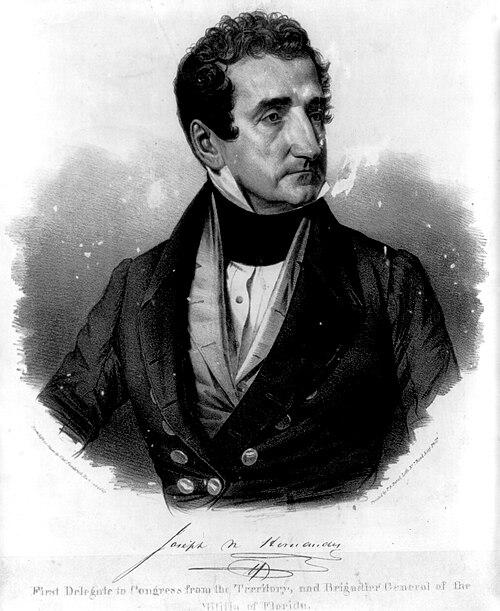
Growing up in the waning years of Spanish Florida, Hernández witnessed the shifting control of the region. Spain’s hold on Florida was weakening, and tensions between European powers, the United States, and Native nations shaped the environment in which he came of age.
Education and Early Life
Hernández received a solid education for his time, first in local schools in St. Augustine and later in Cuba, where many young men from Florida’s Spanish elite were sent for advanced studies. This exposure to Caribbean and Atlantic trade networks broadened his worldview and gave him fluency in both Spanish and English.

Upon returning to Florida, Hernández became involved in agriculture and commerce. He acquired plantations and engaged in the cultivation of cotton and sugarcane. His landholdings and business ventures established him as a prominent figure in the territory’s economic life.
Florida’s Transfer to the United States
In 1821, Spain formally ceded Florida to the United States under the Adams–Onís Treaty. This transition was monumental for the residents of St. Augustine, who were suddenly under a new national government. Hernández adapted quickly, aligning himself with American political structures while maintaining his ties to the Spanish-speaking community.
His ability to navigate between cultures made him a valuable intermediary during Florida’s early years under U.S. governance. Many residents of Spanish descent relied on his leadership to ensure that their rights and property were respected during the transition.
Military Service in the Seminole Wars
Conflict between the United States and the Seminole people intensified in the early 19th century. Hernández played a military role during the Second Seminole War, commanding Florida militia units in campaigns against Seminole resistance. He is perhaps most remembered for his role in the 1837 capture of Seminole leader Osceola under a white flag of truce, an event that has remained controversial in historical memory.
Despite the widely debated tactics, Hernández’s involvement highlighted the intricate and often violent process of U.S. expansion into Florida. His actions reflected the priorities of territorial authorities, who sought to secure land for settlement and agriculture.
Florida’s First Delegate to Congress
In 1822, Florida Territory elected Joseph Marion Hernández as its first delegate to the United States Congress. Delegates from territories could participate in debates and serve on committees, but they could not vote on the House floor.
Hernández served one term, from 1822 to 1823. During his time in Washington, he focused on securing resources for the development of Florida’s infrastructure, including roads and fortifications. He also advocated for territorial organization and support for settlers adapting to new governance. His election made him the first Hispanic American to serve in the U.S. Congress.
Later Political and Civic Life
After leaving Congress, Hernández remained active in Florida’s political and economic life. He served in the Florida Territorial Legislative Council and continued to expand his plantation holdings. His influence extended into legal and civic affairs, where his bilingual abilities and cultural background allowed him to bridge divides between English-speaking newcomers and long-established Spanish-speaking residents.
Hernández also participated in Florida’s push toward statehood, contributing to discussions about governance, economic growth, and representation.
Personal Life and Legacy
Hernández married Anna Marie Hill, and the couple raised several children. His family connections linked him to other prominent Floridian and Caribbean families, reinforcing his place within a trans-Atlantic social network.
By the mid-19th century, Hernández had largely stepped back from public life. He died in Cuba in 1857, where he had traveled for personal and family reasons. His remains were later returned to St. Augustine.
Today, Joseph Marion Hernández is remembered as a figure of firsts: the first Hispanic American to serve in Congress, a leader during the transitional years of Florida’s incorporation into the United States, and a participant in both the political and military history of the territory. His life reflects the cultural complexity of early 19th-century Florida, where shifting borders, economic ambition, and multilingual communities shaped the experiences of its leaders.