

“Mr. Gorbachev, Tear Down This Wall” — The Speech That Became a Cold War Turning Point
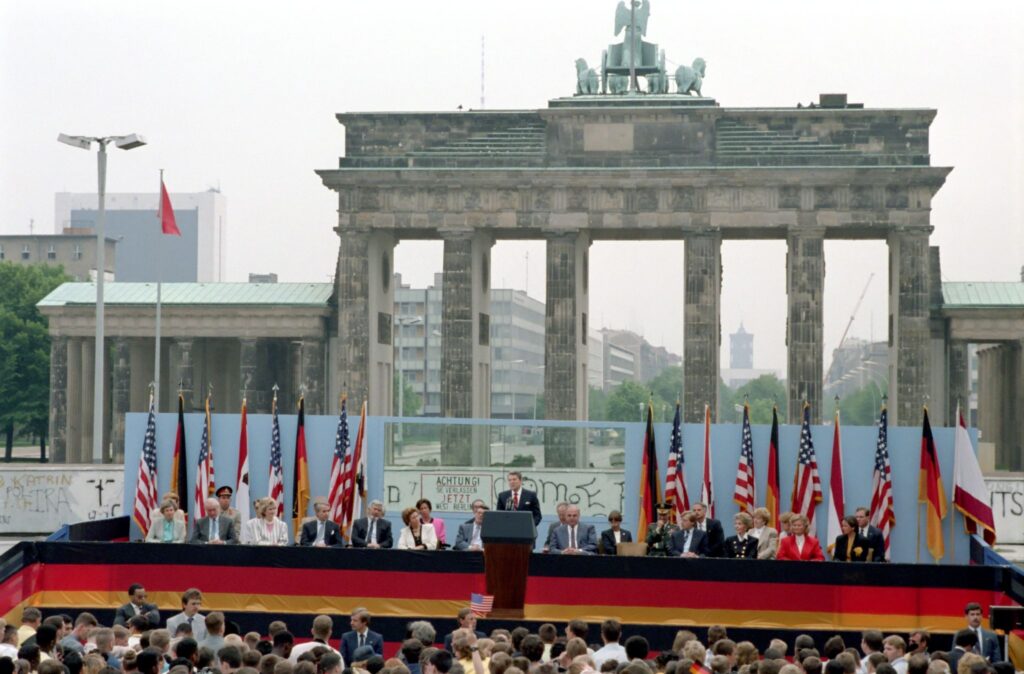
On June 12, 1987, standing before the Brandenburg Gate in West Berlin, President Ronald Reagan delivered a speech that would echo far beyond the crowd gathered that day. With the Berlin Wall looming behind him—an unmistakable symbol of division between East and West—Reagan issued a direct challenge to Soviet leader Mikhail Gorbachev:
“Mr. Gorbachev, tear down this wall.”
The line was simple. The moment was historic. And at the time, its outcome was far from certain.
Few speeches in modern history have so clearly captured a political divide, a moral argument, and a global turning point in a single sentence.
A City Divided, A World on Edge
By 1987, Berlin had lived with division for more than two decades. Since 1961, the Berlin Wall had physically separated East and West Berlin, becoming one of the most visible symbols of the Cold War. Families were divided, movement was restricted, and the wall itself stood as a daily reminder of ideological conflict between democracy and communism.
West Berlin, though free, existed as an island within East German territory. Its residents lived with both the freedoms of the West and the constant awareness of the barrier that surrounded them.
When President Reagan arrived in Berlin, tensions between the United States and the Soviet Union were beginning to shift. Mikhail Gorbachev had introduced reforms such as glasnost (openness) and perestroika (restructuring), signaling possible change within the Soviet system. But the Berlin Wall still stood firmly in place.
The Speech That Almost Didn’t Say the Line
Reagan’s visit to the Brandenburg Gate was carefully negotiated with diplomatic advisors and speechwriters. In fact, the most famous line of the speech nearly did not make it into the final draft. Some members of his administration and diplomatic staff worried that directly challenging Gorbachev could strain fragile East-West relations.
According to historical accounts, the phrase “Tear down this wall” was debated internally before being included. Reagan ultimately insisted it remain in the speech, believing it reflected both moral clarity and the aspirations of people living under division.¹
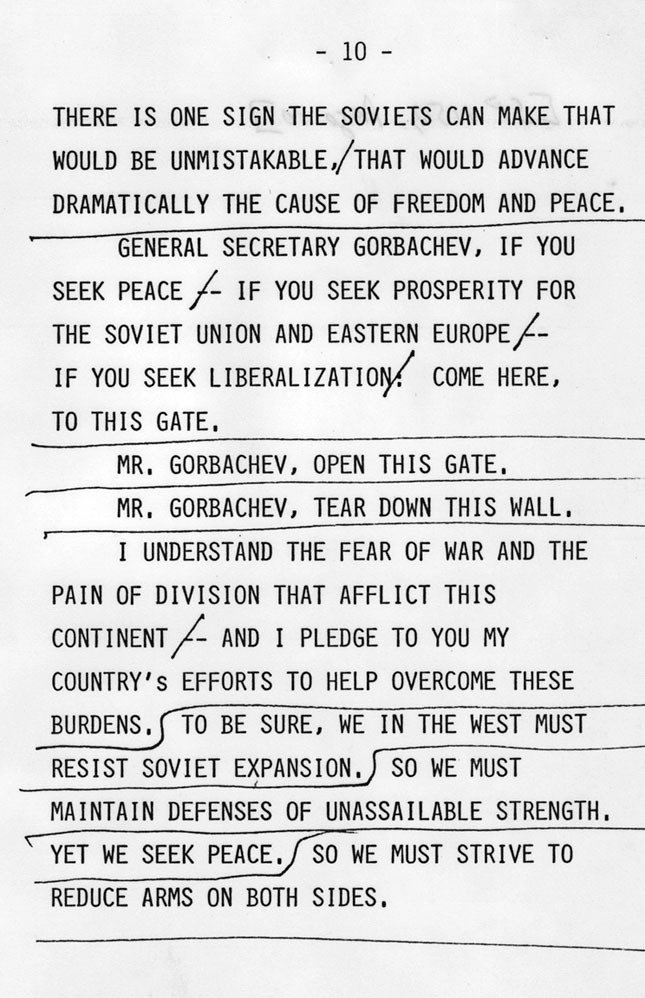
“There Is One Sign the Soviets Can Make”
In the speech, Reagan acknowledged signs of change within the Soviet Union while making a broader argument about freedom and human rights. Standing before the Brandenburg Gate, he framed the moment not only as a political challenge but as a moral one.
He stated that the wall represented more than concrete and barbed wire—it symbolized the broader separation of families, freedoms, and human dignity.
Then came the defining moment:
“Mr. Gorbachev, tear down this wall!”
The words were direct, unambiguous, and delivered to a global audience watching closely.
Immediate Reaction and Mixed Expectations
At the time, reactions to the speech were mixed. Some viewed it as a bold reaffirmation of American values and a clear stance against Soviet control. Others questioned whether such direct language would have any real diplomatic effect.
According to historical analysis, even some U.S. officials were unsure how strongly the speech would resonate or whether it might complicate negotiations with the Soviet Union.²
Yet the speech captured something larger than immediate political concerns: it articulated a vision of a world without division.
A Moment That Outlasted Its Time
Just two years after Reagan’s speech, the Berlin Wall fell in 1989. While no single event can be credited with ending the Cold War, many historians point to the speech as part of a growing international momentum toward change.
The phrase itself became one of the most recognizable political statements of the 20th century—often cited as a symbol of freedom, democratic ideals, and the eventual reunification of Germany.
The fall of the wall transformed what had once seemed permanent into something temporary. What Reagan had called for in 1987 became reality sooner than many expected.
The Power of Civic Language in History
Reagan’s Berlin speech is often remembered for its most famous line, but its broader significance lies in the role of civic rhetoric—the ability of leaders to articulate shared values in moments of tension.
The speech reflected several enduring civic themes:
- The tension between freedom and authoritarian control
- The role of public speech in shaping international relations
- The power of symbolic landmarks in political life
- The idea that civic ideals can influence global change
These themes remain relevant today, as societies continue to grapple with questions of freedom, governance, and human rights.
Looking Back on June 12, 1987
On that day in Berlin, the outcome of history was not yet written. The Cold War was still ongoing, the Berlin Wall still stood, and the future of East-West relations remained uncertain.
Yet Reagan’s words captured a belief that change was possible—that walls, whether physical or ideological, do not define the limits of human aspiration.
For many, the speech remains a reminder that civic leadership is not only about policy decisions, but also about the power of language to shape what people believe is possible.
Footnotes & Sources
- National Archives, Prologue Magazine, “Berlin Wall and Reagan’s Speech,” 2007.
- History.com Editors, “Ronald Reagan’s ‘Tear Down This Wall’ Speech,” History.com.
- Stanford News, “Reagan’s ‘Tear Down This Wall’ Was Almost Left Unsaid,” Stanford University, 2019.
- National Churchill Museum, “Reagan and the Berlin Wall Speech Analysis,” 2019.