

James K. Polk and the Expansion of the United States
James K. Polk served as the 11th president of the United States from 1845 to 1849. Although he completed only one term, his administration oversaw major changes in the nation’s geography, economy, and political development. During his presidency, the United States settled its boundary in the Pacific Northwest, acquired California and much of the Southwest, reduced tariff rates, restored an independent federal treasury, and created new federal institutions. By the time Polk left office, the United States extended from the Atlantic Ocean to the Pacific Ocean.¹
Early Life and Education
James Knox Polk was born on November 2, 1795, in Mecklenburg County, North Carolina. He was the eldest of ten children born to Samuel and Jane Knox Polk. In 1806, the family moved west to Maury County, Tennessee, near the growing town of Columbia. Polk’s father became a successful farmer, landowner, and community leader.²
Polk experienced poor health during his youth. At age seventeen, he underwent surgery to remove urinary stones, a serious procedure in an era before modern anesthesia. After recovering, he pursued a demanding course of study. He attended preparatory schools in Tennessee before enrolling at the University of North Carolina in 1816. Polk graduated in 1818 and returned to Tennessee to study law under Felix Grundy, a prominent Nashville attorney and politician. He was admitted to the Tennessee bar in 1820 and began practicing law in Columbia.²
In 1824, Polk married Sarah Childress. Sarah was well educated and took an active interest in public affairs. During Polk’s political career, she assisted with correspondence, reviewed speeches, followed newspaper coverage, and served as a trusted adviser. At the White House, she managed an active social schedule while continuing to support the president’s work. The couple did not have children.³
From Tennessee Politics to Congress
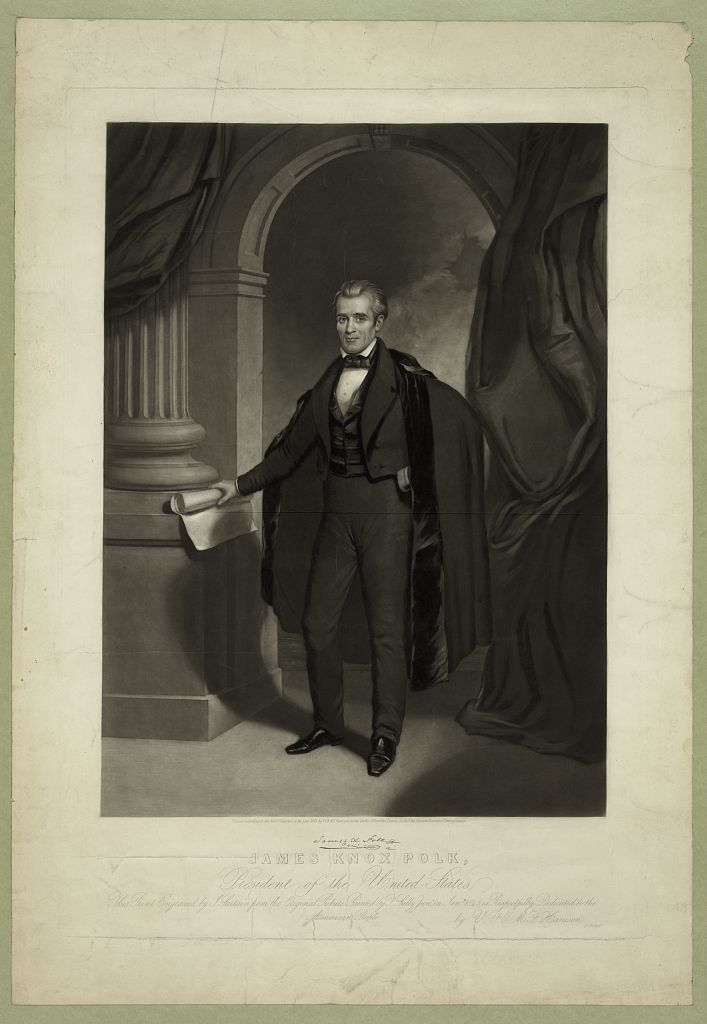
Polk entered public life in 1823 when he was elected to the Tennessee House of Representatives. Two years later, he won a seat in the United States House of Representatives. He would serve fourteen years in Congress.²
Polk became a loyal supporter of Andrew Jackson, the influential Tennessee politician who was elected president in 1828. Because of that association, Polk became known as “Young Hickory,” a reference to Jackson’s nickname, “Old Hickory.” Polk supported the main principles of Jacksonian Democracy, including limited federal spending, a restrained interpretation of federal power, and opposition to a national bank.²
In 1835, members of the House elected Polk Speaker of the House. He served in that position through 1839, presiding over the chamber during a period of sharp disagreement about banking, tariffs, federal authority, and slavery. His years as Speaker strengthened his reputation as a disciplined party leader who understood congressional procedure and legislative strategy.⁴
Polk left Congress in 1839 and was elected governor of Tennessee. He served one two-year term but lost campaigns for reelection in 1841 and 1843. By the beginning of 1844, his national political career appeared uncertain.²
The Election of 1844
The Democratic National Convention of 1844 opened without a clear path to a nominee. Former president Martin Van Buren entered the convention as a leading candidate, but disagreement over the proposed annexation of Texas divided the party. After several rounds of voting, delegates turned to Polk as a compromise choice.
Because Polk had not been widely discussed as a presidential contender before the convention, he became known as the first major “dark horse” nominee in American presidential history. The Whig Party nominated Henry Clay, one of the country’s best-known political leaders. The campaign focused heavily on territorial expansion, particularly the annexation of Texas and American claims in the Oregon Territory.²
Polk narrowly won the election. He received 170 electoral votes to Clay’s 105 and became the youngest person elected president up to that time. During the campaign, Polk indicated that he would serve only one term.⁵
Four Priorities for One Term
Polk entered office on March 4, 1845, with a focused agenda that included reducing tariff rates, restoring an independent treasury, settling the Oregon boundary dispute with Great Britain, and acquiring California and additional western territory.²
This focused agenda shaped the work of his administration. Polk closely supervised his cabinet, read official correspondence carefully, and kept a detailed diary of his presidency. The diary and related papers, now held by the Library of Congress, document his attention to policy, personnel, diplomacy, and daily administration. The collection contains approximately 20,500 items and is one of the most extensive primary-source records of a nineteenth-century presidency.⁶
Texas and the Oregon Territory
The annexation of Texas was already underway when Polk took office. Texas had functioned as an independent republic since 1836, but Mexico continued to regard the region as part of its territory. In the final days of President John Tyler’s administration, Congress approved a joint resolution offering annexation. Polk supported the measure, and Texas formally became the 28th state on December 29, 1845. The annexation contributed to a continuing dispute with Mexico over the southern boundary of Texas.⁷
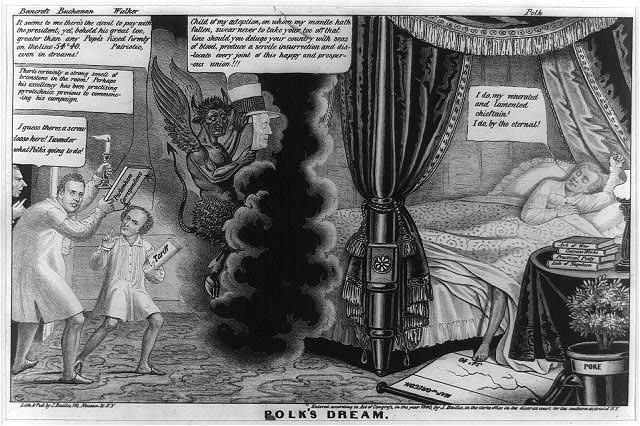
At the same time, the United States and Great Britain both claimed portions of the Oregon Territory in the Pacific Northwest. Expansionist political language during the 1844 campaign called for the United States to claim the region as far north as latitude 54 degrees, 40 minutes.
Once in office, Polk pursued a negotiated settlement. The Oregon Treaty of 1846 established the boundary between the United States and British territory primarily along the 49th parallel, while leaving Vancouver Island under British control. The Senate approved the agreement, and the treaty resolved the longstanding dispute without war. The American portion of the Oregon Territory later became the states of Oregon, Washington, and Idaho, along with parts of Montana and Wyoming.⁸
The Mexican-American War
Relations between the United States and Mexico remained tense after the annexation of Texas. The two governments disagreed over whether the boundary of Texas was the Nueces River or the Rio Grande. Polk also hoped to acquire California and New Mexico and sent diplomat John Slidell to Mexico to seek a negotiated agreement. The Mexican government declined to receive him.
In early 1846, Polk ordered troops under General Zachary Taylor into the disputed region. American and Mexican forces clashed in April. Polk informed Congress that hostilities had begun, and Congress declared war on Mexico in May 1846.⁷
The Mexican-American War lasted nearly two years. American forces led by Taylor, Winfield Scott, and other officers conducted campaigns in northern Mexico, New Mexico, California, and central Mexico. Scott’s army captured Mexico City in September 1847.
The war ended with the Treaty of Guadalupe Hidalgo, signed on February 2, 1848. Under the agreement, Mexico recognized the Rio Grande as the boundary of Texas and transferred more than 525,000 square miles to the United States. The territory included present-day California, Nevada, and Utah, most of New Mexico and Arizona, and parts of Colorado and Wyoming. The United States agreed to pay Mexico $15 million and assumed responsibility for certain financial claims made by American citizens.⁹
The treaty extended the boundaries of the United States to the Pacific Ocean. It also brought the organization and settlement of the newly acquired western lands to the center of national politics.
Domestic Policy and National Institutions
Territorial expansion was the most visible feature of Polk’s presidency, but his administration also pursued a substantial domestic agenda.
In 1846, Polk signed the Walker Tariff, which lowered duties on many imported goods. The measure reflected the Democratic Party’s preference for tariffs designed primarily to raise revenue rather than protect domestic industries from foreign competition.²
That same year, Polk signed legislation restoring the independent treasury system. Under this arrangement, the federal government held and managed its funds through public offices rather than relying on private banks.²
Several national institutions also took shape during Polk’s term. The Naval School opened at Annapolis, Maryland, in October 1845 under Secretary of the Navy George Bancroft. It later became the United States Naval Academy.¹⁰
On August 10, 1846, Polk signed the act establishing the Smithsonian Institution. The legislation created an organization devoted to the “increase and diffusion of knowledge” and provided for a Board of Regents, a library, collections, lecture rooms, and a national museum.¹¹
Polk also signed the legislation creating the Department of the Interior shortly before leaving office in 1849. The department brought together federal responsibilities involving public lands, patents, Native American affairs, and other domestic matters. During his presidency, Iowa joined the Union in 1846, and Wisconsin followed in 1848.²
The Work of the Presidency
Polk was known for his intense work habits and close involvement in the details of government. He often worked long hours, personally reviewed appointments, and maintained firm control over his administration’s priorities.
His presidential diary provides a detailed record of cabinet discussions, diplomatic decisions, congressional relations, and political disagreements. It also reveals the burdens of office during a period that included war, rapid territorial growth, and intense partisan debate. The diary remains an important resource for understanding both Polk and the operation of the presidency in the 1840s.⁶
Retirement and Death
Polk kept his pledge to serve only one term and did not seek reelection in 1848. Zachary Taylor, whose military service during the Mexican-American War had made him a national figure, won the election and succeeded Polk in March 1849.
After leaving Washington, James and Sarah Polk traveled through the South before returning to Tennessee. A cholera epidemic was spreading through the region. Polk became ill shortly after reaching Nashville and died on June 15, 1849, at the age of 53. He had been out of office for 103 days, the shortest retirement of any former president.²
Polk was initially buried in Nashville City Cemetery. His remains were later moved to Polk Place, the family home in Nashville, and eventually to the grounds of the Tennessee State Capitol. Sarah Polk lived until 1891 and worked to preserve her husband’s papers and public legacy.³
Legacy
James K. Polk’s presidency lasted four years, but it produced changes of lasting importance. His administration resolved the Oregon boundary dispute, oversaw the acquisition of California and much of the Southwest, lowered tariff rates, restored the independent treasury, and supported the establishment of major national institutions.
The expansion completed during his term shaped the modern map of the continental United States and strengthened the nation’s connection to the Pacific. It also created new questions about the government and admission of western territories, including the status of slavery within them. Those questions remained central to national politics after Polk left office.
Polk is less widely remembered than many other nineteenth-century presidents, but the events of his administration affected the country’s geography, economy, foreign relations, and federal government. His presidency offers a clear example of how a single term can produce enduring changes in the development of the United States.
Explore more presidents and pivotal figures in the History Lessons series, or visit the President James K. Polk Home and Museum in Columbia, Tennessee.
Continue exploring this transition from Founders to Pioneers in our Founding Generation series, or read more on the explorers, settlers, and statesmen of the westward expansion in our History Lessons.
Footnotes
- U.S. Department of State, Office of the Historian, “The Annexation of Texas, the Mexican-American War, and the Treaty of Guadalupe Hidalgo, 1845–1848.” https://history.state.gov/milestones/1830-1860/texas-annexation
- Library of Congress, “James K. Polk (1795–1849),” James K. Polk Papers: Timeline. https://www.loc.gov/collections/james-k-polk-papers/articles-and-essays/timeline/
- White House Historical Association, “Sarah Polk.” https://www.whitehousehistory.org/bios/sarah-polk
- U.S. House of Representatives, History, Art & Archives, “Speakers of the House in Numerical Order and Speaker Service.” https://history.house.gov/People/Office/Speakers_Numerical_Order/
- National Archives and Records Administration, “1844 Electoral College Results.” https://www.archives.gov/electoral-college/1844
- Library of Congress, “About This Collection,” James K. Polk Papers. https://www.loc.gov/collections/james-k-polk-papers/about-this-collection/
- U.S. Department of State, Office of the Historian, “Mexico: A Guide to the United States’ History of Recognition, Diplomatic, and Consular Relations.” https://history.state.gov/countries/mexico
- U.S. Department of State, Office of the Historian, “The Oregon Territory, 1846.” https://history.state.gov/milestones/1830-1860/oregon-territory
- National Archives and Records Administration, “Treaty of Guadalupe Hidalgo.” https://www.archives.gov/milestone-documents/treaty-of-guadalupe-hidalgo
- United States Naval Academy, Nimitz Library, “History of the United States Naval Academy.” https://www.usna.edu/Library/sca/arc-findingaids/view.php?f=RG405_reference_files
- Smithsonian Institution, “Our History.” https://www.si.edu/about/history