

The Great Moon Hoax of 1835: How The New York Sun Put Bat-Men on the Moon
For six days in August 1835, a struggling New York newspaper told its readers that a celebrated astronomer had discovered civilizations on the moon. The claim was false from its first sentence. What actually happened next is better documented, and considerably stranger, than the legend that grew up around it.
On August 25, 1835, The New York Sun began publishing a series of articles under the headline “Great Astronomical Discoveries Lately Made By Sir John Herschel, LL.D., F.R.S., &c. At the Cape of Good Hope.” Over the following days, the paper described lunar forests, herds of bison, blue goat-like animals with a single horn, large water birds, and beavers that walked upright. Most famously, it described a race of winged, human-like creatures the articles called Vespertilio-homo, or “man-bats,” and an apparently abandoned temple of polished sapphire. None of it was true. Herschel had discovered none of it, said none of it, and knew nothing about the articles at all.
The story that follows separates what the documentary record actually shows from what later writers, publishers, and retellers added on top of it. Both halves are part of the hoax’s history. They are not the same kind of history, though, and this article treats them differently.
A Struggling Paper and a New Writer
The Sun was founded in New York in 1833 as one of the first “penny papers.” These were cheap, mass-circulation dailies sold on the street by newsboys, not by expensive annual subscription. Their business model ran on volume and sensation, not on the political patronage that funded most established papers.1
In 1835 the Sun hired Richard Adams Locke, an English-born journalist, as an editor and reporter.2 Locke had a solid grounding in science reporting, and a reputation, by multiple later accounts, for wit sharp enough to unsettle his colleagues.3
Locke would go on to write the six installments that made the Sun briefly the most talked-about newspaper in the country. He later said, and multiple historians have accepted, that his purpose was satirical. He wanted to mock a real and popular strain of writing in the 1830s that argued the moon and other planets were inhabited — a position known as the “plurality of worlds” theory. Its most prominent contemporary champion was the Scottish clergyman Thomas Dick, who argued for lunar life partly on religious grounds.4 Whatever Locke’s private intent, the Sun published the series as straight news. Readers got no signal that it was anything else.
What the Six Articles Actually Said
The series ran as a purported reprint from a supplement to the Edinburgh Journal of Science. It was attributed not to Herschel directly, but to a fictional companion, “Dr. Andrew Grant,” described as Herschel’s traveling assistant at the Cape of Good Hope observatory.5
The real Herschel had, in fact, traveled to the Cape of Good Hope in 1834 to catalog the southern skies. Locke borrowed that detail from Herschel’s genuine, well-publicized expedition, then fabricated a set of discoveries around it.6
The installments built in scale day by day. Early articles described a 24-foot-diameter object glass weighing nearly seven tons, mounted in an enormous new telescope, and used it to reveal lunar seas, forests, and basalt formations. Later articles added animal life: herds of bison-like creatures, blue goat-like animals with a single horn, tailless beavers that walked on two legs and built fires, and large cranes.
The fourth installment, published August 28, 1835, introduced the series’ most famous invention: bipedal, winged, human-like beings roughly four feet tall, with copper-colored hair and bat-like wings.7
The articles named them Vespertilio-homo, and described an apparently abandoned temple of polished sapphire near where they were seen.5 The series ended when the telescope’s lens, left in the wrong position overnight, focused sunlight into the observatory. A wall of the observatory was reportedly burned, serious enough to end the observations; the account says repairs followed.5
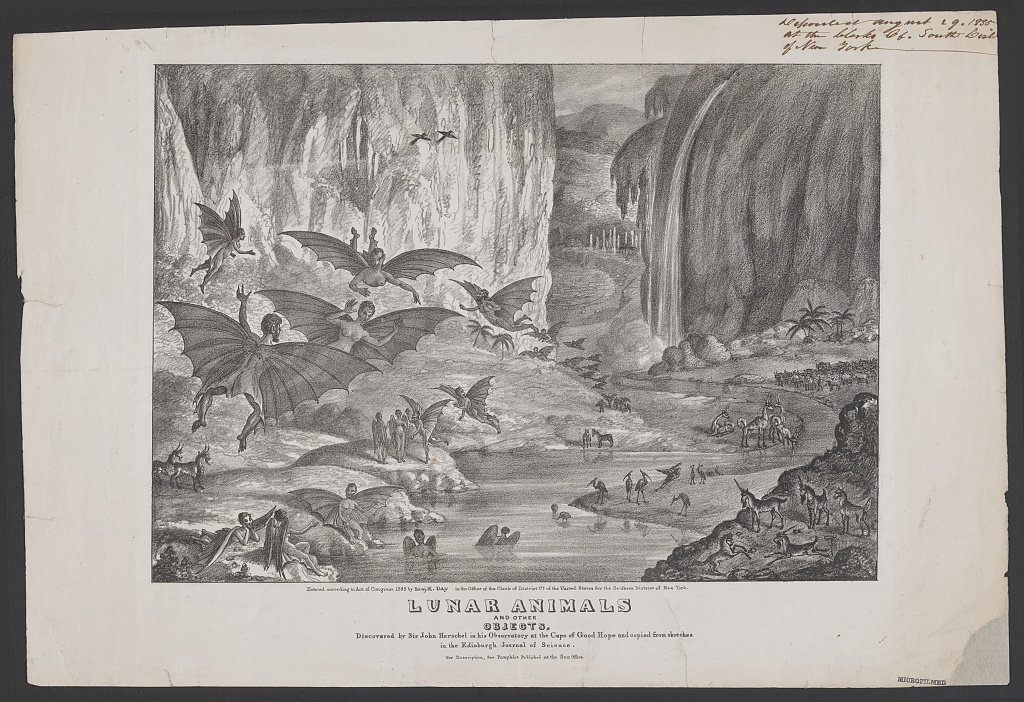
Source: Library of Congress, via Smithsonian National Air and Space Museum Multimedia Gallery
The Astronomer Who Knew Nothing About It
Source: Smithsonian Institution Libraries, via Flickr
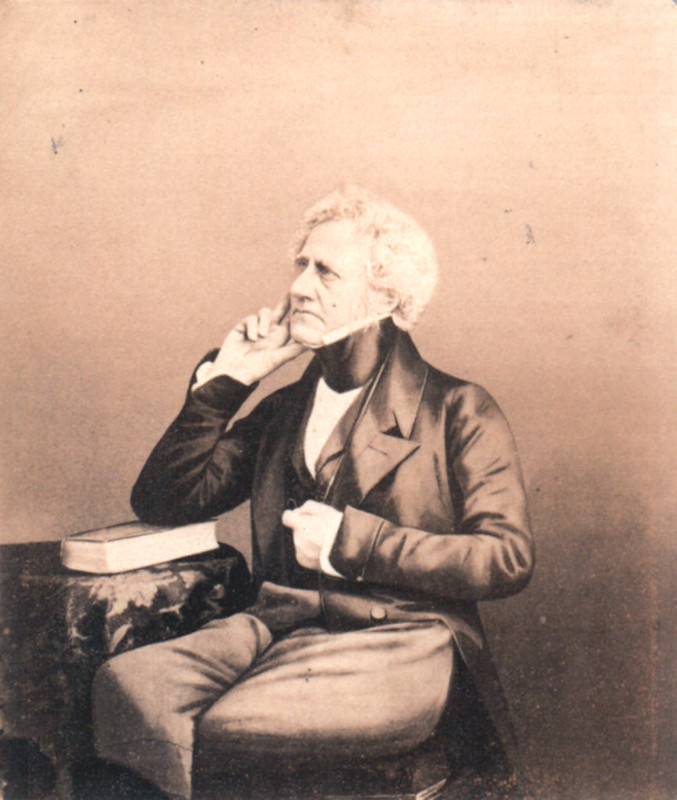
Sir John Herschel was a real, prominent astronomer, and his Cape of Good Hope expedition was genuine. He was at the Cape from 1834 to 1838, methodically surveying stars, nebulae, and double stars visible only from the Southern Hemisphere — work he later published as a formal scientific catalog.6 He had no connection to the Sun‘s articles, and no advance knowledge of them.
Accounts describe his initial reaction upon learning of the hoax as amused. He reportedly remarked that his actual observations could never compete in terms of excitement. Later accounts describe him growing weary of fielding questions from correspondents who believed the invented discoveries were real, and wanted more detail.3 What is not documented is any suggestion that Herschel benefited from, endorsed, or had prior knowledge of the hoax bearing his name.
How Readers Reacted — and What Was Added to the Story Later
Contemporary evidence shows the series was widely read and widely discussed, and that a real portion of the public took it as genuine reporting. Edgar Allan Poe, writing at the time, claimed that “not one person in ten discredited it.” Some newspapers, including papers that later expressed skepticism, initially treated the discoveries as plausible.8 Religious commentary of the period reportedly speculated about the theological implications of lunar inhabitants.
It is also true, and documented by later historians who reviewed period newspapers directly, that skepticism existed from very early on. Credulity has likely been overstated in popular retellings.
One frequently repeated story holds that a delegation of scientists from Yale College traveled to New York demanding to see the original Edinburgh Journal of Science articles, only to be redirected by Sun staff between the composing room and the pressroom until they gave up and went home. This anecdote appears in many popular accounts of the hoax. But researchers who have traced the story’s origins have not found contemporary, firsthand documentation confirming that the episode occurred as described, and later versions of the story appear more elaborate than earlier ones — a pattern historians associate with legend growth rather than eyewitness reporting.9
This article repeats the anecdote here only to flag it explicitly as unverified legend, not as an established fact of the hoax’s history.
Unraveling the Hoax
The Journal of Commerce, a rival New York paper, was among the first to voice public doubt. It compared the series in tone to acknowledged fiction such as Robinson Crusoe and Gulliver’s Travels.9
The more decisive blow came from James Gordon Bennett’s New York Herald, after resuming publication following an earlier interruption. Bennett’s paper identified a fatal factual problem: the Edinburgh Journal of Science, the publication the Sun claimed to be reprinting from, had already ceased publication in 1833 and could not have printed anything in 1835. Bennett’s paper also named Locke, the Sun‘s recently hired editor, as the likely author.9
Locke did not offer a full public confession at the time. He first acknowledged authorship indirectly in 1836, by adding “Author of the Moon Story” to a byline. He gave a fuller account of his intentions in a letter published in 1840 in the New World weekly, describing the series as satire aimed at unchecked religious speculation about astronomy.9
The Sun itself never printed a formal, unambiguous retraction acknowledging deliberate fabrication. What circulated instead was a gradual, public unraveling, driven by rival newspapers and by Locke’s own later, partial admissions.9
A Rival in the Sky: Poe’s Competing Hoax
Edgar Allan Poe had published his own lunar fiction just months earlier: “The Unparalleled Adventure of One Hans Pfaall,” which ran in the Southern Literary Messenger in June 1835, and was reprinted in the New York Transcript September 2 through 5, 1835 — while Locke’s series was still running. Poe’s story described a balloon voyage to the moon and its inhabitants, written as fiction, though its Transcript reprint ran under a sensational news-style headline that didn’t always make that fictional framing obvious to readers. Poe later claimed that Locke’s hoax had effectively stolen his idea and upstaged his own effort, since Locke’s version was presented as fact and drew far more attention.10
In 1846, Poe wrote a biographical sketch of Locke for Godey’s Lady’s Book, as part of his “The Literati of New York City” series. It gives a firsthand, if not fully neutral, contemporary account of Locke’s career.10
What the Hoax Actually Did for The Sun’s Circulation
A widely repeated claim holds that the hoax permanently and dramatically boosted the Sun‘s circulation, and secured its future as a major paper.
An 1859 publisher’s advertisement for a reprinted pamphlet edition of the hoax claimed the series had increased the paper’s circulation fivefold, and that 60,000 copies of the pamphlet sold within a month. Those figures were produced to sell the pamphlet itself. They are not independently verified circulation records.11
Historians who have examined contemporary circulation figures directly describe a more modest picture. The Sun‘s daily circulation in this period is generally put at roughly 15,000 to 19,360 copies, and the extent of any hoax-driven increase appears to have been considerably exaggerated in later popular retellings.12
What is well documented is that the Sun and associated publishers profited from separately sold pamphlet reprints and lithographic prints of the lunar creatures, independent of any bump in the newspaper’s own daily sales.11
Why the Hoax Is Still Studied
The Great Moon Hoax is taught today less because of the specific creatures it invented, and more because of what it reveals about the mechanics of the press at a particular moment: a newspaper industry built on street sales and daily sensation, few of the modern professional norms governing verification and correction, and a public genuinely uncertain about where scientific speculation ended and scientific fact began.9
Locke’s series worked because it mixed real, verifiable elements — Herschel’s actual expedition, real telescope engineering vocabulary, existing scientific debate over life on other worlds — with wholly invented ones. That structure, real details combined with invention, remains a familiar feature of later misinformation and hoaxes.4
The hoax’s own afterlife is itself part of the story. The Yale deputation anecdote, the fivefold-circulation claim, and other embellishments were added, repeated, and expanded by writers long after 1835, until in many popular accounts they became indistinguishable from the documented original event.
Reading the 1835 Sun articles alongside the later record of how the story was told and retold shows two different processes at work: one fabrication, invented deliberately in 1835, and a second layer of embellishment, added gradually and mostly without deliberate intent to deceive, over the following century and a half.
This is the second entry in a new Civics for Life series on media, myth, and public life in American history. Read about Orson Welles and the War of the Worlds here.
Footnotes
- Smithsonian Libraries and Archives Blog, “The Great Moon Hoax, or Was It? The Joke’s on Who?” https://blog.library.si.edu/blog/2013/09/04/the-great-moon-hoax-or-was-it-the-jokes-on-who/
- Linda Hall Library, “Richard Adams Locke,” Scientist of the Day. https://www.lindahall.org/about/news/scientist-of-the-day/richard-adams-locke/
- Encyclopedia Britannica, “The Great Moon Hoax of 1835 Was Sci-Fi Passed Off as News.” https://www.britannica.com/story/the-great-moon-hoax-of-1835-was-sci-fi-passed-off-as-news
- Library of Congress, Teaching with the Library Blog, “Primary Sources and April Fools’ Day: The Great Moon Hoax of 1835.” https://blogs.loc.gov/teachers/2015/03/primary-sources-and-april-fools-day-the-great-moon-hoax-of-1825/
- Richard Adams Locke, The Moon Hoax; or, A Discovery That the Moon Has a Vast Population of Human Beings (New York: William Gowans, 1859). https://www.gutenberg.org/files/62779/62779-h/62779-h.htm
- History.com, “‘The Great Moon Hoax’ Is Published in the New York Sun.” https://www.history.com/this-day-in-history/august-25/the-great-moon-hoax
- Justin Black, “Finding the Truth in the 1835 Moon Hoax” (Mercer University, Department of History) https://liberalarts.mercer.edu/wp-content/uploads/sites/5/2019/12/003-Moon-Hoax-for-publication-Black.pdf
- Edgar Allan Poe, contemporary remarks on public credulity toward the hoax, as reported in Encyclopedia Britannica (endnote 3).
- Museum of Hoaxes, “The Great Moon Hoax (1835).” https://hoaxes.org/archive/permalink/the_great_moon_hoax
- Edgar Allan Poe Society of Baltimore, “Richard Adams Locke” (eapoe.org), and the Society’s Works entry for “The Unparalleled Adventure of One Hans Pfaall.” https://www.eapoe.org/people/lockeria.htm; https://www.eapoe.org/works/info/pt014.htm
- Publisher’s advertisement, in Richard Adams Locke, The Moon Hoax (1859 ed.), cited for the fivefold-circulation and 60,000-pamphlet claims, and for the pamphlet’s separate sale from the newspaper.
- JSTOR Daily, “How The Sun Conned the World with the Moon Hoax,” which itself draws on academic analyses by István Kornél Vida (Hungarian Journal of English and American Studies) and Carlo Martinez (The Edgar Allan Poe Review): https://daily.jstor.org/how-the-sun-conned-the-world-with-the-moon-hoax