

America’s First Income Tax: A Civil War Turning Point
Signed into law on August 5, 1861, America’s first federal income tax was enacted as part of Congress’s effort to finance the Civil War and established an important precedent in American fiscal history.
On August 5, 1861, President Abraham Lincoln signed a law that introduced something entirely new to the American people: a federal tax on personal income. Congress enacted the measure as part of its effort to finance the Union war effort, but the 1861 tax lacked an effective enforcement mechanism and, in practice, generated little to no revenue.
Congress repealed the 1861 income tax provisions the following year and replaced them with a more comprehensive system under the Revenue Act of 1862. Its immediate practical effect was therefore negligible—collections under the 1861 income tax never began—but its historical significance reached far beyond the battlefield. By establishing the principle of a federal tax on personal income, the temporary measure created a precedent that would influence American government, constitutional law, and public finance for generations.¹
Today, millions of Americans file income tax returns each year, making the federal income tax such a familiar part of life that it can be difficult to imagine a time before it existed. For most of the nation’s early history, however, the federal government operated without any tax on individual income. Instead, Washington relied primarily on tariffs, customs duties, and other indirect taxes to raise revenue. The Civil War changed that reality.
Faced with unprecedented expenses and a conflict that threatened the nation’s survival, lawmakers turned to a new source of revenue that would spark debate about taxation, fairness, government power, and civic responsibility that continues to this day.¹
The story of America’s first income tax is therefore about much more than dollars and cents. It is a story about a nation at war, the challenges of financing government, the evolution of constitutional thought, and the ongoing effort to balance public needs with individual obligations. Understanding why Congress created the income tax in 1861 helps explain not only how the Union financed the Civil War but also how a temporary wartime measure eventually contributed to one of the most important transformations in American government.²
A Nation Without an Income Tax
Funding the Early Federal Government
For much of the nation’s early history, the federal government functioned quite differently than it does today. During the late eighteenth and early nineteenth centuries, the responsibilities of the federal government were relatively limited compared with modern expectations. National defense, foreign affairs, customs collection, and a handful of other functions occupied much of Washington’s attention. As a result, Congress could finance federal operations largely through tariffs on imported goods and customs duties collected at ports.¹
Why Americans Distrusted Direct Taxation
The reliance on tariffs reflected more than simple practicality. It also reflected American political culture. Memories of colonial disputes with Great Britain remained powerful. Many citizens associated direct taxation with government overreach and believed that federal power should remain limited. While state and local governments imposed various taxes, many Americans viewed direct federal taxation with skepticism.
The Revolutionary War itself had grown partly out of disputes over taxation and representation. As a result, federal leaders generally favored indirect taxes that were less visible to ordinary citizens. Most Americans expected the federal government to rely on customs duties and excise taxes rather than taxes on personal income.
A Peacetime Revenue Model Meets a National Crisis
That arrangement generally worked during peacetime. Government expenditures remained relatively modest, and customs revenue proved sufficient for many federal needs. Even during earlier conflicts, lawmakers often preferred borrowing money rather than creating entirely new systems of taxation.
By the middle of the nineteenth century, however, the nation faced challenges that would test the limits of this financial model. Political tensions over slavery, sectional interests, and the future of the Union were reaching a breaking point. When civil war erupted in 1861, the federal government suddenly faced expenses on a scale never before experienced in American history.
A Civil War Creates a Financial Crisis
The Cost of Preserving the Union
When Confederate forces fired on Fort Sumter in April 1861, many Americans believed the conflict would be short. Some expected a swift military campaign that would restore national unity in a matter of months. Reality proved far different.
The Union government quickly discovered that large-scale warfare required enormous resources. Hundreds of thousands of soldiers needed food, uniforms, weapons, ammunition, transportation, medical care, and pay. Railroads carried troops and supplies across vast distances. Shipyards constructed naval vessels. Factories increased production to support military operations. Every new campaign added to the government’s growing expenses.⁴
Salmon P. Chase and the Search for Revenue
Treasury Secretary Salmon P. Chase found himself at the center of the government’s financial challenge. Responsible for maintaining the nation’s fiscal health, Chase understood that traditional revenue sources would not generate enough money to wage a prolonged war.
Borrowing would certainly play an important role, but loans alone could not support the Union’s long-term needs. Investors had to be convinced that the government could repay its debts. That required dependable revenue streams capable of sustaining confidence in federal finances.
Chase and other government leaders therefore explored multiple options. Tariffs remained important. Excise taxes could generate additional revenue. But even those measures appeared insufficient when compared with the scale of wartime spending.
Why Tariffs Alone Could Not Pay for the War
The outbreak of war disrupted trade patterns and created uncertainty in financial markets. Revenue from customs duties remained significant, but it could not keep pace with mounting expenditures. Every month of warfare increased the financial burden facing the federal government.
Congress and the Lincoln administration therefore confronted a difficult reality. Preserving the Union required not only military leadership but also financial innovation. The result was a new approach to taxation that would fundamentally change the relationship between citizens and the federal government.
The Revenue Act of 1861
August 5, 1861: A Historic Signature
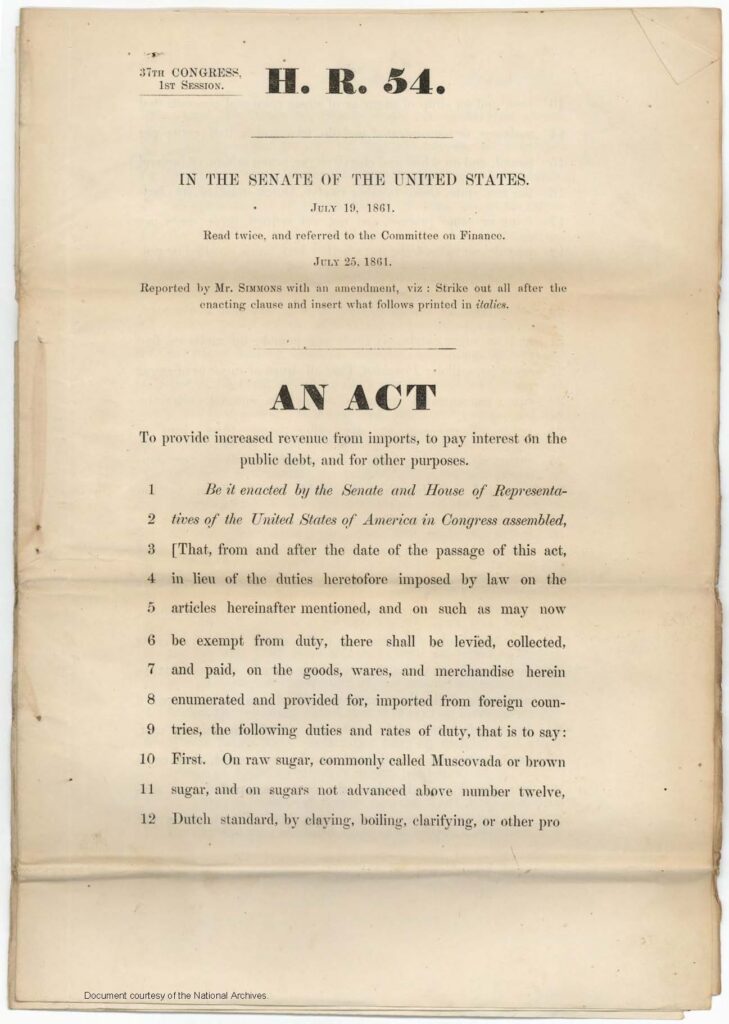
On August 5, 1861, Abraham Lincoln signed the Revenue Act of 1861 into law. Among its provisions was the nation’s first federal income tax. While overshadowed at the time by dramatic military events, the legislation represented a major turning point in American fiscal history.¹
For the first time, Congress authorized a federal tax based on individual earnings rather than goods, transactions, or imports. The measure reflected the extraordinary circumstances facing the nation and lawmakers’ determination to secure the financial resources necessary to continue the war effort.
How the First Income Tax Worked
The law imposed a 3 percent tax on annual incomes exceeding $800—a threshold that limited the tax to a small share of the population. Nevertheless, the principle was groundbreaking.¹
Rather than relying entirely on indirect taxation, the federal government now connected revenue collection directly to income. Citizens with greater earnings would contribute a portion of those earnings to support national needs.
This approach introduced a new way of thinking about federal finance. Income itself had become a source of government revenue.
A Tax Intended to Be Temporary
Importantly, lawmakers did not view the tax as a permanent feature of American life. The income tax was designed primarily as a wartime measure. Congress was responding to an emergency and seeking practical solutions to immediate financial demands.
Few people anticipated that the concept introduced in 1861 would eventually become one of the defining features of modern federal government. Yet even temporary measures can leave lasting legacies, and the first income tax would prove no exception.³
Financing Union Victory
Building a New Revenue System
Because the Revenue Act of 1861 generated little revenue, Congress replaced its income-tax provisions in 1862 with a more comprehensive and administratively workable system. Military expenses remained immense, and lawmakers needed more effective methods of raising and collecting revenue.
The Revenue Act of 1862 created a broader system of internal taxation and a more organized administrative structure for sustained wartime financing.
Creating the Office of Internal Revenue
The Revenue Act of 1862 marked another major milestone. The law created the Office of the Commissioner of Internal Revenue, the predecessor of today’s Internal Revenue Service, and established a dedicated federal administrative system for assessing and collecting internal taxes.⁴
This development reflected an important shift in American governance. Collecting taxes on a national scale required recordkeeping systems, enforcement mechanisms, and trained administrators. The federal government was evolving to meet the demands of modern warfare.
Collecting Taxes During Wartime
Implementing an income tax proved far more complicated than passing a law. Government officials needed procedures for assessing income, determining tax obligations, collecting payments, and resolving disputes.
The process introduced Americans to a level of federal financial administration they had rarely experienced before. Tax collection generated paperwork, documentation, and bureaucratic procedures that became increasingly common as government responsibilities expanded.
Paying for a Modern War
Taxation alone did not finance Union victory. The government relied on borrowing, bond sales, tariffs, and other sources of revenue. Nevertheless, income taxes became an important part of a broader financial strategy that enabled the Union to maintain armies in the field and continue military operations for four years.³
The Civil War demonstrated that modern conflicts required modern systems of finance. The first income tax emerged as part of that transformation.
Citizenship, Sacrifice, and Civic Responsibility
Sharing the Burden of War
The income tax also touched deeper questions about citizenship and national responsibility. During wartime, governments often ask citizens to sacrifice in various ways. Soldiers risk their lives. Families endure hardship and uncertainty. Communities mobilize resources to support national goals.
Taxation became another form of contribution to the war effort.
Rights, Responsibilities, and Federal Authority
The Civil War forced Americans to consider the relationship between individual rights, collective obligations, and federal authority. Supporters of wartime taxation argued that those with sufficient income should contribute to the cost of preserving the Union.
Debates Over Fairness and Taxation
Critics questioned the fairness of the tax, the reach of federal power, and the administrative burdens associated with direct taxation. These disagreements reflected an enduring tension between the government’s need to raise revenue and concerns about how taxing authority should be distributed and limited.
Many modern discussions about taxation continue to address questions that Americans debated during the nineteenth century. The first income tax therefore illustrates the longstanding debate over federal revenue, economic fairness, and the proper scope of government authority.
The Constitutional Question
What Did the Constitution Allow?
The first income tax also influenced ongoing debates about constitutional authority. Congress possessed broad powers to tax, but questions remained about how those powers should be exercised and whether certain forms of taxation fit within constitutional limits.⁵
The Civil War provided an urgent practical justification for action, but legal and political questions persisted long after the conflict ended.
Wartime Necessity Versus Limited Government
Following the war, many Americans expected emergency measures to disappear. Congress allowed the wartime income tax system to expire in the early 1870s, with the tax repealed in 1872 and the assessment offices closed in 1873. The federal government largely returned to its traditional reliance on tariffs and excise taxes.⁵
Even so, the experience left an important legacy. Americans had now witnessed a federal income tax in operation, and lawmakers understood its potential as a revenue-generating tool.
A Precedent That Would Not Disappear
Although the tax itself disappeared, the idea survived. Future generations could look back to the Civil War and point to a precedent demonstrating that income taxation had already been used to address major national challenges.
That precedent would become increasingly important as the nation industrialized and economic conditions changed during the late nineteenth century.
A Tax Disappears… Then Returns
The End of the Civil War Income Tax
After the war, Congress gradually dismantled the temporary tax structure created during the conflict. Many Americans preferred a return to older methods of raising revenue, and the income tax eventually expired.
For several decades, the issue seemed settled.
The Income Tax of 1894
Yet changing economic conditions revived interest in income taxation. Industrialization had transformed American society, creating new forms of wealth and new debates about federal revenue.
In 1894, Congress enacted another federal income tax. Unlike the Civil War measure, however, this law quickly encountered constitutional challenges.⁵
Pollock v. Farmers’ Loan & Trust Co.
The controversy culminated in the Supreme Court’s decision in Pollock v. Farmers’ Loan & Trust Co. (1895). The Court ruled that portions of the tax violated constitutional requirements governing direct taxation.⁵
The decision significantly limited Congress’s ability to impose federal income taxes under existing constitutional interpretations.
The Road to the Sixteenth Amendment
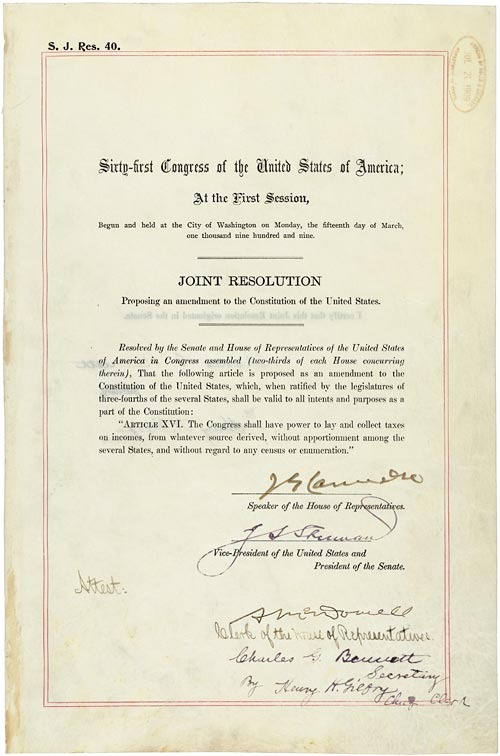
The ruling did not end the debate. Instead, it encouraged efforts to amend the Constitution and remove the apportionment obstacle identified by the Court.
Those efforts succeeded in 1913 with the ratification of the Sixteenth Amendment. The amendment removed the apportionment requirement for taxes on income, allowing Congress to levy them without distributing the tax burden among the states according to population.⁵
The Lasting Impact of America’s First Income Tax
From Temporary Measure to Permanent Institution
The significance of the first federal income tax extends far beyond the Civil War. It established a precedent that altered how Americans thought about government finance and national responsibility. For the first time, the federal government directly connected public revenue to individual income, creating a model that future generations could adapt and expand.¹
Funding a Growing Nation
Today, income taxes help support many functions of modern government. While tax policies have evolved dramatically since 1861, the concept introduced during the Civil War continues to shape how the federal government raises revenue.
The growth of government responsibilities during the twentieth and twenty-first centuries would have been difficult to imagine in Lincoln’s era. Yet the roots of modern federal taxation can be traced back to the financial challenges of the Civil War.
Questions Americans Still Debate
The first income tax also left a legacy of debate. Americans continue to discuss how governments should raise revenue, how tax burdens should be distributed, and what constitutional and political limits should govern federal taxing authority.
Reasonable people may disagree on policy details, but the historical significance of the first income tax is difficult to deny.
The Legacy of August 5, 1861
More than 160 years later, the Revenue Act of 1861 remains a landmark in American history. Congress created the measure to address an urgent wartime problem, but its influence reached far beyond the Civil War.
The first federal income tax emerged from the financial crisis of the Civil War and established an important precedent in constitutional and fiscal history. Although the 1861 measure itself generated little to no revenue, it introduced the principle of federal taxation based on personal income. What began as a limited wartime experiment would ultimately help reshape how the federal government raised revenue.
Footnotes
- United States Senate Historical Office, Revenue Act of 1861.
- National Constitution Center, Say Happy Birthday to the First Income Tax
- National Archives, Civil War Tax Records.
- Internal Revenue Service, IRS History Timeline.
- Constitution Annotated, Library of Congress, “Historical Background on the Sixteenth Amendment.”
Image Sources:
United States Senate, https://www.senate.gov/artandhistory/history/common/civil_war/RevenueAct_FeaturedDoc.htm
National Archives, https://www.archives.gov/milestone-documents/16th-amendment