

The Battle of Bull Run: The First Major Battle of the Civil War and the End of Early Illusions
On July 21, 1861, thousands of Americans awoke with a sense of anticipation. Some were soldiers preparing for battle. Others were government officials, journalists, and curious civilians traveling from nearby Washington, D.C., to witness what many believed would be the defining military engagement of the young Civil War. Some spectators even packed picnic baskets, expecting to watch history unfold before returning home by evening. Few could have imagined that the day’s events would instead mark the beginning of one of the bloodiest chapters in American history.¹
The First Battle of Bull Run, known in the South as the First Battle of Manassas, was the first major land battle of the Civil War. Although relatively small compared with later engagements such as Antietam or Gettysburg, its significance cannot be measured simply by the number of soldiers involved or the casualties sustained. Instead, Bull Run changed how Americans understood the conflict itself. It shattered the widespread belief that the war would end quickly, revealed the challenges of commanding large volunteer armies, and demonstrated that the divisions tearing the nation apart would not be resolved in a single afternoon.²
More than 160 years later, the Battle of Bull Run remains an important moment not only in military history but also in civic history. It reminds us that political disagreements can have lasting consequences when compromise breaks down, that leadership is tested most severely during moments of uncertainty, and that ordinary citizens often experience the effects of national conflict alongside those who serve on the battlefield. Understanding Bull Run means looking beyond troop movements and battlefield maps to examine how one day transformed the expectations of an entire nation.
A Nation on the Brink
The road to Bull Run began long before the first cannon fired across the Virginia countryside. During the decades leading up to the Civil War, Americans struggled with profound disagreements over the expansion of slavery into new territories, the relationship between the federal government and the states, and competing visions for the country’s future. Congress attempted a series of compromises to preserve the Union, but each temporary solution gave way to new disputes. As sectional tensions deepened, trust between North and South steadily eroded.³
The election of Abraham Lincoln in November 1860 accelerated the crisis. Believing their political influence and way of life were under threat, eleven Southern states eventually declared their secession from the United States and formed the Confederate States of America. Although many Americans hoped compromise might still prevent armed conflict, those hopes faded when Confederate forces fired upon Fort Sumter in Charleston Harbor on April 12, 1861. After the fort surrendered, President Lincoln called for volunteers to preserve the Union, while Confederate leaders expanded their own military forces. Within weeks, thousands of men from both sides had enlisted, convinced they would help bring the conflict to a swift conclusion.¹
That optimism reflected a common misunderstanding about war. Few of the volunteers had military experience, and neither government possessed armies prepared for a prolonged conflict. Newspapers often predicted that one decisive victory would force the opposing side to negotiate peace. Families expected soldiers to return home within months. The nation had entered a war unlike any it had previously experienced, but few yet recognized its scale.
Why Bull Run?
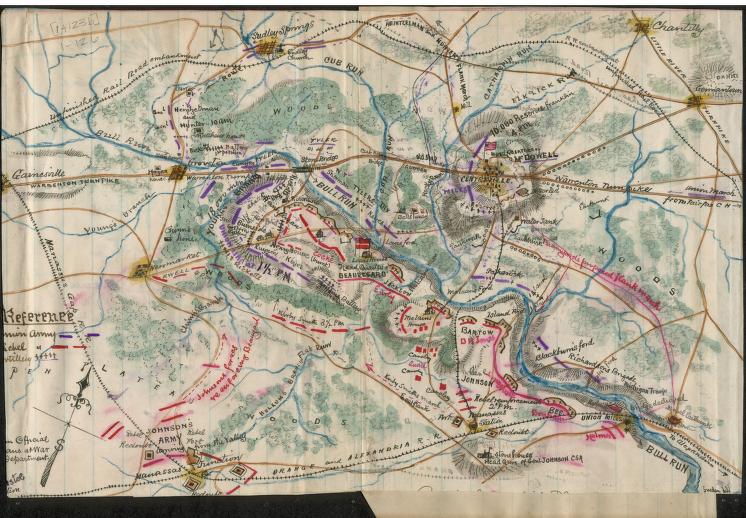
As military planners searched for opportunities to gain an early advantage, attention turned toward northern Virginia. Approximately thirty miles southwest of Washington stood Manassas Junction, one of the South’s most important railroad crossroads. Two major rail lines intersected there, allowing Confederate commanders to move troops and supplies efficiently across the region. Nearby, Bull Run Creek wound through rolling farmland dotted with bridges, hills, and open fields that would soon become a battlefield.³
Union leaders believed a victory near Manassas might open the road toward Richmond, the Confederate capital, delivering both a military and psychological blow. Confederate commanders understood the same geography and were prepared to defend the area. Neither side anticipated that the battle would become a symbol of the war’s unpredictable nature rather than its conclusion.
The armies assembling around Bull Run reflected the uncertainty of the moment. Union Brigadier General Irvin McDowell commanded roughly 35,000 soldiers, while Confederate Generals P. G. T. Beauregard and Joseph E. Johnston led approximately 32,000 men. Although many officers had graduated from the United States Military Academy at West Point, most enlisted soldiers had received only a few weeks of training. Units often lacked standardized uniforms, making it difficult to distinguish friend from foe amid smoke and confusion. Communication depended upon mounted couriers carrying handwritten orders across miles of contested ground, while commanders relied on incomplete reports that frequently arrived too late to influence critical decisions.²
A Battle Unlike What Anyone Expected
Before dawn on July 21, Union forces began marching toward Confederate positions. General McDowell hoped to outflank the Southern army by crossing Bull Run upstream and attacking where the Confederates least expected. The plan required long marches over unfamiliar roads, careful coordination among inexperienced units, and precise timing. Despite delays, Union soldiers initially achieved success. They crossed the stream and began pushing Confederate defenders away from key positions, creating the impression that victory might indeed come quickly.¹
As the morning progressed, however, the battlefield became increasingly chaotic. Thick clouds of black-powder smoke reduced visibility, making it difficult for officers to identify troop movements or recognize friendly regiments. Commands shouted above the noise of artillery often went unheard, while conflicting reports left leaders uncertain about conditions beyond their immediate surroundings. Unlike modern commanders, who can rely on instantaneous communication, Civil War generals frequently made decisions based on information that was already outdated by the time it reached them.³
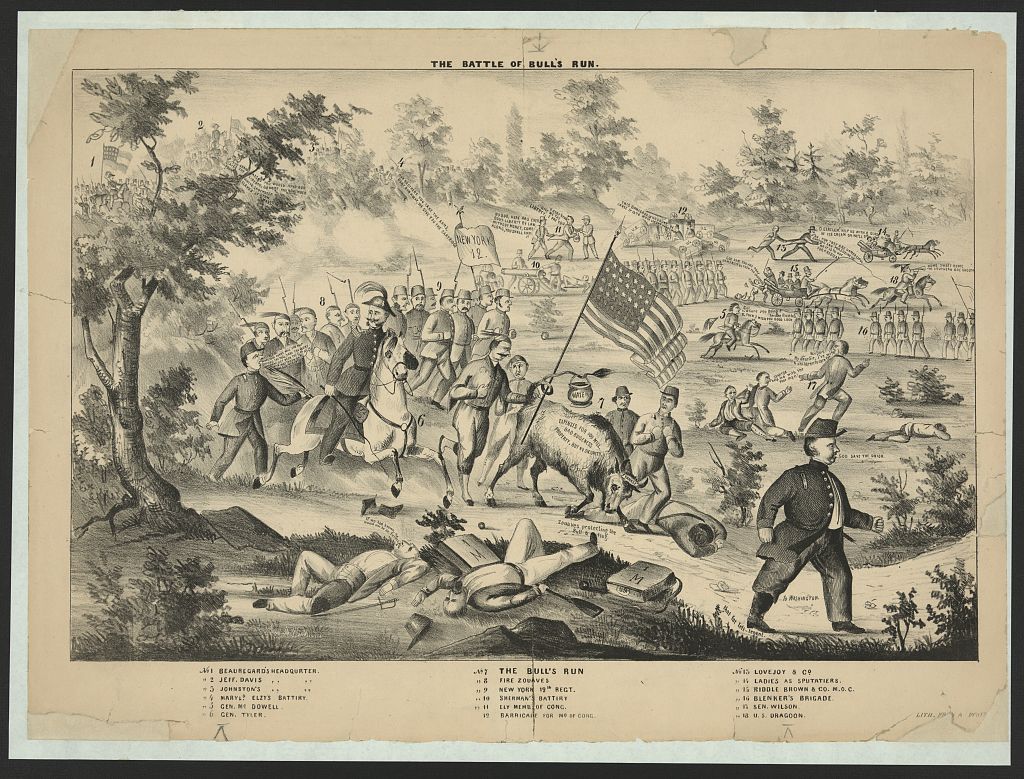
The fiercest fighting centered on Henry House Hill, where repeated Union attacks collided with determined Confederate resistance. Soldiers who had imagined glorious combat instead encountered exhaustion, confusion, deafening artillery fire, and the terrifying unpredictability of battle. Officers struggled to reorganize units that became intermixed, while individual acts of courage often proved just as important as carefully prepared battle plans. Bull Run quickly demonstrated that warfare rarely unfolds according to expectations.
One of the day’s most enduring stories emerged during the fighting on Henry House Hill. As portions of the Confederate line appeared to waver, Brigadier General Thomas Jonathan Jackson positioned his Virginia brigade on high ground and refused to retreat despite mounting pressure. Confederate General Barnard Bee reportedly pointed toward Jackson’s troops and exclaimed, “There stands Jackson like a stone wall!”⁴ Although historians continue to debate Bee’s exact meaning—and even the precise wording of the remark—the nickname endured. From that day forward, Thomas Jackson would forever be known as “Stonewall” Jackson, becoming one of the Civil War’s most recognizable military leaders.
Reinforcements—and a Turning Point
While Jackson’s brigade held its position, another important development unfolded beyond the immediate battlefield. Confederate General Joseph E. Johnston had successfully transported reinforcements from Virginia’s Shenandoah Valley using the railroad network centered at Manassas Junction. Although railroads had previously been used to support military logistics, Bull Run marked one of the earliest examples of trains rapidly delivering large numbers of troops directly to an active battlefield. The arrival of these fresh Confederate soldiers shifted the balance of the fighting at a critical moment and illustrated how emerging technologies were reshaping warfare.²
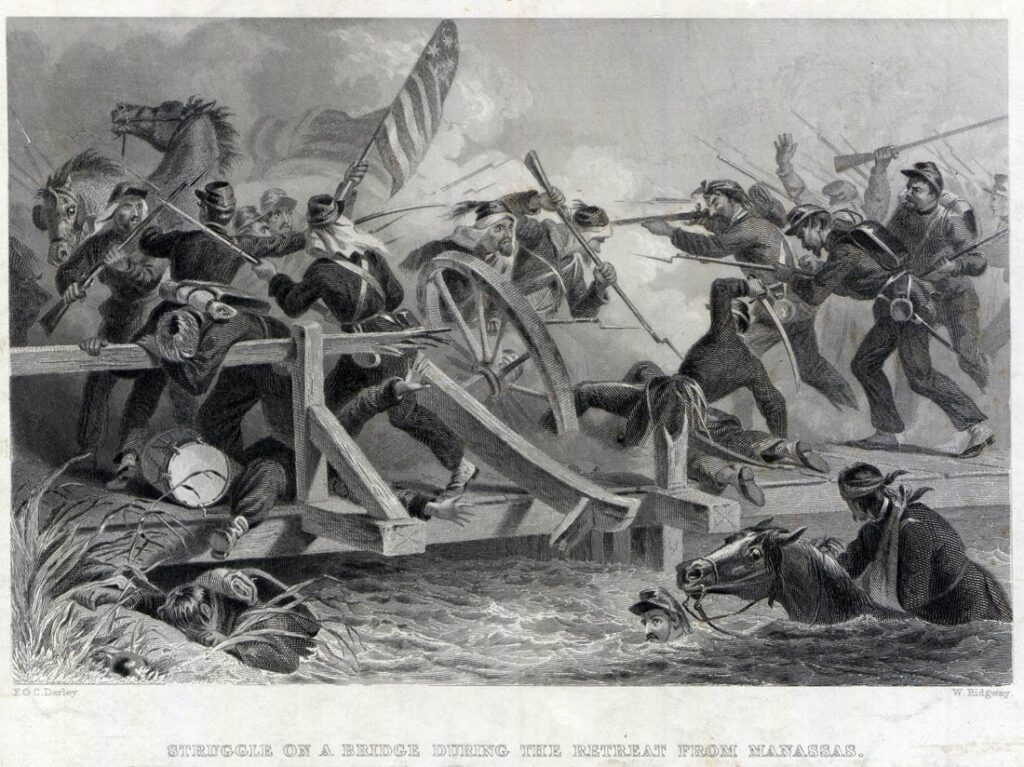
By late afternoon, Confederate counterattacks gained momentum. Union formations that had advanced confidently earlier in the day gradually lost cohesion under sustained pressure. As officers attempted to organize an orderly withdrawal, confusion spread across roads leading back toward Washington. Civilians who had traveled to observe the battle suddenly found themselves caught among retreating soldiers, overturned wagons, frightened horses, and abandoned equipment. Bridges became crowded with military units, government officials, newspaper correspondents, and spectators all seeking to escape at once. What began as a disciplined retreat soon dissolved into panic, creating one of the battle’s most memorable scenes.¹
Although Confederate forces secured the battlefield, they were themselves exhausted after hours of intense fighting and lacked the organization necessary to pursue the retreating Union army effectively. The victory was significant, but it was far from decisive. Both armies had suffered painful losses, and both governments now confronted an unmistakable reality: the Civil War would not end with a single battle. The hopes carried into Bull Run on that July morning had given way to a far more sobering understanding of the conflict that lay ahead.³
The Battle That Changed Expectations
The First Battle of Bull Run resulted in approximately 4,700 combined casualties, soldiers who were killed, wounded, missing, or captured. Compared with later Civil War battles, that number was relatively small. Yet for Americans in 1861, the losses were staggering. Nearly every community had sent volunteers to serve, and news of the battle spread quickly through newspaper reports, personal letters, and telegraph dispatches. Families who had expected joyful homecomings instead confronted the sobering realities of war.¹
Perhaps Bull Run’s greatest impact was psychological. Before July 21, many people in both the North and the South believed that determination alone would secure victory. The battle revealed a different truth. Military success required training, organization, logistics, and experienced leadership. Volunteer regiments that had marched confidently toward Virginia discovered that courage, while essential, could not overcome poor communication, exhaustion, or battlefield confusion. Political leaders likewise recognized that the conflict would require far greater resources than anyone had anticipated. Recruitment expanded, military training improved, and governments began preparing for a war measured not in weeks or months, but in years.²
Bull Run also underscored the importance of adapting to new technologies. Railroads allowed Confederate reinforcements to arrive at a decisive moment, demonstrating how transportation networks could influence military strategy. Telegraph lines carried information more rapidly than ever before, although battlefield communication remained imperfect. Improvements in firearms increased the range and accuracy of infantry weapons, while photography and illustrated newspapers brought images of the war into homes across the nation. Together, these innovations transformed not only how wars were fought but also how citizens experienced them.³
Beyond the Battlefield
The effects of the battle extended far beyond the soldiers who fought there. Farmhouses became temporary hospitals where doctors and volunteers cared for the wounded. Churches and public buildings sheltered those displaced by the fighting. Families living near Bull Run found their fields damaged, fences destroyed, and homes caught in the path of opposing armies. For local residents, the battlefield was not a distant place marked on a map—it was their community.
Journalists also played an increasingly important role in shaping public understanding of the war. Correspondents hurried to send reports to newspapers in major cities, while artists created sketches illustrating combat scenes for readers who had never witnessed battle firsthand. In the years that followed, photographers such as Mathew Brady documented the human cost of the Civil War with unprecedented realism. Although Brady was not present at Bull Run itself, the growing use of photography fundamentally changed how Americans understood war, replacing romanticized images with evidence of its devastating consequences.⁴
The battle, therefore, marked a turning point not only for military leaders but also for the American public. Citizens who had viewed the conflict from a distance increasingly realized that its consequences would touch nearly every aspect of national life.
Why Two Names?
One question often asked by students of history is why this battle is known by two different names. The answer reflects differing traditions rather than disagreement over the event itself.
During the Civil War, Union forces generally named battles after nearby rivers, streams, or other natural features. Because much of the fighting occurred near Bull Run Creek, Northern newspapers referred to the engagement as the Battle of Bull Run. Confederate forces, by contrast, typically named battles after nearby towns or railroad junctions. Since the fighting occurred near Manassas Junction, Southern accounts referred to it as the Battle of Manassas.¹
Today, historians use both names interchangeably, recognizing that they describe the same battle from different historical perspectives. The National Park Service officially preserves the site as Manassas National Battlefield Park, while acknowledging both names in its interpretation of the conflict. The dual naming tradition serves as a reminder that history often reflects the viewpoints of those who record it and that understanding multiple perspectives can deepen our understanding of the past.
Preserving a Place Where History Happened
Today, much of the landscape where the First Battle of Bull Run unfolded has been preserved by the National Park Service. Visitors to Manassas National Battlefield Park can walk along trails that cross the same fields where volunteer armies first tested one another in July 1861. The Stone Bridge spanning Bull Run Creek still stands, Henry House Hill remains a focal point of interpretation, and exhibits throughout the park help visitors understand not only military events but also the experiences of civilians whose lives were forever changed by the war.¹
Historic preservation serves an important civic purpose. Battlefields are not preserved to celebrate war but to provide places where future generations can learn from it. Walking the landscape encourages visitors to consider the decisions made by political leaders, military commanders, soldiers, and ordinary citizens. It reminds us that history took place in real communities, affecting real people whose choices shaped the nation’s future.
Organizations such as the National Park Service, museums, libraries, historians, archaeologists, and volunteers continue working together to protect these sites so that Americans can engage directly with their shared history. Their efforts help transform places of conflict into places of learning.
Why the Battle of Bull Run Still Matters
More than 160 years have passed since soldiers first crossed Bull Run Creek, yet the battle continues to offer valuable lessons about citizenship, leadership, and the responsibilities of self-government.
One lesson is the danger of underestimating complex problems. Before the Battle of Bull Run, many Americans believed that determination alone could resolve deep political disagreements. The battle demonstrated that conflicts rooted in fundamental questions about the nation’s future could not be settled quickly or easily. Although military history often focuses on strategy and tactics, Bull Run also invites us to examine the civic failures that allowed political divisions to escalate into armed conflict.
Another enduring lesson is the importance of preparation. The battle exposed weaknesses in military organization, communication, and planning that both governments spent years addressing. It also highlighted the value of institutions capable of adapting, learning, and improving after failure. These themes extend beyond military history. Whether in government, education, business, or community organizations, effective leadership often depends upon the willingness to evaluate mistakes honestly and make meaningful improvements.
Bull Run also reminds us that history is experienced not only by famous leaders but by ordinary people. Farmers, shopkeepers, journalists, nurses, volunteers, railroad workers, and families living near the battlefield all became part of the story. Their experiences illustrate that national events are ultimately lived at the local level, where communities respond to both the challenges and opportunities created by history.
Perhaps the most enduring lesson is one of humility. The civilians who traveled from Washington, expecting to witness the Civil War’s decisive battle, instead witnessed its beginning. Their confidence reflected assumptions shared by leaders on both sides, assumptions that the events of July 21 quickly overturned. History repeatedly reminds us that the future is rarely as predictable as it appears in the present.
At Civics for Life, studying events like the Battle of Bull Run is not simply about remembering dates or military movements. It is about understanding how political institutions, public leadership, technological change, and civic participation influence the course of history. By examining moments when Americans faced profound challenges, we gain perspective on our own responsibilities as informed and engaged citizens.
The Battle of Bull Run did not determine the outcome of the Civil War. It did something equally important. It transformed how Americans understood the conflict before them and revealed that preserving a nation requires perseverance, thoughtful leadership, and an honest recognition of the costs of division. Those lessons remain as relevant today as they were in the summer of 1861.
Sources:
- Smithsonian Magazine, “The Battle of Bull Run: The End of Illusions,” https://www.smithsonianmag.com/history/the-battle-of-bull-run-the-end-of-illusions-17525927.
- National Park Service, “First Battle of Manassas (Bull Run),” Manassas National Battlefield Park, https://www.nps.gov/mana/learn/historyculture/first-manassas.htm.
- Smithsonian National Museum of American History, “The Battle of Bull Run,” The Price of Freedom exhibition, https://americanhistory.si.edu/explore/exhibitions/price-of-freedom/online/civil-war/battle-bull-run.
- History.com Editors, “First Battle of Bull Run,” History, https://www.history.com/articles/first-battle-of-bull-run.
Continue exploring this transition from Founders to Pioneers in our Founding Generation series, or read more on the explorers, settlers, and statesmen of the westward expansion in our History Lessons.