

Earth Day: How One Senator Sparked a Global Movement
On April 22, 1970, 20 million Americans stepped outside — onto college quads, city sidewalks, and suburban streets — to demand a cleaner, healthier world. That single day of civic action set off a cascade of legislation, institutions, and international agreements that continue to shape life on Earth today. This is the story of how Earth Day began and grew.
A Crisis in Plain Sight
To understand why Earth Day happened, it helps to imagine the world it was born into. Before 1970, a factory could legally spew black clouds of toxic smoke into the air or dump tons of waste into a nearby stream — and there was no federal law to stop it.[3] There was no EPA, no Clean Air Act, no Clean Water Act. Environmental protection was essentially nonexistent at the federal level.
But something was shifting. In 1962, marine biologist Rachel Carson published Silent Spring, documenting the devastating effects of pesticides on birds, ecosystems, and human health. The book shocked readers and seeded a new public awareness. Then came a cascade of disasters: on January 28, 1969, an oil platform six miles off Santa Barbara, California, blew out, spilling more than 3 million gallons of oil and killing more than 10,000 seabirds, dolphins, seals, and sea lions. That same year, the Cuyahoga River in Cleveland — so choked with industrial waste — caught fire when a spark from a passing train ignited oil-soaked debris on the river’s surface. The images were stunning, and they spread quickly.
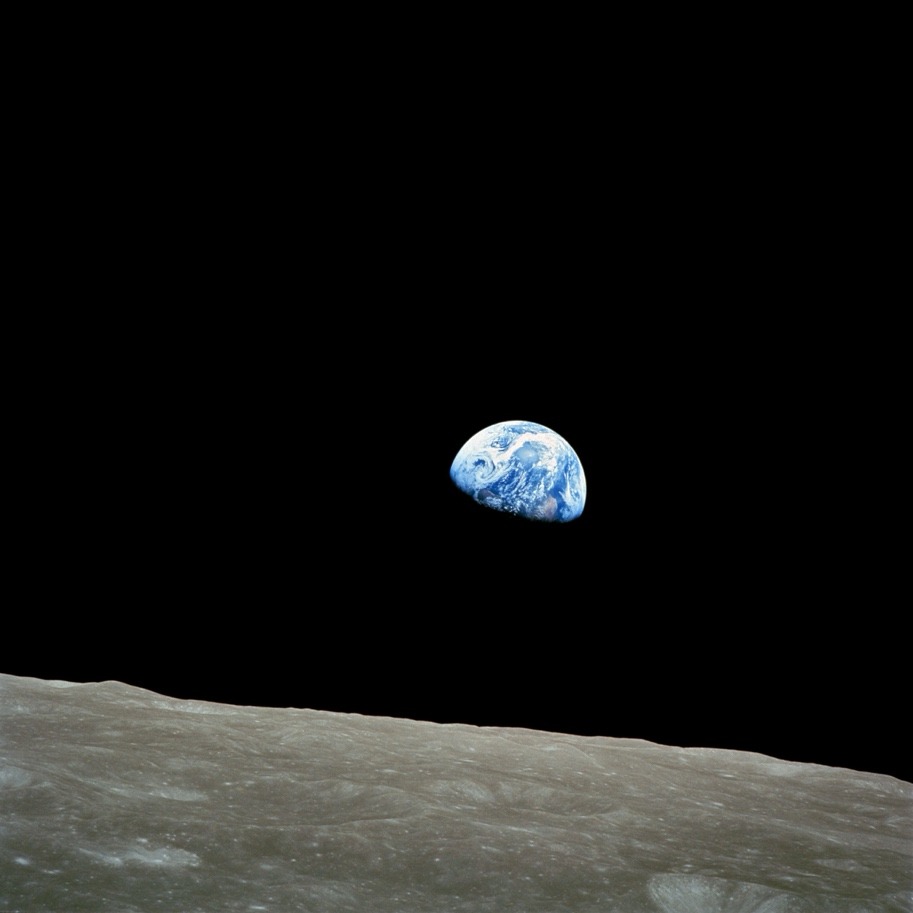
Then there was the view from space. On Christmas Eve 1968, Apollo 8 astronaut William Anders photographed the Earth rising above the lunar horizon — a glowing, solitary blue marble suspended in blackness. That iconic Earthrise image is widely credited with fueling the environmental movement that led to the first Earth Day, giving millions of people a visceral sense of their planet’s fragility and beauty.
The Senator, the Student, and the Idea
Gaylord Nelson was a Democratic senator from Wisconsin and a lifelong conservation advocate. He had championed the Wilderness Act and clean water legislation throughout the 1960s, but he was frustrated that the environment remained a marginal political issue. After touring the Santa Barbara coastline in the aftermath of the oil spill, Nelson flew home and read a magazine article about the anti-Vietnam War teach-ins taking place on college campuses — and was immediately inspired to apply the same model to the environment.
In September 1969, Nelson charged his staff with figuring out how to sponsor environmental teach-ins on college campuses nationwide, to be held on the same day the following spring. He established an independent nonprofit called Environmental Teach-In, Inc. to support the effort — deliberately keeping it outside his Senate office so it could grow as a grassroots initiative rather than a top-down political campaign.
Nelson recruited Denis Hayes, a young activist and former Harvard Kennedy School student, to serve as national coordinator.[1] Hayes was 25 years old. He dropped out of his graduate program to take the job, assembling a team of energetic young organizers with backgrounds in the civil rights movement, the Chicano movement, and anti-war activism. He also recruited Republican Congressman Pete McCloskey of California as co-chair, a deliberate choice that signaled from the outset that the effort was bipartisan.
“In late 1969, had you asked, ‘What do you think about the environment?’ the most common response would have been, ‘What is the environment?’ By mid-1970, about 80 percent of Americans said they were environmentalists.” — Denis Hayes, National Coordinator, First Earth Day, speaking in 2020
The name “Earth Day” was coined by advertising writer Julian Koenig, and it stuck. The team identified the week of April 19–25 as ideal for college schedules and calculated that more students were on campus on Wednesdays, making Wednesday, April 22, the first Earth Day. The date fell between spring break and final exams, maximizing participation.
April 22, 1970: A Nation Steps Outside
What happened on that first Earth Day exceeded every expectation. Participants and celebrants turned out at two thousand colleges and universities, about ten thousand primary and secondary schools, and hundreds of communities across the United States. An astonishing 20 million Americans participated in the first observance — roughly 10 percent of the entire U.S. population at the time. American Heritage magazine later described the event as “one of the most remarkable happenings in the history of democracy.”[1]
In New York, Fifth Avenue was closed to traffic and filled instead with pedestrians and demonstrators. In Philadelphia, thousands formed a mile-long Earth Walk. In Washington, D.C., speakers addressed enormous crowds on the National Mall. From Gary, Indiana, to Los Angeles — cities where the air was, as Hayes later put it, like the air in the most polluted cities in the world today — people showed up demanding change.
What made the first Earth Day unusual, even by the turbulent standards of 1970, was its breadth. Groups that had been fighting separately against power plants, pesticides, leaded gasoline, urban freeways, and ocean pollution came together under a single banner. Labor unions, churches, scientists, students, suburban mothers, and civil rights organizers all found something in the environmental cause that connected to their own concerns. The United Auto Workers provided early and crucial financial support. The day felt, to many who were there, like the beginning of something genuinely new.
Legislation That Followed
The civic energy of that first Earth Day translated almost immediately into legislative action. By December 1970, Congress had authorized the creation of the U.S. Environmental Protection Agency — a new federal agency dedicated solely to tackling environmental issues.[3] President Richard Nixon signed the legislation, and the EPA opened its doors just eight months after the first Earth Day.
The years that followed brought a remarkable wave of bipartisan environmental law. The Clean Air Act, the Clean Water Act, the Endangered Species Act, the National Environmental Policy Act, and the Occupational Safety and Health Act were all enacted within a few years of that first April 22. These laws set binding standards for air and water quality, required environmental impact assessments of federal projects, and gave citizens the legal tools to challenge polluters in court — tools that had not existed before 1970.
Senator Nelson was awarded the Presidential Medal of Freedom in 1995 in recognition of his work founding Earth Day. His lasting legacy, arguably, is not just the day itself but the entire framework of federal environmental law that the day helped make politically possible.
From National to Global: Earth Day Grows Up
The first Earth Day was an American event. By 1990, Denis Hayes returned to organize Earth Day’s 20th anniversary — this time internationally, mobilizing 200 million people in 141 countries.[4] The 1990 Earth Day gave a major boost to recycling movements worldwide and helped set the stage for the 1992 United Nations Earth Summit in Rio de Janeiro, which launched global climate diplomacy and produced the UN Framework Convention on Climate Change.
Earth Day 2000 refocused the world’s attention on climate change and clean energy, with hundreds of millions of participants globally. Earth Day 2016 took on historic significance when the landmark Paris Agreement was signed on Earth Day by the United States, the United Kingdom, China, and 120 other countries — the United Nations deliberately choosing April 22 for the ceremony to acknowledge the day’s symbolic weight in global environmental history.
The 50th anniversary in 2020 fell during the COVID-19 pandemic. Mass gatherings were impossible, but the commemoration went digital: over 100 million people around the world observed the 50th anniversary, making it the world’s largest civic observance — now conducted largely online. The pandemic, in an unexpected way, demonstrated just how deeply Earth Day had embedded itself in civic life: even when people could not gather, they found a way to mark the day.
A Timeline of Key Milestones
- JANUARY 28, 1969: Union Oil’s Platform A blows out off Santa Barbara, CA, spilling over 3 million gallons of oil. Senator Nelson tours the damage and is galvanized to act.
- SEPTEMBER 1969: Nelson announces plans for a national environmental teach-in; Denis Hayes is hired as national coordinator. The name “Earth Day” is adopted.
- APRIL 22, 1970: The first Earth Day: 20 million Americans at 2,000 colleges, 10,000 schools, and hundreds of communities participate in the largest single-day environmental demonstration in U.S. history.
- DECEMBER 1970: The U.S. Environmental Protection Agency is established. The Clean Air Act is signed into law.
- 1972–1973: Clean Water Act (1972), Endangered Species Act (1973), and other landmark environmental laws follow in Earth Day’s wake.
- APRIL 22, 1990: Earth Day goes global: 200 million participants in 141 nations. The event paves the way for the 1992 UN Earth Summit in Rio de Janeiro.
- APRIL 22, 2000: Earth Day 2000 spotlights climate change and clean energy, drawing hundreds of millions of participants worldwide.
- APRIL 22, 2016: 175 nations sign the Paris Agreement on climate change on Earth Day at UN Headquarters in New York.
- APRIL 22, 2020: The 50th anniversary: over 100 million people participate in online events — the world’s largest digital civic mobilization.
- APRIL 22, 2025: Earth Day turns 55. Today, it is observed in 193 countries and is recognized as the planet’s largest civic event.
What Earth Day Teaches Us About Civic Action
For civics students, Earth Day is an unusually instructive case study. It began not with a law, a presidential order, or an agency mandate — but with a senator, a college student, and a letter-writing campaign. The original organizing operation ran on a shoestring budget out of a small Washington office staffed largely by young volunteers. And yet within a single year, it had changed the political landscape of the United States, produced new federal law, and created an institution that would outlast both its founders.
Earth Day demonstrated that civic engagement — organized, sustained, and broadly inclusive — could translate public concern into lasting policy change.[2] The coalition that Nelson, Hayes, and McCloskey assembled was genuinely unusual for its time: it brought together labor and management, Republicans and Democrats, scientists and students, urban activists and rural conservationists. The issues that united them — clean air, clean water, healthy communities —crossed every political and geographic line.
That bipartisan character was not accidental; it was a deliberate strategic choice. Nelson chose McCloskey as co-chair precisely to signal that environmental protection was not a partisan cause. The environmental legislation that followed the first Earth Day was passed with overwhelming majorities in both parties. In the years since, environmental issues have become more contested — but the original Earth Day model of broad coalition-building around shared concerns remains as relevant as ever to anyone interested in how democratic change actually happens.
Celebrating Earth Day Today
Today, more than one billion people celebrate Earth Day in over 193 countries, making it the world’s largest civic observance.[1] Activities range from tree plantings and river cleanups to climate marches, school teach-ins, and corporate sustainability commitments. The Earth Day Network, which Hayes founded and continues to lead, coordinates events and campaigns year-round.
At its core, Earth Day has always been about something simple: the idea that the natural world we share is worth protecting, and that ordinary citizens have both the right and the responsibility to say so. On April 22, that idea is 55 years old — and still going strong.
Footnotes & Sources
- Michigan State University Extension, “The History of Earth Day.” canr.msu.edu/news/the-history-of-earth-day
- U.S. Department of State, American English, “Content Spotlight: Earth Day.” americanenglish.state.gov/content-spotlight-earth-day
- U.S. Environmental Protection Agency, “EPA History: Earth Day.” epa.gov/history/epa-history-earth-day
- Earth Day Network, “The History of Earth Day.” earthday.org/history