

Independence, Missouri: The Jumping-Off Point to the West
From merchants and missionaries to gold seekers and pioneer families, one western Missouri town stood at the center of a continental migration that would reshape a nation.
In the spring of 1849, Independence, Missouri, was a city transformed. Wagons crowded every street. Oxen and mules filled every corral. Merchants sold barrels of flour, wagon parts, rifles, tools, and blankets. Families made last-minute purchases while traders negotiated deals that could determine the success or failure of a months-long journey.
Excitement mixed with uncertainty as emigrants prepared to leave behind everything familiar and venture west. The town—founded only twenty-two years earlier as a modest county seat near the Missouri River—had become one of the busiest transportation and commercial centers in the nation. For a few electric weeks each spring, Independence was the place where individual dreams and national ambitions converged before heading west.¹
For the vast majority of those passing through, Independence was not their final destination. It was a beginning. From Independence and other nearby Missouri River trailheads, three of the most important overland routes of the nineteenth century stretched westward across the continent: the Santa Fe Trail, the Oregon Trail, and the California Trail.
Together, these roads carried traders, settlers, missionaries, soldiers, and fortune seekers into new territories and new lives. The journeys that began here helped reshape the geography, economy, and population of the United States—and earned Independence an enduring reputation as one of America’s leading “jumping-off points” to the West.¹
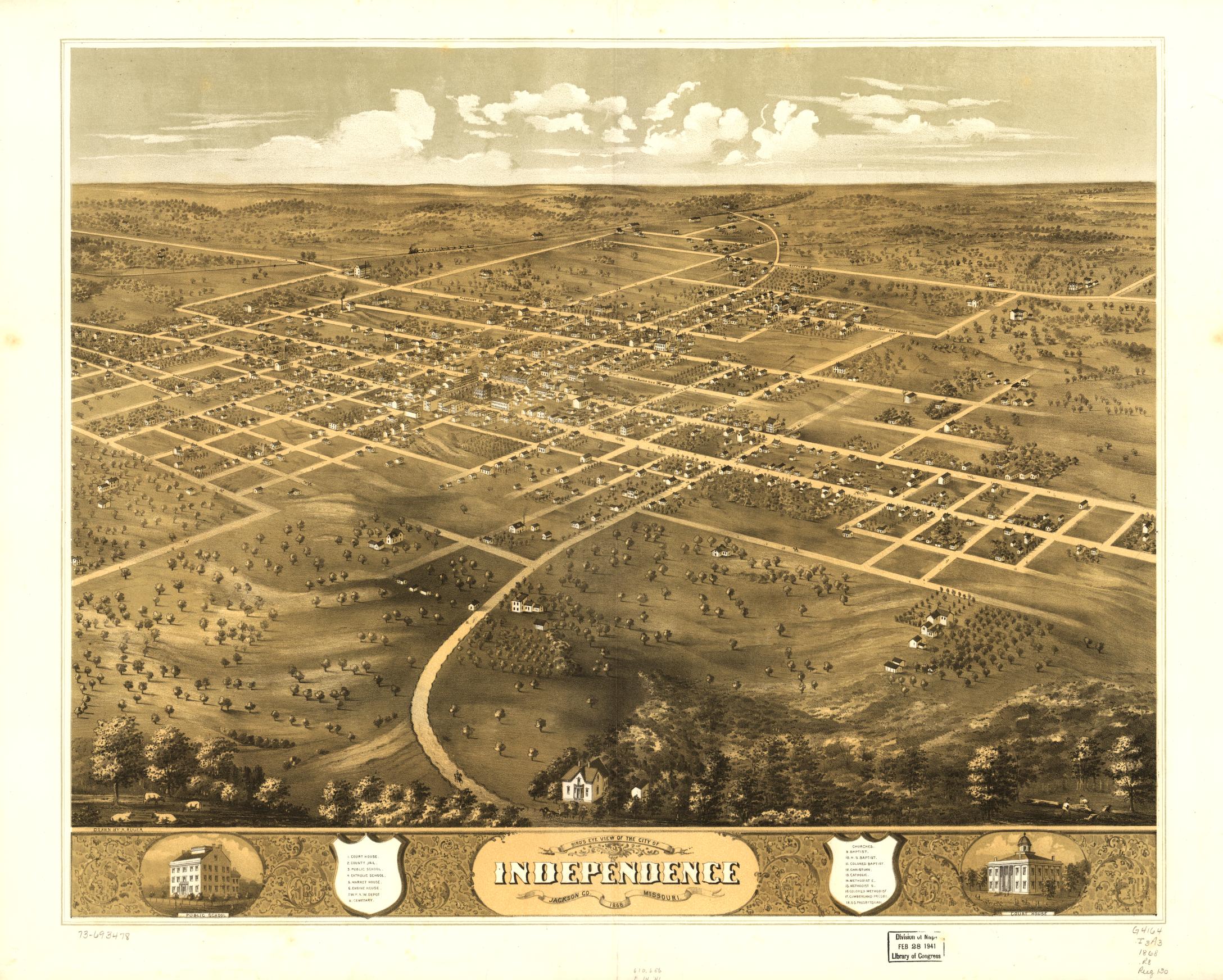
Founded at the Edge of Everything
Independence was founded in 1827 as the county seat of Jackson County, Missouri, a piece of timing that proved consequential. Located near the Missouri River and at the western edge of substantial American settlement, it occupied a near-perfect strategic position between the established communities of the East and the open prairies beyond.
Those prairies were not empty. They were the homelands of Native nations and were crossed by Indigenous travel and trade networks that long predated the arrival of American emigrants. As settlement expanded, the same geography that created opportunity for newcomers would also bring profound change to the people already living there.
What began as a modest frontier town grew within a single generation into a vital center of trade, migration, and continental transportation.¹
Geography made it possible. In the era before railroads, rivers were America’s highways, and the Missouri River was one of the mightiest. Steamboats arriving from St. Louis carried passengers, supplies, and freight to landings near Independence. Travelers then made their way into town, where they purchased wagons, oxen, mules, food, clothing, tools, weapons, and dozens of other necessities before the overland journey could begin.³
That demand created an economy almost overnight. Blacksmiths set up forges. Livestock dealers filled paddocks with mules and oxen. General stores stocked goods that would be unavailable once travelers left the city’s edge. Hotels and boarding houses accommodated waves of newcomers, some waiting weeks for the mud to dry and spring grass to grow before their wagon trains could roll.
Independence became a place where eastern transportation networks ended and western migration began.¹
The Santa Fe Trail: Commerce Comes First
The story of Independence as a trail hub began not with emigrants seeking farmland, but with commerce.
In 1821, Missouri trader William Becknell left Franklin, Missouri, with a small party and a load of trade goods. He arrived in Santa Fe shortly after Mexico had completed its war of independence from Spain. The new Mexican government opened its northern provinces to foreign commerce, and Becknell returned to Missouri with a substantial profit.
Within months, other traders were following his route west, and the Santa Fe Trail—a commercial highway of approximately 900 miles linking Missouri with Santa Fe—was born.²
Franklin initially served as the trail’s eastern terminus, but as settlement and transportation patterns shifted, Independence emerged during the late 1820s and 1830s as one of its principal outfitting points.
Merchants loaded wagons with textiles, manufactured goods, tools, and other products sought by customers in New Mexico. Silver, livestock, wool, and merchandise traveled east in return. Before the Mexican-American War, the trail functioned as a genuinely international commercial highway connecting the United States with Mexican markets. After New Mexico became part of the United States in 1848, the trail remained an important commercial, military, and transportation corridor.²
Long before gold seekers and Oregon emigrants arrived, Santa Fe traders were already demonstrating how a dependable transportation route could stimulate wealth, population growth, and commercial development across an entire region. The trail’s success established Independence as a regional economic hub and gave its merchants the experience and infrastructure that would serve a much larger wave of migration in the years ahead.
The Oregon Trail: A Nation on the Move
Seeking Land and a Fresh Start
Beginning in the early 1840s, thousands of families began arriving in Independence with a different purpose than the Santa Fe traders. They wanted land.
The fertile valleys of the Oregon Country—a vast territory jointly occupied by Britain and the United States until 1846—beckoned with the promise of agricultural opportunity, economic advancement, and a fresh start. These emigrants were not adventurers in the traditional sense. They were farmers, families, craftspeople, and tradespeople making a calculated, if uncertain, bet on their futures.⁴
The Oregon Trail stretched roughly 2,000 miles from the Missouri River to the Willamette Valley in present-day Oregon, passing through what are now Kansas, Nebraska, Wyoming, Idaho, and Oregon.
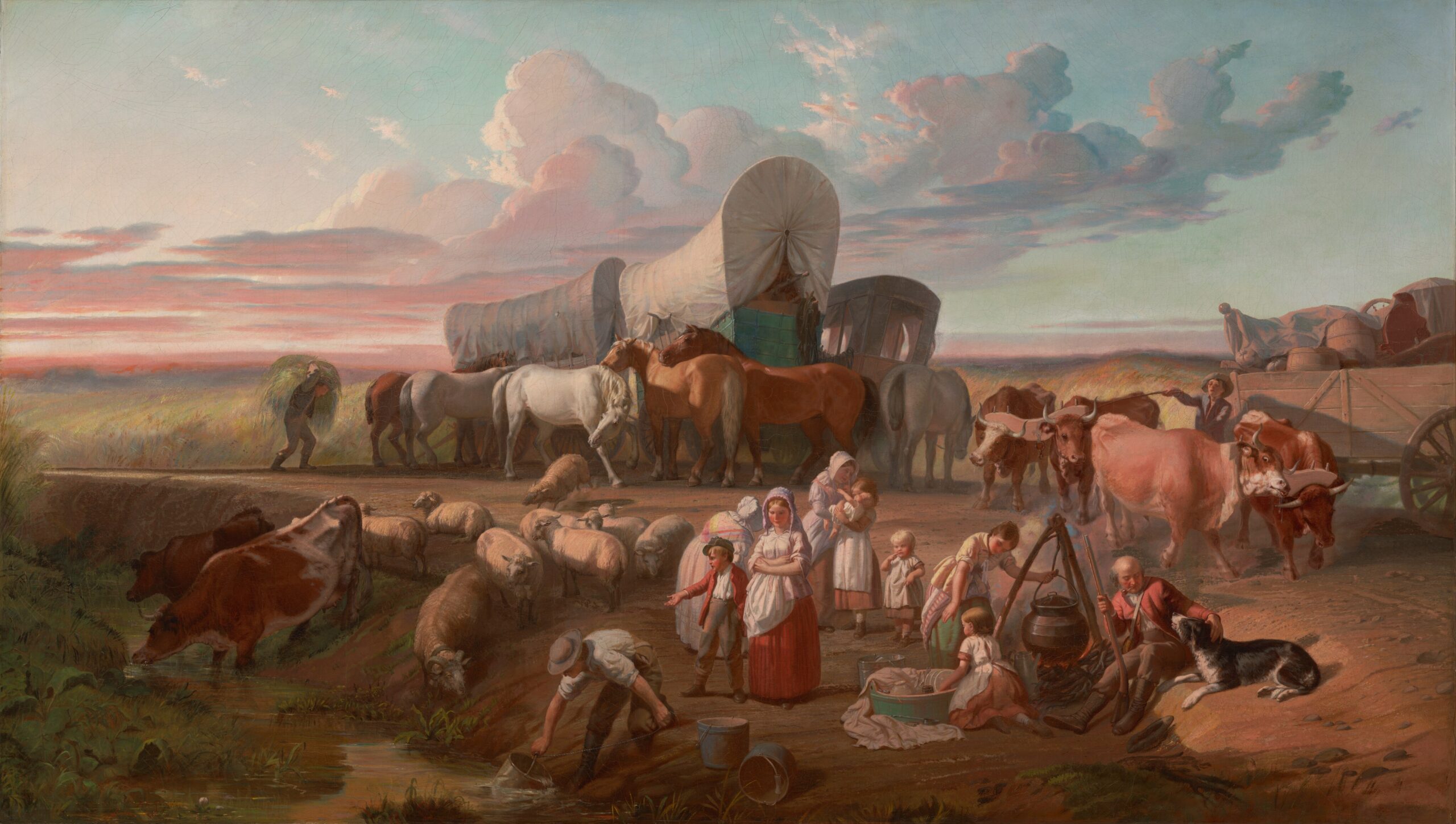
Families packed their possessions into covered wagons, yoked their oxen, and embarked on journeys that commonly lasted four to six months. Most travelers walked much of the way beside their wagons.
The trip required physical endurance, careful preparation, tolerance for months of exhausting routine, and a willingness to face river crossings, accidents, disease, severe weather, and other dangers. Not everyone who set out would arrive.
The Rhythm of Departure
Successful overland travel depended heavily on timing, and Independence’s annual rhythms reflected that fact precisely.
Most wagon trains departed during April or May. Leaving too early risked muddy trails, swollen rivers, cold weather, and insufficient grass for livestock. Departing too late brought different hazards: early winter storms in the mountain passes could strand a wagon train with fatal consequences.⁴
The Donner-Reed Party’s tragedy in 1846 demonstrated how delays could compound along the trail. The party left Independence relatively late and lost additional time after choosing the largely untested Hastings Cutoff. The supposed shortcut required travelers to cross difficult terrain and the Great Salt Lake Desert. By the time the party reached the Sierra Nevada, early winter storms had closed the mountain passes.⁵
Families often spent days or weeks in and around Independence preparing for departure while waiting for the right conditions. Merchants understood the cycle and stocked accordingly. Every spring, the streets filled with newcomers from across the country, and every summer they emptied again as wagon trains rolled westward.
Approximately 500,000 emigrants traveled the Oregon, California, and Mormon Pioneer trail corridors between the 1830s and 1860s. Not all departed from Independence; Westport, St. Joseph, Council Bluffs, and other communities also became important jumping-off points.
Thousands more traveled the Santa Fe Trail as traders, freighters, soldiers, stagecoach passengers, and merchants. Together, these routes supported one of the largest voluntary overland migrations in American history.⁶
The Gold Rush and the California Trail
The discovery of gold in California in January 1848 transformed western migration almost overnight.
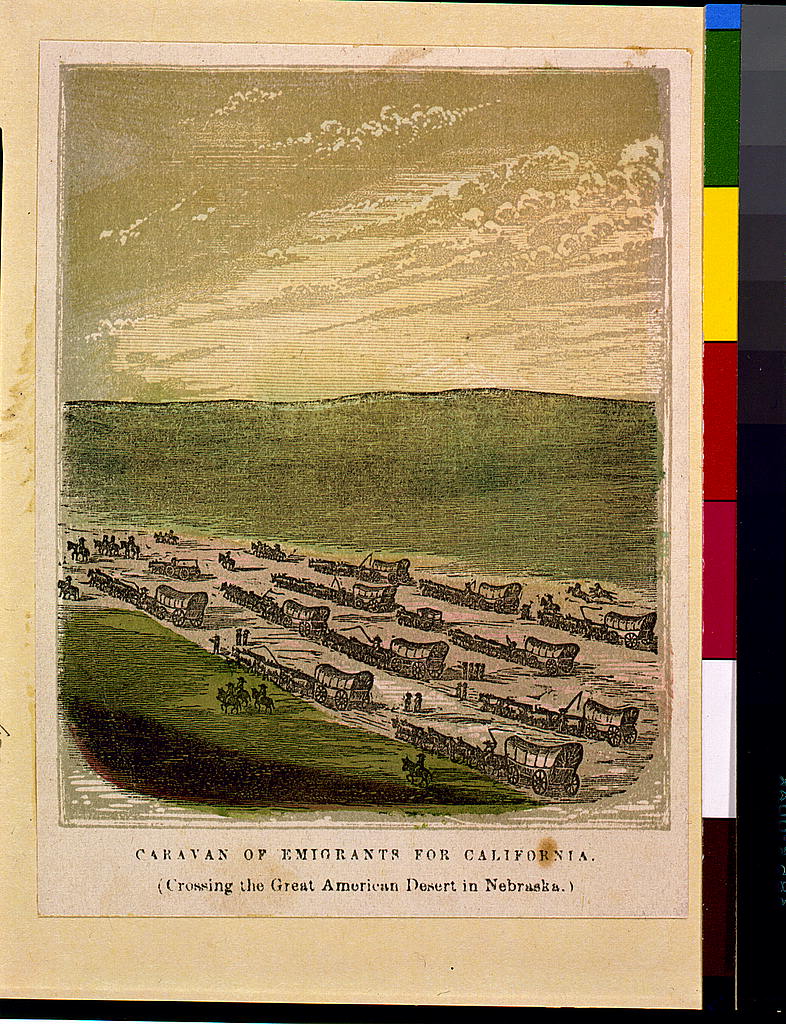
News spread through the country with unusual speed for the era, and by the spring of 1849, the existing stream of Oregon-bound emigrants had been joined by a flood of fortune seekers. They came from every state in the Union and from countries around the world, many of them young men who had never traveled farther from home than the nearest county seat.
Independence was suddenly at the center of a national phenomenon. Demand for wagons, tools, food, and livestock surged. Merchants who had been doing brisk business now faced shortages. The city’s population swelled each spring with “49ers” equipping themselves for the journey.
The Gold Rush did not create an entirely separate route across the continent. The California Trail largely followed the Oregon Trail before branching south near present-day Idaho. But it dramatically intensified the human traffic passing through Independence and the other Missouri River trailheads, cementing the city’s status as one of the nation’s premier outfitting and departure points for western travel.¹
Where the World Came Together
One of the most striking features of Independence during the trail era was the sheer variety of people who gathered there.
In any given spring, a walk through town might encounter farmers from Ohio and Pennsylvania, merchants from eastern cities, German and Irish immigrants making another major migration, missionaries bound for Oregon, military officers carrying government dispatches, traders from New Mexico, fur trappers resupplying for another season, and members of Native nations whose own routes and trade networks crossed the region.²
Many spoke different languages. Many practiced different religions. Some sought farmland; others sought silver or gold. Some sought religious community; others sought escape from debt or failure in the East.
Their paths briefly converged in Independence before diverging across an entire continent. The city was, for a few weeks each spring, an unlikely crossroads of cultures, economies, and ambitions.
Independence also occupies an important—and often overlooked—place in the history of The Church of Jesus Christ of Latter-day Saints.
In 1831, Joseph Smith designated Independence as the site of Zion, and more than 1,000 church members eventually settled in Jackson County. Growing tensions with other residents led to their forcible expulsion from the county in 1833. Church members relocated elsewhere in Missouri before moving to Illinois and, beginning in 1847, to the Salt Lake Valley.⁷
Although the principal Mormon Pioneer Trail departed from a different location, the events that helped shape that migration began in part in Independence—one more thread in the complicated civic and religious fabric of this frontier town.
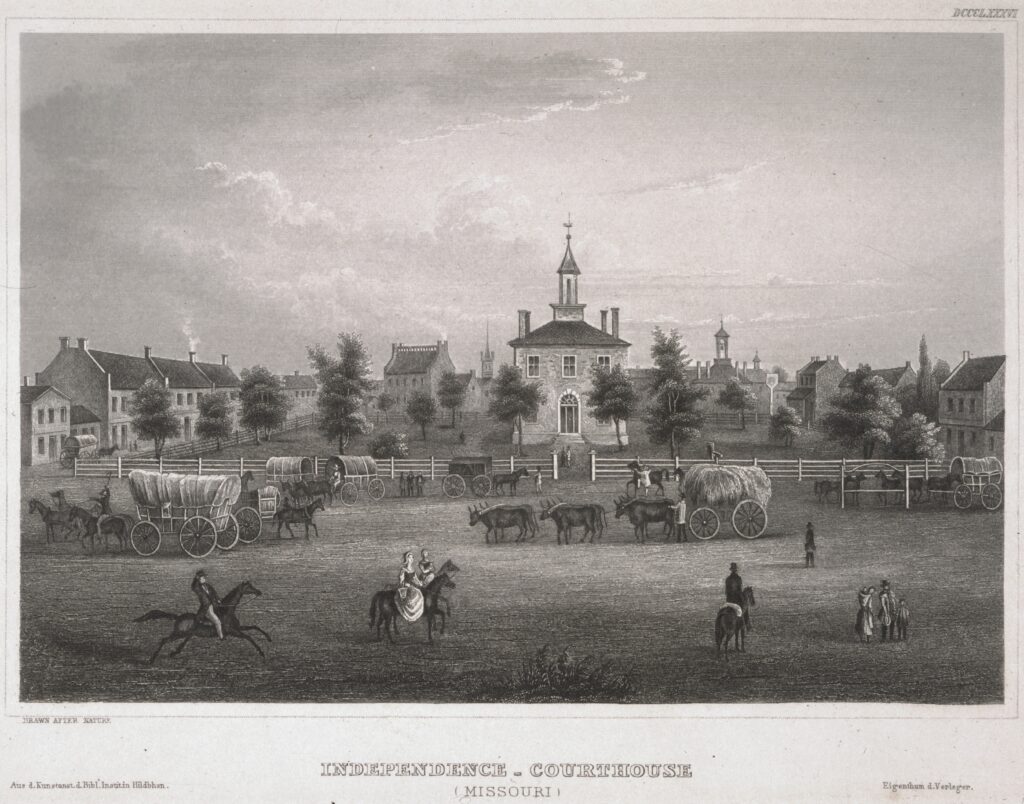
Legacy and Civic Relevance
The completion of the first transcontinental railroad in 1869 sharply reduced the demand for long-distance emigrant travel by wagon.
Trains moved people and goods more quickly, reliably, and cheaply, and the annual spring departure scenes that had defined Independence for decades gradually faded. The change did not happen everywhere at once. The Santa Fe Trail continued to carry commercial traffic in shortened sections until the railroad reached Santa Fe in 1880.⁸
But what happened in Independence did not fade.
The trails associated with the city were among the most consequential transportation corridors in American history. They carried people and goods, connected distant markets, encouraged the creation and growth of western communities, helped integrate new states and territories into a national economy, and supported the emergence of the continental United States.
They also brought lasting consequences. Increased migration placed pressure on Native lands and resources and accompanied federal policies that displaced Native peoples from territories they had inhabited for generations. That history belongs to the full story of westward expansion and cannot be separated from its economic and national achievements.
The idea later known as Manifest Destiny expressed the widespread nineteenth-century belief that the United States was destined to expand across the continent. It inspired confidence in the nation’s future and encouraged migration and settlement, but it was also used to justify territorial acquisition and the displacement of existing communities.
For emigrants, the West promised land, independence, prosperity, adventure, or a new beginning. Their courage, endurance, and ambition helped build communities, develop trade, and connect a continent. The national expansion they advanced also produced conflicts and losses whose consequences endured long after the wagons disappeared.
The National Frontier Trails Museum in Independence remains one of the nation’s leading institutions dedicated to preserving and interpreting this complex legacy. Preserved trail swales—the broad depressions worn into the landscape by thousands of wagons and animals—remain visible in and near the city today, a physical reminder that the history of the trails is not confined to books.¹
“The trails carried people toward opportunity, but they also carried ideas, cultures, goods, ambitions, and aspirations across a continent. Independence stood at the center of that movement.”
For anyone studying civic life and the history of the American republic, Independence offers a vivid illustration of a principle that runs through the entire Pioneer Era: transportation networks shape commerce, migration, political authority, and national development.
The trails associated with Independence connected the ambitions of ordinary people—farmers, traders, missionaries, fortune seekers, and families—to the largest national story of their time.
Some of what they built endures in the cities, states, markets, and transportation systems of the American West. Some of what their movement displaced has never been fully recovered.
That combination of aspiration, achievement, conflict, and consequence is exactly what makes the story of Independence, Missouri, and the trails that left it essential American civics.
Explore more of the people and places in our History Lessons, or plan a visit to the National Frontier Trails Museum in Independence, Missouri.
Footnotes
- City of Independence, Missouri — “Trails History” and “Our History and Culture”:
https://www.independencemo.gov/government/city-departments/parks-recreation-and-tourism/national-frontier-trails-museum/trails-history
https://www.independencemo.gov/visitors/our-history-and-culture - National Park Service — “History & Culture: Santa Fe National Historic Trail”:
https://www.nps.gov/safe/learn/historyculture/index.htm - National Park Service — “Independence” and “Traveling the Emigrant Trails”:
https://www.nps.gov/jeff/planyourvisit/independence.htm
https://www.nps.gov/articles/000/traveling-emigrant-trails.htm - National Park Service — “History & Culture: Oregon National Historic Trail” and “Making the Trek”:
https://www.nps.gov/oreg/learn/historyculture/index.htm
https://www.nps.gov/oreg/learn/historyculture/making-the-trek.htm - National Park Service — “Hastings Cutoff”:
https://www.nps.gov/places/hastings-cutoff.htm - National Park Service — “What Is a National Historic Trail?” and “National Historic Trail Interpretive Themes”:
https://www.nps.gov/safe/learn/what-is-a-national-historic-trail-nht.htm
https://www.nps.gov/articles/000/national-historic-trail-interpretive-themes.htm - City of Independence, Missouri — “Learn About Independence, Missouri, History”; The Church of Jesus Christ of Latter-day Saints — “Jackson County Violence”:
https://www.independencemo.gov/visitors/learn-about-independence-mo-history-timeline-citys-storied-past
https://www.churchofjesuschrist.org/study/history/topics/jackson-county-violence?lang=eng - National Park Service — “Frequently Asked Questions: Santa Fe National Historic Trail” and “Map Timeline, 1878–1880”:
https://www.nps.gov/safe/faqs.htm
https://www.nps.gov/safe/learn/historyculture/map-timeline-5.htm
Image Sources:
- https://www.nga.gov/artworks/195800-evening-halt-emigrants-moving-west-1840
- https://www.loc.gov/item/73693478/
- https://www.loc.gov/pictures/item/93506241/
- https://mohistory.org/collections/item/N39257