
Kit Carson: Frontier Fame, War, and the Navajo Long Walk
How an illiterate Missouri runaway became the most famous frontiersman in America — and how a fuller reckoning with his life now sits alongside the legend.
Christopher “Kit” Carson was born on December 24, 1809, in Madison County, Kentucky, the sixth of ten children.1 He received little formal education and remained nearly illiterate for much of his life; only after his 1854 appointment as Indian agent at Taos did he learn to sign his own name, “C. Carson.”3

None of that stopped him from having one of the most celebrated frontier careers in American memory: mountain man, guide, soldier, and Indian agent. It was a life that carried Carson from the Rocky Mountain fur trade to the front pages of Eastern newspapers and, eventually, to a military campaign whose consequences the Navajo (Diné) people still commemorate today.
As Civics for Life continues to explore the people who shaped westward expansion, Carson’s story, read alongside John C. Frémont’s, connects the celebrated exploration of the nineteenth-century West with the military campaigns that transformed the lives of Native peoples already living there.
Carson became nationally famous for the skills he displayed as a trapper, guide, and soldier. His later military service also placed those same skills at the center of campaigns with profound consequences for Native communities in the Southwest.
A Missouri Runaway on the Santa Fe Trail
Carson grew up on the Missouri frontier, in a family that, like so many others in this series, had moved west in search of better ground. Apprenticed to a saddler in Franklin, Missouri, at the age of fourteen, he found the trade unbearable. In 1826, he left the apprenticeship behind and joined a wagon train bound for New Mexico — a decision that put him, quite literally, on the same road William Becknell had blazed only five years earlier.1
Learning the Frontier Trade
Over the following decade and a half, Carson worked as a teamster, cook, interpreter, and trapper. He traveled across the Rocky Mountains, the Southwest, and into California, learning Spanish and accumulating the kind of detailed regional knowledge that could not be taught in a classroom — only earned, trail by trail, season by season.3
By the early 1840s, that experience had made him one of the most capable and trusted frontiersmen operating out of Taos, New Mexico. He was exactly the kind of man the U.S. Army was looking for.
None of that experience made Carson a public figure on its own. Fur trappers and traders by the hundreds knew the same mountains and rivers Carson did. What set his next chapter apart was less what he knew than who took notice of it.
Guide to “The Pathfinder”
Three Expeditions, One Legend
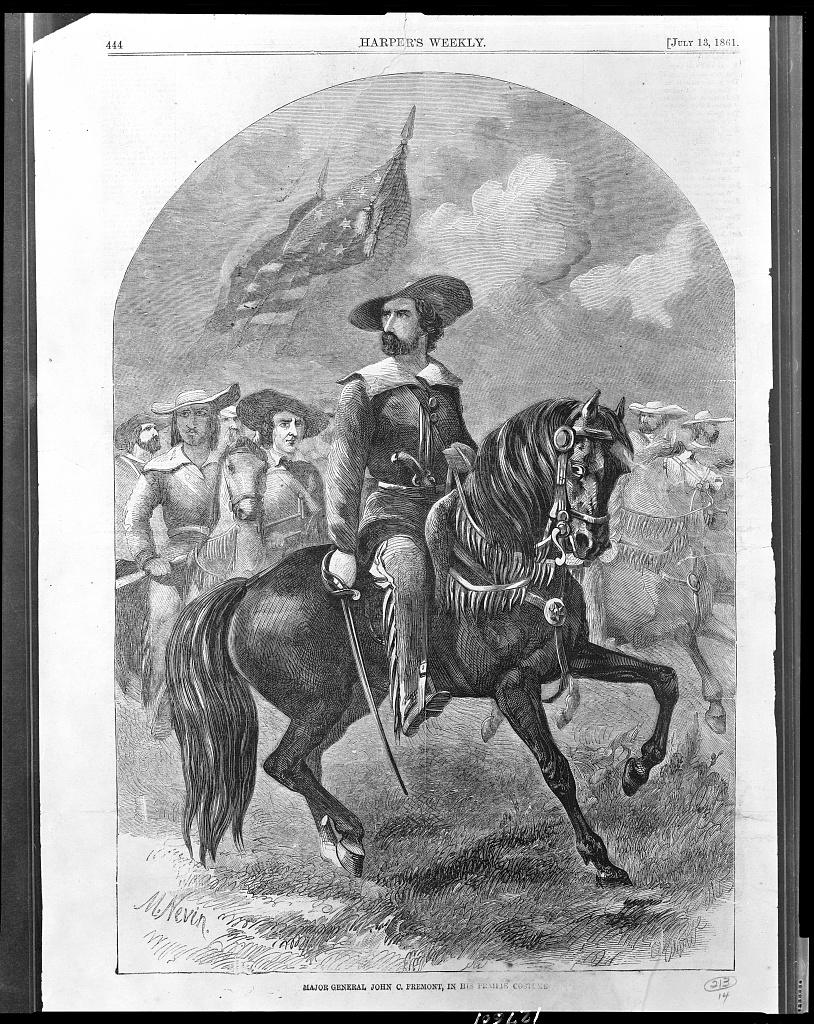
Carson guided John C. Frémont’s first three government expeditions between 1842 and 1846.3 Frémont’s published expedition reports made Carson nationally known as the resourceful, unflappable man of the mountains.
Those reports turned an obscure trapper into a household name years before Carson had done anything himself to seek that fame. Frémont’s account cast Carson as capable, calm, and self-reliant — the kind of figure a growing nation wanted to see as it looked west. That image would outlast Carson himself by more than a century, long before anyone asked what it left out.
The Sacramento River Violence
That fame came at a cost that was not part of the original stories. In spring 1846, Carson rode with Frémont’s armed party during operations in California. Those operations included lethal attacks on Native communities along the Sacramento River.
Carson later described the April 1846 attack in his dictated recollections as a “perfect butchery.” His participation in the episode placed him directly within the violence that accompanied American expansion into California. [Add citation to Carson’s dictated memoirs and/or a scholarly treatment.]
The Mexican-American War
When war broke out between the United States and Mexico in 1846, Carson again served alongside Frémont. He carried dispatches and scouted during the U.S. conquest of California.1
He also made an arduous overland ride to Washington, D.C., to deliver news of events in California to federal officials — a journey national newspapers covered admiringly, further cementing the public image Frémont’s reports had already built.
His service placed him inside the U.S. military campaign that, through the 1848 Treaty of Guadalupe Hidalgo, transferred California, New Mexico, and other territories from Mexico to the United States — the same treaty and territorial transfer that shaped the world James Marshall and John Sutter inhabited at Sutter’s Mill that same winter. The war also set the stage for the New Mexico Territory in which Carson would spend the rest of his career — first as a rancher and Indian agent, and later as a soldier for the Union.
Carson did not shape the war’s outcome or the treaty that followed. He was, in this period as in most of his public life, a capable participant in decisions made well above him — a pattern worth keeping in mind as his story moves toward its most consequential chapter.
Indian Agent in New Mexico
A Decade of Complicated Reputation
After the war, Carson settled permanently in Taos, where he ranched and continued occasional guide work. In 1854, he was appointed Indian agent at Taos, serving the Ute and other Native peoples of northern New Mexico until he resigned in 1861.3
Records of the Office of Indian Affairs, including letters received and sent during Carson’s tenure, are held in National Archives Record Group 75.6
Encyclopedia Britannica describes him as reputedly sympathetic in the role.4 The Texas State Historical Association attributes his effectiveness as an agent to his knowledge of Native languages and customs.3 That reputation makes what came next more historically complicated, not less.
Carson’s later military service placed him under Brigadier General James H. Carleton’s command. When ordered in 1863 to carry out the campaign against the Navajo, Carson initially refused the assignment and submitted his resignation. The resignation was rejected, and he subsequently carried out Carleton’s orders.
Civil War Command in New Mexico
Valverde and a Shift in Priorities
With the outbreak of the Civil War in 1861, Carson helped organize the 1st New Mexico Volunteer Infantry and rose to command it as colonel.3
He fought at Valverde in February 1862, a Confederate tactical victory. The Confederate advance continued north before being turned back following the Battle of Glorieta Pass the following month.
With that threat turned back, Union military authorities in New Mexico turned to a longstanding territorial goal that predated the war entirely. Carleton set his sights on subduing the Navajo and Mescalero Apache and confining them to a reservation at Bosque Redondo, near Fort Sumner.
Carson, by then an experienced Union officer with extensive knowledge of the region and its Native nations, was selected by Carleton to lead the campaign.
The Unvarnished Record: The Navajo Campaign and the Long Walk
The 1863–64 Campaign
The Navajo campaign is central to understanding Carson’s historical legacy. In 1863–64, acting under General James H. Carleton’s orders, Carson led a campaign that destroyed Navajo homes, crops, and livestock.4 The goal was to compel widespread surrender, and it worked. Facing starvation and continued military pressure, thousands of Navajo surrendered or were captured in the months that followed.
The March to Bosque Redondo
What followed is remembered today as the Long Walk. Beginning in 1864, thousands of Navajo men, women, and children were forced to travel hundreds of miles to Bosque Redondo at Fort Sumner. Some accounts place the number removed at about 8,000, while broader estimates covering successive removals between 1863 and 1866 exceed 10,000.
The National Park Service estimates that about 300 died along the way.1 Other accounts of the period cite different totals, a reminder that even well-documented history can carry more than one credible number.
Conditions at Bosque Redondo were disastrous. Disease, exposure, hunger, crop failures, and inadequate supplies contributed to the deaths of roughly 2,000 Navajo people during the four-year internment. The reservation experiment was abandoned in 1868.2
The Navajo Nation today spans more than 27,000 square miles across portions of Arizona, New Mexico, and Utah, much of it within the homeland from which thousands of Diné were forcibly removed in the 1860s.8 That continuity is part of why the Long Walk remains a present subject, not just a historical one, within the Navajo Nation.

Distinguishing Command from Removal
Carson commanded the 1863–64 military campaign that destroyed Navajo food supplies and helped compel widespread surrender. The subsequent forced marches to Bosque Redondo took place within the broader military system commanded by Carleton. Sources differ in how they describe Carson’s direct role in administering the removal itself.3, 4
The distinction is important to the historical record, while the connection between Carson’s campaign, Navajo surrender, and the forced removal that followed remains clear.
The National Park Service’s materials on Canyon de Chelly center the Navajo perspective on this history. They describe the destruction of Navajo subsistence, the forced march, and the failure of the Bosque Redondo experiment as a defining event within Navajo history.2
Those researching this period should note a caution raised by the Library of Congress. Surviving primary-source military collections from this era, including the Kit Carson Papers, come almost universally from non-Native contributors — and, except for one collection, from white American military men. They are best read alongside Navajo oral history and more recent scholarship.5
A Treaty and a Return Home
On June 1, 1868, the Navajo signed a treaty with the United States that permitted their return to a portion of their homeland and established a reservation there.7
Final Years and Death
Carson’s health declined steadily after the Civil War. He continued to serve in a military and diplomatic capacity in dealings with Native nations in the late 1860s, including treaty negotiations.
Carson had died nine days earlier, on May 23, 1868, at Fort Lyon, Colorado, of an aortic aneurysm. His death came not long after that of his wife, Josefa Jaramillo Carson.1
Legacy and Civic Relevance
For much of the twentieth century, popular accounts of Kit Carson tended to emphasize the frontier-hero narrative built around his work with Frémont, framing him primarily as a symbol of frontier competence and courage.
Encyclopedia Britannica notes both his folk-hero status and later condemnation for his part in Native displacement.4
Public memory of Carson remains contested today, with ongoing debate over how his role in the Navajo campaign and the Long Walk should be reflected in memorials and place names bearing his name. Within the Navajo Nation, the Long Walk and the 1868 treaty remain central to how Diné history, sovereignty, and resilience are taught and commemorated.
Carson’s changing reputation offers an opportunity to examine how historical figures are remembered, what evidence shapes those judgments, and how new perspectives can alter public understanding of a familiar life.
Carson’s Place in American Memory
Carson’s record includes both the frontier skills that made him nationally famous and his command of a military campaign that destroyed Navajo homes, crops, orchards, and livestock and helped compel thousands of Diné to surrender. Understanding his place in American history requires examining that full record, including how his reputation was created and how the consequences of his actions have been remembered by the people affected by them.
Continue exploring this series with our companion article on John C. Frémont, “The Pathfinder”.
Footnotes
- National Park Service — “Kit Carson”: https://www.nps.gov/people/kit-carson.htm
- National Park Service — Canyon de Chelly National Monument: https://www.nps.gov/articles/dechelly.htm
- Texas State Historical Association — “Carson, Christopher Houston (Kit)”: https://www.tshaonline.org/handbook/entries/carson-christopher-houston-kit
- Encyclopedia Britannica — “Kit Carson”: https://www.britannica.com/biography/Kit-Carson
- Library of Congress — “Indian Wars: Native American Resources in the Manuscript Division”: https://guides.loc.gov/native-american-manuscript/collections/indian-wars
- National Archives — Records of the Bureau of Indian Affairs, Record Group 75: https://www.archives.gov/research/guide-fed-records/groups/075.html
- National Archives, Ratified Indian Treaties, 1722–1869 — “Navaho [Navajo] at Fort Sumner, New Mexico Territory,” June 1, 1868, Treaty No. 372, National Archives Identifier 6172856: https://catalog.archives.gov/id/6172856
- 8. Indian Health Service, Navajo Area — “Navajo Nation”: https://www.ihs.gov/navajo/navajonation/
Image Sources:
- Portrait of Kit Carson: Brady-Handy photograph collection, Library of Congress, Prints and Photographs Division.
- Illustration of a Frémont-Era Survey Party Crossing the Western Frontier: Library of Congress Prints and Photographs Division
- Canyon de Chelly, Navajo Homeland, Northern Arizona: Library of Congress Prints and Photographs Division