

Lansford Hastings and the Cutoff That Cost Weeks
A lawyer with ambitions in Mexican California proposed a shorter road west before he had traveled it himself — and then, after seeing part of it firsthand, urged wagon families onto it anyway. The route he promoted cost the Donner-Reed Party weeks.
In 1845, Lansford W. Hastings, an Ohio-born lawyer, published a guidebook proposing what he described as a more direct route to California, a route he described in a single sentence and had not yet traveled when the book appeared.1 The following year, four emigrant groups used the cutoff, including the Donner-Reed Party.2 The Donner-Reed Party reached the Sierra too late to cross before heavy snow closed its route.
Hastings promoted a route he had not tested with ox-drawn wagons and whose hardest stretches had not been prepared as a wagon road, while pursuing his own ambitions for American California. Emigrants made their own decisions amid competing advice, incomplete information, seasonal pressure, and the hope of saving distance. This series’ companion piece on Tamsen Donner and the Donner-Reed Party takes up the human story in full. This article stays with Hastings — what he knew, what he claimed, and what responsibility the documents actually support.
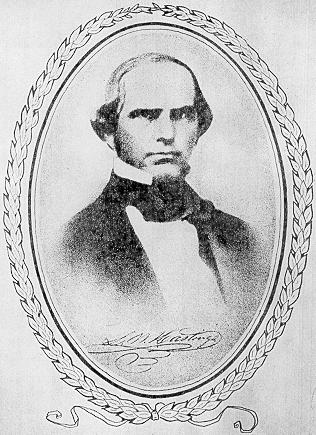
A Lawyer With a Plan for California
Oregon, Then Mexican California
In 1842, the Ohio-born lawyer Lansford W. Hastings joined an overland party bound for Oregon.3 By the following spring, he had reached Alta California, then a Mexican province.3
A Scheme for American Settlement
That experience shaped his plans for California in the years immediately following. Hastings hoped that an influx of American settlers could pressure Mexico to relinquish the province and enable the creation of an independent Republic of California, where he imagined holding high office.2 That project, not simple trail-guiding, is the context for everything Hastings wrote and did over the next two years. Promoting emigration to California was central to that plan.
The Guidebook, and What It Actually Said
Boosterism About California
In 1845 Hastings published The Emigrants’ Guide to Oregon and California, a promotional handbook aimed at Americans weighing the trip west. The book combines route advice with overt boosterism for California’s agricultural and commercial prospects, promising readers a country of such varied and inexhaustible resources.1
One Sentence, No Survey
The guide devoted a single sentence to the route that would outlive everything else Hastings wrote: “The most direct route, for the California emigrants, would be to leave the Oregon route, about two hundred miles east from Fort Hall; thence bearing west southwest, to the Salt lake; and thence continuing down to the bay of St. Francisco, by the route just described.”1 That brief passage is the guidebook’s most consequential published description of the route later called the Hastings Cutoff. Hastings went further still, assuring readers that “wagons can be as readily taken from Fort Hall to the bay of St. Francisco, as they can from the States to Fort Hall” — a confident claim about wagon travel that nothing in his own experience yet supported.1 When he wrote the guide, Hastings had not traveled the proposed cutoff himself, much less tested it with loaded wagons.2
This is the distinction the documents support: Hastings did not fabricate a route from nothing, and the book did not provide the mileage, detailed itinerary, water information, or wagon-road assessment that emigrant families would have needed to judge the route’s practical risks. He proposed a shorter path on the basis of limited direct knowledge.
Testing the Route, After Publishing It
The Clyman Expedition
In spring 1846, Hastings traveled east from California with a party of horsemen led by the mountaineer James Clyman, crossing the desert west of the Great Salt Lake.2 Clyman later described it as some of the most desolate country he had ever crossed.2
A Warning Ignored
Undiscouraged by what the crossing showed him, Hastings made up his mind to divert oncoming emigrants onto his untried cutoff.2 Clyman, for his part, advised James Reed of the Donner-Reed party to remain on the established Fort Hall route, believing the cutoff unsuitable for wagons.4 Reed did not take that advice. Neither, in the end, did most of the party he was traveling with.
Fort Bridger, Summer 1846
The Fork at Little Sandy
At Little Sandy in July 1846, the California-bound emigrants confronted a choice between the established Fort Hall route and the southward route toward Fort Bridger. A smaller group turned toward Fort Bridger, hoping to meet Hastings and take his cutoff.2
A Letter, Not a Guide
Hastings had already departed Fort Bridger with earlier emigrant groups, promoting the cutoff by claiming, in the words of one emigrant who spoke with him that summer, “a saving of 350 or 400 miles in going to California, and a better route.”5 The Donner-Reed Party followed their track roughly eleven days later.2 Hastings left a note at the forks warning against the Weber Canyon route and advising the party to wait until he could return and guide them through an alternate pass; the degree and adequacy of his subsequent guidance remain central questions in the surviving accounts.
The Donner-Reed party sent riders ahead to find him. On August 6, James Reed rode ahead and caught up with Hastings west of the Oquirrh Mountains; according to Utah’s Division of State History, Hastings took Reed only to the summit of Big Mountain and indicated a route through Emigration Canyon before continuing on.6 The Donner-Reed Party then had to follow route directions and tracks rather than travel under Hastings’s continuous leadership.
A Route Still Being Built
The Wasatch Mountains
The National Park Service describes emigrants on the Hastings Cutoff as having to clear and build trail themselves, cross mountains, and traverse an 80-mile desert with little water — and the Donner-Reed Party spent far longer than expected clearing a wagon road through the Wasatch Mountains and crossing the Great Salt Lake Desert, losing time, wagons, and livestock before they ever rejoined the main trail.7
The Great Salt Lake Desert
The NPS trail record preserves a useful check on how much time the cutoff actually cost: Heinrich Lienhard, who traveled the Hastings Cutoff itself, later observed that a party which had left Fort Bridger twelve or thirteen days after his own — traveling the established Fort Hall route — was nevertheless “just as far advanced” by the time both parties reached the Humboldt River, a sobering measure of the cutoff’s claimed advantage.7 Lienhard’s comparison describes his own party, not a precise calculation of the Donner-Reed Party’s delay specifically, but it captures the same pattern: Hastings had promoted the cutoff as a saving of 350 to 400 miles; later experience showed the route to be more than 100 miles longer than the original California Trail.2
One Decision Among Many
Other Parties, Same Cutoff
It is tempting, with the outcome known, to draw a straight line from Hastings’s guidebook to the deaths that followed in the Sierra Nevada that winter. The documented record does not support that straight a line. The first three 1846 groups to use the cutoff reached California safely; their earlier departure and different circumstances were crucial advantages the Donner-Reed Party did not have.2 The Donner-Reed party itself made choices beyond following Hastings: their relatively late departure from Illinois, subsequent delays on the established trail, party composition, animal losses, decisions made after they rejoined the main trail at the Humboldt River, and the heavy October snowstorms that blocked the Sierra route all contributed to what went wrong.8 Hastings’s advice was one link in a longer chain, not the whole of it.
Tamsen Donner’s Own Words
Tamsen Donner is one of the few party members whose contemporaneous words survive, including a June 1846 letter published in the Sangamo Journal describing camp life and travel before the party ever reached Fort Bridger.9 The surviving record of her voice, like the record of the party’s ordeal after the cutoff, is thinner than popular retellings imply. Her life, and the fuller story of the party’s passage and the winter that followed, is the subject of this series’ companion article.
Whose Land the Cutoff Crossed
The Newe and the Numa
The route Hastings promoted, like the rest of the California and Oregon trails, did not cross empty country. West of the Great Salt Lake, emigrants moved through the homeland of the Newe, or Western Shoshone — the name the Te-Moak Tribe of Western Shoshone Indians of Nevada, based in northeastern Nevada, uses for its own people today — and the homeland of the Numu, or Northern Paiute, “the People,” as the Pyramid Lake Paiute Tribe renders the name.10,11 Both nations’ traditional territories extended well beyond their present-day reservation boundaries, which, like the trail itself, were drawn later and do not by themselves define the full historical geography of Shoshone and Paiute homelands.
Washoe Country and Lasting Disruption
Farther west, the route crossed Washoe homelands in and around the Lake Tahoe Basin and the adjacent Sierra Nevada. The Washoe Tribe identifies this landscape as a spiritual and cultural center and describes its traditional territory as stretching from Honey Lake to Mono Lake, occupied for an estimated nine thousand years before 1846. The Tribe notes that this homeland lay directly in the path of California-bound emigrants and, later, gold seekers.12 Growing overland migration, and after 1848 the far larger gold rush influx, brought profound and lasting disruption to Indigenous lands, resources, and political autonomy across this entire corridor — a history that belongs alongside the emigrant narrative, not apart from it.
Responsibility, Weighed Through the Documents
In 1845, Hastings proposed a shortcut he had not traveled himself. In 1846, after a difficult horseback crossing and despite Clyman’s warning, he encouraged wagon parties to use a route whose mountain and desert sections still required extensive trail-building and carried major water and time risks.2
That does not make Hastings the sole cause of the Donner-Reed Party’s tragedy. Their late-season timing, route delays, livestock losses, decisions made after the cutoff, and the Sierra snowstorms all mattered. Hastings’s promotional claims and incomplete guidance were part of the chain of circumstances that left the party dangerously late.
After the Cutoff
Hastings’s California political hopes collapsed when U.S. military intervention brought the province into the United States rather than into the independent republic he had imagined.2 The cutoff outlived his ambitions, however. After later improvements, it became part of routes used by Mormon emigrants, gold seekers, and the Pony Express — evidence that the question in 1846 was never whether a route could exist, but whether it was ready for that year’s wagon families.2
Legacy and Civic Relevance
Hastings’s name endures on Western maps largely because of the party that suffered most from following it. His story is a useful case study in how promotional claims, personal ambition, and incomplete knowledge can combine to put real people at risk — and in how later generations, working from documents rather than legend, can separate what a historical figure actually did from what popular memory has assigned to him.
Continue exploring this series with our companion article on Tamsen Donner and the Donner Party.
Endnotes
- Lansford W. Hastings, The Emigrants’ Guide to Oregon and California (Cincinnati: George Conclin, 1845); digitized by the Newberry Library, Internet Archive: https://archive.org/details/GR_1815
- National Park Service — “Hastings Cutoff,” California National Historic Trail: https://www.nps.gov/places/hastings-cutoff.htm
- Brigham Young University, L. Tom Perry Special Collections — “Lansford Warren Hastings, 1819–1870”: https://net.lib.byu.edu/imaging/into/lvnauvoo/12hastd.html
- James Clyman diary, spring 1846, in Charles L. Camp, ed., James Clyman, American Frontiersman, 1792–1881 (Portland: Champoeg Press, 1960).
- James F. Reed, letter dated July 31, 1846, Fort Bridger, transcribed in Donner Party Diary: http://www.donnerpartydiary.com/jul46.html
- Utah Division of State History — “Hastings Cutoff”: https://historytogo.utah.gov/post/hastings-cutoff/
- National Park Service — “Emigrant Trail Park,” California National Historic Trail: https://www.nps.gov/places/emigrant-trail-park.htm
- National Park Service, California National Historic Trail — “Donner and Reed Wagon Train Incident”: https://www.nps.gov/cali/learn/historyculture/donner-reed-party.htm
- Tamsen Dozier (Eustis) Donner, letter published as “Mrs. George Donner,” Sangamo Journal (Springfield, Ill.), July 23, 1846; typescript in Tamsen Dozier (Eustis) Donner Papers, RG0960.AM, History Nebraska: https://history.nebraska.gov/collection_section/tamsen-dozier-eustis-donner-1801-1847-rg0960-am/
- Te-Moak Tribe of Western Shoshone Indians of Nevada, official tribal website: https://temoaktribe.org/
- Pyramid Lake Paiute Tribe, official tribal website — “The People”: https://pyramidlake.us/the_people
- Washoe Tribe of Nevada and California — “About the Washoe Tribe”: https://www.washeshu.org/site/about/about-the-washoe-tribe; U.S. Forest Service, Wa She Shu: The Washoe People, Past and Present: https://www.fs.usda.gov/media/141982