

Sojourner Truth: The Voice That Refused Silence
From Enslavement to Citizenship: How a woman born into slavery became one of the most influential and powerful voices for abolition, women’s rights, and human rights in 19th-century America.
Long before the Civil Rights Movement transformed the twentieth century, a once enslaved woman stood before crowds and demanded that the nation live up to its promises. She could not read or write. She spoke English with a Dutch accent throughout her life. Born into slavery, she had been sold away from her family, beaten, exploited, and denied the most basic rights of citizenship. Yet by the time of her death in 1883, Sojourner Truth had become one of the most recognizable reformers in the United States.
As Civics for Life continues to explore the Americans who broadened the meaning of liberty and citizenship, Sojourner Truth offers one of the most remarkable stories in the nation’s history. Her life reminds us that democracy’s promises have often been advanced not only by elected officials or lawmakers, but by ordinary people courageous enough to demand justice.
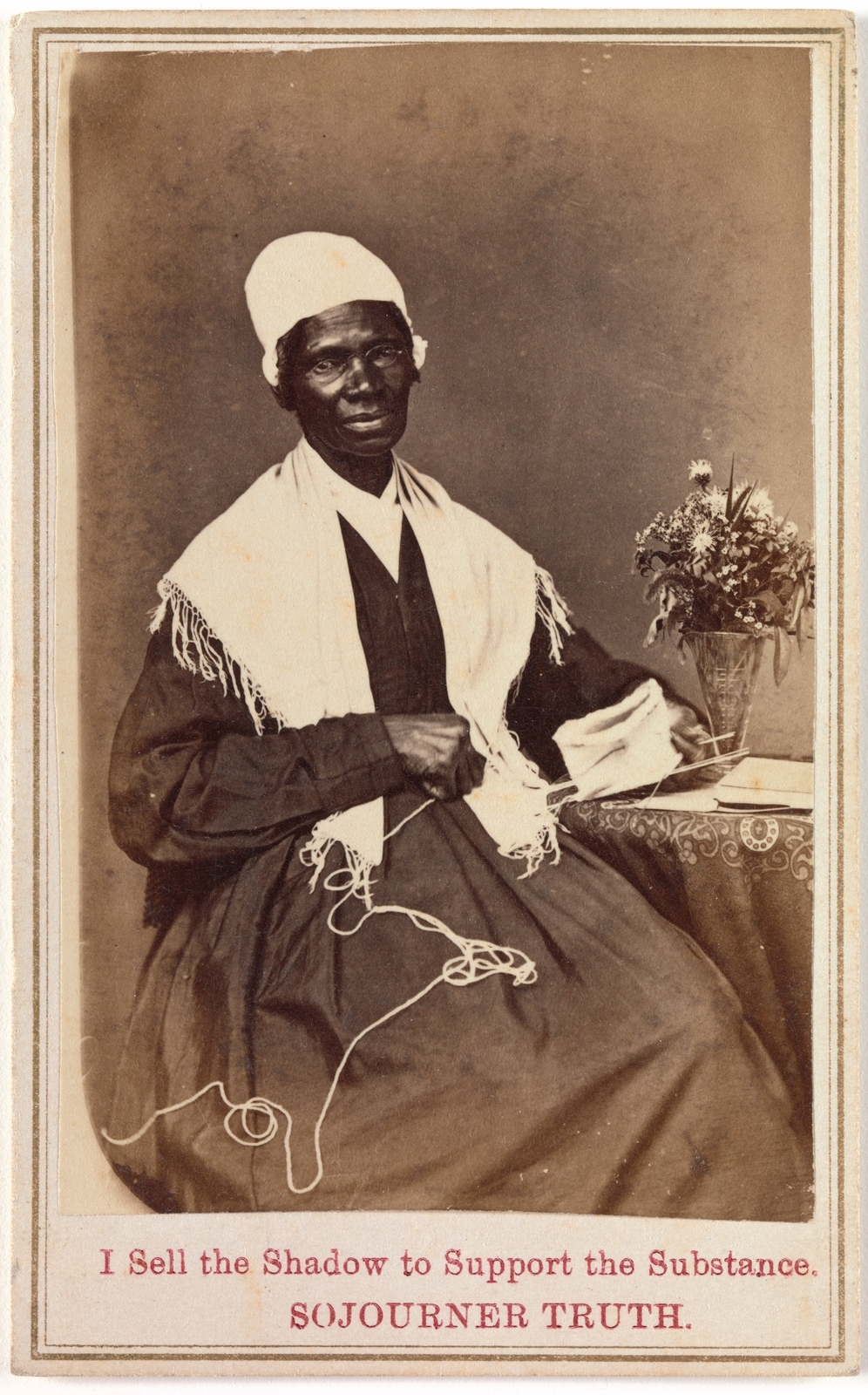
Born Enslaved in New York
Sojourner Truth was born Isabella Baumfree around 1797 in Ulster County, New York. Although many Americans associate slavery primarily with the South, slavery was legal in New York at the time of her birth. Her parents, James and Elizabeth Baumfree, were enslaved by Dutch-speaking families, and Dutch was Isabella’s first language.¹
Her childhood was marked by repeated separation and violence. At about age nine, Isabella was sold away from her parents for $100 along with a flock of sheep. Over the following years, she was sold multiple times to different enslavers and endured severe physical abuse. One enslaver beat her because she could not understand English commands.¹ ²
Her personal life brought additional hardship. A young man she loved, Robert, was violently attacked by his enslaver for maintaining a relationship with her. Later, Isabella was forced into a union with Thomas, an enslaved man held by the same enslaver, and became the mother of five children.¹ ²
Despite these hardships, Isabella developed a deep religious faith that would shape every stage of her life.
“I Did Not Run Away, I Walked Away”
New York gradually moved toward ending slavery in the early nineteenth century, with final emancipation scheduled for July 4, 1827. Isabella’s enslaver, John Dumont, promised to free her before that date but later refused. Rather than accept continued bondage, she self-emancipated in 1826, leaving with her infant daughter Sophia.¹ ²
Reflecting on her decision later, she explained:
“I did not run away, I walked away by daylight.”¹
Her freedom did not end her struggle. Dumont illegally sold her young son, Peter, to Alabama despite New York law. Determined to bring him home, Isabella went to court and successfully secured his return.¹ ²
What happened next was extraordinary.
In 1828, she became one of the first Black women in American history and is widely recognized as the first Black woman to successfully challenge a white man in a United States court and prevail, an astonishing accomplishment for a woman born into enslavement and denied a formal education.²
Becoming Sojourner Truth
After gaining her freedom, Isabella settled in New York City and devoted herself increasingly to religion and preaching. In 1843, she experienced what she believed was a divine calling to travel and bear witness to God’s truth.³ ⁴
She changed her name accordingly.
“Sojourner” reflected her mission to travel from place to place. “Truth” reflected the message she intended to proclaim.³ ⁴
As Sojourner Truth, she became an itinerant preacher and public speaker. Her religious convictions drew her into the abolition movement, where she encountered prominent reformers including Frederick Douglass, William Lloyd Garrison, Wendell Phillips, and David Ruggles.⁴
In 1850, she dictated her autobiography, The Narrative of Sojourner Truth, to Olive Gilbert. The book broadened her audience and helped support her speaking tours.⁴
The Speech That Echoed Through History
Truth’s most famous public appearance came in 1851 at the Ohio Women’s Rights Convention in Akron. At a time when women were widely excluded from civic life and Black Americans were denied basic rights, Truth challenged prevailing assumptions about both race and gender.⁵
The speech became known as “Ain’t I a Woman?” and remains one of the most influential speeches in American history.
Modern historians note that the famous phrase may not have appeared exactly as it is remembered today. The speech was not transcribed verbatim when delivered, and later versions altered portions of her remarks, including the addition of dialect that likely did not reflect the way Truth actually spoke.⁵
Still, the power of the message remains unmistakable. Truth confronted the contradiction of a society that claimed to value womanhood while denying dignity, protection, and rights to all women.
Her argument was remarkably modern. Long before scholars developed language to describe intersecting forms of discrimination, Truth spoke from lived experience about the overlapping injustices of racism and sexism.³ ⁵
Civil War Activist and Advocate for Freedom
When the Civil War began, Truth expanded her activism. She encouraged Black men to join the Union Army and helped provide food and clothing for those who enlisted.³
She also worked in Washington, D.C., assisting formerly enslaved people who had escaped Confederate territory and sought refuge behind Union lines.³
Her work brought her into contact with President Abraham Lincoln, whom she met at the White House in 1864.²
Yet Truth understood that emancipation alone did not guarantee full freedom. Following the war, she advocated for land and resettlement opportunities for formerly enslaved people, believing economic independence was essential to true citizenship.³
Her efforts reflected a broader vision—one in which freedom included not merely legal rights, but meaningful opportunity.
Fighting for Equal Rights After Emancipation
After the Civil War, Truth continued advocating for both racial justice and women’s rights.
She spoke publicly in favor of women’s suffrage and challenged discrimination wherever she encountered it. In Washington, D.C., she protested unequal treatment on public streetcars and worked to expand access for Black riders.³
Unlike some reformers of the period, Truth refused to separate racial equality from women’s equality. She insisted that Black women deserved both.³
Truth never abandoned her broader vision. For her, freedom was indivisible.
A Pioneer of Personal Branding
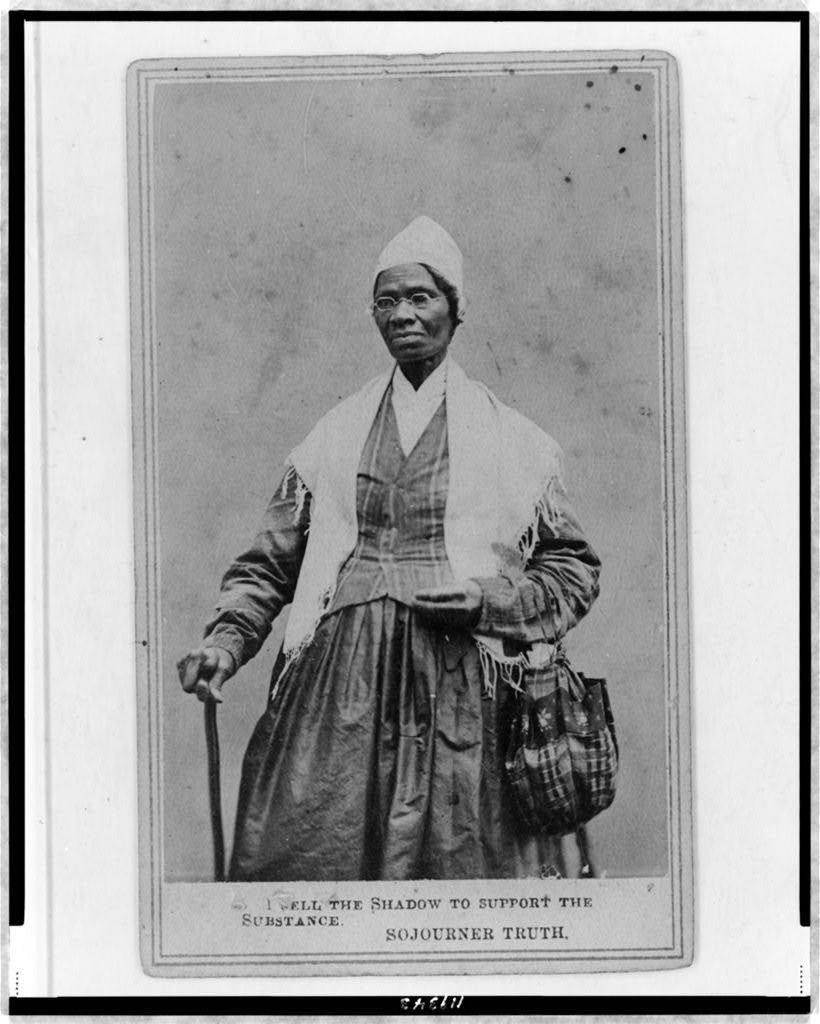
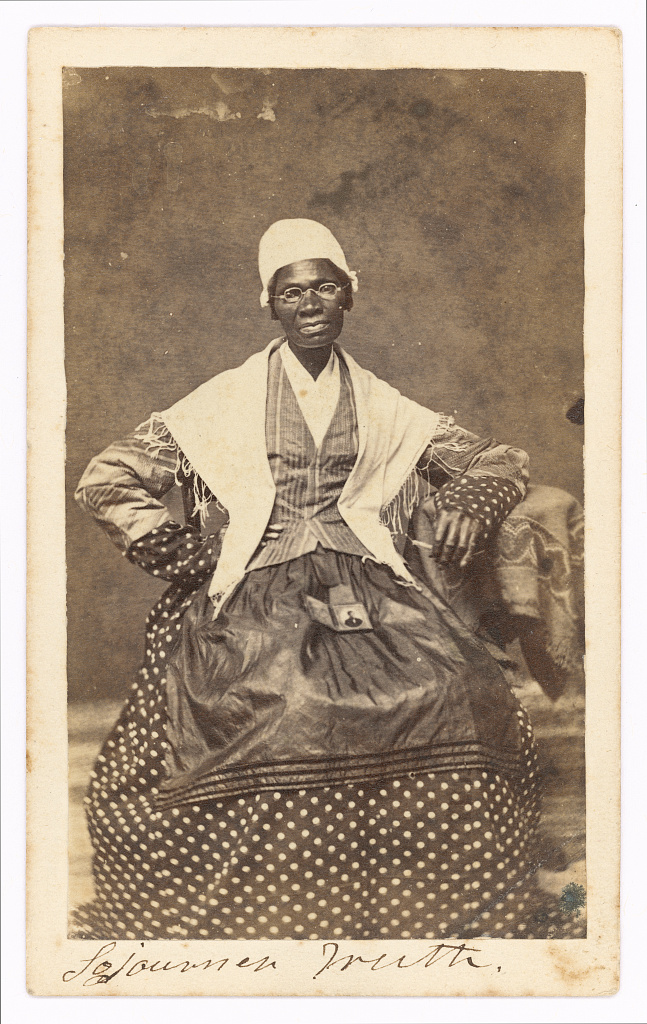
One of the most strikingly modern aspects of Truth’s career was her understanding of public image.
To fund her work, she sold photographs of herself at lectures and public appearances. These cartes de visite carried the phrase:
“I sell the shadow to support the substance.”⁶ ⁷
The statement was both practical and profound. Truth understood that photography could help sustain her advocacy. By retaining rights to her image and controlling its distribution, she became an early example of an American reformer using visual media strategically to advance a public cause.⁶
After settling in Battle Creek, Michigan, in 1857, a major Underground Railroad hub, she helped Black fugitives escape to freedom, working alongside Black and white allies, including Quakers and other abolitionists who operated safe houses and transport routes.
Legacy and Civic Relevance
When Sojourner Truth died in Battle Creek, Michigan, on November 26, 1883, she left behind far more than memorable speeches.¹
She embodied a central truth of American history: progress often emerges because ordinary citizens demand that the nation fulfill its founding ideals.
Truth was born into a society that denied her freedom. She could not vote, hold office, or legally claim ownership of her own labor during her years of enslavement. Yet she spent her life expanding the meaning of citizenship and human rights for future generations.
Her story also reminds us that civic participation takes many forms. She served no elected office and held no formal political power. Instead, she spoke, organized, challenged unjust laws, petitioned government officials, pursued legal action, and persuaded ordinary Americans to reconsider their assumptions.
That is civic engagement in its purest form.
Today, Sojourner Truth remains a powerful example of courage, resilience, and democratic participation. Her insistence that equality could not be divided by race, gender, or social status continues to shape conversations about citizenship and civil rights more than 170 years after she first stood before an audience and demanded justice.
Continue exploring this transition from Founders to Pioneers in our Founding Generation series, or read more on the explorers, settlers, and statesmen of the westward expansion in our History Lessons.
Footnotes
- Library of Congress, [Sojourner Truth, three-quarter-length portrait standing with cane] (1864).
- National Park Service, Sojourner Truth.
- History.com, Sojourner Truth.
- PBS, This Far By Faith: Sojourner Truth.
- Sojourner Truth Memorial Committee, Her History.
- History.com, Sojourner Truth Delivers Powerful Speech on African American Women’s Rights.
- Metropolitan Museum of Art, Sojourner Truth, “I Sell the Shadow to Support the Substance” (1864).
- Library of Congress, Sojourner Truth (c. 1864).