

The Fourteenth Amendment: History, Meaning, and Lasting Civic Impact
A History of One of America’s Most Consequential Constitutional Changes
Ratified July 9, 1868
The Fourteenth Amendment to the United States Constitution stands as one of the most transformative legal instruments in American history. Ratified on July 9, 1868, in the turbulent years following the Civil War, it fundamentally redefined the relationship between the federal government, the states, and the American people. Born out of the urgent need to secure the freedom and equality of formerly enslaved Americans, its reach has expanded far beyond that original purpose, shaping the landscape of civil rights, individual liberties, and constitutional law for more than a century and a half.1
I. Historical Background: A Nation Transformed by War
The Civil War ended in April 1865 with the surrender of Confederate forces, but the work of reconstructing the Union—and determining the status of four million formerly enslaved people—had barely begun. The Thirteenth Amendment, ratified that December, abolished slavery. Yet abolition alone did not guarantee equality or citizenship. In state after state across the South, newly elected legislatures, many dominated by former Confederate leaders, enacted “Black Codes”: repressive statutes that sharply restricted the movement, employment, and legal standing of Black Americans, effectively reinstating conditions of servitude under a different name.6
The constitutional backdrop was equally troubling. The Supreme Court’s 1857 ruling in Dred Scott v. Sandford had declared that Black Americans, whether free or enslaved, could not be citizens of the United States and held no rights that the federal government was bound to respect. Until that ruling was explicitly overturned, even the Thirteenth Amendment’s promise of liberty rested on a shaky legal foundation.
Congress responded first with the Civil Rights Act of 1866, which declared all persons born in the United States to be citizens entitled to equal protection of the law. President Andrew Johnson, a Democrat and former slaveholder from Tennessee who favored lenient terms of readmission for the former Confederate states, vetoed the bill. Congress overrode that veto, the first time in American history that a presidential veto of major legislation had been overridden, and enacted the law.5 Even so, many legislators recognized that a statute could be repealed by a future Congress; only a constitutional amendment could provide a durable guarantee.
II. Drafting and Ratification
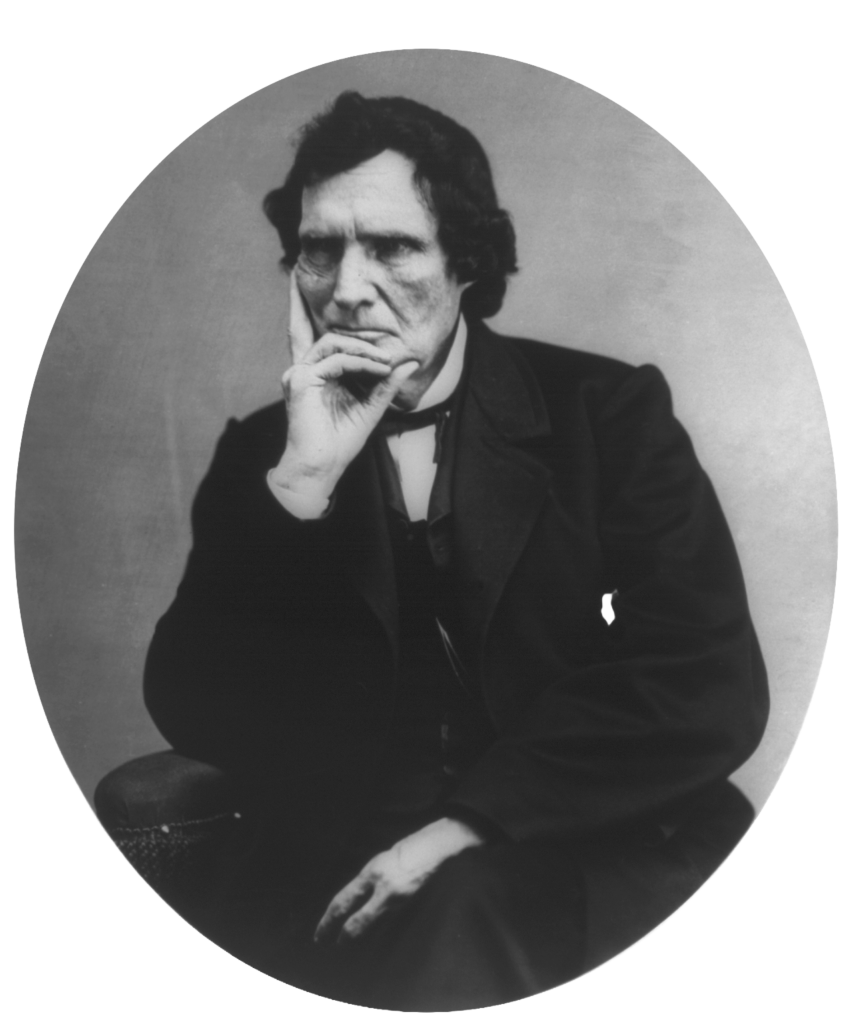
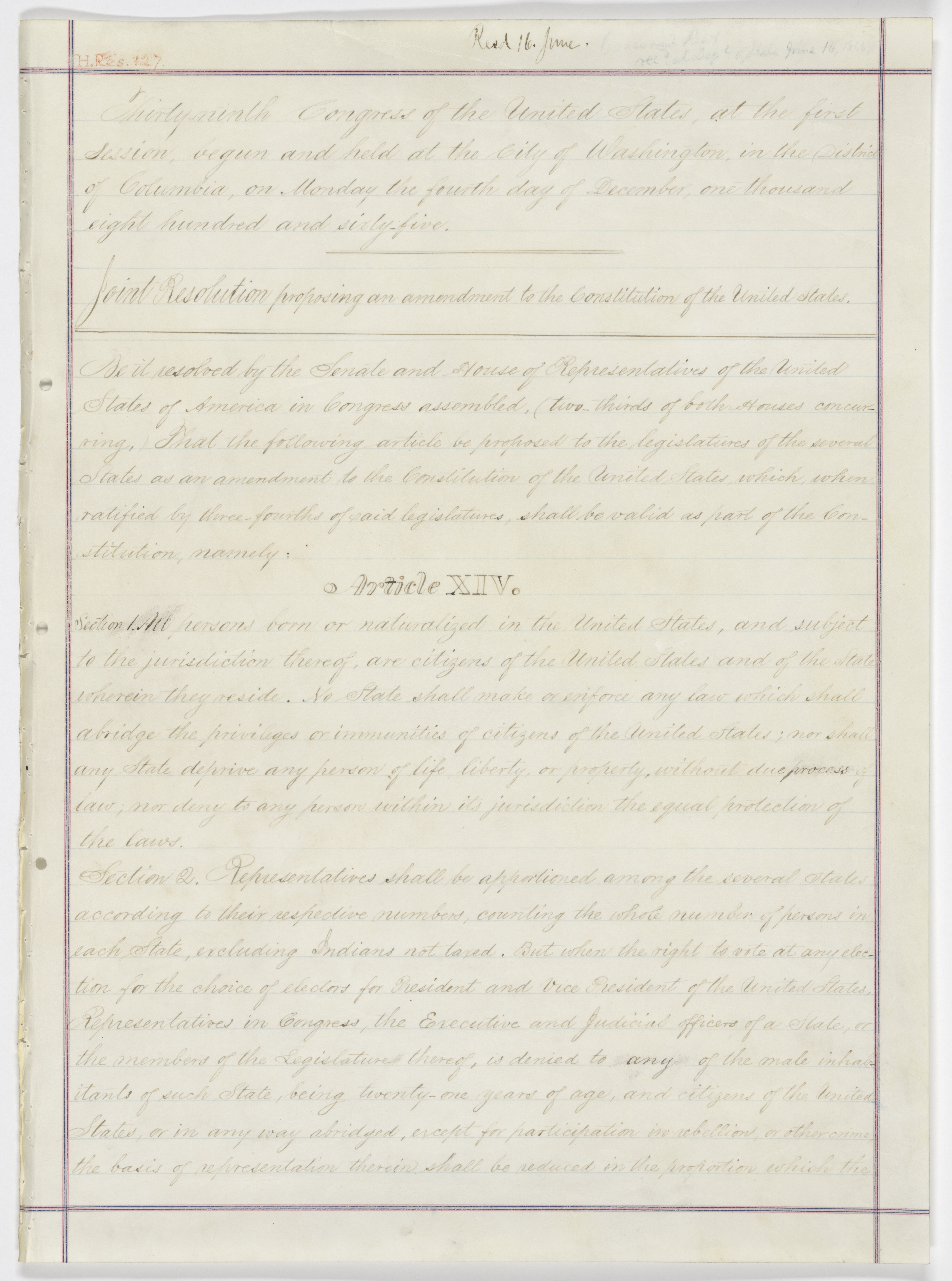
In late April 1866, Representative Thaddeus Stevens of Pennsylvania introduced the joint resolution that would become the Fourteenth Amendment, consolidating several separate proposals, civil rights guarantees, apportionment rules, disqualification of former Confederate officeholders, and repudiation of Confederate war debt into a single constitutional text.3
The primary drafter of Section 1 was Representative John A. Bingham of Ohio, who intended the amendment not only to enshrine citizenship and equal protection but also to nationalize the Bill of Rights, making its guarantees binding on the states as well as the federal government. Senator Jacob Howard of Michigan, who introduced the amendment on the Senate floor, made this intent explicit, stating that the Privileges or Immunities Clause would extend to the states “the personal rights guaranteed and secured by the first eight amendments.”7
The Senate passed the amendment on June 8, 1866, and it was sent to the states for ratification.8 President Johnson made his opposition clear, but congressional elections in late 1866 gave Republicans veto-proof supermajorities in both chambers. Southern states initially resisted, but Congress made ratification of the Thirteenth and Fourteenth Amendments a condition of regaining representation in Congress, and the continued presence of Union troops in the former Confederate states ensured compliance. On July 9, 1868, Louisiana and South Carolina became the pivotal 28th and 29th states to ratify, completing the required three-fourths majority and officially enshrining the amendment in the Constitution.9
III. The Text and Its Provisions
The Fourteenth Amendment contains five sections, each addressing a distinct dimension of the post-war constitutional order.
Section 1: Citizenship, Due Process, and Equal Protection
All persons born or naturalized in the United States, and subject to the jurisdiction thereof, are citizens of the United States and of the State wherein they reside. No State shall make or enforce any law which shall abridge the privileges or immunities of citizens of the United States; nor shall any State deprive any person of life, liberty, or property, without due process of law; nor deny to any person within its jurisdiction the equal protection of the laws.10
Section 1 is the heart of the amendment and the source of most of its constitutional significance. Its opening sentence overturned Dred Scott outright, establishing birthright citizenship — the principle that anyone born on American soil is automatically a citizen. The three subsequent clauses — the Privileges or Immunities Clause, the Due Process Clause, and the Equal Protection Clause — have collectively served as the constitutional engine for nearly every major civil rights development in American law.4
Section 2: Apportionment and Representation
Section 2 repealed the original Constitution’s three-fifths clause, which had counted enslaved people as three-fifths of a person for the purpose of apportioning congressional seats. With slavery abolished, all residents would now be counted as whole persons. The section also provided a penalty mechanism: states that denied the vote to adult male citizens would have their congressional representation reduced proportionally. Although this enforcement mechanism proved weak in practice, Southern states denied Black men the vote throughout the Jim Crow era with little penalty, and it reflected Congress’s intent to tie political power to equal suffrage.11
Section 3: Disqualification for Insurrection
Section 3 barred anyone who had previously sworn an oath to support the Constitution from holding any civil or military office if they had subsequently “engaged in insurrection or rebellion” against the United States or given aid or comfort to its enemies. The provision was aimed squarely at preventing former Confederate leaders from returning to power. Congress retained the authority to remove this disability by a two-thirds vote of each chamber.12
Sections 4 and 5: Federal Debt and Congressional Enforcement
Section 4 guaranteed the validity of the federal war debt while voiding all debts incurred by the Confederacy and prohibiting any compensation to former enslavers for the loss of their enslaved “property.” Section 5, the enforcement clause, granted Congress the power to enact legislation to carry the amendment into effect, a provision that would prove enormously consequential nearly a century later, directly enabling passage of the Civil Rights Act of 1964 and the Voting Rights Act of 1965.13
IV. Early Interpretation: Promise and Retreat
The amendment’s early history was marked by high hopes and swift disappointment. For many years, the Supreme Court read its provisions narrowly, limiting their reach in ways that frustrated the amendment’s egalitarian purpose.16
The first major blow came in the Slaughter-House Cases (1873), in which the Court interpreted the Privileges or Immunities Clause so narrowly as to render it nearly meaningless, limiting its protections to a small set of rights tied to national citizenship while leaving most civil rights to the states.14
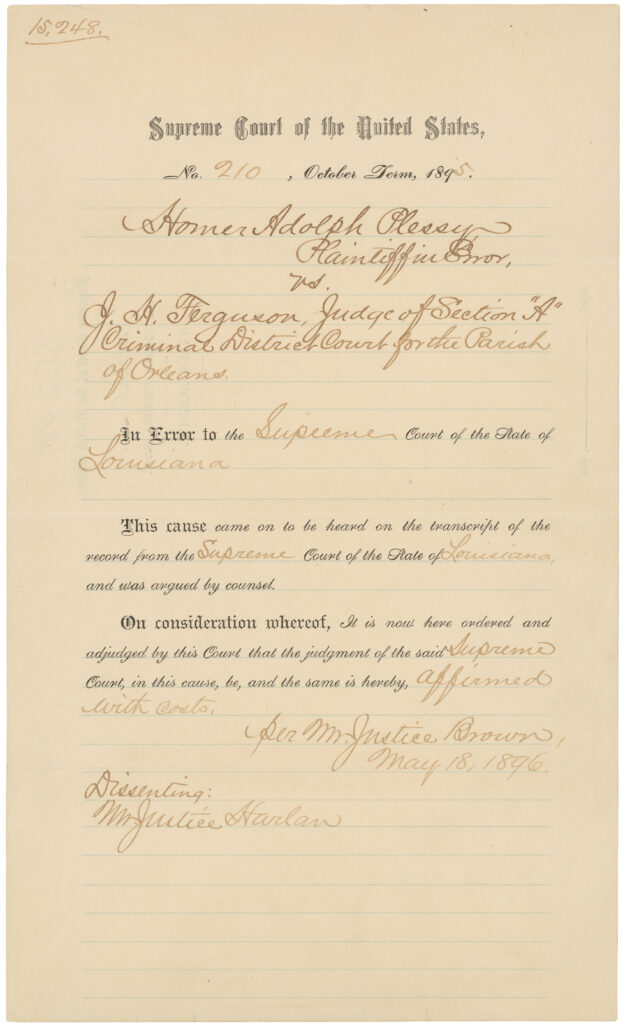
Then, in Plessy v. Ferguson (1896), the Court upheld racial segregation in public transportation under the doctrine of “separate but equal,” ruling that enforced separation did not violate the Equal Protection Clause so long as the separate facilities were nominally equal.15 The decision gave constitutional cover to Jim Crow laws throughout the South and set the stage for decades of legalized racial discrimination.
Despite these setbacks, advocates for civil rights continued to petition, litigate, and legislate. Their arguments in courtrooms and legislatures, even when unsuccessful in the short term, articulated the principles of equality that would eventually reshape constitutional doctrine.
V. The Expansion of the Amendment’s Reach
Incorporation of the Bill of Rights
One of the most far-reaching developments in 14th Amendment jurisprudence was the gradual “incorporation” of the Bill of Rights against the states. Originally, the protections enumerated in the first ten amendments restricted only the federal government. Beginning with Gitlow v. New York (1925), in which the Court held that the First Amendment’s free speech protections applied to state action through the Due Process Clause, the Court began systematically extending constitutional protections to cover state and local governments.17
Over subsequent decades, the Court incorporated the vast majority of the Bill of Rights through the same mechanism, including the freedoms of speech, press, and religion; the right to counsel; the protection against unreasonable searches and seizures; and the right to jury trial in criminal cases.
The Civil Rights Era
Arguably, the most celebrated application of the Fourteenth Amendment came in 1954, when a unanimous Supreme Court ruled in Brown v. Board of Education that racially segregated public schools were inherently unequal and therefore unconstitutional under the Equal Protection Clause, directly overruling Plessy v. Ferguson and setting in motion the desegregation of American public life.18 The amendment’s enforcement clause then provided the constitutional basis for landmark civil rights statutes: the Civil Rights Act of 1964, which prohibited discrimination based on race, color, religion, sex, or national origin; and the Voting Rights Act of 1965, which targeted the systematic disenfranchisement of Black voters across the South.19
Modern Civil Rights and Liberties
The Fourteenth Amendment’s reach continued to expand through the latter half of the 20th century and into the 21st. The Court invoked the Due Process and Equal Protection Clauses in a wide range of landmark decisions: Griswold v. Connecticut (1965, right to contraceptive privacy), Loving v. Virginia (1967, invalidating bans on interracial marriage), Roe v. Wade (1973, abortion rights), Bush v. Gore (2000, presidential election disputes), McDonald v. Chicago (2010, incorporating the Second Amendment right to keep and bear arms), and Obergefell v. Hodges (2015, establishing a constitutional right to same-sex marriage).20
VI. Ongoing Debates and Contemporary Relevance
More than 155 years after its ratification, the Fourteenth Amendment remains a living source of constitutional controversy. Debates persist about the scope of birthright citizenship — specifically, whether children born in the United States to parents without legal immigration status are constitutionally entitled to citizenship — as well as about the meaning of equal protection in contexts ranging from affirmative action in university admissions to voting rights legislation.
These disputes reflect the amendment’s enduring centrality to American constitutional life. Its text has remained virtually unchanged since 1868; what has changed, and continues to change, is the ongoing national conversation about what equality, citizenship, and due process require in each successive generation.
Legacy and Civic Relevance
The Fourteenth Amendment began as a targeted response to a specific historical crisis: the need to secure the freedom and legal equality of millions of formerly enslaved Americans in the aftermath of the Civil War. Its framers could not have foreseen the full scope of what they were creating. Over a century and a half, through the work of lawyers, activists, legislators, and judges, the amendment has grown into the constitutional foundation of American civil rights, a guarantee of citizenship, equal protection, and due process that has been invoked on behalf of nearly every marginalized group in the country’s history.
For students of civics, the Fourteenth Amendment offers a vivid case study in how a single constitutional text can be read narrowly or expansively depending on the era, the composition of the Court, and the broader currents of political will. It illustrates that constitutional rights are rarely self-executing: from the Black Codes that prompted its drafting, to the decades-long struggle against “separate but equal,” to ongoing 21st-century debates over birthright citizenship and disqualification for insurrection, the amendment’s meaning has been forged through sustained civic engagement — litigation, legislation, and public advocacy — rather than through its text alone.
Understanding this history equips citizens to engage thoughtfully with present-day constitutional debates, recognizing that the principles of equal protection and due process remain active, contested, and consequential. The amendment’s story is, in many ways, the story of America’s long and unfinished reckoning with the promises of its founding, a reminder that constitutional government depends not only on the words written into our founding documents, but on each generation’s commitment to living up to them.
Read more on the explorers, settlers, and statesmen of the westward expansion in our History Lessons.
Sources
3. HISTORY.com Editors. “14th Amendment.” HISTORY. A&E Television Networks, last updated May 27, 2025.
4. National Archives. “14th Amendment to the U.S. Constitution: Civil Rights (1868).”
6. Institute for Justice. “The Slaughterhouse Cases (1873).” Discusses the historical record of Reconstruction-era debate, including the imposition of the Black Codes by state and local governments, that informed the drafting of the Privileges or Immunities Clause.
7. National Archives. “14th Amendment.” Congressman John A. Bingham of Ohio is identified as the primary author of Section 1. Senator Jacob Howard of Michigan introduced the amendment in the Senate with an explicit discussion of how the Privileges or Immunities Clause would extend the Bill of Rights to the states.
8. U.S. Senate Historical Office. “Landmark Legislation: The Fourteenth Amendment.” The Senate passed the amendment on June 8, 1866.
9. HISTORY.com Editors. “14th Amendment.” HISTORY. Louisiana and South Carolina were the pivotal 28th and 29th states to ratify, completing the required three-fourths majority on July 9, 1868.
10. U.S. Congress. “Amendment XIV.” Constitution Annotated. The text of Section 1 is drawn directly from the ratified constitutional language.
11. U.S. Congress. “Amendment XIV, Section 2.” Constitution Annotated. Section 2 repealed the three-fifths apportionment formula of Article I and established a representation-reduction penalty for states denying suffrage to adult male citizens.
12. U.S. Congress. “Amendment XIV, Section 3.” Constitution Annotated. Section 3 bars from office those who, having previously taken an oath to support the Constitution, subsequently engaged in insurrection or rebellion.
13. U.S. Senate Historical Office. “Landmark Legislation: The Fourteenth Amendment.” Section 5’s enforcement clause directly enabled landmark 20th-century legislation, including the Civil Rights Act of 1964 and the Voting Rights Act of 1965.
14. Library of Congress, Constitution Annotated. “Privileges or Immunities of Citizens and the Slaughter-House Cases.” The Slaughter-House Cases (1873) interpreted the Privileges or Immunities Clause narrowly, holding that it protected only a limited set of rights tied to national citizenship rather than the broader civil rights envisioned by the amendment’s framers.
15. National Archives. “Brown v. Board of Education (1954).” Plessy v. Ferguson (1896) upheld racial segregation under the doctrine of “separate but equal,” a standard the Supreme Court applied for nearly six decades.
16. National Archives. “14th Amendment.” Notes that while early advocates of total incorporation did not succeed during Reconstruction, their arguments and dissents laid the groundwork for 20th-century change.
17. Vile, John R. “Slaughterhouse Cases (1873).” The First Amendment Encyclopedia. Incorporation of First Amendment protections against the states began with Gitlow v. New York in 1925.
18. National Archives. “Brown v. Board of Education (1954).” On May 17, 1954, the Supreme Court unanimously ruled that state-sanctioned segregation of public schools violated the Equal Protection Clause, overruling Plessy v. Ferguson.
19. U.S. Senate Historical Office. “Landmark Legislation: The Fourteenth Amendment.” The amendment’s enforcement clause provided the constitutional basis for the Civil Rights Act of 1964 and the Voting Rights Act of 1965.
20. HISTORY.com Editors. “14th Amendment.” HISTORY. Landmark rulings citing the 14th Amendment include Griswold v. Connecticut (1965), Loving v. Virginia (1967), Roe v. Wade (1973), Bush v. Gore (2000), McDonald v. Chicago (2010), and Obergefell v. Hodges (2015).
21. Supreme Court of the United States. Trump v. Anderson, 601 U.S. 100 (2024), per curiam opinion issued March 4, 2024. The Court unanimously held that individual states lack the power to enforce Section 3 of the Fourteenth Amendment against federal officeholders and candidates, ruling that enforcement authority belongs to Congress under Section 5.