

The Mexican-American War Begins: A Contested Escalation
Congress declared war less than three weeks after the first clash. Whether the fighting began on American soil or Mexican soil was a dispute Americans were still arguing about in Congress more than a year and a half later.
Annexation transferred a boundary claim from the Republic of Texas to the United States without resolving it. After 1836, the Republic of Texas asserted the Rio Grande as its southern and western boundary through its own constitutional and governmental claims; Mexico rejected that claim, recognized neither Texas independence nor that boundary, and maintained that the Nueces River to the northeast marked Texas’s actual line.1
The land between the two rivers was disputed, and that dispute — combined with expansionist policy in Washington, political turmoil in Mexico, and decisions by both governments — formed the setting in which war began.
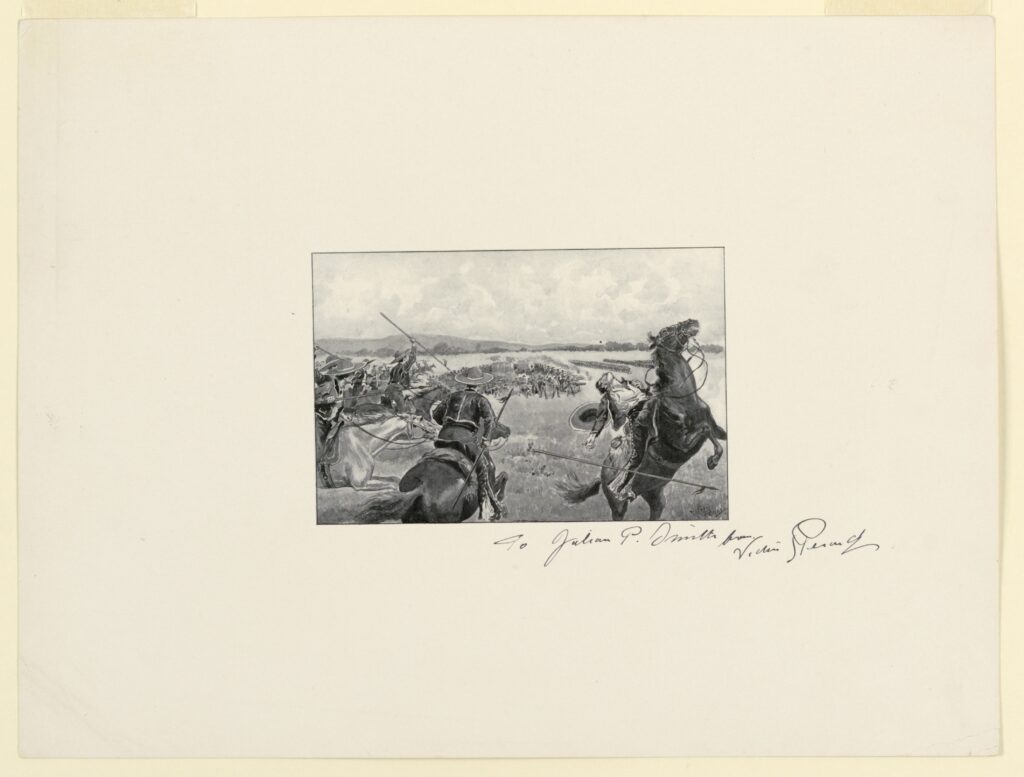
Source: Victor Semon Pérard, “Scene from the Mexican War,” ink on paper, c. 1905. Cooper Hewitt, Smithsonian Design Museum, CC0 / public domain.
Into the Disputed Strip
Corpus Christi to the Rio Grande
In July 1845, shortly after Texas accepted the U.S. annexation offer, President James K. Polk ordered General Zachary Taylor’s army to Corpus Christi, on the Nueces River — the river Mexico regarded as the province of Texas’s traditional southern boundary.2, 1 On January 13, 1846, Polk ordered Taylor to move his more-than-3,500-man army toward the Rio Grande. Taylor’s force began its advance on March 8, reached Point Isabel later that month, and was near the mouth of the Rio Grande, opposite Matamoros, by March 28.1
Mexican officials treated the advance into land they identified as part of the department of Tamaulipas as an invasion; U.S. officials treated it as a defensive move within territory the United States now claimed as part of Texas. In an April 12, 1846 dispatch to Taylor, General Pedro de Ampudia warned that if U.S. forces remained on “the soil of the department of Tamaulipas,” then “arms, and arms alone, must decide the question.”1, 5
Two Rivers, Two Claims
The dispute was not a technicality. Texas asserted the Rio Grande through its 1836 constitutional and governmental claims, but Mexico did not recognize either Texas independence or that boundary, and continued to treat the Nueces as marking the edge of its own territory. Weeks before the Thornton Affair, on March 18, 1846, Mexican General Francisco Mejía issued a proclamation to the inhabitants of Matamoros and the troops under his command, framing Taylor’s approaching army as an invading force on Mexican soil and calling for resistance to it, a Mexican government position stated in writing before a single shot had been fired.4
From Mexico City’s perspective, the land between the Nueces and the Rio Grande remained Mexican soil regardless of what Texas — or the United States, after annexation — claimed on paper.
The Thornton Affair, April 25, 1846
On April 25, 1846, Captain Seth Thornton led a patrol of U.S. dragoons on a reconnaissance mission north of the Rio Grande. A Mexican cavalry force under General Anastasio Torrejón engaged the patrol at Rancho de Carricitos.3 The patrol suffered American dead and wounded, and about forty-seven were captured, including Thornton himself.3 Both governments interpreted the same clash through incompatible territorial claims: U.S. officials said Mexican forces had attacked soldiers on American soil; Mexican officials said the patrol had been operating in Mexican territory.1
Polk’s Message and “American Blood Upon the American Soil”
On May 11, 1846, Polk sent a special message to Congress asking for a declaration of war. Its central claim was direct: “But now, after reiterated menaces, Mexico has passed the boundary of the United States, has invaded our territory and shed American blood upon the American soil.”6 That sentence is best understood as exactly what it was, a president’s argument for war, built on the premise that the Rio Grande was the legitimate boundary and that Taylor’s army had therefore never left American soil. It was not an uncontested statement of geographic fact, and contemporaries, including members of Polk’s own Congress, said so at the time and afterward.
Congress Declares Mexican-American War
Speed Over Deliberation
Congress acted with extraordinary speed, while members raised constitutional, territorial, and sectional concerns.1 The measure combined a formal recognition that a state of war already existed with authorization for volunteers and military appropriations.
The Vote
The House acted first. On May 11, 1846, the same day Polk’s message arrived, it passed the war measure 174 to 14, combining a formal recognition that a state of war already existed with authorization for volunteers and military appropriations.7 The measure went to the Senate the next day. Senator John C. Calhoun of South Carolina, uneasy about the rush to war, succeeded in having Polk’s message divided and referred in part to the Senate’s Foreign Relations and Military Affairs committees, but the Senate refused to refer the war resolution itself to committee and debated and voted on it directly.7
Opponents offered an amendment limiting U.S. action to “repelling invasion” rather than endorsing the war as Polk had framed it. It failed, 20 to 26, and most Whigs then voted for the final measure.7 The Senate approved the measure 40 to 2 on May 12, 1846, and Polk signed the declaration into law the following day, May 13.7 Calhoun, still uneasy, abstained from the final vote.7
Contemporary Disagreement
Lincoln’s Spot Resolutions
The disagreement over where, and on whose soil, the Thornton Affair had actually occurred did not end with the May 1846 vote. On December 22, 1847, Abraham Lincoln, a freshman Whig congressman from Illinois, introduced a set of resolutions in the House asking Polk to identify the precise “spot” where American blood had been shed, and to clarify whether that spot lay within Texas as the United States defined it, within a settlement inhabited by Mexican people, or on land Texas had actually possessed and governed.1
Lincoln’s resolutions were never acted on by the full House, and an Illinois newspaper mocked him afterward as ‘spotty Lincoln,’ a derisive nickname that briefly followed the freshman congressman.1 The episode is useful precisely because it shows a sitting member of Congress, more than a year and a half after the fact, still treating Polk’s central claim as an open question rather than settled history.
A Broader Whig Chorus
Lincoln was not alone, and he was not first. Ohio Congressman Joshua Giddings called the war “an aggressive, unholy, and unjust war,” and argued that its practical purpose was to secure slavery in Texas against a Mexican government that had already abolished it.8 Henry Clay, a former senator and the Whig party’s best-known figure, argued in a widely reprinted 1847 speech that Polk had usurped Congress’s constitutional power to decide on war, and that a negotiated peace without new territorial demands would better suit “a powerful, magnanimous nation” than continued conquest.9
Opposition also came from other Whigs and antislavery critics whose arguments differed from one another: some challenged the president’s authority to make war unilaterally; others condemned the war as a war of conquest; still others opposed it chiefly as a vehicle for slavery’s expansion.1
A Forward Look: Slavery and the Territory to Come
The war was barely three months old when its territorial stakes collided directly with the nation’s oldest unresolved argument. On August 8, 1846, Pennsylvania Congressman David Wilmot proposed an amendment to a $2 million appropriations bill intended to fund negotiations with Mexico, providing “that neither slavery nor involuntary servitude shall ever exist in any part of said territory, except for crime, whereof the party shall first be duly convicted.”10 The Wilmot Proviso passed the House by a sectional vote that cut across party lines, but did not receive a Senate vote before that Congress’s session expired.10
It would return, in one form or another, throughout the territorial debates that followed the war’s end, a reminder that the argument over slavery’s expansion was not a postwar complication. It began the moment Americans started imagining what winning the war might add to the map.
A War Whose Meaning Was Already Contested
The declaration of war did not settle the argument over why fighting began. It opened a conflict that would reshape both nations, intensify violence across contested borderlands, and sharpen an unresolved U.S. struggle over slavery in any territory conquest might bring.
Footnotes
- National Archives — “Lincoln’s Spot Resolutions,” Teaching with Documents
- Texas State Historical Association — “The U.S.-Mexico War”
- American History Central — “Thornton Affair (1846).”
- Francisco Mejía, proclamation to the inhabitants of Matamoros and troops under his command, Matamoros, March 18, 1846 — University of Texas Rio Grande Valley, Rio Grande Sourcebook, “General Francisco Mejía’s Proclamation”
- Pedro de Ampudia, dispatch to Zachary Taylor, April 12, 1846 — University of Texas at Arlington Libraries, U.S.-Mexican War Collection, “Despatch from General Pedro Ampudia, Fourth Military Division”
- Avalon Project, Yale Law School — James K. Polk, Special Message to Congress, May 11, 1846
- U.S. Senate — “Declarations of War: Mexico”
- Gilder Lehrman Institute of American History — “The Mexican-American War: Arguments For and Against”
- Teaching American History — Henry Clay, “Speech on the Mexican-American War”
- American Battlefield Trust — “The Wilmot Proviso”