

William Becknell: Father of the Santa Fe Trail
How a debt-ridden Missouri frontiersman’s desperate gamble opened a 900-mile highway to the American Southwest and helped knit two nations together through commerce.
In the summer of 1821, a Missouri judge handed William Becknell a deadline: pay off his debts within a year or return to debtors’ prison. Becknell, then in his early thirties, was a former soldier and part-time ferryman who had cycled through farming, the salt trade, and freighting without quite finding solid ground. He was not the sort of man most people would expect to open a trade route that would reshape the American Southwest. Yet in September of that year, Becknell placed a notice in the Missouri Intelligencer calling for volunteers to join him on a journey west “for the purpose of trading for Horses and Mules and catching Wild Animals of every description,” gathered four companions, loaded their pack mules, and rode out of Franklin, Missouri, toward a horizon that no American trader had legally crossed before.¹
By November, he had reached Santa Fe, sold everything he carried at enormous profit, and turned for home with his saddlebags full of silver. When he emptied them on a counter in Franklin in January 1822, witnesses reported that the coins rang against the table as a small fortune poured from a bucket. Within months, caravans of traders were following his route west. The Santa Fe Trail, as it came to be known, would serve as the United States’ first international commercial highway for the next six decades — a 900-mile artery of commerce, culture, and westward ambition that connected the young republic to its Mexican neighbor across the Great Plains.¹ As Civics for Life continues its Pioneer era series, Becknell’s story is a fitting companion to the explorers and trailblazers who carried the American republic beyond its founding borders.
A Virginian on the Missouri Frontier
William Becknell was born around 1787 or 1788 in Amherst County, Virginia, to Micajah and Pheby Landrum Becknell — a family with deep roots in the Revolutionary War era, as his father, grandfather, and two uncles had all served in the conflict.⁴ Young Becknell married Jane Trusler in 1807 and, three years later, the couple followed the great westward migration of the early republic to the Missouri Territory, settling west of present-day St. Charles by 1810.¹
The Missouri frontier was rough and contested country. When the War of 1812 broke out, Becknell enlisted as a sergeant in the company of Daniel Morgan Boone — son of the famed explorer Daniel Boone — and saw extensive frontier service over the following two years.¹ He rose to the rank of ensign in 1814, participated in Major Zachary Taylor’s campaign at the Battle of Credit Island near present-day Davenport, Iowa, and took command of Camp Clemson, Missouri, after his commanding officer Captain James Callaway — a grandson of Daniel Boone — was killed in an engagement with Native American fighters in March 1815.¹ He was discharged from federal service as Captain Becknell, a title that followed him for the rest of his life.
After the war, Becknell returned to civilian enterprise: farming, trading horses, operating a ferry at the busy Arrow Rock crossing of the Missouri River, and dealing in salt.¹ None of it made him wealthy. By the late 1810s, following the death of his first wife, he had remarried to Mary Cribbs, from Pennsylvania, and the couple would have four children together.⁴ By 1820, Becknell had accumulated debts that forced him to attempt an unsuccessful run for the Missouri House of Representatives, apparently hoping that public office might stabilize his fortunes. When the Panic of 1819 swept through Missouri’s frontier economy, drying up credit and leaving farmers with no market for their crops and no bank willing to accept paper currency, Becknell’s situation became urgent.¹
The Journey That Changed Everything: September–November 1821
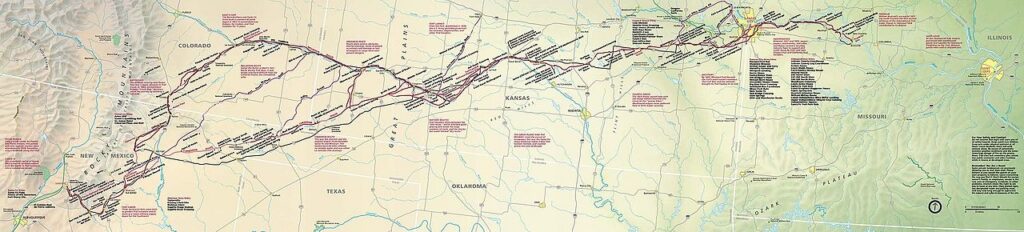
In late August 1821, Becknell’s notice in the Missouri Intelligencer drew four volunteers. The party — five men in all — departed Franklin on or around September 1, crossing the Missouri River at Arrow Rock and heading southwest along established paths toward the southern Rockies.² Becknell held no authorization from the United States government and no guarantee of safe passage through territory that had, until very recently, been closed to American traders by Spanish colonial law. The Spanish colonial government had long regarded American commercial incursion into New Mexico as a threat, and several earlier expeditions had ended with American traders imprisoned by Spanish authorities.²
But 1821 was not a normal year. Mexico was in the final weeks of its war of independence from Spain, and while Becknell’s party made its way across what is now Kansas and Colorado, the political landscape that had blocked American commerce for decades was dissolving. The new Mexican government, eager to attract trade and investment that Spanish mercantilist rules had long excluded, threw open its northern province to American merchants.¹
Somewhere in present-day New Mexico, likely in the vicinity of the Canadian River or Raton Pass, a precise route that historians have debated since the 1993 discovery of a diary kept by Mexican captain Pedro Ignacio Gallego, who led 400 soldiers who encountered Becknell’s party, the five Missouri traders met a Mexican patrol that confirmed the news: Spain’s grip on New Mexico was finished, and American traders were now welcome in Santa Fe.¹ Becknell immediately pivoted from his original plan to trade with Native peoples in the southern Rockies and followed the Mexican soldiers south toward the city.
Arrival and a $6,000 Return on $300
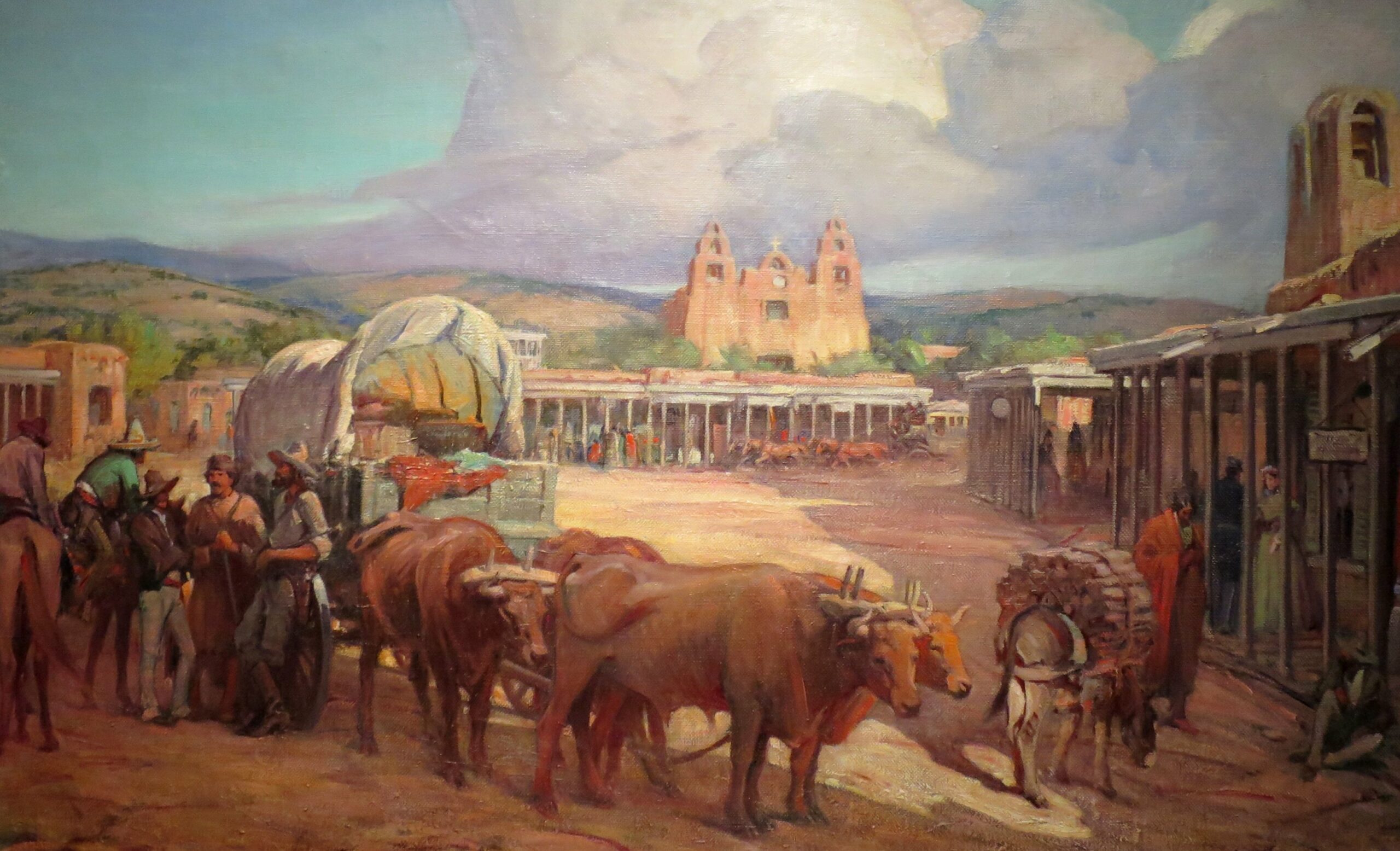
Becknell’s party arrived in Santa Fe on November 16, 1821, just ahead of a second American trading group led by the McKnight-James party, which had come by a different route.⁴ The reception was warm and the profits extraordinary. The people of Santa Fe had been starved of American-manufactured goods for decades of exclusion, and Becknell’s calico and cloth, ordinary trade goods by Missouri standards, commanded astonishing prices. Some cotton cloth sold for three dollars a yard, a then-unheard-of sum.¹
After a month of trading, Becknell and one companion departed Santa Fe on December 13, the rest of the party staying behind to trap and continue trading. Becknell arrived back in Missouri in January 1822. His $300 investment had returned approximately $6,000 in Spanish silver coin.¹ The Panic of 1819 had made hard currency virtually nonexistent in frontier Missouri. Banks would not accept paper money, and local farmers had no medium for commerce. The silver Becknell poured onto a Franklin counter was not merely personal profit; it was a lifeline for a struggling regional economy.¹
The Second Journey: Wagons West and the Cimarron Cutoff (1822)
Becknell barely paused before planning his next expedition. In May 1822, he departed Franklin with twenty-one men, three wagons, and $3,000–$5,000 worth of goods — the first time wagons had ever been used on the overland route to Santa Fe.¹ Taking wagons required a new route: Becknell could not push heavy freight vehicles over the rough mountain terrain near Raton Pass that his packhorse party had navigated. Instead, he left the Arkansas River near present-day Dodge City, Kansas, and struck south across the parched Cimarron Desert toward the Cimarron River.¹
The Cimarron crossing nearly killed them. There was almost no water in the desert between the Arkansas and Cimarron rivers, and both men and animals were reduced to desperate measures in the heat. KRCU Public Radio historian Dr. Bill Eddleman notes that the trade proved mutually advantageous despite the hardship, contributing substantially to the influx of mules into Missouri and providing the state’s economy with a critical infusion of silver coin.² The party reached Santa Fe forty-eight days after departure and returned to Missouri with a profit of roughly $91,000, a sum that made national headlines and triggered a permanent wave of commercial migration westward.¹
This second route, the Cimarron Cutoff, became the favored path for most Santa Fe traders, precisely because its relative flatness accommodated wagons and draft teams. Becknell had not merely opened a trail; he had engineered the first practical freight highway to the American Southwest.

A Bigger Picture: Commerce, Sovereignty, and the Contested Plains
The National Park Service frames Becknell’s 1821 journey as part of a sweeping continental transformation, rather than a simple story of individual entrepreneurship. Becknell was not crossing an empty landscape; his route wound through the competing claims of multiple nations and peoples. The 1819 Adams-Onís Treaty had established a border between U.S. and Spanish territory along the Arkansas River, but the Comanche people, the dominant military power of the southern plains, controlled vast stretches of the route, maintaining their own complex economy of horses, bison hides, manufactured goods, and captives that connected the plains to both the Spanish settlements of New Mexico and the trading posts of Missouri.¹
Missouri itself had joined the Union as a slave state in 1821, the first state located entirely west of the Mississippi, and the contradictions of that moment shaped everything about the world Becknell rode through. As the NPS notes, “although deeply in debt, Becknell possessed freedoms that many residents of Missouri lacked.”¹ The trail he opened would eventually carry enslaved people westward as well as trade goods and settlers, complicating any simple celebration of westward expansion as unambiguous national progress.
Becknell himself seems to have been largely indifferent to these larger forces; his primary motivation, by his own account and that of every contemporary source, was the need to pay his debts and provide for his family. But his timing was near-perfect by accident of history, and the consequences of his $300 wager far outran his personal ambitions.
Building the Trail: Later Expeditions and Congressional Recognition
Becknell made a third journey to Santa Fe in 1824, this time leading a party of trappers into Colorado before continuing on to New Mexico.¹ The following year, Congress authorized a federal survey and marking project for the Santa Fe Trail, and Becknell was hired to help lead it — a recognition by the United States government that the route he had pioneered was now a matter of national commercial and military interest.¹ The survey party negotiated right-of-way with the Osage and Kansas peoples along the trail and established the Cimarron Cutoff as the central route to the Southwest, cementing the path that Becknell had blazed in 1822 as the country’s official road to Santa Fe.
Between 1820 and 1843, trade along the trail generated more than $3 million in commerce, with American goods flowing west and Mexican silver, mules, and furs flowing east.² By 1860, the trail supported more than 3,000 wagons and 9,000 men annually, including businesses as far east as southeast Missouri.² The railroad that finally rendered the trail obsolete did not reach Santa Fe until 1880, nearly sixty years after Becknell’s first pack mules crossed the Cimarron Desert.¹
From Trader to Statesman: Missouri and Texas
Becknell’s commercial success brought him stability, if not lasting wealth. In 1827, he was appointed justice of the peace in Saline County, Missouri, and the following year won election to the Missouri House of Representatives as a Jacksonian Democrat, the same legislature he had failed to enter in 1820.⁴ He served two terms and retained his militia rank of captain, commanding a company during a Native American uprising in 1829 and again during the 1832 Black Hawk War.¹
In 1835, Becknell sold all his Missouri property and relocated to Red River County in northeastern Texas, part of the great southward and westward migration that filled the young Republic of Texas in the years before its annexation by the United States.⁴ When the Texas Revolution broke out in 1836, Becknell raised and commanded a mounted volunteer unit known as the Red River Blues, serving along the Lavaca River through October.¹ He subsequently believed he had been elected to the first Texas Congress, reported to the capital, and was surprised to find that Collin McKinney had more votes, a moment that entered regional folklore as a wry illustration of the chaos of early Texas democracy.⁴
Becknell went on to command Red River militia companies in 1838, 1841, and 1842, served as a supervisor of congressional elections in 1845 and 1846, and amassed a substantial estate of land and livestock in Red River and Lamar Counties, along with a bridge spanning the Sulphur River.⁴ He died on April 25, 1856, and was buried near Clarksville, Texas, where the Texas Legislature later marked his grave with a granite stone in 1957.⁴
Legacy and Civic Relevance
William Becknell’s name is less well known today than those of the explorers and statesmen who surrounded him, partly because no portrait of him exists, and partly because his motivations were so relentlessly practical. He did not set out to make history; he set out to pay a debt. Yet the road he opened in 1821 accomplished something the diplomats and politicians of his era had only talked about: it created a working commercial bond between the United States and Mexico, built through mutual trade and mutual profit rather than through conquest or treaty.
The Santa Fe Trail endured for nearly sixty years because it served the interests of both sides of the border, American manufacturers and Missouri merchants on one end, New Mexico traders hungry for affordable goods on the other. That bilateral economic logic was Becknell’s real discovery, more valuable than any mountain pass or river crossing. The trail he blazed became the template for the market revolution that would carry American commerce all the way to the Pacific.
As the NPS observes, the themes of Becknell’s 1821 journey remain alive today: commerce between nations, goods and people moving at increasing speed across contested borders, the Southwest as a place of vibrant cultural exchange.¹ Becknell himself would not have put it in those terms. He was thinking about silver coin, not civic legacy, but the trail he opened is as good a starting point as any for understanding how the American West was economically stitched together, one mule-load at a time.
Continue exploring this transition from Founders to Pioneers in our Founding Generation series, or read more on the explorers, settlers, and statesmen of the westward expansion in our History Lessons.
Footnotes
- National Park Service — “The Strange Yet Familiar World of William Becknell’s 1821 Journey to Santa Fe”: https://www.nps.gov/articles/000/becknell-s-1821-journey-to-santa-fe.htm
- KRCU Public Radio / Dr. Bill Eddleman — “MO Bicentennial Minutes: William Becknell Opens the Santa Fe Trail”: https://www.krcu.org/education/2021-09-02/mo-bicentennial-minutes-william-becknell-opens-the-santa-fe-trail
- Legends of America — “William Becknell: Father of the Santa Fe Trail”: https://www.legendsofamerica.com/we-williambecknell/
- Texas State Historical Association, Handbook of Texas — “Becknell, William” (Larry Mahon Beachum, 1952, updated 2017): https://www.tshaonline.org/handbook/entries/becknell-william