

Apollo 11: The Journey That Changed Our View of Earth—and Our Future in Space
On July 16, 1969, millions of people around the world watched as a towering Saturn V rocket lifted off from Launch Complex 39A at NASA’s Kennedy Space Center in Florida. Inside the spacecraft were three astronauts—Neil Armstrong, Buzz Aldrin, and Michael Collins—beginning what would become one of humanity’s greatest achievements: the Apollo 11 mission to the Moon.
Four days later, Armstrong and Aldrin would make history as the first humans to walk on the lunar surface while Collins remained in orbit aboard the command module. Their accomplishment has become one of the defining moments of the twentieth century.
But Apollo 11 did not begin on July 16, 1969.
Its story stretches back decades through scientific discoveries, military competition, political leadership, engineering breakthroughs, and the efforts of more than 400,000 people who worked together toward a goal many believed impossible. Apollo 11 represents far more than a successful mission—it demonstrates what can happen when a nation commits itself to solving extraordinary challenges through innovation, collaboration, and public investment.
More than fifty years later, as NASA prepares to send astronauts back to the Moon through the Artemis program, Apollo 11 remains both a historic achievement and a foundation for the future.
A Dream Older Than the Space Age
For centuries, people imagined traveling to the Moon. Ancient civilizations studied its movements, while writers such as Jules Verne and H.G. Wells imagined journeys beyond Earth long before rockets made them possible.
The science that eventually enabled spaceflight emerged gradually. During the early twentieth century, pioneers, including Robert Goddard in the United States and engineers in Europe, developed increasingly sophisticated rocket technology. Their work transformed what had once been science fiction into scientific possibility.
Following World War II, rocket technology advanced rapidly. At the same time, tensions between the United States and the Soviet Union created what became known as the Space Race—a competition that extended beyond military strength to scientific discovery, technological innovation, and national prestige.
The Space Race Begins
The modern space age officially began on October 4, 1957, when the Soviet Union launched Sputnik 1, the world’s first artificial satellite.
For many Americans, Sputnik was a wake-up call. If rockets could place satellites into orbit, they could also carry other payloads over great distances. The launch prompted significant investments in science education, research, and aerospace technology.
Less than a year later, Congress established the National Aeronautics and Space Administration (NASA), which officially opened on October 1, 1958. NASA inherited existing research programs while creating an ambitious vision for America’s future in space.
The agency’s earliest missions focused on learning whether humans could safely survive in space before attempting more complex missions.
Learning One Mission at a Time
The path to Apollo 11 was built through a series of increasingly ambitious programs.
Project Mercury sought to answer the most basic question: Could humans survive and work in space?
In May 1961, Alan Shepard became the first American in space aboard Freedom 7, demonstrating that astronauts could control spacecraft during flight. Although his mission lasted only about fifteen minutes, it marked an important milestone in America’s growing space program.
Less than a year later, John Glenn became the first American to orbit Earth, completing three orbits aboard Friendship 7. His mission demonstrated that longer-duration human spaceflight was possible and gave NASA valuable operational experience.
Mercury proved astronauts could fly in space.
Gemini would teach them how to travel to the Moon.
Throughout ten Gemini missions between 1965 and 1966, astronauts learned essential skills including long-duration spaceflight, rendezvous, docking, spacewalks, and precision reentry. These techniques would become indispensable for lunar missions.
Each success built confidence—and each challenge revealed new lessons.
Apollo 11 was not a single leap but the result of hundreds of smaller ones.
President Kennedy’s Challenge
Perhaps no moment proved more influential than President John F. Kennedy’s address to Congress on May 25, 1961.
Only weeks after Alan Shepard’s flight, Kennedy proposed an ambitious national objective:
“…before this decade is out, of landing a man on the Moon and returning him safely to the Earth.”¹
The challenge was extraordinary.
At the time, the United States had accumulated only fifteen minutes of human spaceflight experience. NASA had not yet developed the rockets, spacecraft, computers, navigation systems, or life-support technology required for lunar travel.
Yet the goal united scientists, engineers, manufacturers, universities, government agencies, and private industry around a common mission.
Rather than specifying exactly how to reach the Moon, Kennedy established a destination and trusted American innovation to determine the path.
Building the World’s Most Powerful Rocket

The five F-1 engines of the Saturn V rocket ignite as Apollo 11 begins its historic journey to the Moon on July 16, 1969. The launch marked the culmination of years of planning, engineering, and scientific innovation that made the first lunar landing possible.
Achieving Kennedy’s goal required entirely new technology.
NASA developed the Saturn V rocket, designed under the leadership of Wernher von Braun and thousands of engineers across the country.
Standing 363 feet tall, Saturn V remains one of the most powerful rockets ever successfully flown. Its first stage alone generated approximately 7.5 million pounds of thrust at liftoff.
The rocket consisted of three stages, each performing a carefully timed role before separating and allowing the next stage to continue the journey toward orbit and eventually the Moon.
The spacecraft itself included three major components:
- The Command Module, where the crew lived during most of the mission.
- The Service Module, containing propulsion, electrical systems, and supplies.
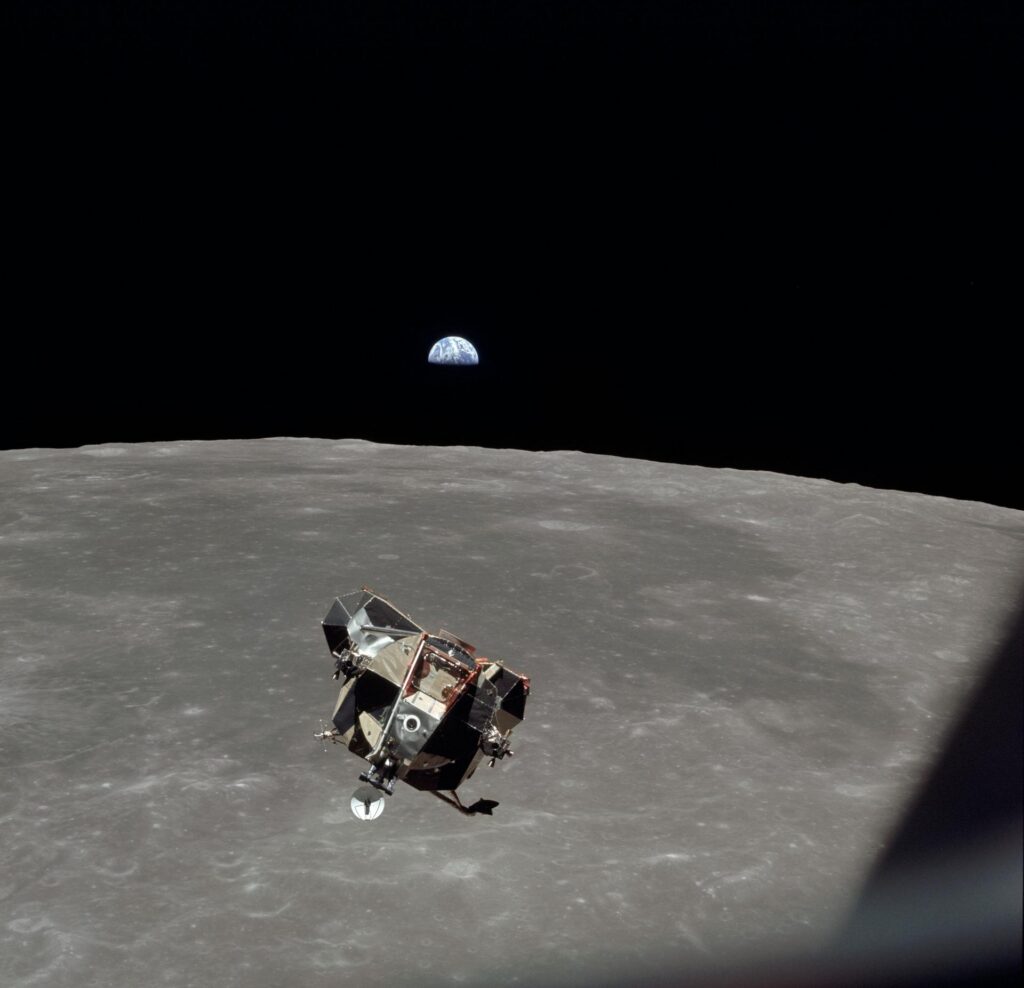
- The Lunar Module, specially designed to land on and depart from the Moon.
Every system required unprecedented precision. A small error in navigation, timing, or engineering could jeopardize the entire mission.
Apollo’s Hard Lessons
Progress toward the Moon was not without tragedy.
On January 27, 1967, astronauts Gus Grissom, Ed White, and Roger Chaffee lost their lives during a launch rehearsal for Apollo 1 when a cabin fire spread rapidly through the spacecraft.
The accident forced NASA to pause the program and carefully examine every aspect of spacecraft safety.
Engineers extensively redesigned the spacecraft, improving wiring, materials, hatch design, and emergency procedures.
The lessons learned from Apollo 1 made later missions—including Apollo 11—safer and stronger.
The mission to the Moon was built not only on success but also on careful reflection after failure.
Apollo 11 Lifts Off
On the morning of July 16, 1969, Apollo 11 launched before an estimated one million spectators gathered near Cape Kennedy, while millions more watched on television around the world.²
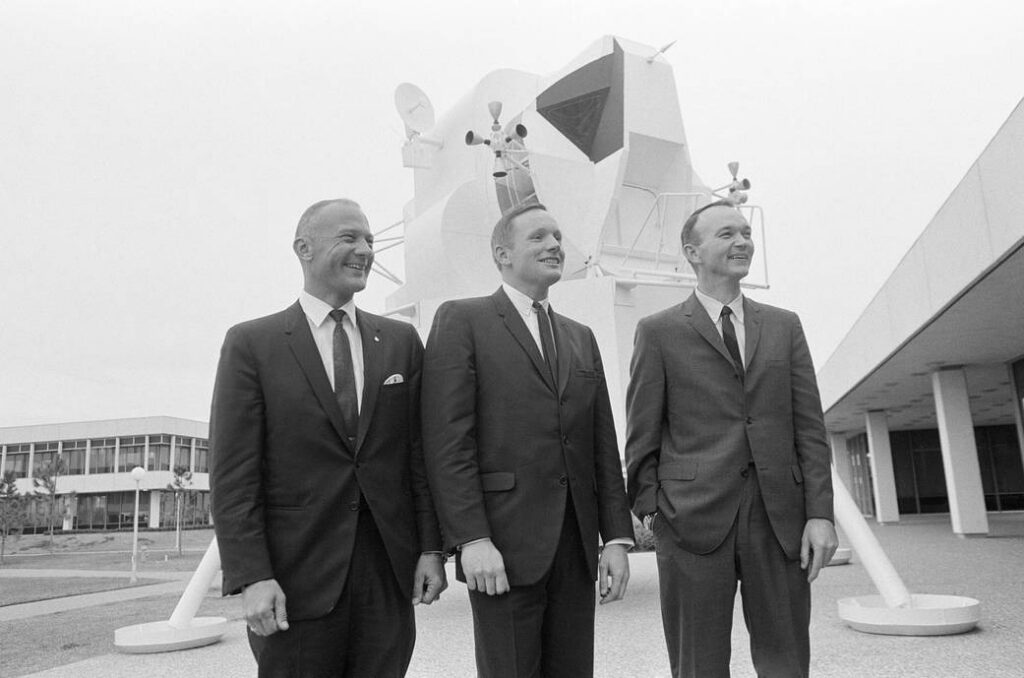
The crew consisted of:
- Commander Neil Armstrong
- Lunar Module Pilot Buzz Aldrin
- Command Module Pilot Michael Collins
Over the next three days, Apollo 11 traveled nearly 240,000 miles toward the Moon.
Their journey represented years of planning, thousands of test flights, millions of calculations, and the efforts of hundreds of thousands of people working behind the scenes.
The launch itself became a symbol of what coordinated scientific and civic effort could accomplish.
One Mission, Many Heroes
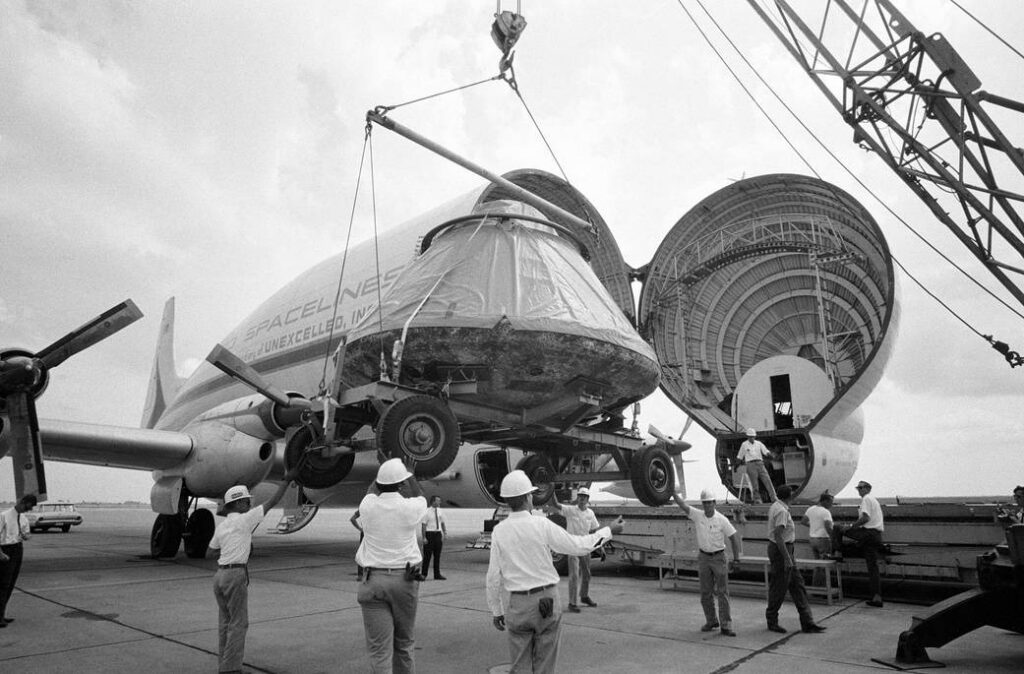
History often remembers the astronauts, but Apollo 11 succeeded because of an enormous team effort.
More than 400,000 people worked on the Apollo program, supported by approximately 20,000 contractors, universities, and industrial partners.³
Among them were mathematicians, engineers, programmers, welders, machinists, technicians, seamstresses who hand-stitched spacesuits, meteorologists, medical specialists, flight controllers, and countless others.
One notable contributor was Margaret Hamilton, whose software engineering team developed flight software that helped guide Apollo spacecraft. During the lunar landing, her software successfully prioritized essential computer tasks when the onboard computer became overloaded, allowing the landing to continue safely.
Apollo demonstrated that major national achievements depend upon expertise from many disciplines working together.

Seeing Earth Differently
Although Apollo 11 reached the Moon, one of its greatest legacies may have been changing how people viewed Earth.
Photographs taken during the mission showed our planet suspended alone in the darkness of space—a vivid reminder that national borders disappear when viewed from hundreds of thousands of miles away.
These images strengthened public appreciation for Earth’s environment and its shared resources. Historians often point to the early space program as one influence that helped shape the growing environmental movement, including the first Earth Day in 1970.
Space exploration not only expanded humanity’s understanding of the universe but also encouraged people to think differently about their own planet.
Beyond Apollo
Apollo 11 was only the beginning.
Five additional Apollo missions successfully landed astronauts on the Moon between 1969 and 1972, conducting scientific experiments, collecting lunar samples, and expanding our understanding of the Moon’s geology.
The technologies developed during Apollo influenced countless innovations beyond space exploration, including advances in computing, telecommunications, materials science, navigation systems, and medical technology.
The program also inspired generations of scientists, engineers, educators, and students to pursue careers in science, technology, engineering, and mathematics (STEM).
Its legacy continues to shape innovation today.
Artemis: Returning to the Moon
More than half a century after Apollo 11, NASA is preparing for humanity’s next chapter of lunar exploration through the Artemis program.
While Apollo focused on proving humans could reach the Moon, Artemis seeks to establish a sustained human presence there, enabling longer missions, expanded scientific research, and preparation for future journeys to Mars.⁴
Artemis also reflects how space exploration has evolved.
The program will include the first woman and the first person of color to walk on the Moon, highlighting how opportunities in exploration have expanded since 1969.
New technologies—including the Orion spacecraft, the Space Launch System rocket, lunar Gateway station, and commercial partnerships—build upon lessons first learned during Apollo while preparing for missions far beyond Earth’s orbit.
Today’s astronauts continue standing on the shoulders of those who came before them.
Why Apollo 11 Still Matters
Apollo 11 is remembered as one of history’s greatest engineering accomplishments, but its importance extends beyond science.
The mission illustrates how democratic societies can pursue ambitious long-term goals through cooperation among government, industry, universities, and citizens. It demonstrates the value of public investment in research, education, and innovation.
It also reminds us that remarkable achievements rarely happen overnight.
Apollo 11 was the result of years of planning, thousands of incremental successes, lessons learned from setbacks, and the dedication of hundreds of thousands of individuals working toward a shared purpose.
As humanity prepares to return to the Moon and eventually journey farther into our solar system, Apollo 11 continues to serve as both inspiration and instruction.
Its greatest lesson may not simply be that humans reached the Moon.
It is that extraordinary accomplishments become possible when curiosity, perseverance, and collaboration point us toward a common horizon.
Explore More from Civics for Life
Continue exploring the remarkable history of American space exploration:
- Alan Shepard: America’s First Journey into Space
- John Glenn: America’s First Orbit of Earth
- The First Moon Landing
- Sally Ride: Breaking Barriers in Space
- Ellison Onizuka: A Pioneer in the Stars
- Earth Day: The History of a Global Movement
Sources
- John F. Kennedy, “Special Message to the Congress on Urgent National Needs,” May 25, 1961, quoted by NASA, Apollo 11 Mission Overview.
- NASA, Apollo 11 Mission Overview; History.com Editors, “Apollo 11 Departs Earth,” This Day in History.
- National Archives, “20 July 1969: One Giant Leap for Mankind”; NASA History, 55 Years Ago: Apollo 11’s One Small Step, One Giant Leap.
- NASA, Artemis