

Cornplanter (Gaiänt’wakê): A Peacemaker Between Nations
When most Americans think of the nation’s founders, names like George Washington, Benjamin Franklin, and Thomas Jefferson often come to mind. But America’s story is broader and more diverse than those familiar figures. It also includes Native leaders whose courage, diplomacy, and foresight helped shape the early years of the United States.
One such leader was Cornplanter (Gaiänt’wakê) — a Seneca chief who worked tirelessly to promote peace between the newly formed United States and the Haudenosaunee (Iroquois) Confederacy.
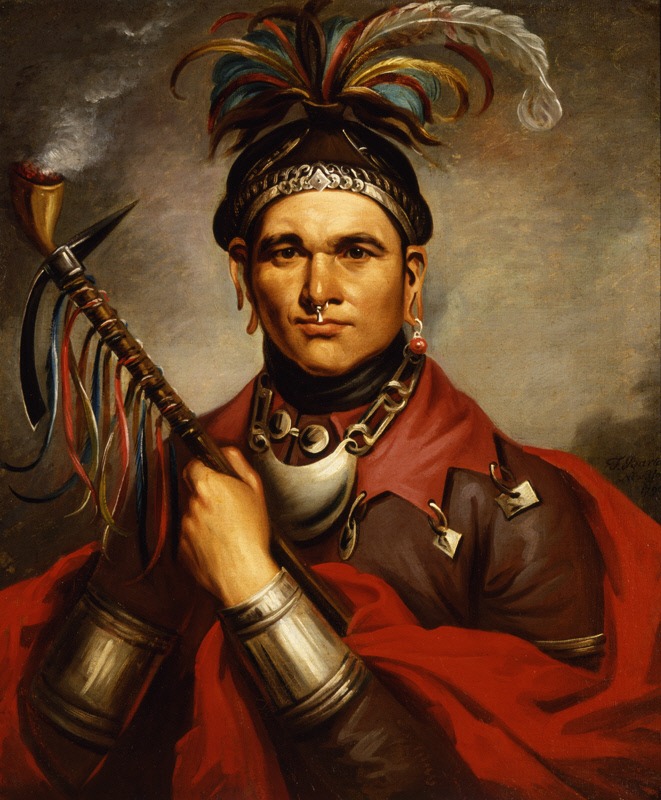
Gayë́twahgeh, generally known as Cornplanter by F. Bartoli circa 1796 (Wikimedia Commons).
Early Life and Heritage
Born around 1740 in what is now western New York, Cornplanter was the son of a Seneca mother and a Dutch trader, Johannes Abeel. In the matrilineal Seneca society, his mother’s family determined his place within the community.
Growing up within the Haudenosaunee Confederacy, a powerful alliance of six Native nations, Cornplanter learned early lessons in balance, consensus, and respect — principles that would define his leadership.
A Divided Confederacy During the Revolution
The American Revolution brought immense challenges to the Iroquois Confederacy. The six nations—Mohawk, Oneida, Onondaga, Cayuga, Seneca, and Tuscarora—were divided over whether to support the British or remain neutral.
Cornplanter initially sided with the British, believing they would best protect Native lands from colonial expansion. But as the war ended and the United States emerged as an independent nation, Cornplanter saw the need for a new approach.
Realizing that peace and diplomacy would be essential for his people’s survival, he shifted his focus to building understanding with the American government.
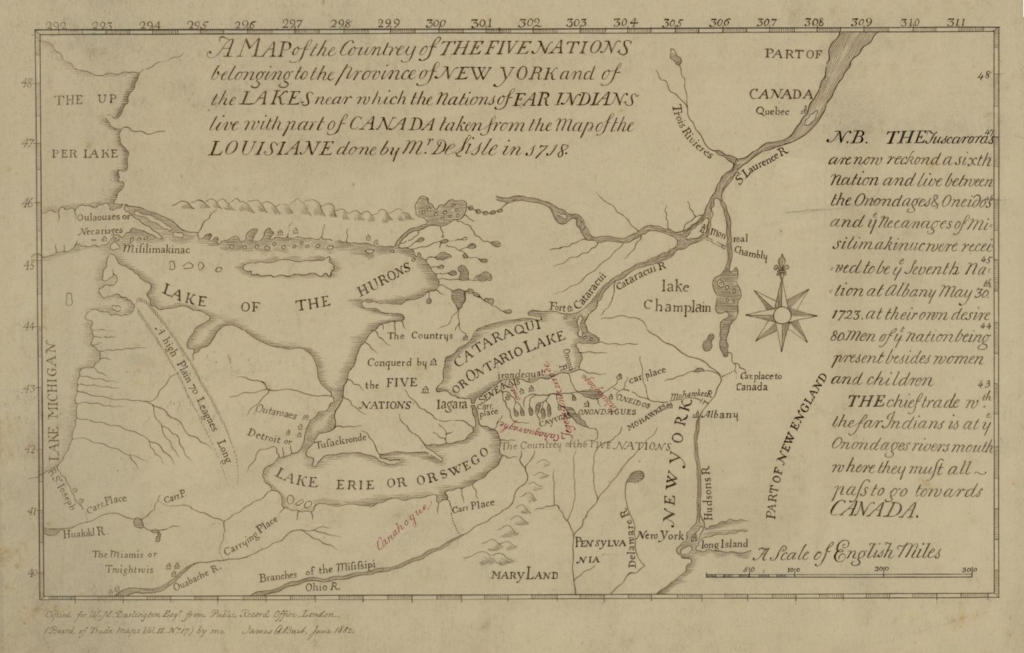
This is a map of the Five Nations, part of the Darlington map collection, housed in the Archives Service Center, University Library System, University of Pittsburgh, Pittsburgh, PA, US. (Wikimedia Commons)
Diplomat and Treaty Negotiator
Cornplanter became a key negotiator between the U.S. government and the Iroquois Confederacy. He played a central role in the Treaty of Fort Stanwix (1784), which sought to establish peace and boundaries between U.S. settlers and Native American lands.
Although not all the treaty’s terms were fair or upheld, Cornplanter’s goal was clear: to protect his people through diplomacy rather than continued conflict.
He later helped negotiate the Treaty of Canandaigua (1794) alongside other Haudenosaunee leaders, reaffirming peace and friendship with the United States while recognizing Iroquois land rights in New York.
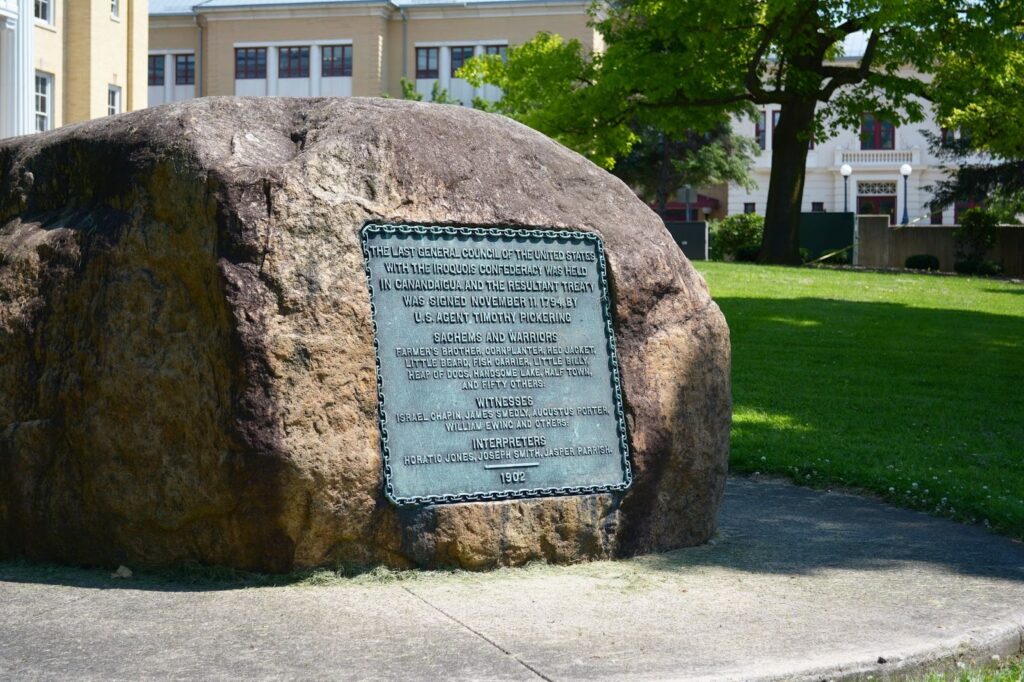
Boulder on the lawn of the Ontario County Courthouse, Canandaigua, NY, placed there in 1902 by Dr. Dwight R. Burrell to commemorate the 1794 Treaty of Canandaigua, also called the “Pickering Treaty.” (Wikimedia Commons)
Cornplanter’s statesmanship earned him recognition from leaders such as George Washington, who personally met with him in Philadelphia. In appreciation for his efforts, the United States granted him land along the Allegheny River in Pennsylvania, later known as the Cornplanter Tract.
A Vision for Education and Adaptation
Cornplanter was not only a diplomat — he was also a visionary community leader. He believed that his people’s future depended on education and adaptability.
He invited teachers and missionaries to the Seneca territory to help young people learn new skills and languages that could serve them in the changing American world. At the same time, he emphasized the importance of preserving Seneca traditions, culture, and self-governance.
Cornplanter’s balanced approach reflected a belief that progress and tradition could coexist — that learning from others did not mean losing one’s identity.
Legacy and Reflection
Cornplanter lived into the early 19th century, continuing to advocate for his people even as federal promises went unfulfilled. Despite his efforts for peace, many Native lands were gradually lost.
Even the Cornplanter Tract — once a symbol of recognition and friendship — was eventually submerged by the Kinzua Dam project in the 1960s, displacing hundreds of Seneca families.
This loss remains a powerful reminder of the long and often painful struggle for Native rights and sovereignty in the United States.
Yet Cornplanter’s story endures as one of courage, diplomacy, and resilience. He bridged two worlds during a defining moment in American history, choosing peace when others called for war and dialogue when mistrust ran deep.
Remembering Cornplanter’s Legacy
Today, Cornplanter is remembered as one of the great Native American statesmen of the 18th century. His efforts to build peace, encourage education, and protect his people’s future remind us that the founding of the United States was not only a story of revolution — but also of negotiation, coexistence, and hope.