

Jesse Applegate: A Trailblazer Who Found a Safer Road West
How a surveyor’s grief over a family tragedy on the Columbia River led him to blaze a safer road west — and to help shape the laws of a territory whose sovereignty was still disputed.
In the autumn of 1843, on a stretch of the Columbia River near present-day The Dalles, Oregon, a raft carrying members of the Applegate party capsized in the current. Jesse Applegate’s young son Edward, his nephew Warren, and Alexander McClellan drowned. Applegate had spent months leading the Cow Column, one of the two main divisions of the roughly thousand-person Great Migration of 1843 — only to lose his son near the journey’s end.

Source: George Applegate, via Joseph Schafer, A History of the Pacific Northwest (1918), p. 166 — Wikimedia Commons.
That loss would shape the rest of Jesse Applegate’s life, and in a roundabout way, it would reshape the road west itself. Applegate is not a household name today the way Lewis and Clark or the Donner Party are. But his work would help shape how emigrants reached Oregon, how settlers governed themselves once they arrived, and how later generations remembered the overland journey.1
His story is a reminder that the story of westward expansion was not written only by explorers and politicians in Washington. It was also written by ordinary, overburdened people making practical decisions under enormous pressure — decisions that, once made, rippled outward for decades.
From Kentucky Farm Boy to Frontier Surveyor
Jesse Applegate was born on July 5, 1811, in Henry County, Kentucky, one of ten children in a farming family that soon joined the broader migration of Americans pushing west of the Appalachians. While he was still a boy, the Applegates relocated to Missouri, then very much a frontier state, where Jesse grew up doing the physical work expected of a farm household on the edge of settled America.1
What set Applegate apart from many of his frontier neighbors was his training in surveying. He studied at Rock Springs Seminary in Shiloh, Illinois, where he learned surveying, and later worked in the Surveyor General’s office in St. Louis. The mathematical and technical skills he developed there would prove essential decades later, thousands of miles from Missouri.1
In 1831, Applegate married Cynthia Ann Parker, and the couple began raising a family in Missouri. By the early 1840s, Jesse and his two brothers, Charles and Lindsay Applegate, were farming in Missouri. Difficult economic conditions, including depressed livestock prices, helped make the prospect of starting over in Oregon attractive to the brothers and their families.
The Great Migration of 1843
The early 1840s saw a surge of American interest in Oregon Country, a vast and only loosely defined region jointly claimed by the United States and Great Britain, stretching from the Rocky Mountains to the Pacific. Missionaries, explorers, and prospective settlers had traveled west during the preceding years, and reports describing Oregon Country’s temperate climate and agricultural opportunities helped fuel what became known as “Oregon fever.”
In the spring of 1843, roughly a thousand emigrants gathered near Independence, Missouri, to attempt the overland journey together — a wagon train large enough that it later became known simply as the Great Migration of 1843. Jesse Applegate, his brothers, and their extended families were among them, driving cattle and horses that numbered well into the thousands.3
Organizing Chaos: The Cow Column
A wagon train of that size created a logistical problem nobody had solved before. Livestock herds moved at a different pace than loaded wagons, kicked up choking dust, and were vulnerable to scattering or theft if not carefully managed. The emigrants eventually split into two loosely organized groups, and Jesse Applegate was chosen to organize and lead the section responsible for the herds — a company that came to be known as the “Cow Column.”3
Applegate later wrote a detailed, vivid account of a single day’s routine leading the Cow Column, describing the predawn rituals of breaking camp, the discipline required to keep thousands of animals and dozens of families moving in the same direction, and the makeshift democracy the emigrants used to resolve disputes along the way. His account, “A Day with the Cow Column in 1843,” later became one of the most widely quoted firsthand descriptions of overland emigration, prized by historians as a firsthand retrospective account written by someone who had experienced the problems of the trail firsthand.
“It is four o’clock A.M.; the sentinels on duty have discharged their rifles — the signal that the hours of sleep are over.” — Jesse Applegate, A Day with the Cow Column in 1843.4
Leading the Cow Column required Applegate to mediate constant friction: families anxious about pace, disputes over grazing and water, the physical exhaustion of moving thousands of animals through unfamiliar terrain. It also gave him an intimate, ground-level understanding of exactly where the existing route to Oregon put emigrants at greatest risk — knowledge that would matter enormously within just a few years.
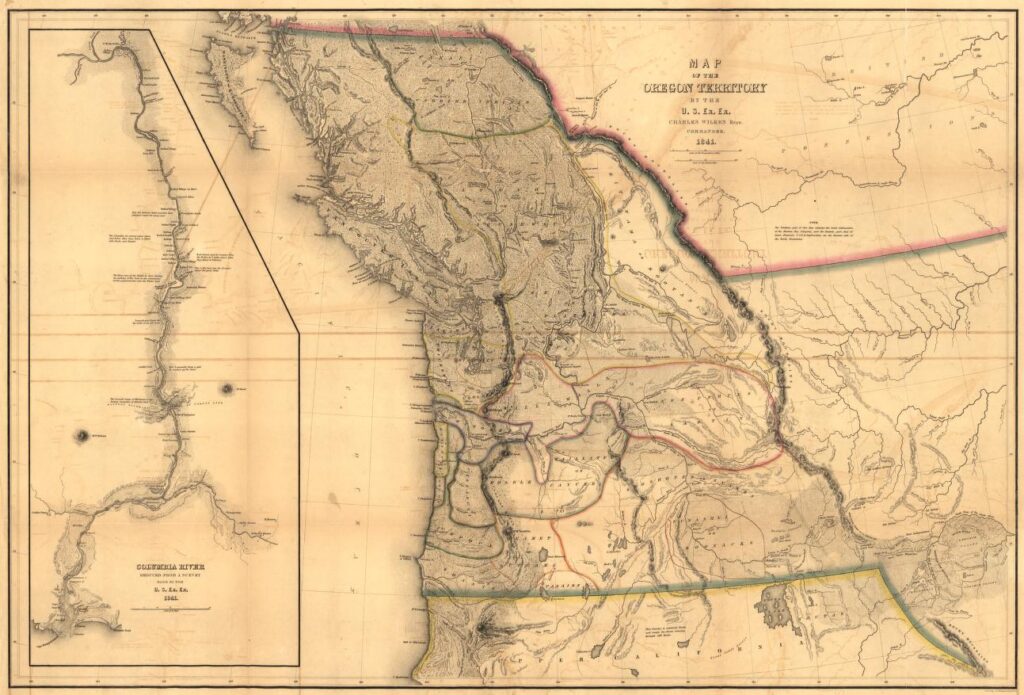
Source: Library of Congress, Geography and Map Division — Map of the Oregon Territory (1841).
Public domain (pre-1928, U.S. government expedition map).
Tragedy at the Trail’s End
By the standards of the era, the 1843 migration was a considerable success: most of the emigrants reached Oregon Country’s Willamette Valley, and the scale of the migration itself helped strengthen the American presence in the region. But the journey’s final stretch was, in some ways, the most dangerous of all.
At the time, no reliable overland route existed around Mount Hood; the only practical way to complete the journey into the Willamette Valley was to float wagons, families, and belongings down the treacherous Columbia River past The Dalles, running rapids and eddies that had capsized rafts before and would capsize many more in the years that followed. It was on this stretch, in November 1843, that Jesse Applegate’s son Edward, his nephew Warren — Lindsay Applegate’s son — and Alexander McClellan drowned when their raft overturned.2
The loss devastated both families. It also planted an idea that would occupy Jesse and Lindsay Applegate for the next several years: the existing route into Oregon’s settled valleys was not just difficult, it was needlessly deadly, and a safer alternative had to exist somewhere south of the Columbia’s gorge.
Building a Government Before There Was One
Once settled in the Willamette Valley, Applegate quickly became one of the leading figures in Oregon Country’s small American community — a community that, in the early 1840s, existed in a strange legal limbo. The United States and Great Britain jointly occupied Oregon Country under agreements that left the region’s ultimate sovereignty unresolved, and the settlers who arrived had no formal court system, no established property law, and no clear authority to appeal to.
In 1844, Applegate put his surveying training to direct civic use, surveying the townsite of Oregon City, then the closest thing Oregon Country had to a capital. The following year, in 1845, he was elected to Oregon’s legislative assembly and played a leading role in shaping the provisional government.3
These provisional rules, known as Oregon’s Organic Laws, provided a working framework for government until Congress created the Oregon Territory in 1848.3
It is easy to overlook how unusual this was. Applegate and his fellow settlers were, in effect, helping create a working government for a region whose sovereignty remained disputed between the United States and Great Britain. Their provisional government provided courts, land rules, and other basic institutions while the international boundary question remained unresolved.
A Safer Road: Blazing the Applegate Trail
The Columbia River tragedy of 1843 never stopped weighing on Jesse and Lindsay Applegate. In 1846, Jesse and Lindsay Applegate, Levi Scott, and other settlers set out to find and survey an alternate route into the Willamette Valley that would allow emigrants to avoid the dangerous Columbia River passage.
Charting the Southern Road
The route the Applegate party surveyed swung well south of the existing trail, branching off from the main road to Oregon and California near the Humboldt River in present-day Nevada, then cutting north and west through the harsh landscape of northern California and the Cascade Range’s southern foothills before entering Oregon’s Umpqua and Rogue River valleys and finally reaching the Willamette Valley from the south — bypassing the Columbia Gorge entirely.5
The National Park Service, which now administers the route as part of the National Historic Trails system, notes that the new southern road was developed specifically because the existing Columbia River portion of the Oregon Trail was so dangerous for emigrants — precisely the danger the Applegate family had experienced firsthand. The route became known by several names over the following decades, including the Applegate Trail and the South Road.2
Reflecting Levi Scott’s role in later re-surveying and improving the route, it also became known as the Scott-Applegate Trail.5
A Rough Trade: One Danger for Another
The trail’s first season revealed how dangerous the new route could be. More than 200 emigrants took the southern road in 1846; at least a dozen died, and travelers suffered major losses of livestock and property. Some survivors blamed Applegate for persuading emigrants to take the new route, and J. Quinn Thornton became a particularly vocal public critic. The road was subsequently improved and continued to attract emigrants, with thousands using it in the years that followed.
The Sage of Yoncalla: Later Life and Political Independence
Applegate eventually settled his family in the Umpqua Valley near present-day Yoncalla, in what is now Douglas County, Oregon, where he built a substantial farm and became known — somewhat affectionately, somewhat warily, depending on who was speaking — as “the Sage of Yoncalla.” He wrote prolifically for Oregon newspapers on politics, agriculture, and philosophy, and he cultivated a reputation as a serious, independent-minded thinker in a territory still working out its own political identity.1
That independence was also evident in his political life. Applegate became active in Republican politics and was elected a delegate to Oregon’s 1857 constitutional convention. He left the convention after ten days, frustrated with its proceedings. The episode reflected a pattern that would characterize much of his public life: Applegate was willing to participate deeply in civic affairs while remaining an independent and sometimes contrarian voice.1
Applegate remained a prominent, sometimes contrarian voice in Oregon public life, writing and corresponding about politics, agriculture, and the pioneer experience. After losing his home and property in 1874 because of liability on a public official’s bond, he spent his later years with family.6 He died at the home of his son Alexander in Yoncalla on April 22, 1888, at the age of seventy-six.1
Legacy and Civic Relevance
Jesse Applegate’s life resists a simple summary, and that is part of what makes it worth studying. He was a surveyor who helped shape a government that did not yet officially exist. He was a grieving father who helped turn personal tragedy into a search for durable infrastructure that shaped emigration patterns for decades. He served in Oregon’s provisional government, participated in the 1857 constitutional convention, and remained active in the territory’s civic and political life for decades.
For readers trying to understand the civic history of the American West, Applegate’s story illustrates the complexity of westward migration. Efforts to build roads, governments, and communities took place amid hardship, conflict, competing territorial claims, and profound changes for the peoples already living in the region. Applegate’s decisions were shaped by real grief, real risk, and real trial and error — the Applegate Trail itself was simultaneously a genuine alternative and a genuinely brutal route, and both things were true at once.
His example is also a reminder that the institutions Americans take for granted — courts, land titles, basic civil procedure — did not always arrive from Washington fully formed. In Oregon Country in the 1840s, settlers created provisional courts, land rules, and civil procedures while the region’s international status remained unresolved. Some of the same people involved in that civic work were also leading wagon trains, surveying town sites, and confronting the hardships of overland migration. Understanding how those two kinds of work — the practical and the civic — were carried out by the same handful of ordinary people is part of what makes Jesse Applegate’s story a small but genuine window into how the American West actually took shape.
Continue exploring the Pioneer Era in our companion articles on William Becknell and the Santa Fe Trail and James Marshall, John Sutter, and the California Gold Rush, and The Oregon Treaty of 1846.
Footnotes
- Oregon Encyclopedia, “Jesse Applegate (1811–1888).” Used for Applegate’s July 5, 1811, birth in Henry County, Kentucky; Missouri upbringing; education and surveying career; 1843 migration and Cow Column leadership; later Oregon career; 1857 constitutional convention; 1874 loss of property; and 1888 death: https://www.oregonencyclopedia.org/articles/applegate_jesse_1811_1888_/
- National Park Service, “Applegate Trail Settlement,” Oregon National Historic Trail. Used for the dangerous Columbia River route, the purpose of the southern road, and the route’s later history: https://www.nps.gov/articles/000/applegate-trail-settlement.htm
- Oregon History Project, “The Applegates.” Used for the Applegate family’s 1843 migration, Jesse’s leadership of the Cow Column, his 1844 survey of Oregon City, and his role in Oregon’s provisional government and Organic Laws: https://www.oregonhistoryproject.org/articles/historical-records/the-applegates/
- Jesse Applegate, “A Day with the Cow Column in 1843,” The Overland Monthly, vol. 1 (1868), pp. 127–135. Primary-source retrospective account of the 1843 migration and Cow Column: https://en.wikisource.org/wiki/The_Overland_Monthly/Volume_1/A_Day_with_the_Cow_Column
- Oregon-California Trails Association, “The Applegate Trail.” Used for the Applegate Trail’s alternate names, including the Southern Road and Scott-Applegate Trail, and for details of the 1846 route and expedition: https://octa-trails.org/articles/applegate-trail/
- U.S. Supreme Court, Dowell v. Applegate, 152 U.S. 327 (1894). Used to corroborate the 1874 bond-liability episode involving Jesse Applegate and Oregon Secretary of State Samuel E. May: https://www.govinfo.gov/content/pkg/USREPORTS-152/pdf/USREPORTS-152-327.pdf