

John C. Frémont: America’s Restless Pathfinder
From Founders to Pioneers: how a Georgia-born surveyor’s son became the man who mapped the road to the American West — and left a legacy as contested as the land he charted.
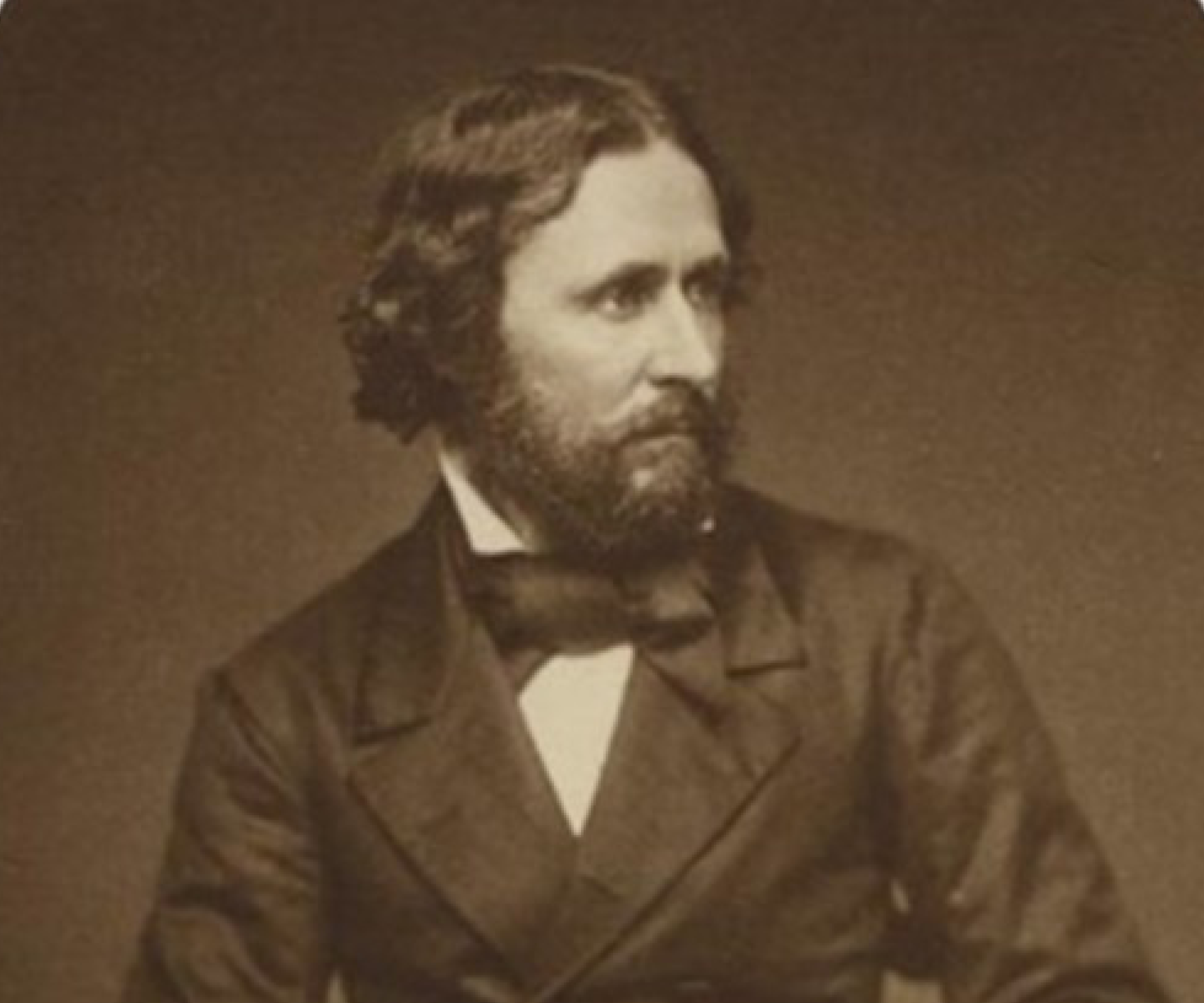
Born on January 21, 1813, in Savannah, Georgia, John Charles Frémont came into the world without his parents’ marriage to legitimize him and without a fortune to smooth his path.¹ He would spend the rest of his life trying to outrun both facts, climbing mountains no American had named, marrying into one of the Senate’s most powerful families, and riding the wave of Manifest Destiny all the way to the first Republican presidential ticket in history. As Civics for Life expands from the Founding generation into the Pioneer era that carried our republic westward, Frémont’s life offers a fitting bridge: equal parts triumph, ambition, and reckoning.
A Restless Boy from Savannah
Frémont’s father, Charles Frémon, was a French-Canadian immigrant tutor who had fled the scandal of his own, an affair with his much older employer’s young wife, Anne Beverley Whiting, the daughter of a prominent Virginia planter family. The couple could never legally marry, and their son grew up carrying the social weight of his “illegitimate” birth in a country that prized respectable lineage almost as much as it prized self-invention. When Charles Frémon died in 1818, Anne moved her children to Charleston, South Carolina, where young John grew into a description biographers still favor: precocious, restless, and unwilling to play by the rules.
That restlessness nearly cost him his education. Frémont enrolled at the College of Charleston in 1829 and showed a genuine talent for mathematics, but he was expelled in 1831 for irregular attendance. The college eventually awarded him a degree retroactively in 1836, once his reputation had outgrown the rebuke. Long before that, however, South Carolina politician Joel R. Poinsett had already noticed the young man’s gifts and secured him a position teaching mathematics aboard the warship USS Natchez. When Poinsett became U.S. secretary of war, he commissioned Frémont a second lieutenant in the Army’s Topographical Corps and paired him with French scientist Joseph Nicollet, who spent three years training Frémont in surveying, geology, and astronomy along the upper Mississippi and Missouri rivers. It was an apprenticeship that would define the next two decades of his life.¹
Mapping a Continent: The Expeditions That Made “The Pathfinder”
Frémont’s work with Nicollet introduced him to Missouri Senator Thomas Hart Benton, the powerful chairman of the Senate Committee on Military Affairs and one of the loudest voices for what would soon be called Manifest Destiny, the conviction that the United States was destined to control the continent from coast to coast. Benton’s teenage daughter, Jessie, fell for the young officer almost immediately. Her father was furious; Frémont was not the society match he had imagined for her. The couple eloped anyway in 1841, and Benton, unable to stay angry at his daughter for long, became Frémont’s most powerful patron instead.
The First Survey (1842)
With Benton’s backing, the War Department sent Frémont west in 1842 to survey the Oregon Trail through the Wind River Range of Wyoming. There, he scaled a 13,745-foot peak, now named Frémont Peak in his honor, and planted an American flag at its summit. The expedition’s published report, co-written with Jessie, who possessed a gift for vivid prose her husband lacked, was printed in newspapers nationwide and helped popularize the West not as a wasteland to be feared but as fertile country waiting to be settled.
To the Pacific and Back (1843–1844)
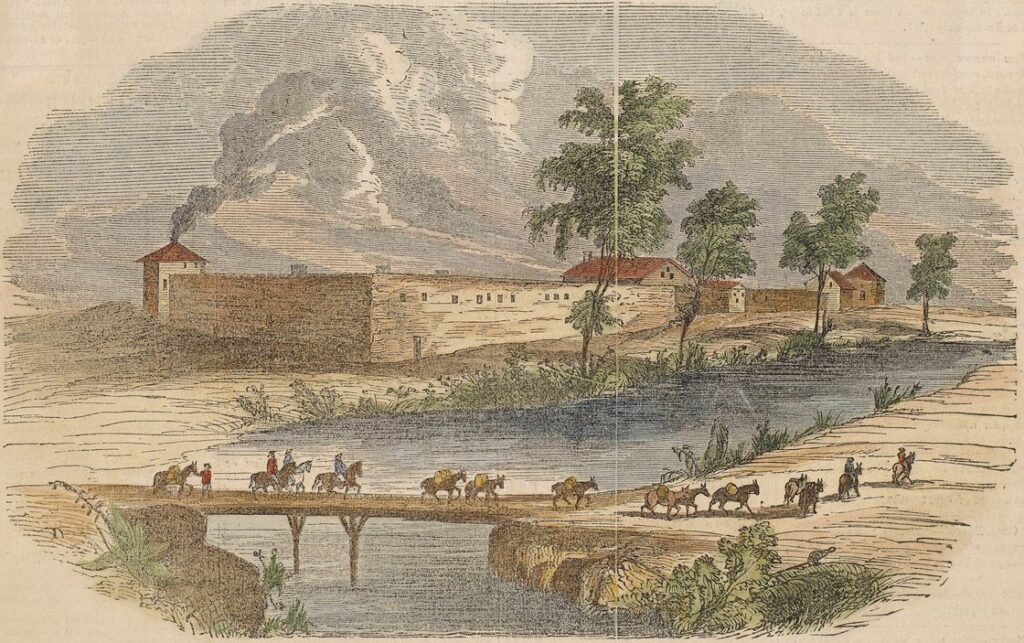
A second, more ambitious expedition followed in 1843, this time with the famed guide Kit Carson at his side. Frémont’s party explored the Great Salt Lake, pushed into the Pacific Northwest, and then, rather than turning home, struck south and west into the unmapped Great Basin. In the dead of winter, Frémont’s men crossed the Sierra Nevada and arrived at Sutter’s Fort on the Sacramento River in early March 1844, becoming among the first Americans to see Lake Tahoe along the way.⁴ Captain John Sutter, the fort’s Swiss-born proprietor, welcomed and resupplied the exhausted party. The expedition’s findings, confirming that the Great Basin had no outlet to the sea and disproving a long-rumored river that supposedly cut through the Sierra, reshaped American understanding of Western geography. Congress ordered 10,000 copies of the report printed for public distribution, and “The Pathfinder” became a household name.
Disaster in the San Juans, Triumph at Cochetopa (1848–1854)
Not every expedition ended in glory. In 1848, hoping to prove that a transcontinental railroad could run year-round along the 38th parallel, Frémont led a privately funded winter crossing of Colorado’s San Juan Mountains. Trappers at Bent’s Fort warned him against it; he pressed on anyway. The party became trapped in deep snow, mules froze and starved, and ten men died before the survivors — reduced to eating their dead companions to stay alive — finally staggered into Taos, New Mexico, in February 1849.³ It remains one of the grimmest chapters in the history of American overland exploration.
Frémont tried again in the winter of 1853–1854, this time succeeding where he had failed before. His party crossed Colorado’s San Luis Valley in December and climbed over the Continental Divide at Cochetopa Pass before continuing on to California, proving that winter rail travel through the central Rockies was at least possible.³ The irony, as the National Park Service notes, is that the transcontinental railroad was ultimately built through southern Wyoming — a far easier route that made Frémont’s hard-won Colorado passage a historical footnote rather than a national thoroughfare.³
War and Conquest in California
By 1845, war with Mexico over Texas looked all but certain, and Frémont’s third expedition carried secret instructions for military action should fighting break out. After a tense standoff with Mexican authorities near Monterey, Frémont withdrew north toward Oregon, then turned back south after receiving a mysterious dispatch from Washington, the exact contents of which historians still debate. Back in California, he threw his support behind a small band of American settlers near Sonoma who had launched an uprising against Mexican rule, declaring the short-lived Bear Flag Republic in June 1846.
When news arrived that the United States and Mexico were officially at war, Commodore Robert F. Stockton folded Frémont’s men into U.S. service as the California Battalion, with Frémont commissioned as a major. Frémont and Stockton completed the American conquest of California, and on January 16, 1847, Stockton appointed Frémont military governor.¹ The appointment did not last. General Stephen Watts Kearny, who had separately been ordered to establish California’s government, refused to recognize Frémont’s authority. The standoff between the two men ended with Frémont’s arrest, a court-martial in Washington on charges of mutiny and insubordination, and a conviction that President James K. Polk quietly commuted, in part to placate Frémont’s powerful father-in-law in the Senate.¹ Bitter over the ordeal, Frémont resigned his commission rather than accept the partial pardon as vindication. The public, largely unmoved by the legal technicalities, continued to regard him as a hero.
The Unvarnished Record: Violence Against California’s Native Peoples
No honest account of Frémont’s 1846 campaign can leave out its human cost to the Native peoples of California. As Frémont’s armed party moved through the Sacramento Valley and on toward Oregon that spring, his men carried out a series of attacks on Native villages along the way, including what is now remembered as the Sacramento River massacre. Surviving expedition members gave wildly different casualty counts, ranging from roughly 120 to 150 deaths by some accounts to several hundred by others; one eyewitness later put the toll above 800.⁴ Kit Carson, who rode in the attack, later described it in blunt terms: “It was a perfect butchery.”⁴ Days later, after Native fighters killed three of Frémont’s men in apparent retaliation for the violence his party had inflicted along the trail, Frémont ordered an attack on a Klamath fishing village, destroying it and killing at least fourteen people in what is known as the Klamath Lake massacre.⁵
Historians today generally situate these episodes within the broader pattern of violence against Indigenous Californians during the era of American conquest and settlement. UCLA historian Benjamin Madley’s award-winning study of the period describes this pattern using the term California genocide, identifying Frémont’s 1846 campaign as a significant and overlooked prelude to decades of state-sanctioned violence that reduced California’s Native population from roughly 150,000 to about 30,000 by 1873.⁴ This history does not erase Frémont’s genuine achievements as a surveyor and explorer, but it cannot be separated from them either. The same expeditions that opened the West to American settlers also opened the way for catastrophic violence against the people who already lived there. A complete civics education holds both truths at once.
Gold, the Senate, and a Presidential First
Settling in California after his resignation, Frémont purchased a 70-square-mile tract in the Sierra foothills called Las Mariposas, land he hoped would sit near San Francisco, but that turned out to lie much farther inland, near what is now Yosemite. The disappointment did not last long. Sonoran miners soon informed him that gold had been discovered on his property, and Frémont became a multimillionaire almost overnight as the California Gold Rush transformed the territory around him.¹
When California entered the Union in 1850, the state legislature elected Frémont as one of its first two U.S. senators, a short, largely ceremonial term of just 175 days, during which he opposed harsh penalties for those who assisted enslaved people escaping bondage and supported abolishing the slave trade in Washington, D.C. His firm anti-slavery stance cost him reelection in a legislature increasingly controlled by pro-slavery interests, but it also made him an ideal standard-bearer six years later for an entirely new political party.
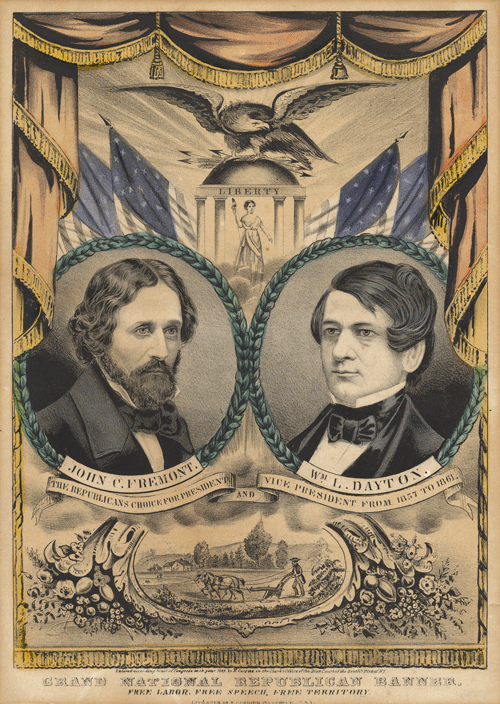
In 1856, the newly formed Republican Party, united by opposition to the expansion of slavery into Western territories, nominated Frémont as its first presidential candidate. The campaign’s slogan, “Free Soil, Free Men, and Frémont,” fused the party’s anti-slavery message with the explorer’s celebrity, and Jessie Frémont, more politically fluent than her husband, helped run the campaign herself.² Frémont lost to Democrat James Buchanan, carrying eleven states to Buchanan’s nineteen, but he came closer to uniting the North and West against the South than any presidential candidate before him, a preview of the sectional alignment that would define the Civil War just four years later.
Civil War Command and a Defiant Proclamation
When the Civil War began in 1861, Abraham Lincoln appointed Frémont a major general and gave him command of the Department of the West, headquartered in St. Louis.² Missouri was a slaveholding border state teetering toward secession, and Frémont inherited a chaotic command with few weapons, fewer uniforms, and a population sharply divided in its loyalties.² After Union forces under General Nathaniel Lyon suffered a costly defeat at the Battle of Wilson’s Creek, and guerrilla warfare spread across the state, Frémont moved decisively, and, in Lincoln’s eyes, recklessly.
On August 30, 1861, Frémont declared martial law across Missouri, ordered the arrest of known secessionists, shut down disloyal newspapers, and announced that the property, including enslaved people, of anyone taking up arms against the Union would be confiscated and freed.² It was the first emancipation order issued by any Union commander, and it electrified abolitionists nationwide. It also terrified Lincoln, who feared the proclamation would push slaveholding border states like Kentucky out of the Union entirely. When Frémont refused to rescind the order on his own, Lincoln formally overturned it on September 11. Frémont sent his formidable wife, Jessie, to plead his case directly to the president; the meeting only hardened Lincoln’s resolve, and within two months, Frémont was relieved of his command.²
Frémont briefly led the Mountain Department of Virginia in 1862 before resigning from active service, frustrated with his diminished role. In 1864, a faction of radical abolitionist Republicans dissatisfied with Lincoln’s pace on emancipation briefly drafted Frémont to challenge the president for the nomination. Recognizing that a split Republican vote would hand the election to the Democrats, Frémont withdrew his candidacy, a rare moment of political restraint in an otherwise headstrong career.
Final Years: Railroads, Arizona, and a Quiet End
Frémont’s fortune, built so suddenly on Mariposa gold, evaporated almost as quickly. He poured much of his wealth into a postwar railroad venture that collapsed in 1866, and the Panic of 1873 wiped out most of what remained. In 1878, President Rutherford B. Hayes appointed the once-wealthy explorer territorial governor of Arizona, a post he held until 1881, and largely relied on his wife’s writing income to sustain himself.² “The Pathfinder,” who had once commanded armies and run for president, died of peritonitis in New York City on July 13, 1890, far from the mountains and rivers that had made his name, and was buried at Rockland Cemetery in Sparkill, New York.²
Legacy and Civic Relevance
John C. Frémont’s life traces the same arc as the country he helped expand: audacious, self-mythologizing, and built on a foundation that included real injustice alongside real achievement. His maps and reports genuinely opened the American West to a generation of settlers and gave the federal government its clearest understanding yet of the continent’s geography. His unauthorized 1861 emancipation order, issued months before Lincoln’s own Emancipation Proclamation, marked him as a sincere and early opponent of slavery willing to risk his career for the cause. Yet that same expansionist drive carried devastating consequences for the Native peoples whose homelands lay in the path of “manifest destiny,” a cost too often left out of the Pathfinder legend.
Frémont’s story is a useful reminder that American expansion was never a simple, single narrative of progress. It was negotiated, contested, and at times violently imposed, carried forward by people who were themselves capable of both genuine conviction and serious moral failure. Understanding that complexity, rather than flattening it into either hero worship or simple condemnation, is exactly the kind of clear-eyed civic thinking this country’s next chapter will continue to require.
Continue exploring this transition from Founders to Pioneers in our Founding Generation series, or read more on the explorers, settlers, and statesmen of the westward expansion in our History Lessons.
Footnotes
- Encyclopedia Britannica — John C. Frémont: https://www.britannica.com/biography/John-C-Fremont
- Civil War on the Western Border, Kansas City Public Library — Frémont, John C.: https://civilwaronthewesternborder.org/encyclopedia/fremont-john-c
- National Park Service, Great Sand Dunes National Park & Preserve — John Fremont Expeditions 1848 and 1853: https://www.nps.gov/grsa/learn/historyculture/john-fremont-expeditions-1848-and-1853.htm
- Benjamin Madley, An American Genocide: The United States and the California Indian Catastrophe, 1846–1873 (New Haven: Yale University Press, 2016), as summarized in UCLA Newsroom, “Revealing the History of Genocide Against California’s Native Americans”: https://newsroom.ucla.edu/stories/revealing-the-history-of-genocide-against-californias-native-americans
- Oregon Historical Society, Oregon History Project — “Frémont and Kit Carson at Upper Klamath Lake”: https://www.oregonhistoryproject.org/narratives/nature-and-history-in-the-klamath-basin/inhabiting-the-land/fremont-and-kit-carson-at-upper-klamath-lake/