

John Paul Jones — The Scottish Sailor Who Gave America a Navy
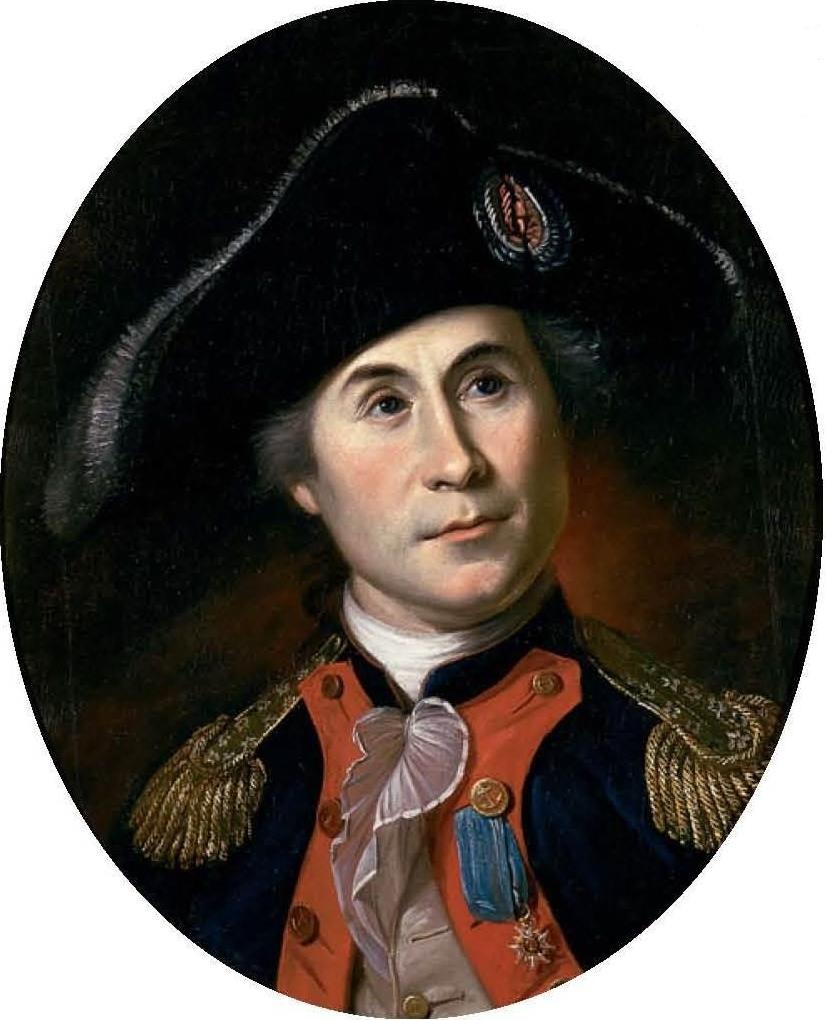
He was born John Paul — no surname — in a gardener’s cottage on the Arbigland Estate in Kirkbean, Scotland, the son of a man who tended other people’s grounds. He went to sea at thirteen. He changed his name, changed his country, and changed the course of a revolution. By the time John Paul Jones uttered his most famous words — “I have not yet begun to fight!” — in the middle of a losing battle three and a half hours long, he had already become something the young United States desperately needed: a naval officer of genius, ferocity, and unyielding will. He is remembered today as the Father of the American Navy, and his body rests beneath the chapel floor of the United States Naval Academy at Annapolis — a fitting home for a man who, as the inscription on his tomb declares, gave the nation’s navy “its earliest traditions of heroism and victory.”
Early Life: The Sea Calls from Kirkbean
John Paul Jones was born on July 6, 1747, in Kirkbean, Scotland, the fourth of seven children.³ From childhood, he was drawn to the nearby port of Carsethorn, where he spent his free hours talking to sailors and clambering over moored ships. The pull of the sea was undeniable, and at thirteen, he signed on as an apprentice to a Scottish merchant shipper named John Younger, beginning his maritime education on voyages to Barbados and Virginia, where his older brother William had emigrated and established himself as a tailor.³
When John Younger’s business collapsed, Jones was released from his apprenticeship at seventeen and entered the slave trade — an experience he would later describe with disgust as an “abominable trade,” which he abandoned as quickly as he could.³ Both rapid advancement and recurring controversy marked his subsequent career as a merchant captain. He rose swiftly to command his own vessels. Still, accusations — of excessive flogging, and later of killing a mutinous crewman in the West Indies in a dispute over wages — dogged his reputation and ultimately forced a fateful decision.²
Facing potential trial in the Caribbean with local sentiment against him, Jones fled to Virginia in 1773. It was there, sheltered by his brother’s community and surrounded by the gathering storm of American colonial resistance, that John Paul became John Paul Jones — the name he would carry into history.⁴
Choosing a Revolution
Jones arrived in Virginia at a moment when the colonies were approaching the point of no return with Britain. His sympathies were entirely with the patriot cause. When the Continental Congress established the Continental Navy in 1775, Jones rushed to Philadelphia to offer his services and was commissioned as a first lieutenant in December of that year — one of the earliest officers of what would become the United States Navy.³
He began his naval career aboard the Alfred, serving under Commodore Esek Hopkins, and quickly impressed his superiors with his knowledge of tactics, seamanship, and the art of command. He was given his first independent command — the sloop Providence — in 1776 and proved immediately aggressive and effective. In a single extended cruise, he captured eight British prizes, sank or burned eight more, and disrupted British commerce and supply lines across the Atlantic.³ He was a naval officer who took the words he later wrote as a personal creed — “Whoever can surprise well must conquer” — and lived by them.²
Raid on Britain’s Own Shores
In June 1777, Jones was given command of the newly built sloop Ranger and sailed for France. He arrived in Brest in May 1778 to a hero’s welcome — and promptly became the first American naval officer to receive a formal salute from a foreign power when a French admiral returned his thirteen-gun salute in recognition of the Continental flag.¹
What followed was even more audacious. Operating out of Brest, Jones led a cruise into the Irish Sea and directly raided Whitehaven, England — the very port from which he had sailed as a boy — spiking the guns of the harbor fort and threatening British merchant shipping in home waters. He also crossed to Scotland and attempted to kidnap the Earl of Selkirk as a bargaining chip for American prisoners of war. The Earl was not home, but the raid sent a shock through the British public: the war had come to their doorstep.³
Days later, Jones engaged and captured the HMS Drake in the Irish Sea — the first major naval battle fought under the newly adopted Stars and Stripes flag, and the first time an American warship had taken a British naval vessel in British home waters.¹ He returned to Brest famous on both sides of the Atlantic. In Britain, some called him a pirate. In America and France, he was a hero.
“I Have Not Yet Begun to Fight”
The defining moment of Jones’s career — and one of the most celebrated single engagements in the history of American arms — came on the night of September 23, 1779, off Flamborough Head on the northeast coast of England. Jones was commanding the Bonhomme Richard, a converted French merchant vessel he had renamed in honor of his patron Benjamin Franklin — the title referring to Franklin’s famous Poor Richard’s Almanack.⁴ He commanded a squadron of seven ships and was intercepting a British merchant convoy when the fleet’s escort — the new, powerful frigate HMS Serapis — turned to engage him.
The Serapis outgunned the Bonhomme Richard in almost every respect. Within two hours of the battle’s opening, Jones’s ship was on fire, taking on water, and had lost much of her armament. Several of his own crew urged surrender.⁴ The British captain, Richard Pearson, called across the water and asked if Jones intended to strike his colors. Jones’s reply — “I have not yet begun to fight!” — became one of the most famous phrases in American military history.²
He did not surrender. Instead, he maneuvered the battered Bonhomme Richard alongside the Serapis. He lashed the two ships together, turning the battle into a ferocious, close-quarters fight that lasted another hour and a half. As dawn threatened, it was Captain Pearson who hauled down the British colors. Jones had won, but the Bonhomme Richard was so damaged that she sank two days later. Jones transferred his flag and crew to the captured Serapis and sailed for the Netherlands.³
The victory was celebrated across France and America. King Louis XVI awarded Jones a gold sword and the Order of Military Merit. Congress voted him a gold medal — the only naval officer to receive one during the Revolution.³
After the Revolution: Restless and Unrecognized
Jones returned to America in 1781 and spent the final years of the war advising Congress on the organization and training of a permanent naval force — work less glorious than battle but essential to the long-term strength of the republic.³ When peace came, however, the Continental Navy was disbanded, and Jones found himself without a commission, without financial security, and without the official recognition he believed his service had earned.
He offered his considerable skills to Empress Catherine II of Russia in 1788, serving as a rear admiral in the Imperial Russian Navy during a campaign against Ottoman forces in the Black Sea. Internal politics and court intrigue frustrated his ambitions there as they had in America, and by 1790, he had returned to Paris — the city that had celebrated him so wildly a decade earlier — where he spent his final years in declining health, writing letters to estranged family members and lobbying on behalf of sailors who had never been paid for their service aboard the Bonhomme Richard.²
John Paul Jones died alone in his Paris apartment on July 18, 1792, at the age of forty-five, of the kidney ailment nephritis, complicated by pneumonia. An admiring French friend arranged a handsome lead coffin and burial in the Saint Louis Cemetery for foreign Protestants — and with the quiet foresight that history sometimes grants, had the coffin sealed and filled with preserving alcohol against the day America might come looking for him.¹
A Hero Brought Home
That day came more than a century later. In the late 1890s, as the United States began a major naval expansion, interest in Jones was revived. American Ambassador to France General Horace Porter spent four years and his own personal funds searching for the forgotten cemetery — following antique maps, tracing correspondence, and eventually tunneling through basement walls and buried streets until the sealed lead coffin was found and disinterred.¹
When the casket was opened, the corpse — preserved remarkably well by the alcohol and sealed lead — was examined at the University of Paris, where it was compared to the 1780 sculptural portrait bust of Jones made by the great French sculptor Jean-Antoine Houdon, who had taken a plaster impression directly from Jones’s living face. The identification was conclusive.¹
In July 1905, the remains of John Paul Jones were transferred to the USS Brooklyn and escorted across the Atlantic by a special naval squadron sent by President Theodore Roosevelt. As the ship entered the Chesapeake Bay, seven battleships fired salutes. On April 24, 1906 — the anniversary of the battle between the Ranger and HMS Drake — elaborate ceremonies were held at the Naval Academy, attended by Roosevelt, Ambassador Porter, Admiral George Dewey, and a French naval fleet that sailed up the Chesapeake for the occasion.¹
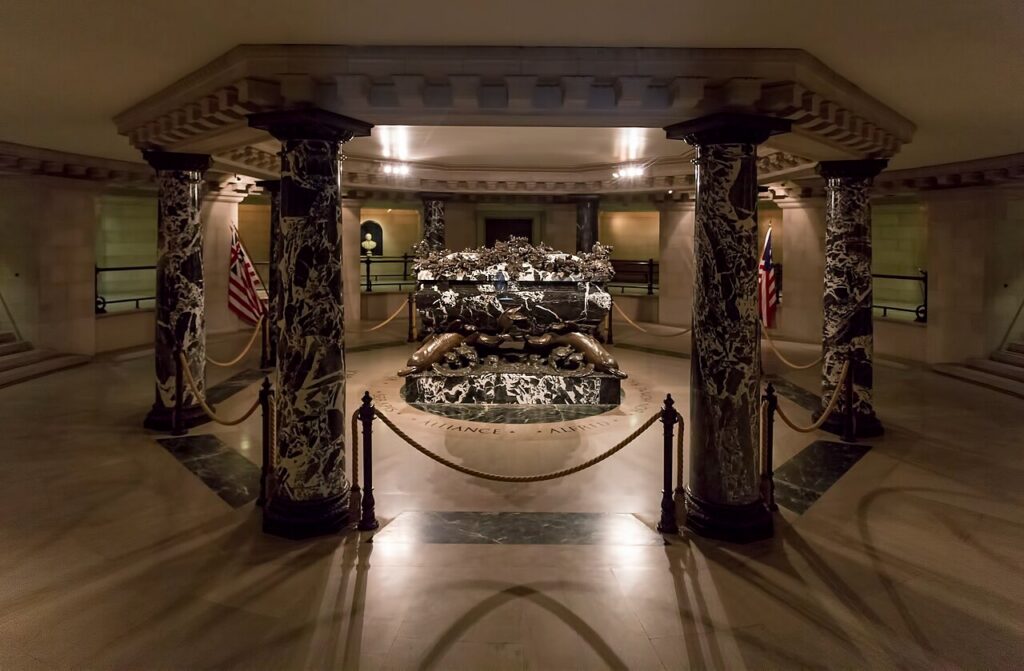
On January 26, 1913, John Paul Jones was laid to rest in the crypt of the United States Naval Academy Chapel in Annapolis, Maryland. The 21-ton marble sarcophagus — modeled after the tomb of Napoleon and supported by bronze dolphins — bears on its base the names of every Continental Navy ship Jones commanded. The inscription above reads: *He Gave Our Navy Its Earliest Traditions of Heroism and Victory.*¹ Visitors may pay their respects today during public visiting hours at the Chapel.
On the National Mall in Washington, D.C., a bronze statue of Jones — ten feet tall, his hand resting on the hilt of his sword — stands at the intersection of 17th Street and Independence Avenue SW, dedicated on April 17, 1912, by President William Howard Taft and unveiled by Admiral Dewey.⁴
Legacy and Civic Relevance
John Paul Jones never held public office, never signed a founding document, and never commanded a land battle. What he did was something the young republic could not survive without: he proved that America could fight at sea, carry the war to the enemy’s own shores, and build a naval tradition worthy of a sovereign nation. His example made possible the institutional development of American naval power that followed across the next two centuries.

His life also speaks to something larger about the founding era and the America 250 commemoration. Jones was not born an American. He was a Scot who chose this country, who saw in the revolutionary cause something worth his complete and irreversible commitment. He called the United States his “country of fond election.” That phrase — a deliberate choice of nation, made freely and at great personal risk — captures something essential about what the founding meant and still means.
His most famous words, spoken in the middle of a losing battle, offer a creed for any generation facing overwhelming odds: I have not yet begun to fight. As the nation marks America 250, John Paul Jones stands as proof that the founding was not only a political achievement but a demonstration of what human will and civic courage can accomplish when they find the right cause to serve.
Explore more stories from the Revolutionary era in our Founding Generation series.
Footnotes
- U.S. Naval Academy Public Affairs Office, “John Paul Jones,” https://www.usna.edu/PAO/faq_pages/JPJones.php
- American Battlefield Trust, “John Paul Jones,” https://www.battlefields.org/learn/biographies/john-paul-jones
- Naval History and Heritage Command, “John Paul Jones,” U.S. Department of the Navy, https://www.history.navy.mil/browse-by-topic/people/historical-figures/john-paul-jones.html
- National Park Service, National Mall and Memorial Parks, “John Paul Jones,” https://www.nps.gov/nama/planyourvisit/jones.htm