

Lucy Flucker Knox — Patriot by Choice, Partner in Revolution
Not every act of patriotism takes place on a battlefield. Some of the most consequential choices of the American Revolution were made in quiet moments of personal courage — a young woman defying her powerful family, stitching a sword into the lining of her cloak, sitting down to write an honest letter about the cost of war. Lucy Flucker Knox (1756–1824) made all of those choices, and many more. Born into one of Boston’s most prominent Loyalist families, she rejected a life of privilege and crown allegiance to stand with her husband and the cause of American independence — at the price of everything she had known. Her story is one of the most vivid illustrations in the founding era of what civic commitment, at its most personal, actually demands.
A World of Privilege and Expectation
![Knox, Lucy Flucker. "Lucy Flucker Knox." Object. [ca. 1790]. Massachusetts Historical Society, https://www.masshist.org/database/764](https://civicsforlife.org/wp-content/uploads/2026/04/image-4-683x1024.jpeg)
Lucy Flucker was born on August 2, 1756, in Boston, Massachusetts, the daughter of Thomas Flucker, the Crown-appointed Secretary of Massachusetts and one of the colony’s most powerful royal officials, and Hannah Waldo Flucker, whose family held vast tracts of land in Maine known as the Waldo Patent. The Fluckers were deeply connected to British authority and expected their daughter to marry into a family of equal wealth and political loyalty. This match would enhance the family’s standing in the colonial elite.¹
It was a world that offered Lucy comfort, education, and social standing. And it was a world she would choose to leave.
A Forbidden Love and a Fateful Decision
In the summer of 1773, seventeen-year-old Lucy spotted a striking young man drilling with the Boston Grenadier Corps and followed him to his bookshop in Boston’s printing district. The man was Henry Knox — a self-educated, working-class bookseller with radical politics and a passion for military history. He was, by every measure her family valued, entirely unsuitable.²
Her parents forbade the relationship. For two years, Lucy and Henry conducted a secret courtship through letters and stolen conversations. Henry called her “the animating object of my life.” In June 1774, just days before her eighteenth birthday, they married in secret — and Lucy’s family promptly disowned her.¹
The choice was deliberate and clear-eyed. Lucy understood that marriage to Henry Knox meant not only the loss of her family’s approval but also almost certain financial hardship. She chose him anyway. Within months, the political storm that had been building for years broke open, and her personal act of defiance became inseparable from the larger cause of American independence.
Escaping Boston and Entering the Revolution
When the Battles of Lexington and Concord erupted in April 1775, the world Lucy had grown up in collapsed almost overnight. British General Thomas Gage, who controlled Boston, threatened to arrest Henry if he attempted to flee the city. The Fluckers — loyal to the Crown — left the colonies entirely. Lucy stayed.³
In the spring of 1775, the Knoxes made their escape from British-occupied Boston in the middle of the night. According to longstanding accounts, Lucy sewed her husband’s sword into the lining of her cloak to smuggle the weapon past British sentries — one of the most enduring images of her courage and quick thinking.¹ Henry crossed over to the Continental Army encampment in Cambridge and soon enlisted under General George Washington. Lucy was left behind in Worcester, which Henry believed to be safer, as the war began in earnest.
Henry’s first great assignment — transporting 59 cannons and mortars over 300 miles of frozen wilderness from Fort Ticonderoga to Boston in the winter of 1775–76 — helped turn the tide in New England, forcing the British to evacuate Boston. Lucy, meanwhile, gave birth to their first child, a daughter, alone and far from home.¹
Life at the Camps: Service, Sacrifice, and Influence
For much of the Revolutionary War, Lucy Knox had no permanent home. She moved between rented rooms in taverns, the homes of friends, and — whenever Henry would allow it — the army encampments themselves.² Henry often resisted her visits, fearing both for her safety and the possibility that she or their children could be used against him, given his high rank. But Lucy went anyway. In one letter, she reminded him that he may be commander of the artillery, but she was “commander in chief of her own house,” and she would not be kept away from the only friend she had in the world.¹
At encampments including Valley Forge and Morristown, Lucy performed the work of a camp follower — helping with daily logistics, serving food, and organizing the social gatherings that sustained morale through brutal winters. She forged a deep and lasting friendship with Martha Washington, the two women spending long stretches side by side at camp.² During the Siege of Yorktown in 1781, when the final major campaign of the war was underway, Lucy stayed at Mount Vernon as Martha Washington’s guest while the armies fought south.
Her letters throughout the war — frank, intelligent, and sometimes searingly honest — offer one of the most vivid windows into the experience of Revolutionary-era women. Writing to her sister in April 1777, she lamented that war had turned brother against brother and parent against child, asking simply: “tis pity the little time we have to spend in this world — we cannot enjoy ourselves and our friends.”¹
A Voice Taken Seriously
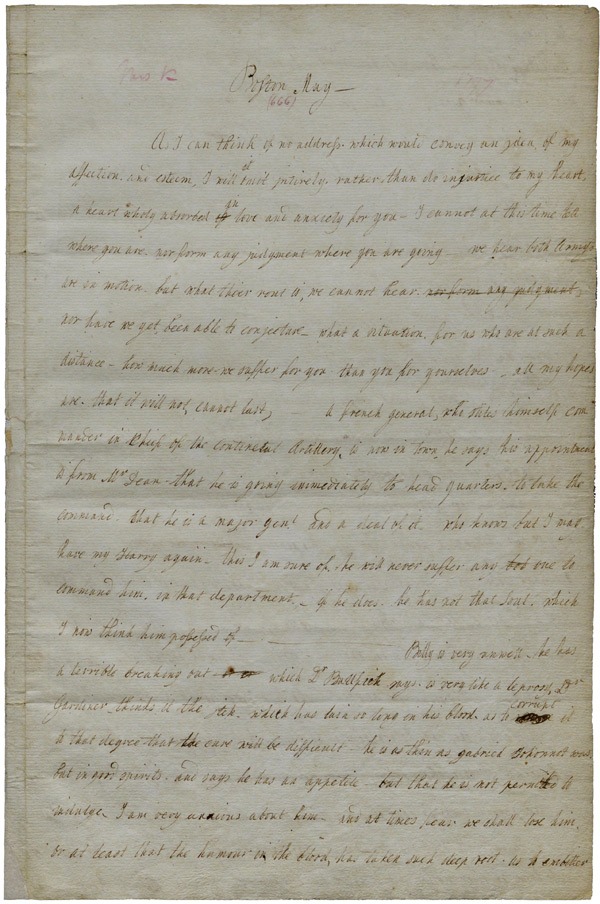
What distinguished Lucy Knox was not only her endurance but her active intellectual engagement with the war and the government it was building. She was not reluctant to discuss affairs of state directly with her husband, and by many accounts, Henry took her counsel seriously.³ Contemporary observers noted that General Knox appeared to regard his wife as a figure of superior judgment, and that her influence was acknowledged even by Washington himself.
Scholar Nancy Rubin Stuart, author of Defiant Brides, has described Lucy as a combination of forceful personality, social authority, and political intelligence — “kind of a combination of an Oprah and a Rosie O’Donnell and maybe a Margaret Thatcher,” someone who dominated the social and civic landscape of the Federalist period with deliberate purpose.²
When Henry was appointed the first Secretary of War of the United States in 1785, Lucy moved with him to the seat of government. She became one of the foremost social authorities of the new republic — more influential in matters of official ceremony, some observed, than even Martha Washington. She insisted on formality and dignity in the social rituals of the new nation, understanding that the republic’s conduct in public life was itself a civic statement.²
Land, Legacy, and Loss
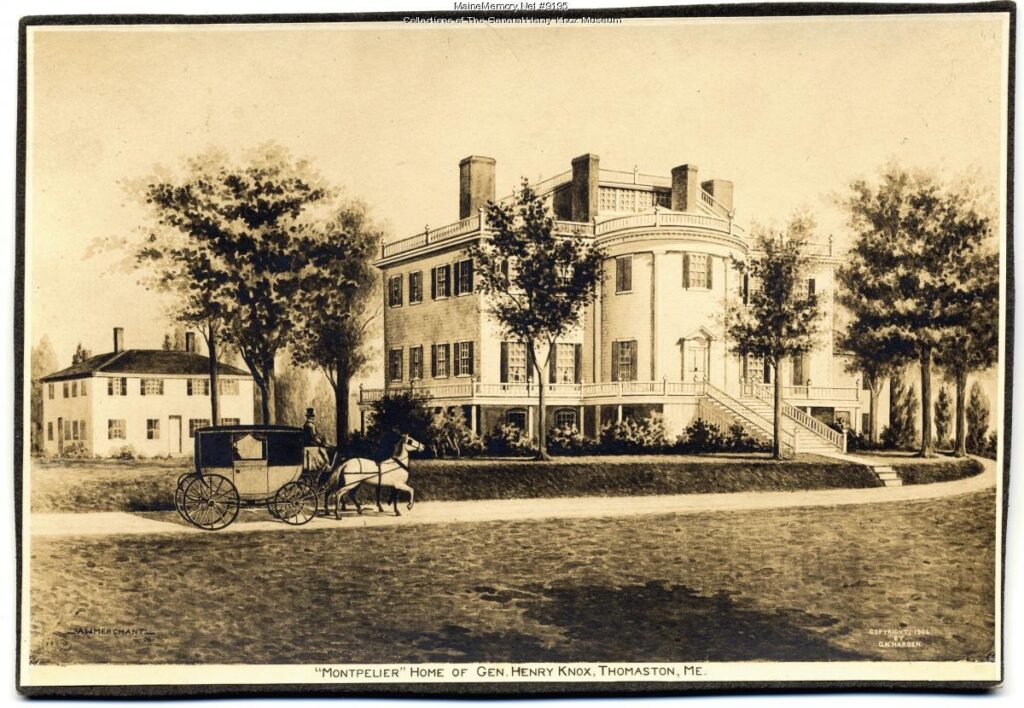
In 1795, Henry Knox retired from public service, and the couple moved to Maine, where Lucy claimed her inheritance from the Waldo Patent — thousands of acres of land that had been confirmed to the Knoxes after the Revolution, partly because Lucy was the only member of the Flucker family who had not remained loyal to the Crown. There, they built Montpelier, a nineteen-room mansion on the St. George River, where they entertained hundreds of guests, and Lucy presided over the social life of the region.¹
Of the thirteen children Lucy bore, only three survived to adulthood — a grief that shadowed even her most public years. Henry died in 1806, and Lucy outlived him by eighteen years, remaining a widow until her own death on June 20, 1824.
Legacy and Civic Relevance
Lucy Flucker Knox’s story is not a footnote to her husband’s. It is its own act of founding. She gave up family, security, and the world she was born into — not because she was swept up in someone else’s cause, but because she examined the conflict, made her own judgment, and committed to it fully and at great personal cost.
Her letters alone constitute a significant historical record — nearly two hundred exchanged with Henry during the war, candid about loneliness, fear, politics, and the day-to-day experience of a nation being born under fire.³ They are among the most complete correspondence between Revolutionary-era spouses that spans the entire conflict.
Lucy Flucker Knox stands as a reminder that civic life has always been shaped by people who choose principle over comfort — and that the founding of the republic was not only the work of men on battlefields and in legislative halls, but of women who defied convention, endured hardship, and brought intelligence, courage, and care to the cause of a new nation.
Explore more stories from the Revolutionary era in our Founding Generation series.
Footnotes
- American Battlefield Trust, “Lucy Flucker Knox,” https://www.battlefields.org/learn/biographies/lucy-flucker-knox
- National Endowment for the Humanities, Humanities Magazine, “Love and the Revolution,” https://www.neh.gov/humanities/2013/septemberoctober/statement/love-and-the-revolution
- George Washington’s Mount Vernon Digital Encyclopedia, “Lucy Knox (1756–1824),”https://www.mountvernon.org/library/digitalhistory/digital-encyclopedia/article/lucy-knox-1756-1824