

Mexican Independence and Mexico’s Colonization of Texas
How an eleven-year struggle ended in a negotiated settlement — and how the frontier policy Mexico adopted afterward set in motion the story of Anglo-American Texas.
On September 27, 1821, the Army of the Three Guarantees entered Mexico City in a solemn, peaceful procession, making visible the collapse of Spanish colonial authority in Mexico after nearly three centuries of rule.1 It is tempting to treat that day as the whole story — the moment Mexico simply appeared as an independent nation. It was not. Entry into the capital was the last visible step in a process that unfolded over eleven years of war and, in its final phase, seven months of negotiation: a proclamation in February, a treaty in August, and a formal declaration the day after the army’s march into the city.
Independence placed Texas under a new Mexican government that, over the next several years, adopted colonization laws intended to secure and develop its northern frontier. Understanding how independence was won helps explain why Mexico invited American settlement into Texas in the first place, and why that invitation was not the opening move in a story about annexation, but the closing move in a story about building a nation.
A War Eleven Years in the Making
Mexico’s independence movement grew out of an economic and political crisis that began well before anyone raised arms. An 1804 royal decree confiscating Church assets, disrupted overseas trade, poor harvests, and mounting colonial debt strained New Spain in the years before the war.1 The opening came in 1808, when Napoleon invaded Spain and forced King Ferdinand VII’s abdication. The political vacuum in Madrid gave criollos—American-born people of Spanish descent who often resented peninsular Spaniards’ dominance of the colony’s highest offices—an opening to challenge that control.1
Hidalgo’s Grito de Dolores
On September 16, 1810, the parish priest Miguel Hidalgo y Costilla issued his Grito de Dolores from his church in the town of Dolores, mobilizing a broad, socially mixed uprising that included many Indigenous and mixed-race rural people alongside some criollo supporters.1 Royalist forces under General Félix María Calleja defeated Hidalgo’s army at the Battle of Calderón Bridge in January 1811. Hidalgo and other insurgent leaders were captured at the Wells of Baján on March 21 while fleeing north; Hidalgo was executed in Chihuahua on July 30, 1811.1
Morelos and the Movement’s Long Retreat
José María Morelos y Pavón took up the cause after Hidalgo’s death. He convened the Congress of Chilpancingo, advanced the Sentimientos de la Nación in 1813, and helped give the movement a formal declaration of independence and the 1814 Constitution of Apatzingán.1 Without sustained support from many elite creoles, and under intense royalist military pressure, the movement could not hold territory; Morelos was captured in November 1815 and executed on December 22, 1815, and the war fragmented into scattered, localized revolts that would smolder for another five years.1
The Plan of Iguala and Its Three Guarantees
The final turn came from an unlikely direction. In 1820, a military uprising in Spain forced Ferdinand VII to restore the liberal Constitution of 1812, reshaping the political crisis across the Spanish empire.1 Agustín de Iturbide, a royalist officer who had spent years fighting the insurgency, reached an accommodation with insurgent leader Vicente Guerrero and other supporters of independence.1 The result, proclaimed on February 24, 1821, was the Plan de Iguala. A proclamation that unified Guerrero’s insurgent forces and Iturbide’s regular army under a single political program.2
The plan rested on three guarantees, later commemorated in the name of the army that carried it forward: the preservation of Roman Catholicism as the established religion; Mexican independence under a constitutional monarchy; and union among the inhabitants of Mexico. The plan sought to remove distinctions between Spaniards born in Europe and those born in the Americas, while other provisions used broader language about the rights and citizenship of inhabitants. These declarations did not erase the social, racial, and economic inequalities inherited from the colonial system.2
The Treaty of Córdoba and the Army’s Entry into Mexico City
A Negotiated Recognition
On August 24, 1821, Agustín de Iturbide and Juan O’Donojú, Spain’s newly appointed political chief in New Spain, signed the Treaty of Córdoba. The agreement extended the Plan of Iguala and recognized an independent Mexican constitutional monarchy, though the Spanish government later refused to accept the treaty.3 The treaty provided for Mexico’s new Congress to elect an emperor if no suitable European prince accepted the throne, a detail that mattered within months, when, lacking Spanish acceptance, Iturbide was subsequently proclaimed Emperor Agustín I with the backing of military and political supporters.3 Spain’s rejection did not restore its authority in Mexico, but formal diplomatic recognition by Spain came only in 1836. The Treaty of Córdoba therefore mattered as a negotiated settlement that helped consolidate independence on the ground, not as a treaty Madrid ultimately ratified.3
The Army of the Three Guarantees Enters the Capital
The military and political outcome of Córdoba became visible five weeks later. On September 27, 1821, the Army of the Three Guarantees, under Iturbide’s command, entered Mexico City in a peaceful procession that made visible the collapse of Spanish colonial authority after nearly three centuries of rule.1 On September 28, 1821, Mexico’s new governing junta signed the Acta de Independencia del Imperio Mexicano — the Mexican Empire’s formal declaration of independence, following the Plan of Iguala, the Treaty of Córdoba, and the army’s entry into the capital. A printed edition of the Acta appeared less than two weeks later, on October 10, 1821, bearing the signature of José Manuel de Herrera as secretary of relations for the new government.4 The two dates — September 27 and 28 — are easy to collapse into one, but they marked distinct acts: the army’s entry made the collapse of Spanish authority visible, while the Act of Independence was the new government’s formal declaration, not the sole legal act that created Mexican sovereignty on its own.

Source: “Generales del Trigarante” (Entrada del Ejército Trigarante a la Ciudad de México), lithograph by Julio Michaud, c. 1840s, Instituto Nacional de Antropología e Historia (INAH) collection. Wikimedia Commons, public domain.
A Frontier Already Inhabited
Independence changed who governed Mexico. It did not change who already lived on Mexico’s northern frontier, including Texas, New Mexico, California, and the northern reaches of Sonora, Chihuahua, and Coahuila. Before any colonization law invited a single American settler into Texas, the region was home to established Indigenous nations and to Mexican residents whose communities predated the empresario system by generations.
Comanche Power on the Southern Plains
Comanche people call themselves Nermernuh, “the People.” By the 1820s, Comanche communities exercised major military, diplomatic, and commercial power across the Comanchería, a broad region encompassing much of the southern plains and parts of Texas; Spanish authority there had already been declining for years, and Mexican independence did little to change that balance of power.5 Their political organization was decentralized: bands formed, divided, and made decisions through leaders and councils rather than a single unified state, so no single treaty or chief could bind Comanche communities as a whole.5 Mexican officials and Comanche leaders negotiated shifting peace and trade arrangements in the late 1820s. Those arrangements reflected Comanche power and Mexican officials’ limited capacity to enforce policy across the frontier, and Comanche traders continued to control regional exchange networks—bartering buffalo products, horses, and captives for manufactured goods.5 Historian Pekka Hämäläinen has argued that Comanchería functioned as its own political and economic power center throughout this period — a reminder that Spanish, Mexican, and later Texian and U.S. authority all operated at the edges of Comanche power, not over it.6
The Karankawa of the Gulf Coast
Along the Gulf Coast between Galveston Bay and Corpus Christi Bay lived several Indigenous communities historically grouped under the name “Karankawa.” Colonial and later sources used multiple band names, but those labels do not necessarily represent fixed, uniform, or self-defined political units.7 Anglo-American settlement brought escalating conflict, displacement, disease, and violence to Karankawa communities along the Texas coast in the years that followed.7 Older histories often described the Karankawa as extinct by the mid-nineteenth century — a narrative that historian Tim Seiter’s 2020 revision of the standard reference entry on the Karankawa corrects by tracing family lines from a supposed 1858 “extinction point” forward to the present, using archival records alongside descendant oral histories.7 Today, descendants who call themselves the Karankawa Kadla — kadla meaning “culturally mixed” — continue to reclaim Karankawa identity, language, and cultural practices along the Gulf Coast, work an organization representing them describes simply as “preserving Karankawa heritage.”8, 9
Tejano Texas Before Anglo Settlement
Tejano is now commonly used for Texans of Mexican descent, and Mexican residents of Texas were established there well before the first Mexican empresario contract. Historical variants of the term appeared during the Mexican period itself: in 1824, Miguel Ramos Arizpe, author of Mexico’s federal constitution, referred to Texas residents as Tejanos, and after independence the term Coahuiltejano identified residents of the newly combined state of Coahuila y Tejas.10 Historians distinguish these established Tejano communities from the Texian, Anglo-American, settlers who began arriving under the colonization laws described below, a distinction that mattered for how the two populations understood their stake in Texas’s future.10
Opening the Northern Frontier: Mexico’s Colonization Laws
Mexico’s new government inherited a northern frontier it considered vulnerable and underdeveloped. Its answer, developed over the following four years, was a series of colonization laws designed to bring settlers — and revenue, and a buffer against foreign encroachment — into Texas under Mexican terms and Mexican sovereignty.
The Imperial Colonization Law of 1823
On January 3, 1823, the Junta Instituyente — the governing body acting under Emperor Iturbide — enacted the Imperial Colonization Law, inviting Catholic immigrants to settle in Mexico and providing a national framework for agents, called empresarios, to introduce immigrant families into the country in organized units of two hundred.11, 12 Farmers received at least one labor of land (about 177 acres); cattle ranchers received one league (about 4,428 acres); those doing both received both grants. Empresarios earned substantial bonus lands, up to three haciendas and two labors, roughly 66,774 acres, for every two hundred families they successfully settled.11 Settlers received six years free of taxes, then six more at half rates, could import goods and tools duty-free up to $2,000 in value, and could become naturalized citizens after three years if married and self-supporting.11 Article 30 prohibited domestic slave trading and provided that children born to enslaved people in Mexican territory would become free at age fourteen, provisions that were sometimes evaded in practice.11
The General and State Colonization Laws of 1824–1825
The National Colonization Law of August 18, 1824, gave Mexican states broad authority to regulate settlement on unappropriated land, but it also kept Mexico City’s hand on the frontier’s most sensitive ground: no land could be granted within twenty leagues of an international boundary, or within ten leagues of the coast, without the approval of the federal executive.11 Congress also reserved the right to restrict immigration from specific nations for national security reasons, and capped any individual land title at eleven leagues.11
The Coahuila and Texas state colonization law followed on March 24, 1825, providing the immediate legal framework for settlement in Texas itself.11 Under it, the state provided immigrant heads of family a league of land, subject to fees and settlement conditions, with payments due in years three through six; empresarios received five leagues of bonus land for every hundred families introduced; colonists were exempt from taxes (aside from military contributions) for ten years; and settlers acquired Mexican citizenship automatically upon settling.11
Read together, these laws were not written with an eye toward eventual American annexation. Mexico sought to secure and develop a vulnerable northern frontier under its own sovereignty — their federal-control provisions over border and coastal land, their citizenship and religious requirements, and their emphasis on settling loyal, productive families all point toward a government trying to keep and strengthen a frontier it considered its own, not one preparing to give it away.
By 1830, Mexico’s approach was changing. Concerned about the growing number of immigrants from the United States and the difficulty of maintaining control of the frontier, the federal government passed the Law of April 6, 1830. It restricted immigration from the United States, suspended some empresario contracts, and prohibited the further introduction of enslaved people into Mexico. The law marked a significant shift from the earlier policy of encouraging immigration and became an important source of tension between Mexican authorities and Anglo-American settlers.13
Moses Austin’s Petition and Stephen F. Austin’s Colony
The colonization laws had a direct predecessor, one that arrived before Mexico itself existed as an independent nation. In late 1820, Moses Austin, a former banker from Missouri, traveled to San Antonio de Béxar to seek permission from Spanish authorities to introduce three hundred families into Texas; Spanish officials granted the permit on January 17, 1821, well before the first Mexican empresario contracts.13 Austin died in June 1821, months before Mexican independence was even achieved, leaving the undertaking to his son, Stephen Fuller Austin.13
Stephen F. Austin spent the next two years navigating a rapidly changing political landscape, from a Spanish colony to an independent empire under Iturbide, then to the federal republic that followed. He received the only empresario contract issued under the Imperial Colonization Law before Iturbide’s empire fell in March 1823; the following month, in April 1823, the newly restored republican Congress confirmed the contract.13 Austin secured four additional six-year contracts between 1823 and 1828, and a fifth contract in 1831 that was later disputed; by 1834, available Texas historical records estimate that he had settled about 966 families across a large territory between the Brazos and Colorado rivers.13 The first three hundred families were required to be Catholic under the terms Moses Austin had originally negotiated; later Mexican and Coahuila y Tejas laws required Christian settlers more broadly, along with an oath of loyalty and obedience to Mexican law.13 A family head could typically receive a league and a labor of land, about 4,605 acres, at a low fee payable over several years, while empresarios earned bonus land after meeting their family-settlement benchmarks; only state-appointed land commissioners, not the empresarios themselves, could issue final land titles.13
Available tallies place Austin’s colony at about 1,800 people, including enslaved people, in 1826, and 5,565 by 1831 — though surviving records from the period are incomplete and such figures should be treated as estimates.13 Other empresarios followed: Green DeWitt settled 189 families before his contract expired in 1831, and Martín De León, one of the relatively few Mexican-born empresarios, founded his own colony near Victoria, a reminder that the colonization system was a Mexican legal framework applied to more than one population, not simply a pipeline for Anglo-American settlement.13
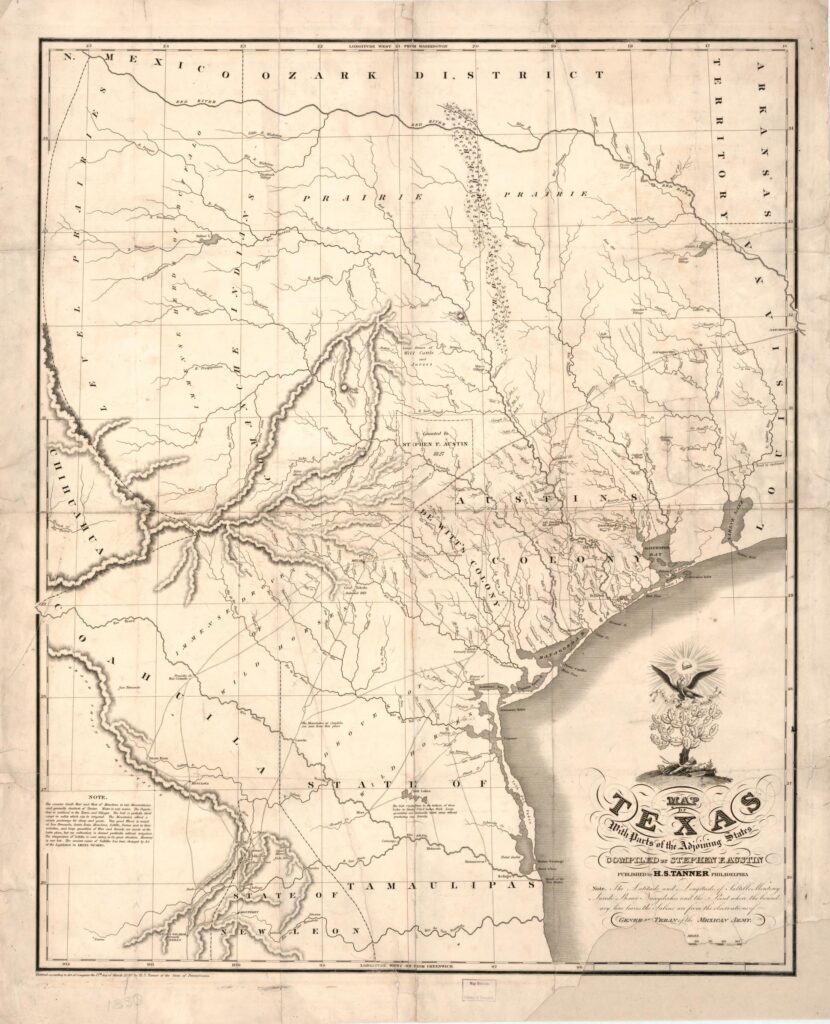
Source: Map — Stephen F. Austin (cartographer), “Map of Texas with parts of the adjoining states,” Henry Schenck Tanner, 1830. Library of Congress. Population figures — Texas State Historical Association, “Anglo-American Colonization”
Mexico’s Frontier and a New Political Problem
Mexico’s colonization laws sought to secure and develop a vulnerable northern frontier under Mexican sovereignty. They did not anticipate surrendering Texas. Yet Anglo-American migration rapidly changed the province’s population, economy, and political pressures. By the early 1830s, disputes over immigration, slavery, federal authority, local governance, and national identity had made the colonization system itself part of the crisis to come—tensions that would build toward the Texas Revolution of 1836 and, a decade later, toward the political fight in Washington over annexation.
That story, how a colony authorized under Mexican law became first a republic and then a contested addition to the United States, is the subject of our next entry in the Growing America series.
Read more from this era in The Mexican-American War Begins, Texas and the Road to Annexation, and The Treaty of Guadalupe Hidalgo and America’s New Border.
Endnotes
- Texas State Historical Association — “Mexican War of Independence”
- Agustín de Iturbide, Plan de Iguala, February 24, 1821, Spanish-language primary text — Mexican Government Documents Collection, Digital Commons @ California State University, Monterey Bay
- Library of Congress — “Independence from Spain to President Porfirio Díaz,” The Mexican Revolution and the United States exhibition
- Acta de Independencia del Imperio Mexicano, signed September 28, 1821; printed October 10, 1821 — Rare Book Division, New York Public Library, “Mexican Declaration of Independence”
- Carol A. Lipscomb, “Comanche Indians,” Handbook of Texas Online, Texas State Historical Association
- Pekka Hämäläinen, The Comanche Empire (New Haven: Yale University Press, 2008).
- Tim Seiter, “Karankawa Indians,” Handbook of Texas Online, Texas State Historical Association (rev. 2020)
- Texas Tribune — “Karankawa People, Once Thought Extinct, Reclaim Their Culture on the Gulf Coast,” October 4, 2021
- Karankawa Kadla (organization site)
- Texas State Historical Association — “Tejano”
- Texas State Historical Association — “Mexican Colonization Laws”
- Texas State Historical Association — “Empresario”
- Texas State Historical Association — “Anglo-American Colonization in Mexican Texas (1821–1835)”