

Peter Salem: A Soldier of the American Revolution
From Enslavement to Military Service
Peter Salem was born into slavery in Framingham, Massachusetts, in 1750, where he grew up working on a farm before the outbreak of revolutionary conflict. In early 1775, his enslaver, Major Lawson Buckminster, emancipated him so he could enlist in the local militia and serve in the Patriot cause that was rapidly gaining strength in New England.¹
Salem’s journey reflects the complex dynamics of freedom and military service during the Revolutionary era: for some formerly enslaved men, joining the militia offered both a path to self-determination and active participation in a war for liberty, even as slavery remained entrenched.¹
Early Engagements and Bunker Hill
Salem first saw action in the opening engagements of the war, including the Battles of Lexington and Concord on April 19, 1775, as part of the Framingham militia. Shortly afterward, he was mustered into Colonel John Nixon’s 5th Massachusetts Regiment and fought at the Battle of Bunker Hill on June 17, 1775.¹
During that chaotic and fiercely fought battle, Salem’s role became part of Revolutionary memory. Historical accounts from American observers credited him with firing the shot that mortally wounded British Major John Pitcairn, a senior officer leading the assault against colonial defenders. While British reports differ on the exact source of the fatal shot, the belief that Salem delivered it became an enduring part of his reputation.²
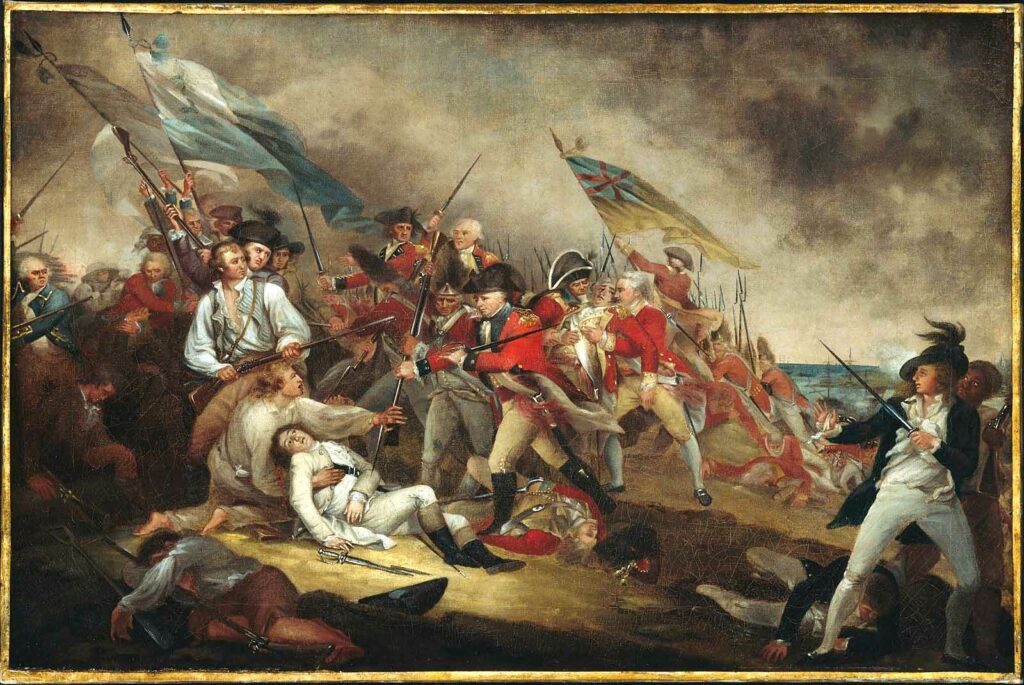
The idea that Salem delivered this decisive blow held symbolic meaning for Americans at the time and contributed to his later remembrance. His presence in battle was cemented in popular imagery when the artist John Trumbull included a Black soldier, traditionally identified as Salem, in his famous painting The Death of General Warren at the Battle of Bunker’s Hill.²
Continued Service in the Revolution
Salem continued serving after Bunker Hill. Contemporary records show he enlisted with the Continental Army and fought in additional campaigns throughout the war, including engagements in New York and New Jersey. His service extended beyond a single battle and demonstrated sustained commitment to the Patriot forces during critical campaigns.¹
Despite this long service, like many Revolutionary veterans, Salem faced economic uncertainty after the war’s end. His name appears infrequently in the historical record after discharge, but the communities of Massachusetts eventually recognized his contributions more publicly in later decades.

Legacy and Recognition
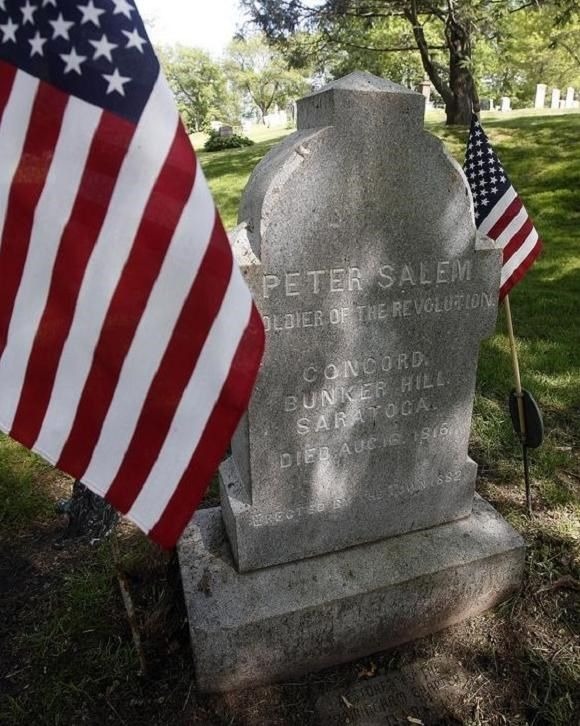
Peter Salem died in 1816 in his hometown of Framingham. Nearly seventy years later, in 1882, the town erected a monument at his gravesite in the Old Burying Ground to honor his service in the Revolution.³
His legacy goes beyond a single act in battle. Salem’s story broadens common narratives about the Founding Era to include Black Patriots whose service and sacrifices were significant but often overlooked. His life illustrates the promise and contradictions of early American claims about liberty and equality, especially for men and women who were formerly enslaved or free Black citizens.
Why Peter Salem Matters Today
Peter Salem’s story enriches our understanding of the Revolutionary generation by reminding civic learners that the fight for American independence involved a diversity of experiences and backgrounds. Studying his life alongside political and military leaders underscores a more complete history of the nation’s founding struggles.
Explore more stories from the Revolutionary era in our Founding Generation series.
Footnotes
- National Park Service, “Peter Salem,” National Park Service, https://www.nps.gov/people/peter-salem.htm
- American Battlefield Trust, “Historic Overview: Peter Salem and Battle of Bunker Hill,” https://www.battlefields.org/learn/biographies/peter-salem
- City of Framingham, MA, “Peter Salem,” https://www.framinghamma.gov/3965/Peter-Salem