

Prince Whipple: Enslaved Soldier in the Fight for Liberty
From Africa to Enslavement in New England

Prince Whipple was born in Africa around 1750 and enslaved as a child before being brought to New England. Little is known about his early life before enslavement, a reflection of how frequently the identities of enslaved people were erased from the historical record. By the time of the American Revolution, he was living in Portsmouth, New Hampshire, enslaved by William Whipple, a merchant who would later become a brigadier general and a signer of the Declaration of Independence.¹
Whipple’s life in colonial America was shaped by forced labor and legal bondage, yet it unfolded alongside a growing political movement centered on liberty, resistance, and natural rights. This contradiction—between revolutionary ideals and the continued existence of slavery—defined the lived experience of many enslaved people during the founding era.
Service During the American Revolution
When the Revolutionary War began, Prince Whipple served with William Whipple in a military capacity. Records indicate that he accompanied Whipple during campaigns and was present during key moments of the war, including the winter of 1776–1777. His service reflects the broader participation of thousands of enslaved and free Black men who contributed to the American war effort, often in hopes that military service might bring freedom or improved status.²
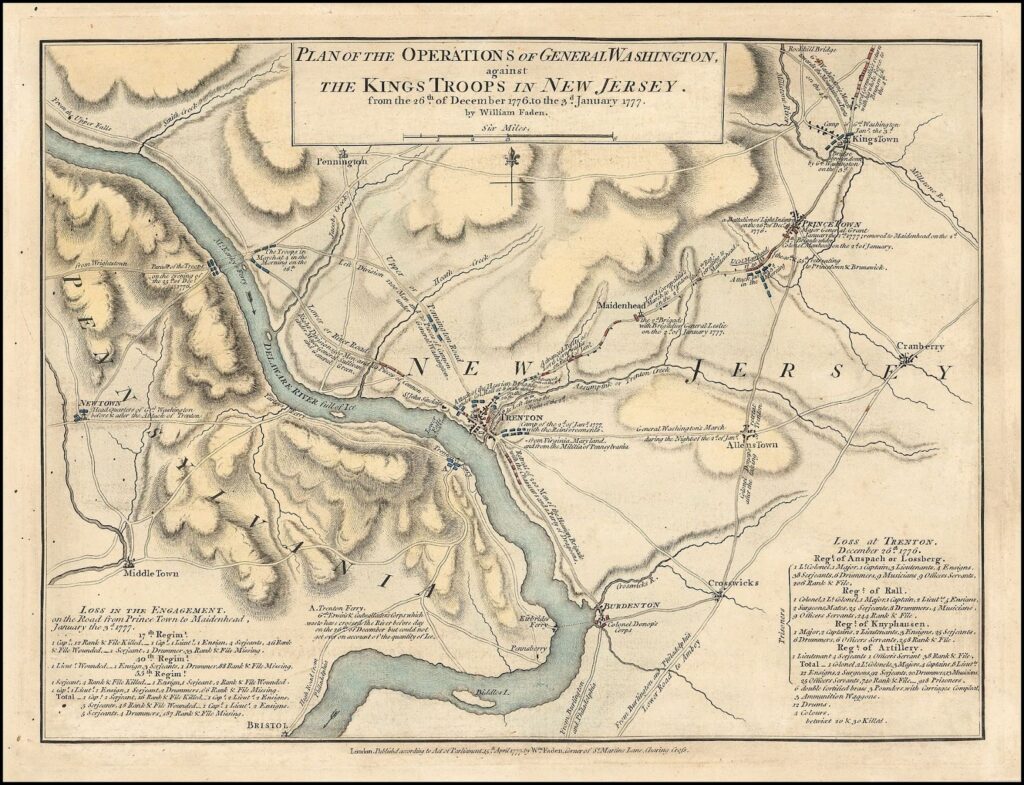
Although documentation is limited, Prince Whipple is widely believed to have crossed the Delaware River with General George Washington’s army on the night of December 25, 1776. This event later became immortalized in art and memory as a turning point in the war.
Appearing in a Famous Painting
Prince Whipple is commonly identified as one of the figures in Emanuel Leutze’s iconic 1851 painting, Washington Crossing the Delaware. In the image, a Black man stands prominently at the front of the boat, guiding it through icy waters. While Leutze painted the scene decades after the event and took artistic liberties, historians generally agree that the figure represents Prince Whipple.³
The inclusion of a Black figure in one of the most recognizable images of the American Revolution has made Prince Whipple a powerful symbol. His presence challenges simplistic narratives of the founding and reminds viewers that people of African descent were part of the nation’s earliest struggles—even when denied the rights they were claiming.


Fighting for Freedom in an Unfree World
Prince Whipple’s story embodies the central paradox of the American Revolution. He fought in a war framed around liberty while remaining enslaved for much of his life. After the war, William Whipple reportedly became an advocate for abolition, influenced in part by conversations with Prince Whipple about the meaning of freedom. William Whipple freed Prince Whipple before his death in 1785.⁴
Prince Whipple later married Dinah, an enslaved woman who was also emancipated, and the couple lived as free people in New Hampshire. Prince Whipple died in 1796, a free man—but one whose freedom came late and whose contributions went largely unrecorded for generations.⁵
Why Prince Whipple Matters Today
Prince Whipple is not remembered for holding office or signing documents, but his life offers an essential perspective on the founding era. His service underscores that the fight for independence depended on the labor, courage, and sacrifice of people excluded from the promises of the new nation.
Studying Prince Whipple broadens our understanding of the Founding Generation by placing lived experience alongside political philosophy. His story encourages reflection on how ideals of liberty were contested, incomplete, and unevenly applied—and how the struggle to align principle with practice has continued throughout American history.
Prince Whipple’s legacy reminds us that civic learning is not only about famous names, but about understanding whose stories were left out—and why they still matter.
Explore more stories from the Revolutionary era in our Founding Generation series.
- New Hampshire Historical Society, “William Whipple Jr,”
https://www.nhhistory.org/object/255366/whipple-william-jr-1730-1785 - National Park Service, “1779 Petition to the New Hampshire Government,”
https://www.nps.gov/articles/000/inde-1779-petition-new-hampshire-prince-whipple.htm - Metropolitan Museum of Art, Washington Crossing the Delaware,
https://www.metmuseum.org/art/collection/search/11417 - George Washington’s Mount Vernon, “William Whipple,”
https://archives.mountvernon.org/agents/people/1676 - BlackPast, “Prince Whipple (c. 1750–1796),”
https://www.blackpast.org/african-american-history/whipple-prince-1750-1796/