

Samuel Adams — The Spark That Lit the Revolution
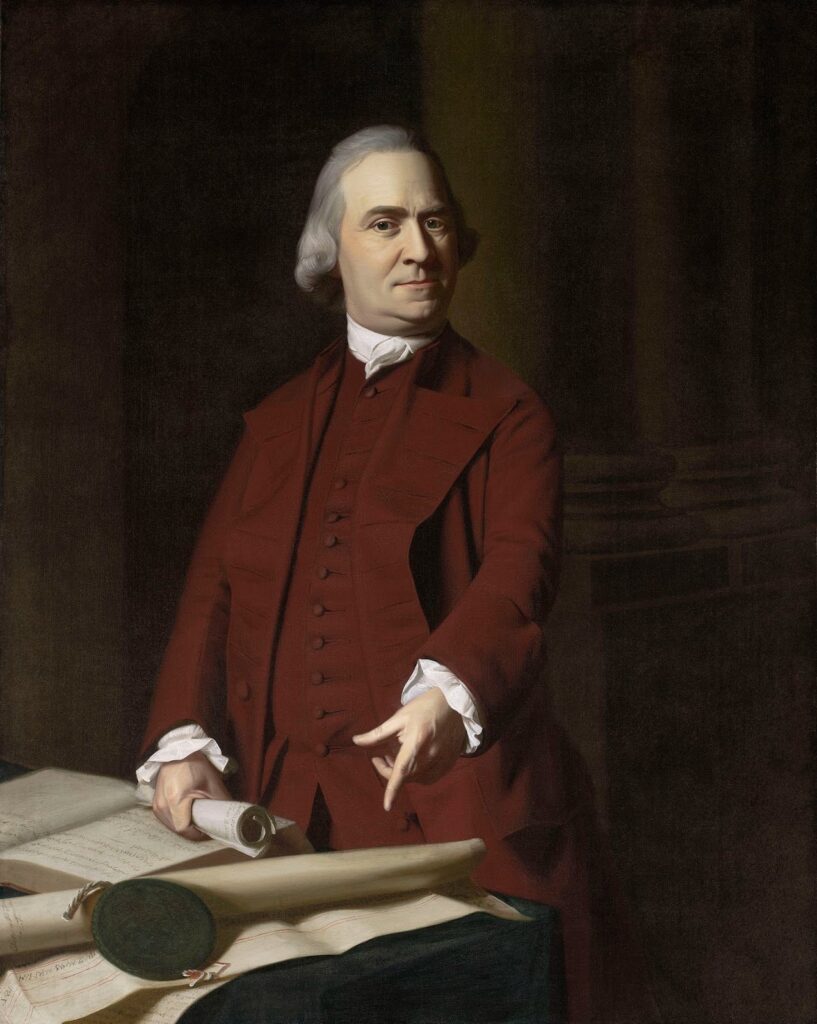
Before there were armies, before there were battles, before there was a Declaration of Independence, there was Samuel Adams — writing furiously, organizing relentlessly, and persuading ordinary citizens that their rights were worth fighting for. More than perhaps any other figure of the founding era, Adams understood that revolutions are not made on battlefields alone. They are made in print shops, in meeting houses, in taverns, and in the public square, wherever citizens gather to debate the meaning of liberty. His life is a study in the power of civic engagement — and a reminder that the road to self-government is built by those willing to do the hard, unglamorous work of awakening a people to their own cause.
Early Life: Failure, Faith, and Political Fire
Samuel Adams was born on September 27, 1722, in Boston, Massachusetts, into a family steeped in both Puritan faith and political activism.¹ His father, a prosperous deacon and brewer, was himself no stranger to civic life — he regularly organized local citizens to lobby Boston’s political officials, and young Samuel frequently accompanied him. These early lessons in the power of organized public pressure would prove formative.
Adams attended Harvard College, where he encountered the Enlightenment philosophy of John Locke — the idea that all people possessed inherent rights and that government existed only by the consent of the governed. His 1743 master’s thesis argued the legality of resisting British authority. The intellectual framework of the Revolution was taking shape in his mind long before the first shot was fired.²
His professional life, by contrast, was a study in repeated setbacks. He failed at business, proved spectacularly inept as a city tax collector — his ledgers reportedly came up short by thousands of pounds — and struggled to hold a steady occupation.³ What he could do, with remarkable gifts, was write and organize. He and a circle of friends launched an early newspaper, The Public Advertiser, through which Adams urged Bostonians to cherish their liberties and be wary of both complacency and recklessness. Politics was his true vocation, and he pursued it with the single-mindedness of a man who had found his calling.¹
The Voice of Colonial Resistance
When Britain began taxing the colonies in earnest after the Seven Years War — starting with the Sugar Act of 1764 — Adams recognized the moment for what it was. While other colonists grumbled about economic harm, Adams elevated the argument to a matter of principle: taxation without representation was not merely an inconvenience but a violation of the fundamental rights of British subjects. “If Taxes are laid upon us in any shape without our having a legal Representation where they are laid,” he wrote, “are we not reduced from the Character of free Subjects to the miserable State of tributary Slaves?”¹
He was elected to the Massachusetts House of Representatives in 1765, the same year the deeply unpopular Stamp Act passed, and he served in that body for nine years.³ From that platform, he organized boycotts, drafted petitions, and wrote prolifically under pen names including “Vindex” and “Candidus,” seeding the public with arguments against British authority.² He helped build the Sons of Liberty into a powerful popular force and was instrumental in convincing Boston merchants to stop importing British goods.
When British troops arrived to occupy Boston in 1768, Adams doubled his efforts. He publicized soldiers’ abuses against ordinary citizens, kept colonists’ grievances alive in print, and worked to spread the resistance movement beyond Massachusetts to the other colonies. After the Boston Massacre of 1770, he led elaborate memorial processions to honor the victims — ensuring that neither Bostonians nor the wider colonial world would forget what unchecked military authority could do. Even then, he urged that the accused soldiers receive a fair trial, persuading his cousin John Adams to take up their defense.⁴
The Boston Tea Party and the Point of No Return
By 1773, Parliament’s passage of the Tea Act — which granted the British East India Company a monopoly on colonial tea sales — gave Adams a new and urgent cause. He organized meetings at Old South Meeting House, where thousands of Bostonians gathered to debate and resist the tea shipments. He led negotiations with ship owners and customs officials, making every effort to resolve the standoff lawfully. When those efforts failed, and Royal Governor Thomas Hutchinson refused to let the ships return to London, Adams rose from his pew and declared: “This meeting can do nothing more to save the country!”²
What followed became one of the most famous acts of political defiance in American history. A group of colonists — some dressed as Mohawk warriors — boarded the tea ships in Griffin’s Wharf and dumped 342 chests of British tea into Boston Harbor. Adams celebrated the action the very next day, writing to fellow patriots in New York and Philadelphia of how peaceful and principled the destruction of the tea had been, calling it “conducted with decency, unanimity, and spirit.”²
Britain’s retaliatory Coercive Acts — closing Boston’s port, stripping Massachusetts of its charter, stationing troops in homes — only accelerated the path toward open conflict. Adams had long anticipated this moment. When British General Thomas Gage marched troops toward Lexington in April 1775 to arrest Adams and John Hancock and seize stored weapons, American spies alerted the countryside. The resulting Battles of Lexington and Concord marked the opening shots of the Revolutionary War.³
Delegate, Signer, and Statesman
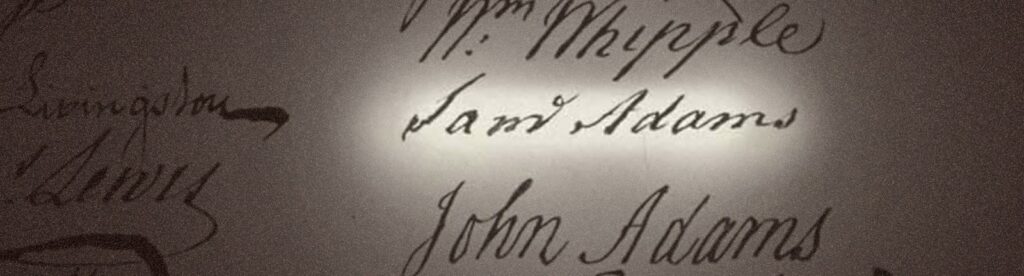
As a delegate to the Continental Congress, Adams signed the Declaration of Independence and helped draft the Articles of Confederation, the framework of American governance that preceded the Constitution.⁴ His rhetoric at the Congress was characteristically uncompromising. In a 1776 address in Philadelphia, he challenged those who might still prefer submission to liberty: “If ye love wealth better than liberty, the tranquility of servitude than the animating contest of freedom — go from us in peace.”³
After the war, Adams returned to Massachusetts and remained active in public life. He served as president of the Massachusetts Senate, as Lieutenant Governor under John Hancock, and then as Governor himself from 1794 to 1797. He retired from office due to declining health and died in Boston on October 2, 1803.¹ He is buried at the Granary Burying Ground — a short walk from the Old South Meeting House, where he helped launch a revolution.
Legacy and Civic Relevance
Samuel Adams was not a general. He commanded no army, won no battles, and held none of the offices the history books most celebrate. What he did was something arguably harder: he changed minds. Through decades of writing, speaking, and organizing — often in the face of ridicule, indifference, and the overwhelming power of the British Empire — he helped create the conditions in which independence became imaginable and then inevitable.
His life offers a timeless lesson in the mechanics of civic change. He understood that political transformation begins with persuasion, that public opinion is itself a form of power, and that citizens who understand their rights are citizens capable of defending them. He once wrote, “We cannot make events. Our business is to wisely improve them” — a creed that speaks as directly to civic life today as it did in 1776.⁴
Samuel Adams stands as proof that the founding of the republic was not only the work of statesmen in legislative halls but of citizens — restless, principled, and stubbornly committed to the idea that self-government is worth the struggle.
Explore more stories from the Revolutionary era in our Founding Generation series.
Footnotes
- National Park Service, “Samuel Adams,” https://www.nps.gov/people/samuel-adams.htm
- Boston Tea Party Ships & Museum, “Samuel Adams,” https://www.bostonteapartyship.com/samuel-adams
- History.com Editors, “Samuel Adams,” History, https://www.history.com/articles/samuel-adams
- American Battlefield Trust, “Samuel Adams,” https://www.battlefields.org/learn/biographies/samuel-adams