

Sybil Ludington — The Teenage Patriot Who Rode Into Legend
In the spring of 1777, two years into a Revolution still very much in doubt, a sixteen-year-old girl from the Hudson Valley is said to have mounted her horse in a driving rainstorm and ridden forty miles through the night — twice the distance of Paul Revere’s famous ride — to rouse her father’s militia and answer a British attack on Danbury, Connecticut. Whether every detail of Sybil Ludington’s legendary ride can be fully confirmed by the historical record, the story that has come down through the generations captures something true and important about the founding era: that the Revolution was not made by famous men alone, but by ordinary citizens — including young women on horseback in the dark — whose courage and resourcefulness made American independence possible. Hers is a story about what patriotism looks like when it is young, unrecognized, and simply necessary.
Early Life: The Oldest of Twelve
Sybil Ludington was born on April 5, 1761, in Fredericksburg, New York — a town that would later be renamed Ludingtonville in her honor — the eldest of twelve children born to Colonel Henry Ludington and Abigail Knowles.¹ Her father was a complex figure: a former British loyalist who switched allegiances around 1773 and became one of Putnam County’s most effective militia commanders. So effective, in fact, that the British reportedly placed a bounty of 300 English guineas on his capture, dead or alive.³
Growing up as the oldest child in a large, active household on the patriot frontier of New York’s Hudson Valley, Sybil was accustomed to responsibility and self-reliance from an early age. She was not a girl sheltered from the realities of war. The countryside around her family’s home was, as later accounts described it, populated by roving bands of loyalist irregulars known as “Cowboys” and patriot marauders called “Skinners” — a dangerous and unsettled landscape for anyone traveling alone, let alone at night.³
One account survives of Sybil’s courage before the famous ride: when a group of loyalists under a man named Ichabod Prosser came to capture her father at their farm, Sybil reportedly organized her younger siblings to march around the house in front of the windows with muskets, giving the impression that the home was heavily guarded. The Loyalists withdrew. She was still a teenager.
The Night of April 26, 1777
On the evening of April 26, 1777, Colonel Ludington’s militia was on furlough — most of the men were farmers, and it was planting season. A mud-soaked messenger arrived at the Ludington farmhouse with urgent news: British General William Tryon had landed 2,000 troops at Westport, Connecticut, marched inland, and was burning Danbury — the site of a major Continental Army supply depot containing provisions and munitions critical to the patriot cause.⁴
Colonel Ludington faced an immediate problem. He needed to organize and command his men when they arrived, and he needed someone to ride out through Putnam County and alert the 400 militiamen scattered across the surrounding farms. The exhausted messenger who had brought the news was in no condition to go further. There was no one else available.
According to the family tradition that has been passed down and gathered by historians, Sybil — just three weeks past her sixteenth birthday — either volunteered or was asked by her father to go. Around nine o’clock that night, she set out on horseback into a driving rainstorm, carrying a long stick she used both to knock on the shutters of farmhouses and to defend herself against any threats along the way.¹
What followed, by the account that has come down through history, was a forty-mile circuit through the dark and rain of Putnam County, New York — through Carmel, Mahopac, Stormville, and back — rousing farmer after farmer, militia soldier after militia soldier, telling them the British were burning Danbury and that Colonel Ludington needed them at the house by daybreak. She completed the ride just before dawn.³
By morning, nearly the whole regiment had assembled at the Ludington farm, ready to march. They could not save Danbury — it was already in ashes — but they joined forces with militias from Connecticut and, together with General Benedict Arnold (still a patriot at that moment), drove the British forces back to their ships at Westport. The British never mounted another inland raid in that region.⁴
A Story Rooted in Family Memory
It is worth being honest about what history can and cannot confirm. No contemporary official record of Sybil Ludington’s ride survives from 1777. The earliest written account appeared in an 1880 local history by Martha Lamb, which cited extensive interviews with the Ludington family. A fuller account came in 1907 in a biography of her father. The earliest known document referring to the ride is a 1854 letter from her nephew, Charles H. Ludington, asking that his aunt be recognized at a ceremony honoring Revolutionary heroes — describing how she rode “on horseback in the dead of night…through a Country infested with Cowboys and Skinners to inform Gen’l Putnam.”²
Smithsonian magazine’s 2022 examination of the historical evidence noted that scholars have raised legitimate questions about the ride’s full details, and that Sybil’s own surviving letters do not mention it — possibly, researchers suggest, because far more difficult events followed in her life.² Harvard colonial historian Laurel Thatcher Ulrich has encouraged readers to consider such stories “not just in the context of when they supposedly happened, but when they emerged and became popular” — noting that Sybil’s story surfaced during the patriotic enthusiasm surrounding the Revolution’s centennial, when many stories of women’s Revolutionary contributions first gained wider circulation.²
None of this means the ride did not happen. Historian Vincent Dacquino, who has devoted decades to researching the Ludington family archives at the New York Historical Society, maintains that the family letters and other documents provide credible evidence of a real event.² What the historical debate does mean is that Sybil Ludington belongs to a vital tradition: the tradition of women whose contributions to the founding were real, significant, and yet left so few official traces that each generation must work to recover and honor them.
Life After the Revolution
Sybil Ludington lived long after the war she helped to support — long enough to see her story nearly forgotten, and long enough to experience serious hardship. In 1784, a year after American independence was secured, she married Edmund Ogden, a Continental Army veteran, with whom she had one son, also named Henry.² The couple operated a tavern in Catskill, New York, hoping the town would become a major commercial hub. Edmund died of yellow fever in 1799, leaving Sybil widowed with a teenage son.²
She continued to operate the tavern on her own and raised her son, who grew up to become a prominent lawyer and a New York State assemblyman — a legacy Dacquino considers a testament to his mother’s quiet determination and perseverance.² In 1838, near the end of her life, Sybil applied for a pension based on her late husband’s military service. Her application was denied because she could not produce her marriage certificate. Even her legal existence was difficult to prove.
She died on February 26, 1839, at the age of seventy-seven, and was buried in a Presbyterian cemetery. On her gravestone, her name is spelled “Sibbell.”²
Recognition and Legacy
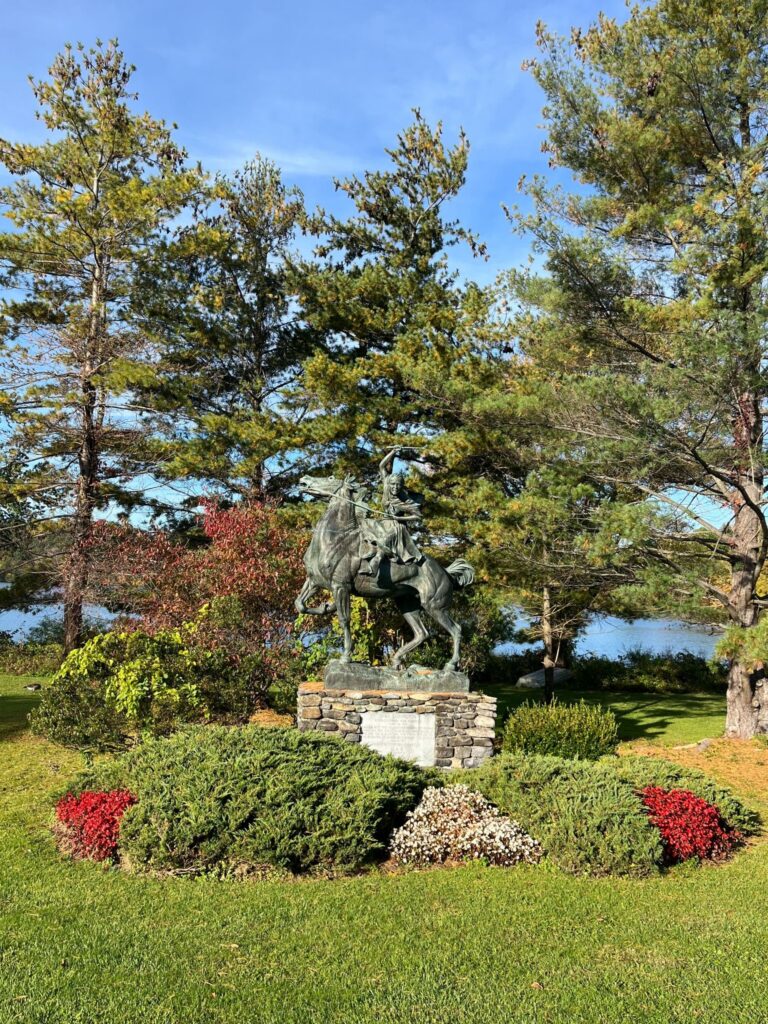
For more than a century after her death, Sybil Ludington remained largely unknown outside her own community. That began to change in the twentieth century. In 1961, the Daughters of the American Revolution commissioned noted sculptor Anna Hyatt Huntington to create a dramatic equestrian statue of Sybil astride her horse, which stands today on the banks of Lake Gleneida in Carmel, New York, and has been replicated at the DAR headquarters in Washington, D.C., and in the public library in Danbury, Connecticut.¹
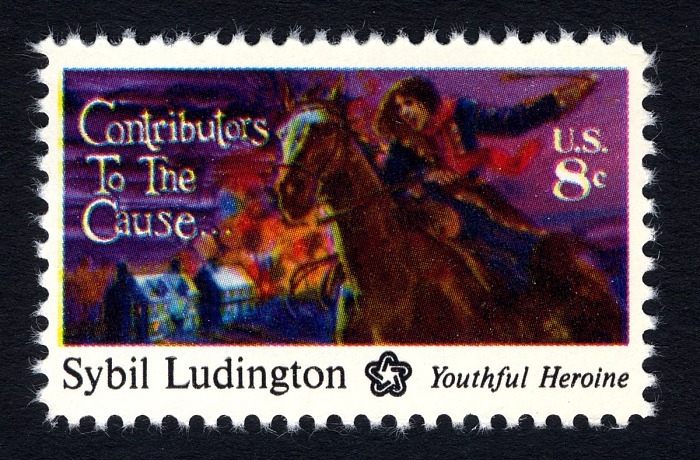
In 1975, during the nation’s Bicentennial, the United States Postal Service honored Sybil Ludington with a commemorative stamp in the “Contributors to the Cause” series — placing her alongside other patriots whose contributions to independence were recognized, if long delayed.³ Historic roadside markers now trace her purported route through Putnam County, and an ultramarathon follows in the hoof prints of her legendary ride.²
As the nation commemorates America 250, Sybil Ludington stands as a symbol of the countless founding-era women whose patriotism was expressed not in halls of power but in dark, dangerous, unglamorous action — women who answered the call of their moment and were not recognized in their own lifetimes. Her story, confirmed in its spirit if debated in its details, belongs to the history of the Revolution precisely because it reflects what so many women of that era actually did: showed up, took responsibility, and kept the cause alive.
Explore more stories from the Revolutionary era in our Founding Generation series.
Footnotes
- American Battlefield Trust, “Sybil Ludington,” https://www.battlefields.org/learn/biographies/sybil-ludington
- Abigail Tucker, “Did the Midnight Ride of Sibyl Ludington Ever Happen?” Smithsonian magazine, March 2022, https://www.smithsonianmag.com/history/did-midnight-ride-sibyl-ludington-ever-happen-180979557/
- Smithsonian National Postal Museum, “Sybil Ludington,” Women on Stamps exhibition, https://postalmuseum.si.edu/exhibition/women-on-stamps-part-1-forming-the-nation-revolutionary-fighters/sybil-ludington
- A Mighty Girl, “Sybil Ludington: The Teen Who Rode Twice as Far as Paul Revere,” https://www.amightygirl.com/blog?p=24115