

The Great Seal of the United States: Six Years, Three Committees, and One Enduring Symbol
On the afternoon of July 4, 1776, the same day the Continental Congress adopted the Declaration of Independence, the delegates turned immediately to another urgent matter: the new nation needed a face. It needed a symbol that would announce to the world not merely that a revolution had occurred, but that a sovereign republic had been born, one with its own identity, its own values, and its own place among the nations of the earth.
What followed was one of the most fascinating design processes in American history. It took six years, three separate committees, contributions from artists and lawyers and statesmen, proposals featuring Moses parting the Red Sea, Hercules at a crossroads, a phoenix rising from flames, and the ancient Eye of Providence. It produced three designs that Congress rejected before a fourth, assembled by a single determined man, finally captured what the young republic meant to say to the world about itself.
On June 20, 1782, the Continental Congress approved the Great Seal of the United States. It has not changed since.¹
The First Committee: Franklin, Adams, Jefferson
The resolution was characteristically brief: “Resolved, That Dr. Franklin, Mr. J. Adams, and Mr. Jefferson, be a committee, to bring in a device for a seal for the United States of America.”² Three of the most celebrated minds in the new nation were handed an assignment that sounds simple: design a symbol, and immediately discovered how hard it was.
Each brought a different sensibility to the task. Benjamin Franklin, drawing on his love of classical learning and his deep engagement with Enlightenment ideas of moral virtue, proposed a scene from the Book of Exodus: Moses lifting his staff over the Red Sea as Pharaoh’s armies drowned in the waters, with the motto “Rebellion to Tyrants is Obedience to God.” Thomas Jefferson imagined the reverse side bearing another biblical image, the children of Israel in the wilderness, guided by a pillar of fire by night and a cloud by day. On the other side, he proposed a depiction of the ancient Britons from whom Americans claimed their heritage of liberty.
John Adams, characteristically more classical than scriptural in his instincts, proposed the choice of Hercules, the mythical figure of strength, standing at a crossroads between the paths of virtue and sloth, choosing the harder road.² These were vivid, imaginative proposals, rich with the moral seriousness of men who understood they were founding something meant to last.
To help render their concepts visually, the committee enlisted Pierre du Simitière, a Swiss-born artist and naturalist with some experience in heraldic design. His version of the committee’s ideas included a shield bearing symbols of the six nations from which the American population had come, England, Scotland, Ireland, France, the Netherlands, and Germany, framed by the Goddess of Liberty and the Goddess of Justice, and surrounded by the initials of the thirteen states. He also proposed an eye of providence in a radiant triangle, the year 1776 in Roman numerals, and, most durably, the Latin motto E Pluribus Unum: “Out of many, one.”²
Congress received the committee’s proposal on August 20, 1776, and set it aside. The design was too complicated, too abstract, and too expensive to render. The motto, however, would survive.
The Second Committee: Stars, Stripes, and the Olive Branch
Four years passed. The Revolution consumed everyone’s attention, and the matter of the seal fell quiet. In March 1780, Congress appointed a second committee: James Lovell of Massachusetts, John Morin Scott, and William Churchill Houston. They invited Francis Hopkinson — the New Jersey lawyer and designer widely credited with helping create the American flag’s arrangement of stars — to contribute his considerable artistic gifts.²
Hopkinson’s design for the second committee introduced several elements that would eventually survive into the final seal: a constellation of thirteen six-pointed stars surrounded by clouds, an olive branch as a symbol of peace, and a shield bearing thirteen red-and-white stripes on a blue field. The motto Bella vel Paci — “for war or for peace” — reflected the dual nature of a nation simultaneously fighting for survival and hoping for reconciliation.

Congress rejected this design as well, but the constellation of stars, the olive branch, and the arrangement of red, white, and blue on the shield were seeds that would eventually take root in the final design.
The Third Committee: The Eagle Arrives
A third committee was appointed in May 1782: John Rutledge, Arthur Middleton, and Elias Boudinot. This group, too, sought outside assistance. They turned to William Barton, a Philadelphia lawyer with a serious amateur interest in heraldry. Within five days, the committee submitted its design.
Barton’s contribution introduced, for the first time, an eagle, though in this version it appeared only in the crest above a shield, not as the central figure. The design also retained the unfinished thirteen-step pyramid topped by the Eye of Providence, an image favored by du Simitière in the first committee’s proposal six years earlier.² Congress reviewed this third design and found it, like its predecessors, wanting.
Three committees. Six years. Three rejections. The challenge was finally passed to the man who kept the records of everything: Charles Thomson, Secretary of the Continental Congress.

Charles Thomson’s Synthesis: June 20, 1782
Thomson was not an artist or a heraldic specialist. He was an administrator, methodical, precise, and deeply familiar with every proposal that had come before him. Rather than starting fresh, he did something elegant: he took the best elements from all three committees’ designs, synthesized them into a coherent whole, and enlisted William Barton to refine his sketches.
The result was submitted to Congress on June 20, 1782, and was approved the same day.³
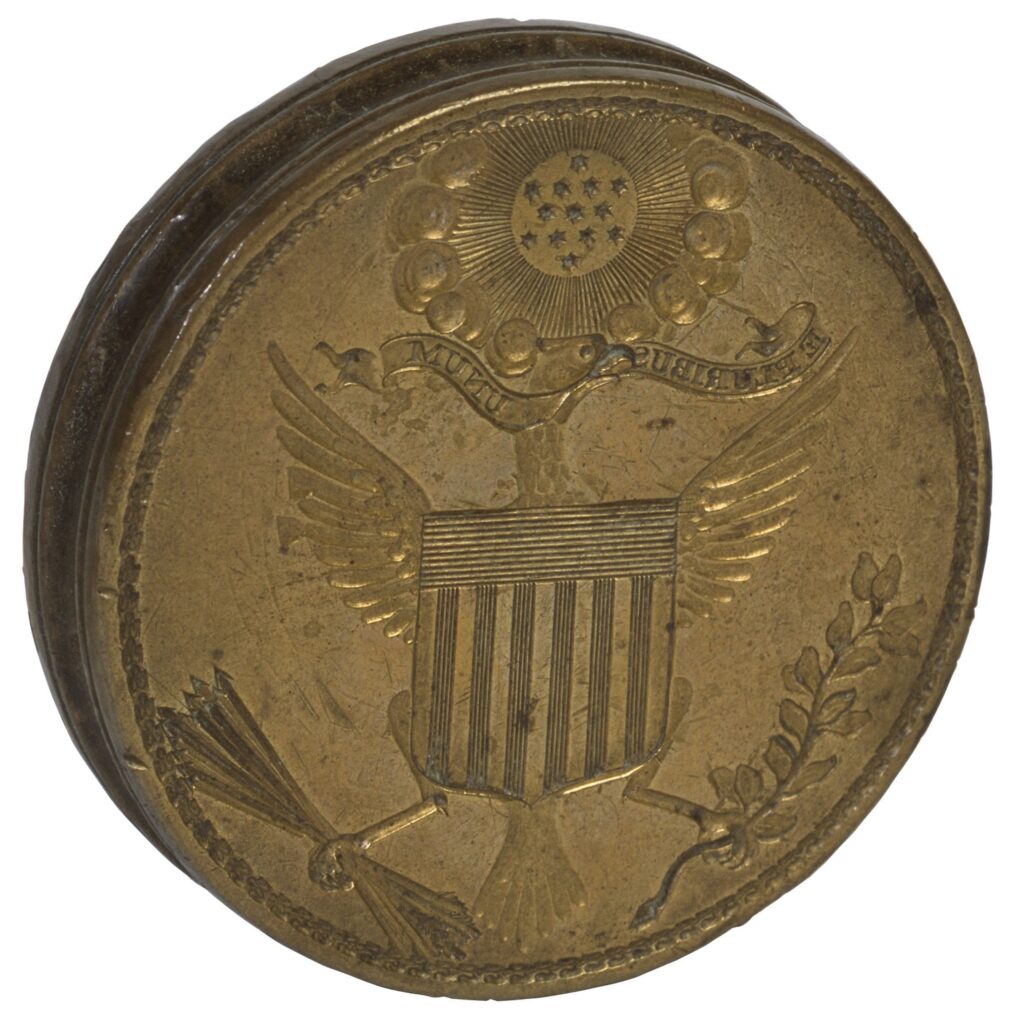
The central figure of the obverse was the American bald eagle, a choice of native creature over classical or biblical imagery, asserting an identity distinctly American rather than borrowed from ancient civilizations. The eagle holds an olive branch in its right talon, representing peace, and a bundle of thirteen arrows in its left, representing war. Its gaze turns toward the olive branch, signaling that though the nation stands ready to defend itself, it desires peace above conflict.¹
On the eagle’s breast rests a shield, the escutcheon, bearing thirteen red and white vertical stripes beneath a blue chief, representing the original states united under Congress. Thomson’s own explanation was precise: “The pales in the arms are kept closely united by the Chief, and the Chief depends on that union and the strength resulting from it for its support, to denote the Confederacy of the United States of America and the preservation of their union through Congress.”² The eagle holds in its beak a scroll bearing the motto E Pluribus Unum, the phrase first proposed by du Simitière in 1776, surviving six years of debate to find its permanent home.

Above the eagle’s head, a constellation of thirteen six-pointed stars breaks through a ring of clouds, representing “a new State taking its place and rank among other sovereign powers.”² The colors of the shield carry their own meaning: white for purity and innocence, red for hardiness and valor, and blue — the color of the chief — for vigilance, perseverance, and justice.¹
The reverse of the seal, never used as an actual seal and therefore less familiar, carries the unfinished pyramid of thirteen courses, topped by the all-seeing Eye of Providence and surrounded by two Latin mottos: Annuit Coeptis, “He has favored our undertakings,” and Novus Ordo Seclorum, “A new order of the ages.” At the base of the pyramid, the Roman numeral MDCCLXXVI records the year of the Declaration of Independence.² Both sides of this reverse appear on the one-dollar bill, making it perhaps the most widely seen piece of American symbolism in daily life, even if few pause to consider what it means.
The number thirteen runs throughout the entire design like a thread: thirteen stars, thirteen arrows, thirteen stripes on the shield, thirteen courses of the pyramid, one for each of the original states that had declared their independence and were fighting, in 1782, to secure it.¹
From Design to Die: The Seal in Use
A brass die was cut, probably by the engraver Robert Scot of Philadelphia, though this has never been definitively confirmed, and on September 16, 1782, Thomson used it for the first time on a document authorizing General George Washington to negotiate a prisoner-of-war exchange with the British.² The republic had its symbol, and it was immediately put to work.
Charles Thomson served as keeper of the seal until the Constitution took effect and a new government was organized under it. Custody of the seal then passed to Thomas Jefferson, the nation’s first Secretary of State, an appropriate steward, given that Jefferson had helped commission the original design six years before.² The Department of State remains the custodian today.
The original 1782 brass die is now on display at the National Archives in Washington, D.C., modest in size, measuring just two and five-sixteenths inches in diameter, bearing a rendering of the eagle that is rougher and wilder-looking than the refined version familiar from currency and official documents. The original die is a fitting artifact: a small, imperfect thing that somehow carries the full weight of a nation’s aspirations.³
What Franklin Really Thought About the Eagle
One footnote to the Great Seal’s history is too good to omit. Benjamin Franklin, writing privately to his daughter Sarah Bache on January 26, 1784, expressed his regret at the choice of the bald eagle as the national symbol. He found the eagle’s character wanting: a bird of bad moral character, he wrote, that steals fish from the hardworking osprey and is driven off by smaller birds. He preferred, he confessed, the wild turkey, a true native of America, a bird of courage that would not hesitate to defend its farmyard against a British grenadier.²
Franklin never published this letter, and the turkey did not become the national bird. But the letter survives as a reminder that even the most celebrated of the Founders could look at the finished product of six years of deliberation and wonder if they had gotten it quite right.
Legacy and Civic Relevance
Today, the Secretary of State affixes the Great Seal to approximately 3,000 official documents each year, treaties, commissions, and proclamations, using a modern die that preserves the 1782 design specifications exactly as Charles Thomson specified them.¹ The seal appears on U.S. passports, above the entrances to American embassies and consulates around the world, on the backs of every one-dollar bill in circulation, and on the official documents that flow continuously from the executive branch of government.
It is, in the truest sense, the face America shows to the world.
As the nation marks America 250, the anniversary of the Great Seal’s adoption on June 20 is worth pausing to observe — not merely as a piece of historical trivia, but as a reminder of how long and how seriously the founders thought about what the republic meant. Six years of debate. Three committees of distinguished men. Proposals drawn from the Bible, from classical mythology, from heraldic tradition, and from the natural world. All of it in service of a single question: what does this nation stand for, and how do we show it?
The answer, an eagle with arrows and an olive branch, a shield of the United States, a constellation of new stars, and three Latin words that mean “out of many, one,” has lasted 243 years. It was designed to.
Sources & Further Reading
- National Museum of American Diplomacy, U.S. Department of State, “The Great Seal,” https://diplomacy.state.gov/the-great-seal/
- American Revolution Institute of the Society of the Cincinnati, “The Great Seal of the United States,” https://www.americanrevolutioninstitute.org/lesson-plans/objects-of-revolution/the-great-seal-of-the-united-states/
- National Archives and Records Administration, “Original Design of the Great Seal of the United States (1782),” https://www.archives.gov/milestone-documents/original-design-of-the-great-seal-of-the-united-states
- National Archives, “The Great Seal of the United States” (exhibit), https://visit.archives.gov/whats-on/explore-exhibits/great-seal-united-states