

Thomas Jefferson at 282: Founder, Visionary, and America’s Most Enduring Paradox
Born on April 13, 1743, in the Virginia colony, Thomas Jefferson authored the words that would become the philosophical cornerstone of American democracy — and spent the rest of his life both embodying and contradicting them. On his birthday, Civics for Life reflects on the man, his legacy, and the questions he still asks of us.
A Virginia Boy Who Changed the World

Thomas Jefferson was born on April 13, 1743, at Shadwell plantation along the Rivanna River, near the Blue Ridge Mountains of colonial Virginia.[1] His father, Peter Jefferson, was a successful planter and surveyor; his mother, Jane Randolph, came from one of Virginia’s most distinguished families. Peter Jefferson died when Thomas was just fourteen, leaving behind a sprawling estate — and a son who would inherit not only the land but an intense hunger for learning and self-improvement.
Jefferson enrolled at the College of William & Mary at sixteen, where he fell under the influence of Professor William Small, who introduced the latest Enlightenment thinking from Edinburgh and the wider European intellectual world. From 1762 to 1767, Jefferson read law under George Wythe — one of the preeminent legal scholars in the colonies — and emerged, by some accounts, as the best-read attorney in Virginia.[2] This grounding in philosophy, natural law, and classical rhetoric would shape every sentence he ever wrote for public consumption.
Penning the Words That Founded a Nation
By 1776, Jefferson had earned a reputation for eloquence that led his fellow delegates in the Second Continental Congress to trust him with the most consequential writing assignment in American history. John Adams, who admired Jefferson’s superior literary gifts, declined to write the first draft himself and handed the task to the younger Virginian.[2] Jefferson produced a draft rooted in the Enlightenment ideas of John Locke, Montesquieu, and George Mason — a document whose opening sentences would echo through every subsequent movement for human freedom.
“We hold these truths to be self-evident, that all men are created equal, that they are endowed by their Creator with certain unalienable Rights, that among these are Life, Liberty and the pursuit of Happiness.” — Thomas Jefferson, Declaration of Independence, 1776
Congress debated the document for three days, removing Jefferson’s biting attack on King George III for the transatlantic slave trade — a deletion Jefferson resented for the rest of his life — before adopting the final text on July 4, 1776. The Declaration did not merely announce independence; it established a standard of universal rights that Americans and people around the world would invoke for generations.
A Career in Public Service Spanning Five Decades
He served as the nation’s first Secretary of State under President Washington, as the second Vice President under John Adams, and as the third President of the United States from 1801 to 1809.[3] Before all of that, he served as Governor of Virginia, as a member of the Virginia House of Burgesses, and as U.S. Minister to France — a posting that exposed him to the social ferment that would soon ignite the French Revolution.
As president, Jefferson’s most consequential act was the Louisiana Purchase of 1803. By negotiating the acquisition of approximately 828,000 square miles of territory from France for $15 million, he nearly doubled the size of the young United States in a single stroke — opening the continent to westward expansion and commissioning the Lewis and Clark Expedition to explore the vast new territory. Many historians consider it the defining achievement of his presidency, even though Jefferson privately agonized over whether the Constitution authorized such an action.
Architect, Inventor, and Polymath
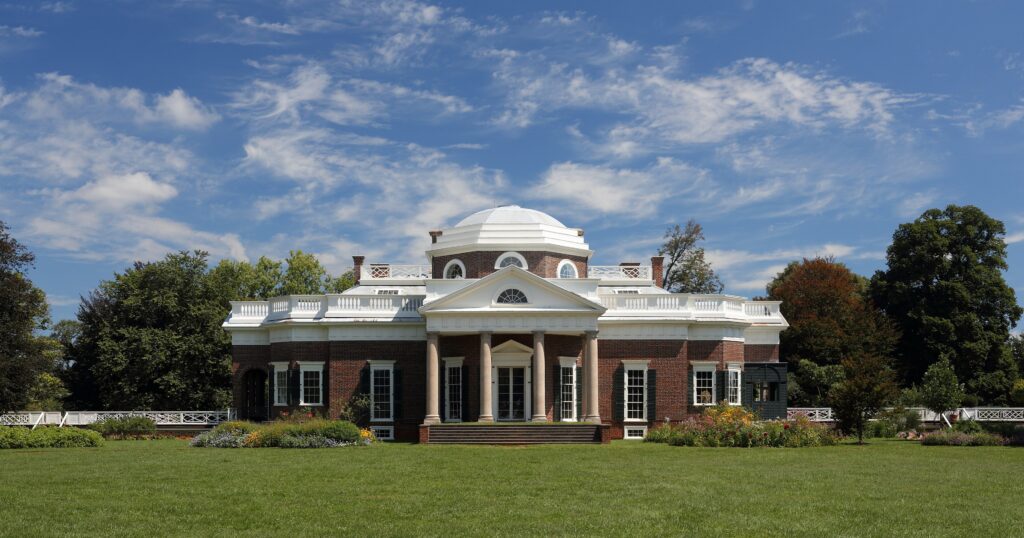
Jefferson’s fascination with science, architecture, music, and natural history made him one of the most wide-ranging intellects of his era.[4] He designed Monticello himself, incorporating innovations like dumbwaiters, hidden beds, and an alcove clock that tracked the days of the week. He cataloged fossils, cultivated hundreds of plant species in his kitchen garden, and maintained a meticulous daily weather log for decades. He spoke or read six languages and assembled a personal library of nearly 6,500 volumes — a collection that, after the British burned Washington in 1814, he sold to Congress to form the nucleus of the Library of Congress.
Jefferson also championed the separation of church and state with a conviction that was radical for his time. In 1786, he authored Virginia’s Statute for Religious Freedom, which became a model for the First Amendment and, ultimately, for constitutions around the world. He founded the University of Virginia in 1819, designing its famous Academical Village and insisting that it be a secular institution. When Jefferson composed his own epitaph, he chose three accomplishments: author of the Declaration of Independence, author of the Virginia Statute for Religious Freedom, and father of the University of Virginia. His presidency — eight years as the most powerful person in the country — did not make the list.
The Unresolved Contradiction
No honest account of Jefferson’s life can avoid what Britannica calls “America’s most problematic and paradoxical hero.” The man who wrote that all men are created equal owned more than 600 enslaved people over the course of his lifetime — more than any other American president — and freed only seven of them. He articulated, in his published writings, the belief that gradual emancipation was necessary. Yet, he did little to bring it about and profited enormously from the labor of enslaved workers at Monticello and his other properties.
DNA evidence confirmed in 1998 that Jefferson almost certainly fathered children with Sally Hemings, an enslaved woman owned by him. Hemings negotiated privileges for her children — the right to be freed upon reaching adulthood — before agreeing to return to Virginia after a period in France, where she was technically free under French law. Four of their children survived to adulthood and were eventually freed. This history is now presented directly to visitors at Monticello, where the Hemings family’s story is woven into the site’s interpretation.
These contradictions are not footnotes to Jefferson’s legacy; they are central to understanding why he still matters. The gap between the ideals he proclaimed and the life he lived is the same gap American democracy has been struggling to close ever since. His words set a standard that generations of abolitionists, suffragists, civil rights leaders, and democracy advocates have used to demand that the promise be extended to all people.
Why Jefferson Still Belongs in a Civics Curriculum
For students and citizens today, Thomas Jefferson is not a simple hero to celebrate or a simple villain to condemn. He is something more instructive: a human being of extraordinary capability and unquestioned moral failure who, despite himself, helped author a set of principles powerful enough to outlast his own limitations. The Declaration of Independence, the Virginia Statute for Religious Freedom, and the Northwest Ordinance gave future Americans the legal and philosophical tools to build a more just society.
His birthday on April 13 is a fitting occasion to do what good civics education always requires: look at the full record with clear eyes, weigh the contributions against the contradictions, and ask what obligations we inherit from both. Jefferson himself believed that each generation must re-examine the principles it inherits. On his 282nd birthday, that work continues.
Continue the Conversation:
Watch Paradox of Liberty, which shares the stories of six enslaved families at Monticello and examines the life of Sally Hemings, the enslaved woman who bore Jefferson six children. Our one-hour online program includes audience Q&A.
Explore more stories from the Revolutionary era in our Founding Generation series.
Footnotes
- Thomas Jefferson’s Monticello — Biography:monticello.org/biography-of-jefferson
- Miller Center, University of Virginia — Thomas Jefferson:millercenter.org/president/jefferson
- Encyclopedia Britannica — Thomas Jefferson:britannica.com/biography/Thomas-Jefferson
- PBS / Ken Burns — Thomas Jefferson Documentary:pbs.org/kenburns/thomas-jefferson