

The Homestead Act of 1862: Opportunity, Hardship, and Dispossession
A wartime law offered surveyed public land to eligible claimants who could meet its conditions. What made that land available — and what it cost — is the rest of the story.
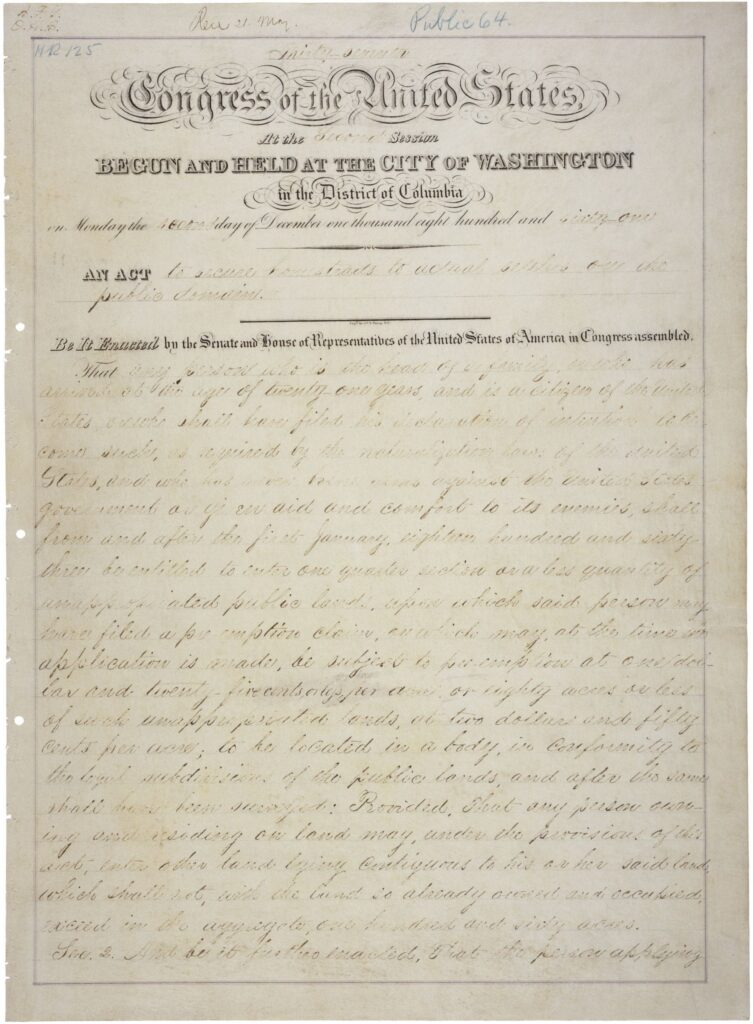
In the middle of the Civil War, President Abraham Lincoln signed a law that would reshape the American landscape for more than a century. The Homestead Act of 1862 let an eligible claimant apply for up to 160 acres of surveyed federal public land, live on it, cultivate or improve it, and — after five years, or sooner through an alternative purchase route — receive title to it outright.1 It is often remembered as a grant of “free land to anyone willing to work for it.”
That description undersells how much the law actually asked of a claimant, and it skips past where the “public” land came from in the first place. Both parts of that fuller story matter, and this article is about both of them.
A Wartime Land Policy
The idea of giving settlers direct access to public land was not new in 1862; reformers had pushed for it since the early 1800s as a way to loosen wealthy speculators’ grip on western land. A homestead bill passed Congress in 1860, but President James Buchanan vetoed it on June 22 of that year, arguing that Congress lacked constitutional authority to give away public land. Southern lawmakers also opposed the measure, fearing that a large population of small free-soil farmers in the West would shift the country’s political balance over slavery.2 Once Southern representatives left Congress after secession, the path cleared.
Lincoln signed the Homestead Act on May 20, 1862. Congress did not stop there: on July 1, it chartered the transcontinental railroad through the Pacific Railroad Act of 1862, and on July 2, it created the land-grant college system through the Morrill Act.3 Together, the three laws formed part of a broader wartime program of federal investment and western development, though each had its own distinct purpose and mechanism.
None of this created a West that had been empty before 1862. Indigenous nations had governed, traveled, traded, farmed, and defended these regions for generations. What changed after 1862 was the scale and federal organization of non-Native settlement — public land surveys, land offices, a transcontinental railroad, and a specific statute that told a claimant exactly how to turn occupancy into private title.
Claiming a Homestead

The Homestead Act offered no guaranteed farm and no simple gift. An eligible claimant — a U.S. citizen or someone who had filed to become one, and who had not taken up arms against the United States — went to a federal land office, paid a filing fee (roughly $10 under the original statute, plus additional land-office charges that varied by place and over time, not a flat figure), and selected an available surveyed tract.1
Filing the claim was the easy part. Keeping it required living on the land, cultivating or improving it, and avoiding an absence of more than six months at a stretch. After five years, the claimant needed sworn testimony from witnesses attesting to exactly what had been built and planted before a land examiner would approve a patent.
A faster alternative existed too: after just six months of residence and improvement, a claimant could purchase the tract outright at $1.25 an acre — an option that mattered because many families could not afford to wait five years for title, and because none of this worked without money for tools, seed, livestock, transportation, and food to survive the years before a first real harvest.1
Homestead files preserved today — applications, affidavits, witness statements, and patents — show exactly what that process looked like on paper.
Who Could Claim, and Who Couldn’t
Eligibility was broader than the old landowning class, but access still depended heavily on circumstance. The statute itself set no racial restriction; it opened claims to male citizens, widows, single women, and immigrants who had declared their intention to become citizens. After the Civil Rights Act of 1866 and the Fourteenth Amendment confirmed African Americans’ citizenship, Black homesteaders were legally eligible to claim land under the same terms as anyone else.4 An estimated 3,500 Black claimants ultimately received patents, covering roughly 650,000 acres, with as many as 15,000 people living on those homesteads when family members are counted.4
About seven in ten of them settled in clusters or organized colonies with other Black families — communities such as Nicodemus, Kansas; Dearfield, Colorado; and DeWitty, Nebraska — while the rest filed individually on remote federal land.4 Their success came against the same harsh climate and drought-prone terrain every homesteader faced, compounded by the broader racial discrimination of the era.
Former Confederates who had borne arms against the United States, by contrast, were excluded from filing under the original law’s own terms. Landownership under the Act was more open than it had ever been — and still shaped, at every step, by money, race, citizenship status, and local power.
Life on the Plains Was Not One Story
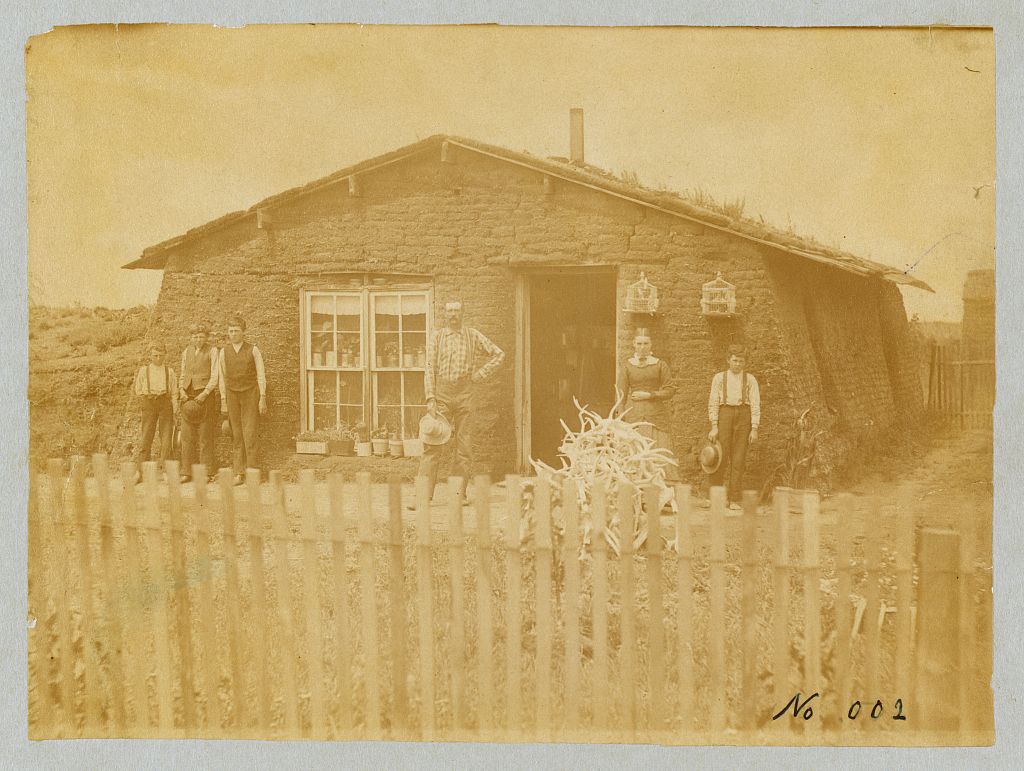
Homesteading drew a wide range of people west: European immigrants, Union veterans, single women filing in their own names, and formerly enslaved people seeking a new start, alongside families who had simply run out of affordable land back east. Conditions on the claims themselves varied as widely as the people who held them. On treeless stretches of the Plains, some families built their first homes from the sod itself; elsewhere, settlers built log, frame, or dugout structures instead.
Farming a claim took teams of animals, tools, seed, and — for those who could arrange it — credit and hired labor, not effort alone.5 Weather was a constant risk: drought, hail, prairie fires, and grasshopper plagues could undo a season’s work without warning.
Isolation, too, was real but not universal. Some claims sat miles from the nearest neighbor, and a bad winter could cut a family off from help for weeks. But homesteading also happened next to towns, rail lines, and kin. Families frequently filed claims near relatives, near churches and schools, and — as railroads expanded across the Plains — near depots and land offices that connected a claim to markets and mail.
De Smet, Dakota Territory, where Charles Ingalls and Almanzo Wilder each proved up a homestead in the 1880s, grew up as exactly that kind of railroad town, with the Ingalls and Wilder claims filed within a few miles of one another.6 Isolation and community both belonged to the story, often in the same county.
The Homestead Act and Laura Ingalls Wilder
Laura Ingalls Wilder was born in 1867, five years after the Homestead Act became law. Her family’s eventual move to Dakota Territory, and Almanzo Wilder’s own homestead near De Smet, were part of the settlement system this law helped create. Federal records show Charles Ingalls filing his claim at the Brookings land office in February 1880 and Almanzo Wilder proving up his own claim in September 1884 — each one a sworn, document-based case of exactly what the statute above asked a family to build, plant, and prove.6
Wilder’s own Little House books preserve the emotional truth of that life: the cabins, the blizzards, the harvests, the debt. The federal record adds the other half — that homesteading was not only a personal frontier adventure, but a regulated legal process inside a national land-distribution program. Read our companion article on Laura Ingalls Wilder for that family’s story in full.
Land Made “Public”
The federal government described the acreage offered under the Homestead Act as “public land.” That phrase concealed a contested history. Much of the land distributed under federal land law lay within the homelands of Indigenous nations, and became available to non-Native claimants through a range of federal actions, including treaties, military campaigns, forced confinement, and policies that weakened or disregarded Indigenous sovereignty.
The Homestead Act did not itself authorize every removal associated with western settlement. But it operated alongside other federal policies — military campaigns and enforcement, treaty-making conducted under unequal power, railroad land grants, and later the Dawes Act of 1887 — that transferred land and reshaped Native nations’ ability to hold onto it.7
The Dawes Act was a later, separate federal Indian land policy, not an extension of the Homestead Act: it divided reservation land into individual allotments and opened whatever acreage was left over as “surplus” to non-Native settlers, operating on tribal reservation land rather than the general federal public domain the Homestead Act drew from.7
By one federal estimate, Native nations held roughly 150 million acres before the Act and lost the majority of it in the decades that followed.7 This history is not only one of loss. Indigenous nations resisted these policies, negotiated where they could, adapted, preserved families and traditions, and continue to exercise sovereignty today. A complete account of homesteading has to hold both the opportunity the law offered some settlers and the political conditions that made the land available to claim in the first place — and to keep these related but distinct federal systems, homestead entry and reservation allotment, from blurring into one story.
A Nation Transformed, By the Numbers
During its history, from 1862 until its general repeal in 1976, the Homestead Act transferred more than 270 million acres of federal land to individual homestead claimants — about 10 percent of the land area of the United States.8 That figure describes homestead patents specifically, across the Act’s full lifespan. It is sometimes conflated with a larger, differently defined number: from 1862 to 1904 alone, the General Land Office distributed roughly 500 million acres of public land in total, to homesteaders and non-homesteaders alike, through sales, grants, and other programs alongside the Homestead Act — of which only about 80 million acres went to homesteaders under the Act itself.1
The two figures cover different time periods and measure different things, and neither should stand in for the other. Congress repealed the Homestead Act in the contiguous United States in 1976, though a version of it remained available in Alaska until October 20, 1986.9 Federal land grants also helped build the railroads that carried migrants west and connected new farms to distant markets: railroads and their associated companies helped shape settlement patterns, marketed western land, and encouraged the development of towns, like De Smet, along their routes.
Remembering the Whole Story
The Homestead Act changed the United States because it joined private aspiration to public power. It gave some people a real path to landownership, but it did not give them success — weather, money, labor, markets, railroads, and local communities often decided whether a claim could become a livelihood. It also shows that land policy is never only about land. Congress decided who could claim federal acreage, under what rules, and on territory the United States had defined as public.
Those decisions built farms, towns, and family stories — including the one Laura Ingalls Wilder later told. They also accelerated the dispossession of Indigenous nations whose homelands were being surveyed, divided, and transferred while those same farms took root.
Remembering the Homestead Act well means holding both realities at once: a genuine avenue to ownership for some Americans, and a major instrument in the remaking of the West through federal power. Continue this story with our companion article on Laura Ingalls Wilder, and look for the third piece in this set, on the Kansas-Nebraska Act, as part of the Westward Expansion series.
Endnotes
- National Archives, Milestone Documents — “Homestead Act (1862)”
- U.S. Capitol Visitor Center — “President James Buchanan’s Veto of S. 416, the Homestead Act, June 22, 1860”
- National Archives, Milestone Documents — “Pacific Railway Act (1862)”; National Archives, Milestone Documents — “Morrill Act (1862)”
- National Park Service — “African American Homesteaders in the Great Plains”; supplemented by Homestead National Historical Park’s Black Homesteaders Project and, where individual examples are used, the National Archives’ homestead case files.
- Richard Edwards, Jacob K. Friefeld, and Rebecca S. Wingo, eds., Homesteading the Plains: Toward a New History (University of Nebraska Press, 2017)
- National Archives, Prologue Magazine (Winter 2003) — “De Smet, Dakota Territory: Little Town in the National Archives”; National Archives, Records of the Bureau of Land Management (Record Group 49), via DocsTeach — “Homestead Proof Testimony of Almanzo Wilder,” September 12, 1884
- National Park Service — “The Dawes Act”
- National Archives, Prologue Magazine (Winter 2012) — “How the West Was Settled: The 150-Year-Old Homestead Act Lured Americans”
- Bureau of Land Management — Alaska Homesteading Frequently Asked Questions
Image Sources
Act of May 20, 1862 (Homestead Act): National Archives, General Records of the United States Government (Record Group 11), Enrolled Acts and Resolutions of Congress, via DocsTeach — docsteach.org/document/homestead-act (National Archives Identifier 299815). Public domain.
Photograph of a Family with Their Covered Wagon During the Great Western Migration; National Archives (NARA Identifier 518267) — catalog.archives.gov/id/518267. Original caption: “The Covered Wagon of the Great Western Migration. 1886 in Loup Valley, Nebr.” Public domain.
Sod house, Custer County, Nebraska: Solomon D. Butcher Collection, Nebraska State Historical Society, digitized by the Library of Congress (“Prairie Settlement: Nebraska Photographs and Family Letters”) — loc.gov/item/2005693389 (“[J.C. Cram sod house, Loup County, Nebraska]”).