

Laura Ingalls Wilder and the Homestead West
How one family’s homestead records — not just the books they inspired — show what it actually took to settle the post-1862 West.
Laura Ingalls Wilder was born on February 7, 1867, near Pepin, Wisconsin — five years after Congress passed the Homestead Act.1 Her family’s moves through Wisconsin, Kansas, Minnesota, Iowa, and Dakota Territory unfolded in a West being reorganized by federal land law, railroad expansion, land speculation, and the continuing erosion of Indigenous sovereignty.
Wilder later transformed those experiences into the Little House books, among the best-known American literary accounts of western settlement. But her family’s federal records tell another part of the story: land claims, final-proof testimony, weather reports, railroad employment, and survey descriptions reveal how much federal policy, capital, labor, and legal paperwork mattered alongside courage and endurance.
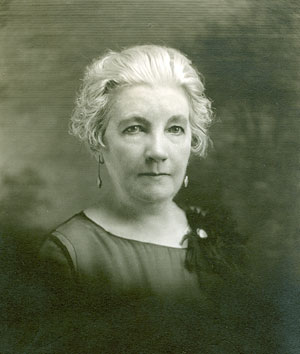
Civics for Life has already followed several people who carried that same expansion westward: Jesse Applegate, Kit Carson, and the discovery at Sutter’s Mill. Wilder’s family arrived at a later chapter of the same wider history — not only a wagon party or a mountain trail, but also a substantial paper trail of land-office applications, affidavits, witness testimony, and patents.
The Little House books are fictionalized accounts rooted in Wilder’s memories and family history, written decades later and edited closely by her daughter, Rose Wilder Lane, whose exact hand in each finished volume remains debated among scholars.2 This article sets that memory beside the federal record — land claims, statutes, and treaties — to see what each one adds to the story the other one tells.
A Family Already Living Ahead of the Law
Before Dakota Territory, there was Kansas. In September or October 1869, when Laura was two, the Ingalls family settled in Rutland Township, Montgomery County, in southeastern Kansas — land within the Osage Diminished Reserve. An 1865 treaty had explicitly closed that reserve to homestead entry, so the family had no legal claim to the ground their cabin stood on. Contemporary accounts describe it as customary frontier practice at the time to settle on Indian land once the federal government had begun negotiating its purchase — practice that did not make the settlement any more legal.3
Unauthorized settlement on land not yet opened to entry was not unique to the Ingalls family’s corner of Kansas, and the federal government was, by 1870, moving to enforce removals on other reserves as well. On August 26, 1870, Captain John S. Poland issued a written warning to unauthorized settlers on Cherokee lands in Indian Territory, south of the Kansas line, that they would be removed by force if they did not leave voluntarily — a different reserve from the Osage Diminished Reserve where the Ingalls family lived, though it shows the same federal posture toward unauthorized settlers that Kansas squatters eventually faced.
That same summer, Congress had passed a law opening the Osage Diminished Reserve itself to sale, once surveyed, at $1.25 an acre in tracts of up to 160 acres to actual settlers — the same acreage limit the Homestead Act itself used elsewhere in the country.3 The process that led to Osage removal from Kansas was also driven by escalating pressure from settlers, including documented violence against Osage families and property on other parts of the reserve, and unfolded over the following several years rather than all at once.4 The Ingalls family left sometime between August 1870 and May 1871, returning to Wisconsin; no source locates federal troops personally removing them.3
That episode is worth holding onto for the rest of this story. For the Ingalls family, southeastern Kansas involved real uncertainty over land that had not been opened to non-Native settlement through any completed federal process. Dakota Territory in 1879 would be something else entirely: a place where federal surveys, a federal land office, and a specific federal statute told a family exactly how to turn a claim into a title.
The Law That Reached Dakota Territory
That statute was the Homestead Act, signed into law on May 20, 1862. It let qualifying citizens — and people who had filed to become citizens — claim up to 160 acres of surveyed federal public land available for entry; eligibility excluded anyone who had borne arms against the United States or aided its enemies. A claimant paid a filing fee, then had to establish actual residence, cultivate the land, make improvements, and avoid an absence from the claim of more than six months at a time. After five years, final proof — sworn testimony from the claimant and from witnesses who could vouch for the improvements — could lead to a federal patent conveying title.
A faster alternative existed too: a claimant could purchase the tract after six months of residence and improvement at $1.25 an acre.5 A companion Civics for Life article walks through that statute, and the postwar system of railroad grants and treaty policy it operated inside of, in full — this piece follows just one family through it.
None of that made a homestead simple, and none of it made the land empty. What it made was a process — one with paperwork, deadlines, fees, and a legal definition of what counted as proof that a family had truly settled. The Ingalls and Wilder families’ own claims near De Smet, Dakota Territory, were processed through the federal land-office system serving Dakota Territory, and are preserved today in exactly that form: applications, sworn testimony, and witness statements.6
Two Claims Near De Smet
Charles Ingalls entered his homestead claim on February 19, 1880 — 160 acres in Section 3, Township 110 North, Range 56 West, in what was then Kingsbury County, Dakota Territory, filed at the Brookings land office. When he made final proof in 1886, he testified that he had built a fourteen-by-twenty-foot house with a twelve-by-sixteen-foot addition and a sixteen-by-twenty-four-foot barn, and had planted apple and plum trees, valuing the improvements and the homestead together at $1,000.6 Those are not the details of a story told for effect. They are the details a federal land examiner required before signing off on a patent.
Almanzo Wilder — the young homesteader Laura would marry in 1885 — came to Dakota Territory in 1879 and entered a nearby homestead claim: 160 acres in Section 21, Township 111 North, Range 56 West. His final proof, sworn on September 12, 1884, describes a twelve-by-twelve-foot frame house with two doors and one window, a stable, a cellar, and a well, with 32 acres broken and cultivated, the whole valued at $300; the witnesses named on that sworn testimony were A. J. Sheldon and O. C. Sheldon.7 This is a standardized sworn federal record, not a personal narrative — but it shows plainly the improvements Almanzo offered as proof that he had met the Homestead Act’s residence and cultivation requirements.
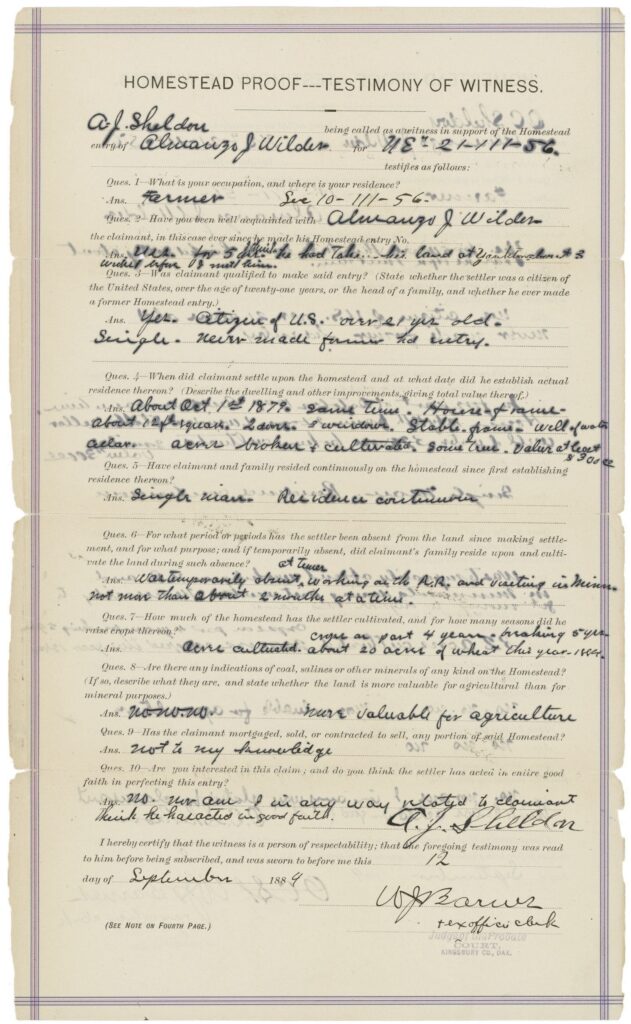
Homesteading required capital the paperwork doesn’t show — for seed, for a team of animals, for the years between planting and a first real harvest. De Smet’s early years included severe weather, including the blizzards of 1880–81 that cut the town off from outside supply for months.1 The Ingalls and Wilder families completed final proof on their claims; many other homestead entries nationwide were abandoned, transferred, or never patented.8
The Railroad That Helped Make the Town
De Smet’s rapid growth depended on railroad expansion. In 1879, Charles Ingalls came to Dakota Territory to work for the Chicago and North Western Railway as a storekeeper, bookkeeper, and timekeeper.6 The railroad’s arrival helped turn De Smet into a town site, brought workers and supplies, and connected local homesteaders to distant markets.
The larger national context was federal policy. Congress’s Pacific Railroad Act of 1862 provided land grants and government bonds to help finance a transcontinental railroad and telegraph line, part of a broader wartime commitment to transportation, military mobility, and western development; the transcontinental line was completed in 1869, cutting cross-country travel from months to about a week.9 But the Pacific Railroad Act did not itself create De Smet or directly finance the Chicago and North Western’s branch line into Dakota Territory.
The Ingalls family arrived in a region shaped by the wider railroad economy that federal subsidies, land policy, corporate investment, and local town promotion had helped make possible — passed by the same Civil War Congress as the Homestead Act, and complementary to it, even though the two laws worked through different mechanisms.
Whose Homeland This Was
The land around De Smet was not an unclaimed wilderness. The region that became Kingsbury County had been part of the homeland of Dakota peoples, including the Yankton Sioux, who ceded the area to the United States in 1859.10 By the time the Ingalls family arrived two decades later, federal surveys and subsequent settlement had transformed land that had long been used and governed by Native peoples into public land available for non-Native settlement.
The Dawes Act of 1887 belongs in this broader story as a later chapter in federal Indian land policy, not as another phase of the mechanism through which the Ingalls and Wilder homesteads were acquired. It used allotment and land classification to break up reservation land and, through the sale of land deemed “surplus,” opened additional acreage to non-Native settlement — a different legal mechanism from the Homestead Act, operating on reservation land rather than the general federal public domain.11
The Ingalls and Wilder homesteads predate the Dawes Act and were not created by it. But both policies, distinct as their mechanisms were, contributed to the same broader federal transformation of western landholding — one that made land available to homesteading families near De Smet while narrowing what Dakota nations elsewhere in the territory were permitted to keep.
From Homestead to Little House
Laura Ingalls Wilder did not start writing the Little House books until she was in her sixties, beginning with a memoir draft called Pioneer Girl in 1930 and publishing the first novel, Little House in the Big Woods, in 1932.2 Her daughter, Rose Wilder Lane, an established writer in her own right, worked closely with her mother on the manuscripts — editing and shaping them for publication in the children’s-book market of the 1930s; scholars continue to debate the extent of Lane’s own hand in the finished books.2 The result is Wilder’s remembered and reconstructed childhood world — memory shaped by decades of distance, collaboration, editing, and the conventions of children’s fiction.
That doesn’t make the books unreliable so much as incomplete in a specific way. They preserve a vivid literary account of blizzards, claim shanties, harvests, and family labor. What the books largely leave outside the frame is the paperwork: the statute, the land office, the survey lines, and the treaties, land cessions, and federal policies that had already reshaped the region before the Ingalls family arrived — and whose consequences continued well after. Reading Wilder’s memory beside her family’s own federal records does not correct the books. It fills in the other half of the story they were never trying to tell.
Legacy and Civic Relevance
Laura Ingalls Wilder’s family did not settle an old, empty frontier. They moved, claim by claim and statute by statute, through a West that a recently expanded federal framework of land and railroad policy was actively organizing around them — related patterns of federal expansion and Indigenous dispossession explored elsewhere in this series, on Jesse Applegate and Kit Carson, though the people, policies, and regional histories differed in each case. What makes the family especially revealing is that their federal paper trail can be read beside some of the best-known frontier stories in American literature.
Continue this story with our companion article on the Homestead Act — the federal law behind the Ingalls and Wilder claims — and look for the third piece in this set, on the Kansas-Nebraska Act, as part of our Westward Expansion series.
Footnotes
- National Park Service, Homestead National Historical Park — “Laura Ingalls Wilder”
- Caroline Fraser, Prairie Fires: The American Dreams of Laura Ingalls Wilder (Metropolitan Books, 2017); PBS American Masters, “Laura Ingalls Wilder Biographical Timeline”
- Penny T. Linsenmayer, “Kansas Settlers on the Osage Diminished Reserve,” Kansas History 24, no. 3 (Autumn 2001), Kansas Historical Society
- Osage Nation, “About the Osage Nation Reservation,” Osage Nation Historic Preservation and Cultural Resources
- National Archives, Milestone Documents — “Homestead Act (1862)”
- National Archives, Prologue Magazine (Winter 2003) — “De Smet, Dakota Territory: Little Town in the National Archives” (Charles Ingalls filed at the Brookings land office on February 19, 1880; Watertown, South Dakota, appears in the record only as a later records office.)
- National Archives, Records of the Bureau of Land Management (Record Group 49), via DocsTeach — “Homestead Proof Testimony of Almanzo Wilder,” September 12, 1884
- Richard Edwards, Jacob K. Friefeld, and Rebecca S. Wingo, eds., Homesteading the Plains: Toward a New History (University of Nebraska Press, 2017)
- National Archives, Milestone Documents — “Pacific Railway Act (1862)”
- South Dakota State Historical Society, Kingsbury County historical marker
- National Park Service — “The Dawes Act”
Images Sources:
Laura Ingalls Wilder Portrait: National Archives, “Pieces of History” blog (Prologue Magazine), citing the Herbert Hoover Presidential Library’s Rose Wilder Lane Papers — prologue.blogs.archives.gov/laura-ingalls-wilder-2; image file at prologue.blogs.archives.gov/…/laura-ingalls-wilder1.jpg
Homestead Proof Testimony of Almanzo Wilder, September 12, 1884, Homestead Proof Testimony of Almanzo Wilder, September 12, 1884, Records of the Bureau of Land Management, Record Group 49, National Archives; presented by DocsTeach. Public domain.