

Kansas-Nebraska Act: Railroads, Slavery, and the Fight for the West
The 1854 law that organized two new territories, reopened the fight over slavery’s expansion, and set the stage for everything from Bleeding Kansas to the Homestead Act.
On May 30, 1854, President Franklin Pierce signed a law organizing two new U.S. territories: Kansas and Nebraska.1 Congress had not yet built formal government for the vast stretch of land west of Iowa and Missouri, and settlers, land speculators, and railroad promoters all had reasons to want that changed. The Kansas-Nebraska Act solved that organizing problem — and, in doing so, reopened one of the most explosive questions in American politics: whether slavery could expand into the West at all.
This article covers the years before the Homestead Act and before Laura Ingalls Wilder’s family moved west — the political fight that shaped the Congress, and the country, both of those later stories depend on. Read our companion article on the Homestead Act for what Congress built once that fight was, for the moment, settled.
A Territory Without a Government
By 1854, thousands of Americans looked west past Iowa and Missouri toward land Congress had not yet organized for settlement. Senator Stephen A. Douglas of Illinois, who chaired the Senate Committee on Territories, strongly supported organizing the territory and favored a transcontinental railroad route connecting Chicago to the West.
Territorial organization was closely connected to his broader vision for western development, pursued openly alongside a genuine effort to hold together a national coalition in Congress — though the legislation that resulted involved several overlapping political and sectional considerations beyond the railroad question alone.
For years, Southern senators had blocked passage of any bill organizing the territory, so long as the Missouri Compromise’s ban on slavery remained in effect there. That 1820 law had barred slavery from most of the Louisiana Purchase territory north of the 36°30′ line — a line that ran through both Kansas and Nebraska — and Southern support for organizing the territory depended on lifting that ban. Douglas’s legislation ultimately proposed replacing the congressional restriction itself with “popular sovereignty”: letting the residents of each new territory decide slavery’s legal status for themselves, rather than having Congress decide it in advance.
On February 15, 1854, Douglas amended his own bill in the Senate to add language declaring that Congress’s intent was “not to legislate slavery into any Territory or State, nor to exclude it therefrom, but to leave the people thereof perfectly free to form and regulate their domestic institutions in their own way” — the amendment that made the bill’s break with the Missouri Compromise explicit.2
Antislavery senators saw the danger immediately. In January 1854, a group of them, including Salmon P. Chase and Charles Sumner, published the “Appeal of the Independent Democrats,” warning that the bill would reverse a sectional truce that had held for more than three decades. Congress passed the bill anyway, and Pierce signed it into law on May 30, 1854.1
What the Law Actually Did
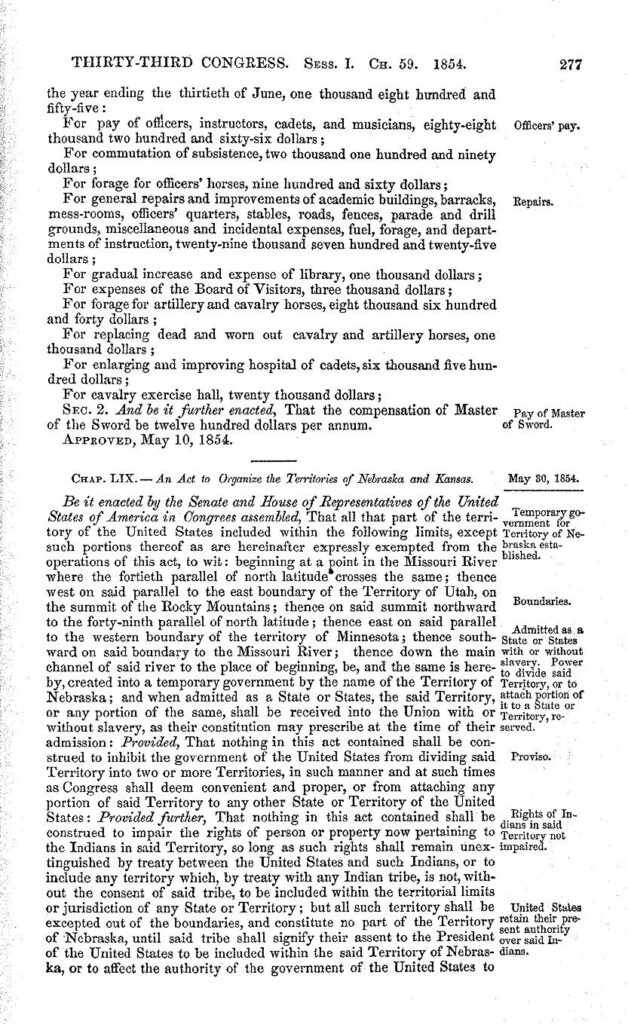
The law’s formal title was “An Act to Organize the Territories of Nebraska and Kansas.” It created two territorial governments, each with its own governor, legislature, and courts, bringing the region under a new framework of federal territorial administration — not settling it for the first time, since Indigenous nations, missionaries, traders, military posts, and non-Native settlers were already present, but formally organizing it for the first time under U.S. territorial law.
It also stated, in nearly identical language for each territory, that neither legislature would be restricted on the question of slavery within its borders — the popular-sovereignty language Douglas had added in February. And in sections addressing each territory in turn, it declared the Missouri Compromise’s 1820 restriction on slavery north of 36°30′ “inoperative and void.”2
The same law, in its final section, also stated that “all treaties, laws, and other engagements made by the government of the United States with the Indian tribes inhabiting the territories embraced within this act, shall be faithfully and rigidly observed.”2 That clause matters for what follows. The region Congress was organizing was not legally empty. It was home to sovereign Indigenous nations with existing treaty relationships to the United States — relationships the Act’s own text promised to honor even as it opened the door to organized, large-scale non-Native settlement.
Whose Homeland This Was
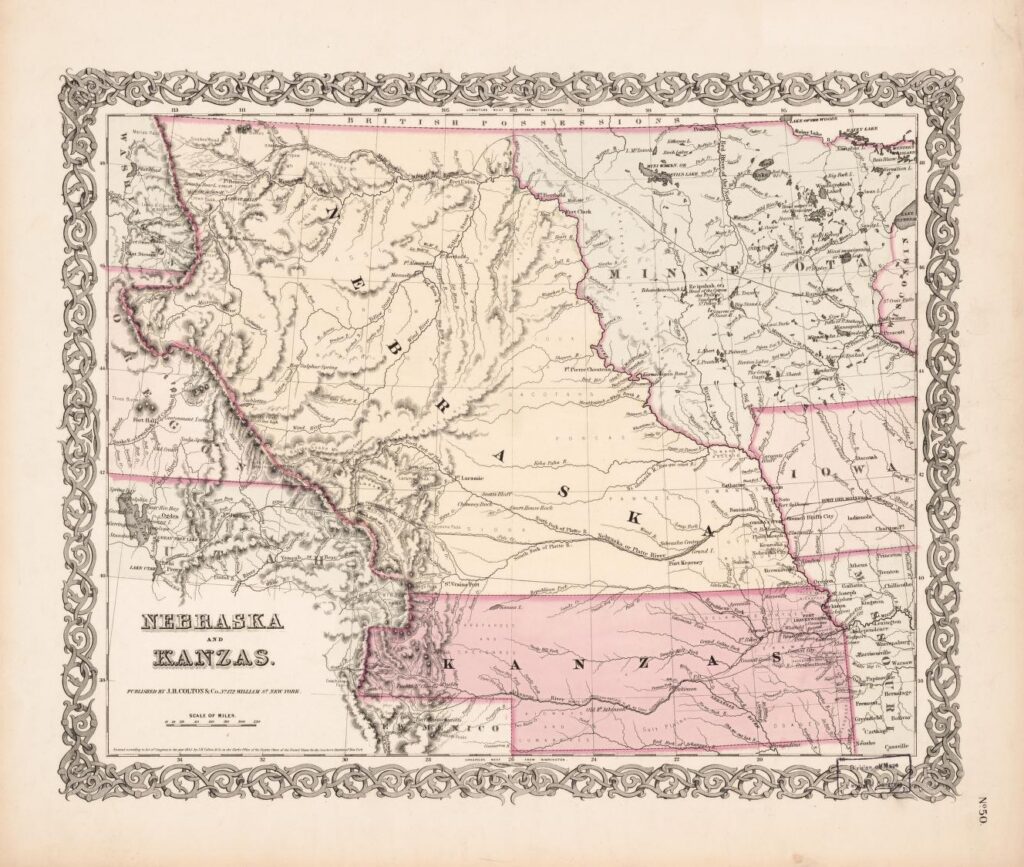
The land Congress organized as Kansas Territory was the homeland of the Kansa, or Kaw, Nation, whose name the state itself carries. By the Kaw Nation’s own account, its ancestors held an estimated 20 million acres across most of present-day Kansas before a series of treaties — beginning after the 1803 Louisiana Purchase transferred the region to U.S. control without the tribe’s consent — steadily reduced that landholding over the following decades.3
Kansas Territory was also home to the Osage, whose own homelands lay in the southeastern part of the territory. By the Osage Nation’s own account, its ancestors were confined to a diminished reserve in southeastern Kansas; railroad expansion, pressure from non-Native settlement, and federal legislation — including an 1870 act of Congress requiring the sale of the Osage’s remaining Kansas land at $1.25 an acre — together contributed to the loss of their Kansas lands and their eventual removal from the state.4
To the north, in what became Nebraska Territory, the Pawnee occupied land along the Platte River. An 1833 treaty had already required the Pawnee to cede land south of the river in exchange for a small annual payment; a second treaty, signed at Table Creek in Nebraska Territory on September 24, 1857, ceded most of their remaining land and confined the tribe to a reservation along the Loup River. Sioux raids, famine, and worsening conditions on that reservation led to a gradual migration south beginning in the 1870s, formalized by an October 1874 agreement, later confirmed by Congress, with the last groups leaving for Indian Territory, in present-day Oklahoma, by October 1875.5
Kansas and Nebraska Territories also held homelands and treaty lands belonging to the Otoe-Missouria, Omaha, Potawatomi, Kickapoo, Shawnee, and Delaware nations. The Otoe-Missouria, by their own account, were confined to a reservation on the Big Blue River in southeast Nebraska in 1855.6 The Omaha held a documented homeland extending from near present-day Yankton, South Dakota, south to Rulo, Nebraska.7 And the Potawatomi, Kickapoo, Shawnee, and Delaware nations had been settled in eastern Kansas earlier in the century under federal Indian removal policy that relocated nations from east of the Mississippi River.8
Congress’s promise that existing treaties would be “faithfully and rigidly observed” did not, in practice, halt what territorial organization set in motion. Federal surveys, new territorial governments, settler migration, and railroad planning brought sustained pressure on Native land and political authority in the years that followed — a pattern each of these nations experienced on its own terms, but that repeated across the territory the Act had just organized.
Popular Sovereignty in Practice
“Popular sovereignty” sounded like a simple democratic solution, but the Act did not establish a single, up-or-down territory-wide referendum on slavery. Instead, territorial institutions — and, eventually, a state constitutional process — became the arenas where Kansas’s status would actually be decided, a mechanism far less settled in practice than the phrase “popular sovereignty” suggests.
Voting itself was restricted by the territorial laws and conventions governing participation: women and many other residents were not eligible to vote under those laws.10 Nor were the settlers who could vote left to decide quietly on their own: proslavery and antislavery activists deliberately crossed into Kansas, in some cases only long enough to cast a ballot, specifically to influence the territorial outcome. Election fraud, intimidation, and — before long — a proslavery territorial government contested by a rival free-state government made the promise that Kansans would decide freely difficult to take at face value.9
Kansas Becomes a Battleground
The conflict that followed became known as “Bleeding Kansas.” Proslavery and free-state settlers, many recruited and funded by organizations on both sides, moved into the territory through 1854 and 1855. Missouri residents crossed the border in large numbers to vote in Kansas’s March 30, 1855 territorial election; Governor Andrew Reeder voided the results in six districts where fraud was formally protested, but the legislature that convened went on to reseat the original, proslavery-favoring winners in those districts anyway.
Free-state Kansans came to call the resulting body the “Bogus Legislature.”10 By 1855, Kansas had a proslavery territorial government, seated first at Pawnee and then at Lecompton, contested by a rival free-state government organized at Topeka.9
Violence followed. On May 21, 1856, a proslavery posse marched into the free-state town of Lawrence, destroyed two antislavery newspaper offices, and burned the Free State Hotel.11 In the Senate the next day, May 22, 1856, Representative Preston Brooks of South Carolina beat Senator Charles Sumner of Massachusetts unconscious with a cane, in retaliation for a speech Sumner had delivered three days earlier attacking slavery and a Southern senator by name.12 Three days after the sack of Lawrence, on May 24, 1856, John Brown and a small band that included four of his sons killed five proslavery settlers at Pottawatomie Creek in Franklin County.13
The Lecompton Constitution went through a disputed, multi-stage vote rather than a single up-or-down decision. Delegates meeting at Lecompton drafted the proslavery document between October and November 1857. On December 21, 1857, an election let voters choose only between two versions of the constitution — one permitting slavery to expand further, one nominally restricting it while still protecting slaveholders already in the territory — with no option to reject the constitution outright; free-state opponents boycotted, and the proslavery version passed easily under contested conditions.14
On January 4, 1858, in a vote organized by the free-state legislature and not officially sanctioned by Congress, Kansans rejected the constitution decisively, roughly 10,000 votes to under 200.15 Congress ultimately required the constitution to be resubmitted to a full, congressionally sanctioned vote; on August 2, 1858, Kansas voters rejected it again, this time by a wide and broadly recognized margin, and the territory continued under contested government for several more years.14 Kansas finally entered the Union as a free state on January 29, 1861.16
Kansas’s years-long crisis involved far more than two sides simply labeled “settlers.” It drew in Missouri residents crossing the border to vote, Northern emigrant-aid societies recruiting and funding migrants, territorial officials on both sides, free and formerly enslaved Black residents building lives in a contested territory, Indigenous nations whose land and authority were caught in the middle, and national political organizations and newspapers directing money and attention from far outside the territory.
A Nation Realigned
The Kansas-Nebraska Act’s effects reached far beyond the territory itself. The Whig Party, already strained by years of sectional disagreement, rapidly collapsed as a national political force after the Act’s passage. The Democratic Party held together nationally but split along sectional lines that proved impossible to fully repair. Opposition to the Act helped bring together a new political party in the following months, organized around a single unifying position: opposing slavery’s extension into the territories. That party took the name Republican.17
Among the politicians the Act returned to prominence was Abraham Lincoln, then a former one-term congressman out of elected office. On October 16, 1854, in Peoria, Illinois, Lincoln delivered a lengthy public reply to Douglas, arguing that popular sovereignty could not make slavery a morally neutral question for a territory to simply vote on. The speech marked Lincoln’s return to a more prominent role in national political debate and previewed arguments he would repeat for the rest of the decade.17
From Kansas to the Homestead Act
The Kansas-Nebraska Act did not create the homestead system that later brought the Ingalls and Wilder families to Dakota Territory, and it did not itself hand land to settlers — that came later, with the Homestead Act of 1862.18 But it changed the political meaning of western land. Congress had shown, in the clearest possible terms, that organizing territory, building railroads, and deciding who could settle the West could not be separated from slavery, Indigenous sovereignty, and the balance of federal power.
The Civil War transformed the political balance in Congress, clearing the way for a very different Congress to pass the Homestead Act and the Pacific Railroad Act in 1862 — laws that would reorganize western migration again, on new terms, and that this series covers in its companion article on the Homestead Act. Read that article, and our article on Laura Ingalls Wilder, for the rest of the story Kansas-Nebraska set in motion — as part of our Westward Expansion series.
Endnotes
- National Archives, Milestone Documents — “Kansas-Nebraska Act (1854)”
- The Kansas-Nebraska Act, Statutes at Large, 10 Stat. 277 (1854), full text via the Avalon Project, Yale Law School (Sections 14 and 32, Missouri Compromise repeal; Section 37, Indian treaty-obligations clause); Stephen A. Douglas’s amendment to S. 22, February 15, 1854, U.S. Capitol Visitor Center
- Kaw Nation, “History of Kaw Nation”
- Osage Nation, “About the Osage Nation Reservation,” Osage Nation Historic Preservation and Cultural Resources
- Treaty with the Pawnee, September 24, 1857 (Table Creek, Nebraska Territory), 11 Stat. 729, U.S. Statutes at Large via GovInfo.gov; Nebraska State Historical Society, “Marker Monday: Pawnee Villages” (1833 treaty, reservation conditions, and the 1873-75 removal to Indian Territory)
- The Otoe-Missouria Tribe, “History”
- Nebraska Indian Community College, “Omaha Tribe of NE and IA”
- Kansas Historical Society, “American Indian History”
- National Park Service, “Bleeding Kansas”
- Kansas Historical Society, Kansapedia — “Bogus Legislature”
- Kansas Historical Society, Kansapedia — “Sack of Lawrence”
- U.S. Senate, Art & History — “The Caning of Senator Charles Sumner”
- Kansas Historical Society, Kansapedia — “Pottawatomie Massacre”
- American Battlefield Trust, “Lecompton Constitution” (drafting dates and the August 2, 1858 vote)
- Civil War on the Western Border, “Lecompton Constitution” (the December 21, 1857 and January 4, 1858 votes)
- National Archives, “Kansas Statehood, January 29, 1861”
- Papers of Abraham Lincoln Project, “Speech at Peoria, Illinois,” October 16, 1854; Michael F. Holt, The Political Crisis of the 1850s (Wiley, 1978), for the Whig collapse, the Democratic Party’s sectional split, and the Republican Party’s founding.
- National Archives, Milestone Documents — “Homestead Act (1862)”
Image Sources:
An Act to Organize the Territories of Nebraska and Kansas: Library of Congress, U.S. Statutes at Large — loc.gov/resource/llsalvol.llsal_010/?sp=299. Public domain.
Nebraska and Kanzas: J. H. Colton, “Nebraska and Kanzas,” New York, 1855–56, Library of Congress, Geography and Map Division — loc.gov/item/2017586283