

The Trail of Tears: Cherokee Removal, Survival, and Rebuilding
What happened to the Cherokee people during the forced removal of 1838–39, and how the Cherokee Nation endured, governed, and rebuilt in Indian Territory.
The Trail of Tears is often pictured as a single line of Cherokee people walking west. The history was larger and more complex. In 1838 and 1839, the United States removed Cherokee people through military roundups, stockades, river transport, and seventeen recognized detachments traveling along several land and water routes.1 Disease, confinement, drought, winter weather, and inadequate supplies caused devastating loss.
It is also a story of survival. Cherokee people lost thousands of relatives, their eastern homeland, and much of the property they had built over generations. In Indian Territory, they reunited with Western Cherokee communities, rebuilt their government, adopted a new constitution in 1839, and continued the work of national life.
This article focuses on the Cherokee experience. For the 1830 law and the removals of the Choctaw, Muscogee (Creek), Chickasaw, and Seminole nations, see The Indian Removal Act and Its Consequences. For the life and leadership of Principal Chief John Ross, see Chief John Ross: Cherokee Sovereignty and the Long Fight Against Removal.
A Treaty the Nation Rejected
In December 1835, a minority group of Cherokee men signed the Treaty of New Echota. According to the Cherokee Nation, they “lacked authority to do so under Cherokee Nation law, but nevertheless purported to agree, on behalf of the Nation, to relinquish the Cherokee Nation’s lands east of the Mississippi.”2
More than 15,000 Cherokee citizens signed petitions opposing the treaty. The U.S. Senate nevertheless ratified it in 1836. The treaty gave the Cherokee two years from ratification to remove.3 Most Cherokee people remained in their eastern homeland rather than voluntarily removing under a treaty their national government had rejected.
The Roundup
In the spring of 1838, President Martin Van Buren’s administration assigned General Winfield Scott to lead the forced removal. On May 10, Scott addressed the Cherokee people:
“Cherokees! The President of the United States has sent me, with a powerful army, to cause you, in obedience to the Treaty of 1835, to join that part of your people who are already established in prosperity, on the other side of the Mississippi. . . . The full moon of May is already on the wane, and before another shall have passed away, every Cherokee man, woman and child . . . must be in motion to join their brethren in the far West.”4
A week later, on May 17, Scott issued General Order No. 25. It organized the removal into three military districts and directed troops to bring Cherokee people to designated collection points. The order also told the troops that “every possible kindness, compatible with the necessity of removal,” must be shown, and it warned against “acts of harshness and cruelty.”5
Cherokee testimony and contemporary observers describe something very different: abrupt removal from homes, family separation, property loss, crowding, unsanitary camps, disease, and death. Federal troops and state militia went from house to house and forced families out, often with almost nothing.6 A Cherokee widow named Ooloo-Cha later recalled:
“The soldiers came and took us from our home. They . . . drove us out of doors and did not permit us to take anything with us, not even a second change of clothes.”6
Missionary Daniel S. Butrick wrote that “in two or three days about 8,000 people . . . were rendered homeless, houseless and penniless.” They left behind homes, farms, livestock, tools, and businesses; Cherokee testimony and contemporary accounts describe widespread loss of property.6
Cherokee people were confined first in temporary stockades and then in larger camps. In Tennessee, about 7,000 Cherokee people were held in camps spread across an area roughly twelve miles long and four miles wide near Fort Cass, the military headquarters for the removal, in present-day Charleston.7 One camp at Rattlesnake Springs held about 600 people in July 1838.1 Crowding and poor sanitation led to outbreaks of disease, and many people died before the journey west began.7
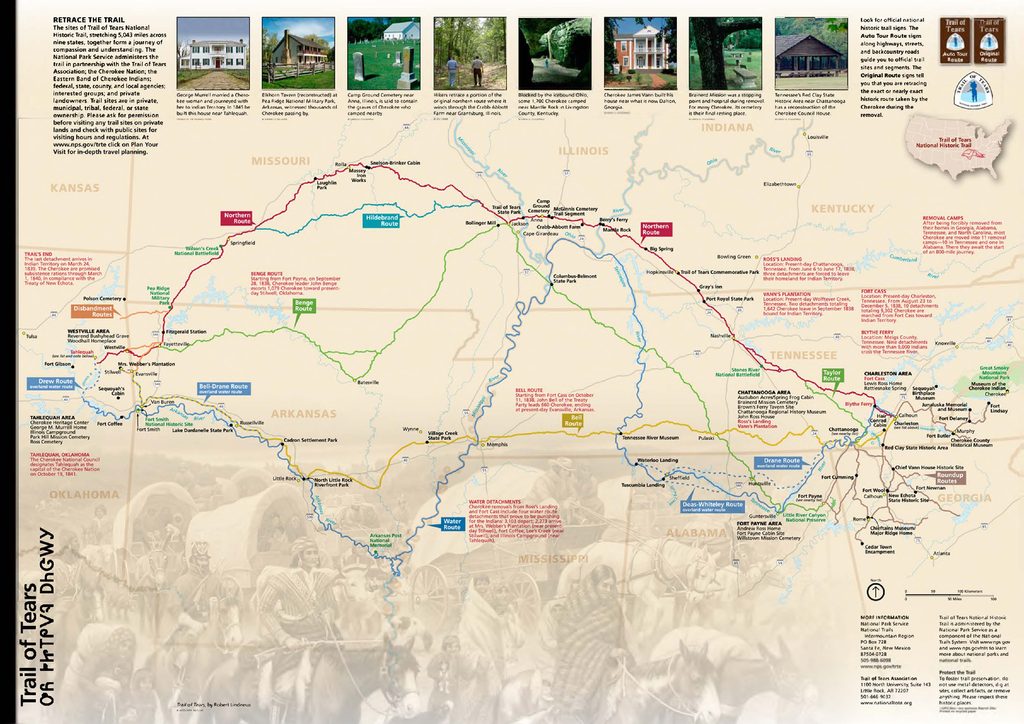
Source: National Park Service, Trail of Tears National Historic Trail —https://www.nps.gov/trte/planyourvisit/upload/National-Park-Service-Trail-of-Tears-Map-508.pdf
The First Detachments and a Summer Halt
In June 1838, the Army sent three groups west by water from Ross’s Landing, on the Tennessee River at present-day Chattanooga.7 A drought had left the rivers low. Boats ran aground, people were forced to walk long stretches in the heat, and, according to the National Park Service, “dire conditions, disease, and deaths plagued the last two groups.”7
By the end of June, as disease and dangerous conditions worsened, Scott suspended further removal until September. Principal Chief John Ross asked to supervise the remaining removal, arguing that Cherokee leaders could better care for their own people. Scott agreed to let Ross oversee the remaining removal, and thirteen Cherokee-led detachments subsequently traveled west under Cherokee conductors.6 Thousands of people remained in the camps through the summer while preparations were made.
Cherokee-Led Detachments
Under the new arrangement, the remaining people were organized into Cherokee-led detachments, often numbering roughly 1,000 people. Their conductors included leaders such as Hair Conrad, James Brown, and Jesse Bushyhead.7 The first of these overland detachments set out on August 28, 1838.8 The Nation arranged for food, wagons, and other supplies.1
Not every group traveled under the Ross government’s management. A detachment of about 650 to 700 people associated with the Treaty Party traveled separately under John Adair Bell. No muster roll or list of its members is known to survive.9 Together, the three June detachments sent by the Army, the Bell detachment, and the thirteen Cherokee-led detachments made up the seventeen detachments recognized by the National Park Service.1 John Ross traveled with the final water-route detachment, which left in December 1838.10
This shift gave Cherokee leaders greater control over food, supplies, travel arrangements, and detachment organization. It did not make removal voluntary. Every detachment traveled under the authority of a treaty the Cherokee Nation had rejected, after months of military confinement and amid continuing federal control.
The removal also carried people who had no say. Some Cherokee families held enslaved people of African descent, and those men, women, and children were forced west as well.1
Many Routes West
No single Trail of Tears existed. Many Cherokee detachments followed what is now called the Northern Route, crossing the Tennessee River at Blythe Ferry and traveling over the Cumberland Plateau.7 From there, the route ran through Nashville, Kentucky, Illinois, and Missouri to northwestern Arkansas.8 John Benge’s detachment took a route across northern Arkansas, while the Bell detachment followed roads through Memphis and Little Rock, and Ross’s party traveled by river.11
Some detachments spent months on the road. Many traveled routes more than 1,000 miles long.1
The fall drought gave way to a hard winter. According to the National Park Service, about two-thirds of the travelers on the Northern Route were trapped in January between the frozen Ohio and Mississippi rivers, waiting in the cold for the ice to clear.3 Illness, exposure, and shortages of food and shelter followed the detachments the whole way.
Counting the Dead
No one knows exactly how many Cherokee people died. No full census was taken, records for some detachments are incomplete or missing, and many deaths happened in the camps before the journey began.
One widely cited estimate, attributed to the missionary physician Elizur Butler and cited by the National Park Service, is more than 4,000 deaths.3 The Cherokee Nation’s own history likewise states that some 4,000 Cherokee people “perished in camps or along the Trail of Tears.”2 The National Museum of the American Indian cites historians’ estimates of 2,000 to 4,000.6 The New Georgia Encyclopedia gives a range of 4,000 to 5,000.12
None of these is a precise count. Estimates differ because historians and institutions use different sources and methods to calculate deaths. According to the National Park Service, the hardship fell heaviest on infants, children, and the elderly.1
Arrival and Rebuilding
By March 1839, the surviving Cherokee from the removal detachments had arrived in Indian Territory, in present-day Oklahoma.7 According to the Oklahoma Historical Society, the new arrivals joined about 6,000 Western Cherokee, often called the Old Settlers, who had moved west in earlier decades and had their own government, as well as Treaty Party families who had emigrated earlier.13
Within months of arrival, and amid continuing conflict among the different Cherokee communities, leaders began rebuilding a unified national government. On July 12, 1839, representatives of the Eastern and Western Cherokee signed an Act of Union, and on September 6, a convention adopted a new constitution for the reunited Nation.14 The Act of Union described the moment as “bringing together again the two branches of the ancient Cherokee family.”15
In Tahlequah, the Nation established its capital and built government buildings, schools, businesses, and homes. In 1844, it established the Cherokee Advocate, published in English and in Cherokee using Sequoyah’s syllabary.2
The reunion was not peaceful at first. Political conflict and violence continued until an 1846 treaty among the Cherokee factions and the United States sought to settle their disputes.2 The Ross article follows those politics in detail.

Source: https://www.loc.gov/pictures/item/ok0004.photos.129290p/
Those Who Remained
Not every Cherokee person was removed. The National Park Service estimates that about 1,000 Cherokee in Tennessee and North Carolina escaped the roundup or otherwise remained in the region; their descendants became part of the Eastern Band of Cherokee Indians, today based in western North Carolina.3 Along with the Cherokee Nation and the United Keetoowah Band of Cherokee Indians in Oklahoma, the Eastern Band is one of three federally recognized Cherokee governments.13
Remembering the Trail
The Cherokee name for the removal is often rendered Nunna-da-ul-tsun-yi, “the place where they cried.”8 In 1987, Congress established the Trail of Tears National Historic Trail to commemorate the Cherokee removal routes.1
Remembrance also continues in Cherokee communities. Cherokee Nation began the Remember the Removal Bike Ride in 1984; it became an annual program in 2009, and the Eastern Band of Cherokee Indians joined in 2011. Riders retrace the route, stopping at historic sites such as New Echota, Blythe Ferry, and Mantle Rock.16 The Cherokee National Holiday, held each year in Tahlequah, commemorates the signing of the 1839 Cherokee Constitution and the Act of Union.15

Source: https://commons.wikimedia.org/wiki/File:Blythe-ferry-site-tn1.jpg
Setting the Record Straight
A few distinctions help keep this history accurate:
Jackson signed the law; the 1838 removal happened under Van Buren.
Jackson signed the 1830 Indian Removal Act, and his administration backed the removal policy and the treaty process that culminated at New Echota. The 1838 roundup and the removal that followed occurred under Van Buren.
There were many trails, not one.
Detachments left at different times, by different routes, under different leaders, and their experiences differed.
Cherokee-led does not mean voluntary.
Cherokee leaders took over much of the removal to reduce its harms, even though their government had rejected the process.
The Cherokee were not the only nation removed.
The Choctaw, Muscogee (Creek), Chickasaw, and Seminole nations each faced their own removals, on different timelines and terms. The Indian Removal Act article compares those experiences.
Legacy and Civic Relevance
The Trail of Tears is remembered as a loss, and it was one. It is also the story of Cherokee communities that reunited, began rebuilding a unified national government within months of arrival amid continuing conflict, and continue today. The Cherokee Nation, the Eastern Band of Cherokee Indians, and the United Keetoowah Band each carry that history forward in their own way.
For students of civics, the removal raises lasting questions: What happens when a treaty is made without the consent of the people it binds? What do a government’s written promises mean when they are not kept? And whose records do we rely on to tell the story?
Continue exploring this history with Chief John Ross: Cherokee Sovereignty and the Long Fight Against Removal, The Indian Removal Act and Its Consequences, and Sequoyah and the Cherokee Syllabary.
Endnotes
- National Park Service, Teaching with Historic Places, “The Trail of Tears and the Forced Relocation of the Cherokee Nation”: nps.gov
- Cherokee Nation, “History”: cherokee.gov
- National Park Service, Trail of Tears National Historic Trail, “What Happened on the Trail of Tears?”: nps.gov
- North Carolina Department of Natural and Cultural Resources, “Military Order Beginning the Trail of Tears,” quoting Gen. Winfield Scott’s address to the Cherokee Nation, May 10, 1838: dncr.nc.gov
- Maj. Gen. Winfield Scott, Order No. 25 Regarding the Removal of Cherokee Indians to the West, May 17, 1838, Records of U.S. Army Continental Commands, Record Group 393, National Archives, NAID 6172200; via DocsTeach: docsteach.org
- National Museum of the American Indian, Native Knowledge 360°, “Forced Cherokee Removal”: americanindian.si.edu
- National Park Service, “Trail of Tears National Historic Trail: Tennessee” (brochure): nps.gov
- Tennessee Encyclopedia, Ben Harris McClary, “Trail of Tears, or Nunna-da-ul-tsun-yi”: tennesseeencyclopedia.net
- Retracing the Bell Route: An Archive of Cherokee Removal, “Context”: cherokee-bell-route.org
- Encyclopedia of Arkansas, Cody Lynn Berry, “Quatie Ross (1791–1839)”: encyclopediaofarkansas.net
- Encyclopedia of Arkansas, Kitty Sloan, “Trail of Tears”: encyclopediaofarkansas.net
- New Georgia Encyclopedia, Tim Alan Garrison, “Cherokee Removal”: georgiaencyclopedia.org
- Oklahoma Historical Society, Encyclopedia of Oklahoma History and Culture, Rennard Strickland, “Cherokee (tribe)”: okhistory.org
- The Constitution and Laws of the Cherokee Nation (1840), Act of Union, July 12, 1839, and Constitution of the Cherokee Nation, September 6, 1839.
- Library of Congress, In Custodia Legis (Law Library blog), “Cherokee National Holiday,” September 2016: blogs.loc.gov
- Cherokee Nation, “Remember the Removal Bike Ride — About”: remembertheremoval.cherokee.org