

The Indian Removal Act and Its Consequences
What the 1830 law authorized, how “exchange” became coercive in practice, and how five nations experienced removal differently
The Indian Removal Act was brief. Its consequences were not. Signed into law on May 28, 1830, the statute authorized the president to negotiate land exchanges with Native nations living east of the Mississippi River. Nothing in its text ordered a single forced march or named a single nation for expulsion.1
What followed was a decade-long federal project carried out treaty by treaty. The experiences of the Choctaw, Muscogee (Creek), Chickasaw, Seminole, and Cherokee nations differed from one another in important ways, but removal repeatedly unfolded amid unequal bargaining power, state pressure, fraud, confinement, military force, illness, and death.
What the Law Actually Authorized
The Act was brief, but its operative provisions gave the president broad authority to establish western districts, negotiate land exchanges, and fund relocation. Section 1 authorized the president to designate districts in federal territory west of the Mississippi, outside existing states and organized territories, where Indigenous title had already been extinguished, for the resettlement of tribes willing to move. Section 2 authorized the president to exchange those western lands for the eastern lands tribes agreed to give up. Section 3 promised that the United States would “forever secure and guaranty” the new western lands to whichever tribe accepted them, and authorized federal payment for the improvements — houses, fences, cleared fields — that families would leave behind.2
Read on its own terms, the statute described a program of consent: tribes “as may choose” to exchange their lands would receive federal assistance and a guarantee of their new territory. The statute did not authorize a single automatic expulsion process. But it operated alongside state laws and pressure from state governments and settlers seeking access to Native lands — pressure that sharply narrowed Native nations’ practical ability to refuse removal. That gap between the statute’s language and the larger context in which it operated is the central fact of everything that follows.

Source: National Archives — “On Exhibit: the Indian Removal Act” (Prologue: Pieces of History) — https://prologue.blogs.archives.gov/2017/03/16/on-exhibit-the-indian-removal-act/
From Statute to Treaty
The Removal Act did not remove anyone by itself. Removal happened nation by nation, through numerous treaties and agreements negotiated over the following decades — each shaped by different combinations of state pressure, federal promises, internal political division, and, in several cases, outright coercion or fraud. The removals of the Cherokee, Choctaw, Chickasaw, Muscogee (Creek), and Seminole nations — often grouped in older sources under the label “Five Civilized Tribes,” a term coined by outside observers rather than one these nations chose for themselves — illustrate how differently “exchange” played out in practice. The rest of this article refers to them collectively as the five southeastern nations.
The Choctaw and the Treaty of Dancing Rabbit Creek, 1830
The Choctaw Nation became the first of these nations to sign a removal treaty under the new law. The Treaty of Dancing Rabbit Creek, signed September 27, 1830, ceded the Choctaw Nation’s remaining lands in Mississippi in exchange for territory in the west.3 The treaty included a provision — Article XIV — allowing individual Choctaw heads of family to remain in Mississippi and receive land allotments under state law if they chose not to remove.
In practice, the provision was largely defeated by its own administration: according to Choctaw Nation of Oklahoma’s own historical account, the federal registering agent, William Ward, refused to register most Choctaw applicants and evaded them entirely rather than process their claims, and land the provision was meant to secure for Choctaw families was instead sold to incoming settlers, often before those families had left it.4
Large numbers of Choctaw people began moving west starting in 1831, in a series of removals marked by inadequate supplies, harsh winter conditions, illness, and death.
The Muscogee (Creek) Nation and the Treaty of Cusseta, 1832
The Muscogee (Creek) Nation signed the Treaty of Cusseta in 1832, which allotted individual land parcels to Muscogee families within Alabama rather than immediately requiring removal.5 In practice, allotment holders faced fraud, intimidation, and violence from white speculators seeking their land — conditions serious enough that federal officials documented widespread abuse. That dispossession and the conflict it produced contributed to the crisis that culminated in the 1836 Creek War; federal and state authorities then carried out large-scale removal of the Muscogee Nation beginning that year, in many cases under military guard, with some people transported in chains. The National Park Service estimates that roughly 3,500 Muscogee people died in Alabama and during removal.6
The Chickasaw and the Treaty of Pontotoc Creek, 1832
The Chickasaw Nation signed the Treaty of Pontotoc Creek in 1832, ceding its remaining lands in Mississippi.7 Chickasaw leaders negotiated a comparatively unusual arrangement: rather than accepting a fixed western territory and a government payment outright, the nation arranged to sell its Mississippi land directly and use the proceeds to fund its own move and resettlement. Although Chickasaw leaders secured terms they regarded as comparatively favorable, the nation was negotiating under intense pressure from Mississippi, which had extended its laws over Chickasaw territory, and remaining under state authority was not regarded as offering meaningful security. Chickasaw removal unfolded across the late 1830s, with many families relocating beginning in 1837 and settling on land within the Choctaw Nation’s western territory under a separate agreement between the two nations.8
The Seminole and the Treaty of Payne’s Landing, 1832
The Seminole Nation of Florida presents the clearest case of a “removal” treaty meeting organized armed resistance. The Treaty of Payne’s Landing, signed in 1832, purported to commit Seminole leaders to removal pending a delegation’s inspection of western lands; Seminole leaders disputed whether that agreement and the later inspection process represented valid national consent to removal.9 When the federal government moved to enforce removal in 1835, a substantial portion of the Seminole Nation, alongside Black Seminoles who had found refuge among them, resisted through the Second Seminole War, which lasted from 1835 to 1842 — often described as the longest and costliest U.S. conflict against an Indigenous people, waged largely from the Everglades and Florida’s interior swamps. The war did not result in the complete removal of the Seminole population from Florida.10 Some Seminole families were forced west during and after the war; others remained in Florida, and their descendants, along with related Indigenous communities that also remained, form the modern Seminole Tribe of Florida and the Miccosukee Tribe of Indians of Florida — both distinct from the Seminole Nation of Oklahoma, formed by those who were removed.
Cherokee Sovereignty and the Supreme Court
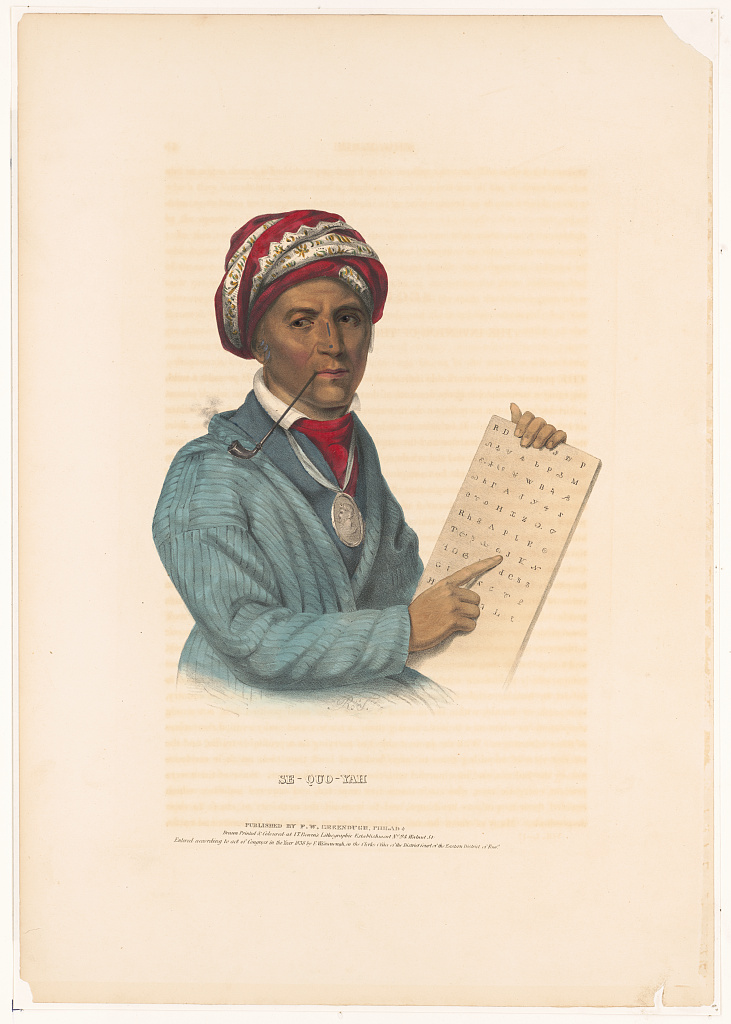
Source: Library of Congress, Prints and Photographs Division — “Se-Quo-Yah” — https://www.loc.gov/item/93504544
The Cherokee Nation pursued a different strategy from the other southeastern nations: it went to court. The Cherokee Nation first sought judicial protection in Cherokee Nation v. Georgia in 1831. A related case, Worcester v. Georgia, reached the U.S. Supreme Court the next year after Georgia convicted Samuel Worcester, a missionary living in Cherokee territory, under a state law requiring white residents there to obtain a state license.11
Chief Justice John Marshall’s opinion for the Court held that Georgia’s laws had no force in Cherokee territory and that relations with the Cherokee Nation fell within federal — not state — authority.
Jackson is often credited with saying, “John Marshall has made his decision; now let him enforce it.” No reliable contemporary evidence establishes that he said those words.12 Jackson was not a formal party to Worcester v. Georgia, and the Supreme Court had no independent enforcement arm of its own.
The Jackson administration did not use federal power to compel Georgia to comply with the Court’s ruling — a choice that remains central to the history of the case and to historical debate about the episode, rather than a simple matter of Jackson having no possible role at all. Later, however, the administration encouraged Georgia toward resolving the immediate dispute, and Georgia’s governor, Wilson Lumpkin, pardoned Worcester in 1833, ending the immediate crisis without resolving the underlying constitutional question or securing Cherokee sovereignty against removal.13
The episode remains important both for what the Court decided and for the practical limits of federal enforcement power in this period.
Division and the Treaty of New Echota, 1835

Source: Library of Congress, Prints and Photographs Division — “John Ross, a Cherokee chief” — https://www.loc.gov/item/94513504/
Facing Georgia’s continued pressure and a Supreme Court ruling with no enforcement behind it, the Cherokee Nation split over how to respond. A minority faction, led by Major Ridge, his son John Ridge, and Elias Boudinot, concluded that removal was now unavoidable and that the nation’s best remaining option was to negotiate favorable terms rather than wait for land to be seized outright.
This group signed the Treaty of New Echota on December 29, 1835, ceding the Cherokee Nation’s eastern territory in exchange for western land and payment.14
The treaty was never approved by the Cherokee National Council, and Principal Chief John Ross — who led the great majority of Cherokee citizens, including more than 15,000 people who signed petitions protesting the treaty — repudiated it and petitioned Congress against its ratification. The U.S. Senate ratified the treaty anyway, by a vote of 31 to 15, with exactly the two-thirds the Constitution requires.15
In 1839, amid the continuing internal conflict over removal and the treaty, Major Ridge, John Ridge, and Elias Boudinot were killed; Cherokee historical and scholarly accounts connect the killings to a Cherokee law that made unauthorized cession of national land a capital offense, though the precise circumstances of each killing remain a subject of historical study rather than settled record.16
Forced Removal and the Trail of Tears
The treaty required removal within two years of its ratification, setting the deadline in May 1838. When most Cherokee people refused to leave under a treaty they had not accepted, President Martin Van Buren authorized General Winfield Scott to carry out removal.17 Federal troops and state militia rounded up about 16,000 Cherokee people into stockades in 1838. They traveled west in multiple detachments along both water and overland routes, with many journeys covering roughly 1,000 miles, mostly between the late summer of 1838 and the spring of 1839.18
The removal is remembered by the Cherokee Nation as the Trail of Tears, a name that has also become widely used in American history. The exact death toll remains unknown. Missionary physician Elizur Butler, who accompanied one of the detachments, estimated that more than 4,000 Cherokee people died during the roundup and journey, amid disease, inadequate food and shelter, poor sanitation, exposure, and the accumulated effects of forced travel.19 The elderly, children, and infants were especially vulnerable.
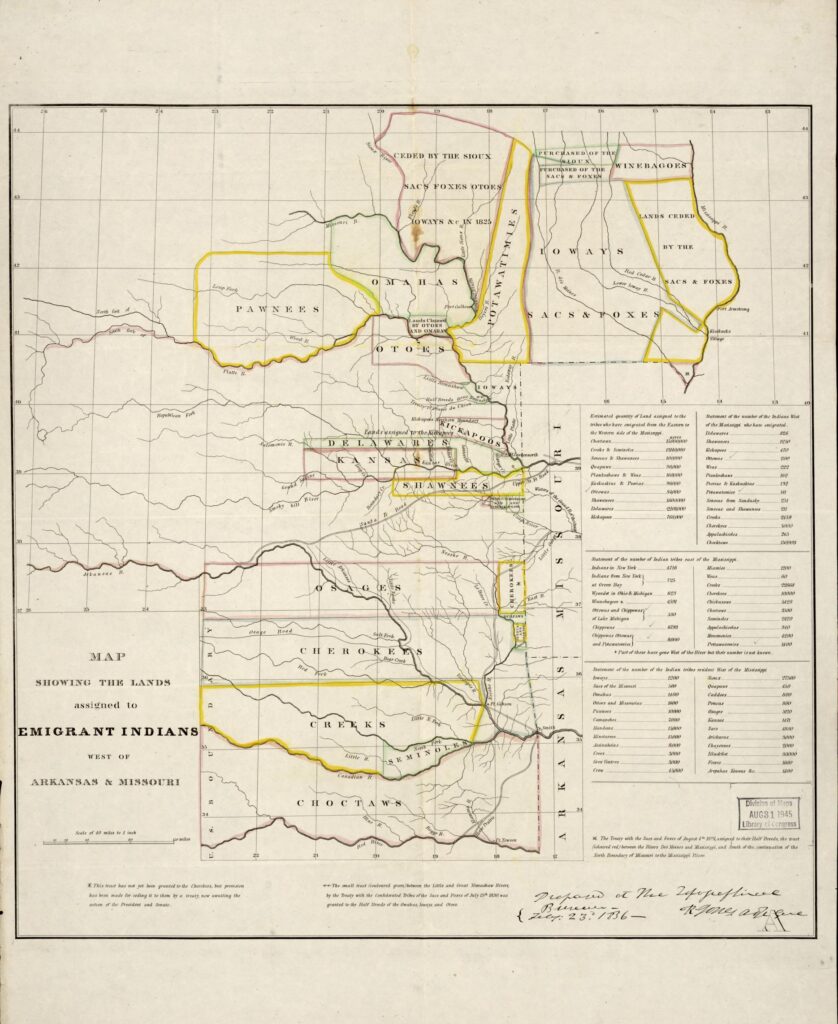
Source: Library of Congress, Geography and Map Division — “Map showing the lands assigned to emigrant Indians west of Arkansas and Missouri” — https://www.loc.gov/item/99446197/
Setting the Record Straight
A few distinctions are worth stating directly, because popular memory tends to compress this history. The Trail of Tears National Historic Trail specifically commemorates Cherokee removal, while the phrase is also often used more broadly for the era’s removal policies; the Cherokee Nation was not alone, and the other four of the five southeastern nations experienced their own forced or coerced removals, on different timelines, under different treaties, and with different degrees of violence — the National Park Service estimates that about 100,000 American Indians were relocated from areas east of the Mississippi between 1830 and 1850, a figure describing that broader removal era rather than the Removal Act alone.20
Removal was also not something that happened only to a passive population: Native nations negotiated, petitioned Congress, sued in federal court, organized political resistance, and, in the Seminole Nation’s case, fought a war that lasted the better part of a decade. And the statute’s language of “exchange” and voluntary “choice” should not be read as an accurate description of how removal was actually obtained: across these histories, voluntary-language treaties frequently operated amid severe pressure, unequal bargaining power, and, in many instances, fraud or military force — though the degree and form of that coercion varied considerably from nation to nation and treaty to treaty, and should not be flattened into a single uniform story.
Legacy and Civic Relevance
The Indian Removal Act remains one of the clearest examples in American history of the gap that can open between a law’s written terms and its real-world enforcement — a gap civics education returns to often, because recognizing it is part of reading any law critically. The five southeastern nations sustained and rebuilt governments, communities, and institutions in Indian Territory and beyond; related communities also remained in or returned to ancestral homelands in the Southeast. Today, federally recognized governments including the Cherokee Nation, Choctaw Nation of Oklahoma, Chickasaw Nation, Muscogee Nation, Seminole Nation of Oklahoma, Seminole Tribe of Florida, and Miccosukee Tribe of Indians of Florida maintain their own governments, courts, citizenship systems, and historical archives that offer a fuller account of this period than any single federal document can.
The companion article to this one, “Andrew Jackson: An American Life and Legacy,” follows Jackson’s full career, including the political arguments that produced the 1830 statute. This piece has focused instead on what the law said, how treaty-making and federal enforcement turned its language of choice into experiences of coercion and forced removal, and how the nations subject to it resisted, endured, and rebuilt.
Footnotes
- Indian Removal Act, ch. 148, 4 Stat. 411 (May 28, 1830); National Archives; DocsTeach.
- Indian Removal Act, Sections 1–3; National Archives; Library of Congress, Indian Removal Act: Primary Documents in American History research guide.
- Treaty of Dancing Rabbit Creek, September 27, 1830; treaty text via Choctaw Nation of Oklahoma, “1830 Treaty of Dancing Rabbit Creek”; Mississippi Encyclopedia, “Doak’s Stand, Dancing Rabbit Creek and Pontotoc Creek, Treaties of.”
- Treaty of Dancing Rabbit Creek, Article XIV, and its administration by federal registering agent William Ward; Choctaw Nation of Oklahoma, “Choctaw Resistance to Removal from Ancient Homeland” (Iti Fabvssa series); Mississippi Encyclopedia.
- Treaty of Cusseta, 1832, and documented fraud and violence against Muscogee allotment holders; National Park Service, Trail of Tears National Historic Trail materials on Muscogee (Creek) removal; Oklahoma Historical Society, “Timeline of Removal.”
- The Creek War of 1836 and the forced removal of the Muscogee (Creek) Nation, including removal under military guard and the National Park Service’s estimate of approximately 3,500 Muscogee deaths in Alabama and during removal; National Park Service, Trail of Tears National Historic Trail; Oklahoma Historical Society, “Timeline of Removal.”
- Treaty of Pontotoc Creek, 1832; Chickasaw Nation historical materials; Mississippi Encyclopedia.
- Chickasaw removal in the late 1830s and resettlement within Choctaw territory; Oklahoma Historical Society, “Timeline of Removal”; Chickasaw Nation historical materials.
- Treaty of Payne’s Landing, 1832, and Seminole leaders’ disputed consent to its terms; Seminole Tribe of Florida and Seminole Nation of Oklahoma historical materials.
- Second Seminole War, 1835–42, and its outcome; National Park Service, describing it among the longest and costliest U.S. conflicts against an Indigenous people; Oklahoma Historical Society, “Timeline of Removal”; Seminole Tribe of Florida and Miccosukee Tribe of Indians of Florida, official histories, for communities that remained in Florida.
- Cherokee Nation v. Georgia, 30 U.S. 1 (1831); Worcester v. Georgia, 31 U.S. 515 (1832); Chief Justice John Marshall’s opinion for the Court in both cases.
- On the disputed “now let him enforce it” quotation and the Supreme Court’s limited enforcement capacity: Federal Judicial Center, “Executive Enforcement of Judicial Orders.” Jackson was not a party to Worcester v. Georgia, and the Jackson administration did not use federal power to compel Georgia’s compliance.
- On the Jackson administration later encouraging Georgia toward resolving the Worcester dispute, and Samuel Worcester’s 1833 pardon by Governor Wilson Lumpkin; Federal Judicial Center, “Executive Enforcement of Judicial Orders.”
- Treaty of New Echota, December 29, 1835; Cherokee Nation historical and treaty materials; John Ross’s petitions against the treaty.
- U.S. Senate Executive Journal, 24th Cong., 1st sess., May 18, 1836, recording ratification of the Treaty of New Echota by a vote of 31–15; Cherokee Nation historical materials; Theda Perdue and Michael D. Green, The Cherokee Nation and the Trail of Tears (Penguin, 2007).
- The 1839 killings of Major Ridge, John Ridge, and Elias Boudinot amid continuing conflict over the Treaty of New Echota, and their connection to Cherokee law regarding unauthorized land cession; Cherokee Nation historical materials; Theda Perdue and Michael D. Green, The Cherokee Nation and the Trail of Tears (Penguin, 2007).
- The Treaty of New Echota’s two-year removal deadline (May 1838) and President Martin Van Buren’s 1838 authorization of General Winfield Scott to carry out removal; National Park Service, Trail of Tears National Historic Trail resources.
- Cherokee removal, 1838–39: approximately 16,000 people removed via stockades and multiple water and overland routes, with many journeys covering roughly 1,000 miles; National Park Service, Trail of Tears National Historic Trail.
- Estimate of more than 4,000 Cherokee deaths during removal, attributed to missionary physician Elizur Butler; National Park Service, Trail of Tears National Historic Trail. The precise total remains unknown.
- National Park Service, Trail of Tears National Historic Trail materials describing the trail as commemorating Cherokee removal specifically, and NPS estimates of approximately 100,000 American Indians relocated from areas east of the Mississippi between 1830 and 1850 as a description of the broader removal era rather than the Indian Removal Act specifically.