

Andrew Jackson: An American Life and Legacy
From an orphaned Carolina childhood to the White House — the full record of a consequential and contested president
Andrew Jackson remains one of the most consequential and contested figures in American political history. He is remembered both for his battlefield victories, his defense of federal authority during the Nullification Crisis, and his role in the expansion of mass electoral politics, his expansion of presidential power, and policies toward Native nations that resulted in dispossession and forced removal.
These assessments draw on a substantial historical record, though historians weigh that record differently. This account follows Jackson’s life from the Carolina backcountry to the White House and back again, placing his achievements, choices, and consequences in the context of his time.
A Childhood Shaped by War
Andrew Jackson was born March 15, 1767, in the Waxhaws, a frontier settlement straddling the border between North and South Carolina; Jackson himself maintained he had been born on the South Carolina side, though the exact location has never been definitively settled.1 His father, also named Andrew, died shortly before his birth, and his mother, Elizabeth, raised Andrew and his two older brothers with the help of relatives.
The Revolutionary War arrived at the Jackson family’s doorstep. His eldest brother, Hugh, died in 1779 after the Battle of Stono Ferry. Andrew, then a young teenager, and his older brother Robert served with local militia forces and were captured by British troops in 1781. In a story Jackson later repeated, a British officer struck him with a saber after he refused to clean the officer’s boots, leaving scars he carried for life.2
Both brothers contracted smallpox in captivity; Robert died shortly after their release. Elizabeth Jackson died later that year, reportedly after contracting cholera while nursing American prisoners of war. By age fourteen, Jackson had lost his father, two brothers, and his mother.
Law, Land, and a Rising Career in Tennessee
Jackson read law in North Carolina and was admitted to the bar in 1787, then moved west to the Mero District of what would become Tennessee, working as a public prosecutor before settling in the new town of Nashville in 1788.3 He built a career there as a lawyer, planter, and land speculator. Over the following decades, he developed the plantation later known as the Hermitage and enslaved people there, a fact of Jackson’s life, discussed further below, that later generations have weighed heavily in assessing him.
Jackson and Rachel Donelson Robards believed her earlier marriage had been legally dissolved when they first married in 1791; after the divorce was formally completed, they remarried in 1794 — a chronology their political opponents would distort into a scandal decades later.4
Jackson’s reputation for personal volatility also dates to this period: in 1806, a dispute over a horse-racing wager led to a formal duel with Charles Dickinson. Dickinson’s shot lodged near Jackson’s heart; it was never removed. Jackson, still standing, then returned fire and killed him.5 Politically, Jackson rose quickly in the new state: a delegate to Tennessee’s constitutional convention in 1796, the state’s first U.S. congressman, briefly a U.S. senator, and a judge on the Tennessee superior court through the early 1800s.6
A General’s War: The Creek War and the Battle of New Orleans
Jackson’s national reputation was made on the battlefield. As a Tennessee militia major general, Jackson led U.S. regulars, militia, and Cherokee and Lower Creek allies to a decisive victory over Red Stick Creek warriors at the Battle of Horseshoe Bend in March 1814; he received his major-general commission in the U.S. Army later that year.7 The battle broke Red Stick resistance, and the Treaty of Fort Jackson formally ended the Creek War later in 1814. That treaty compelled both Red Stick opponents and Creek allies who had fought alongside Jackson to cede approximately 23 million acres across present-day Alabama and Georgia. The treaty demonstrated how military victory could be followed by sweeping land cessions, a pattern that would recur in Jackson’s later dealings with Native nations.8
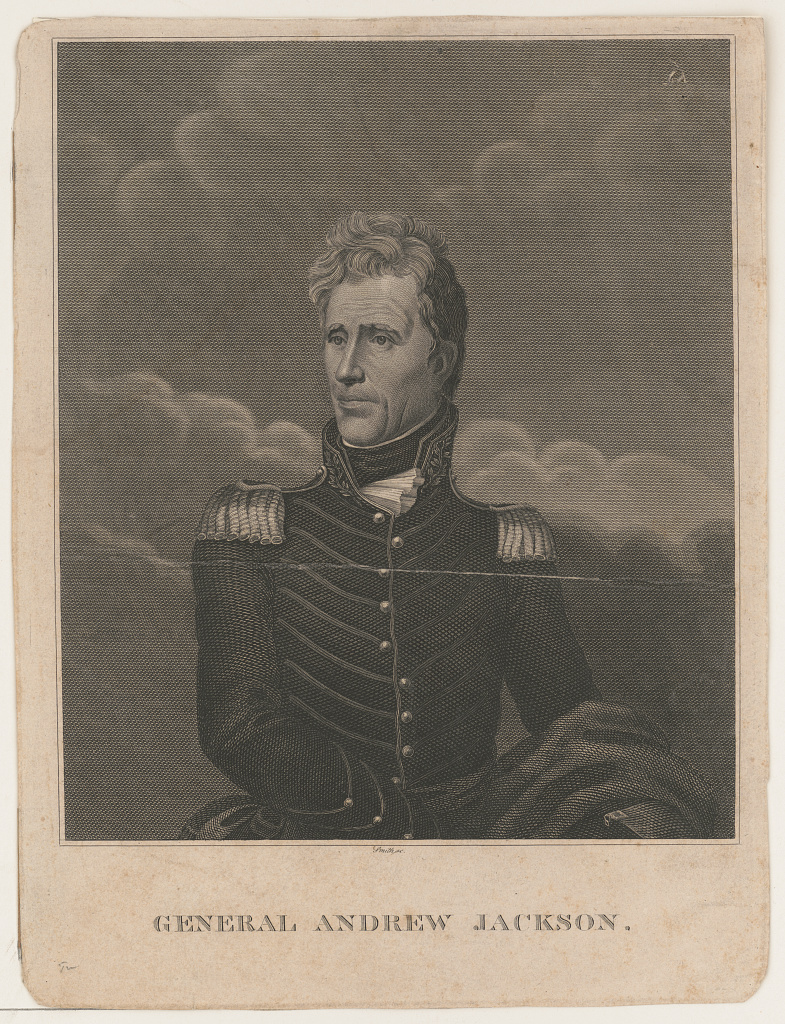
Source: Library of Congress, Prints and Photographs Division — “General Andrew Jackson / Smith sc.” — https://www.loc.gov/item/2012648932/
Jackson’s enduring fame came a few months later. At the Battle of New Orleans on January 8, 1815 — fought, unknown to both sides, after a peace treaty had already been signed in Europe — Jackson’s outnumbered force of regulars, militia, free Black volunteers, Choctaw allies, and Jean Lafitte’s privateers inflicted more than 2,000 British casualties (killed, wounded, captured, or missing) while suffering only a small fraction of that number themselves.9 The victory made Jackson a national hero, celebrated in newspapers and popular memory as a dramatic American triumph over British forces, and it became the foundation of his political career for the next fifteen years.
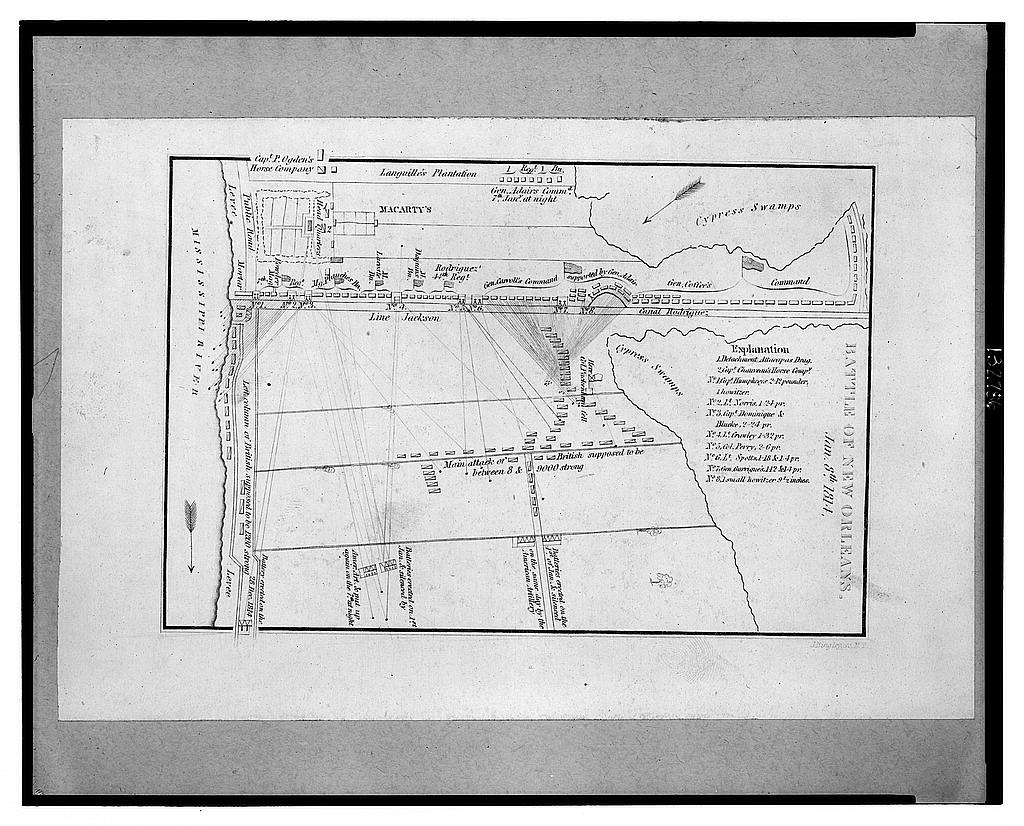
Source: Library of Congress, Prints and Photographs Division — “Battle of New Orleans, Jan. 8th 1814 [i.e., 1815]” — https://www.loc.gov/item/2003668275/
Treaty Commissioner and Frontier General
Before his presidency, Jackson repeatedly served as a federal treaty commissioner and military commander in dealings with Native nations, participating in negotiations that secured major land cessions from the Chickasaw, Choctaw, Cherokee, and other southeastern nations — involvement substantial enough that the State Department’s own historical overview credits him with helping negotiate roughly nine of the eleven major U.S. treaties securing Native land in the Southeast during this period.10
During the First Seminole War of 1817–18, he led U.S. forces into Spanish Florida and seized Pensacola; his execution of two British subjects accused of aiding Seminole resistance, and the broader question of whether he had exceeded his orders and U.S. authority on Spanish territory, generated an international controversy that reached Congress and the cabinet.11
Jackson built a political identity, popular in his home region, around defending frontier settlers against what he and his supporters described as the threat of Indian raids and disputed land claims. Critics of Jackson’s approach — then and since — have argued that this framing understated Native nations’ own legal claims and diplomatic standing. Both views shaped the removal policy Jackson would pursue as president, examined in the companion piece to this article, The Indian Removal Act and Its Consequences.
The Election of 1824 and the “Corrupt Bargain”
Jackson first ran for president in 1824, in a four-way race against John Quincy Adams, William H. Crawford, and Henry Clay. Jackson won the largest share of both the popular vote and the electoral vote — a plurality of the popular vote and 99 of 261 electoral votes, against 84 for Adams, 41 for Crawford, and 37 for Clay — but fell short of the majority required to win outright.12 Under the Twelfth Amendment, the decision moved to the House of Representatives, which could choose only among the top three finishers. Clay, eliminated from contention but serving as Speaker of the House, supported Adams in the House contingent election, which Adams won on the first ballot. When Adams then named Clay his secretary of state, Jackson and his supporters denounced the outcome as a “corrupt bargain” — an accusation Adams and Clay denied, and one historians still debate the fairness of, but which became the defining grievance of Jackson’s next campaign.13
The Election of 1828 and a Personal Loss
Jackson spent the next four years building a political coalition — one that, with organizers including Martin Van Buren, evolved into the Democratic Party — around the “corrupt bargain” grievance and a broader argument that entrenched elites in Washington had subverted the will of ordinary voters. The 1828 rematch against Adams was an exceptionally harsh and personal presidential campaign: Jackson’s opponents revived the old controversy over his marriage to Rachel and attacked his temperament, while Jackson’s supporters attacked Adams as an aristocrat out of touch with the common citizen.14
Jackson won decisively, with 56 percent of the popular vote and 178 of 261 electoral votes. Rachel Jackson, already in poor health and reportedly distressed by the campaign attacks on her character, died on December 22, 1828, weeks before her husband’s inauguration — a loss from which associates said Jackson never fully recovered.15
The Jackson Presidency
Jackson served two terms, from 1829 to 1837, and his presidency reshaped the office and the party system around it. Supporters at the time and historians since have credited him with presiding over an era of expanding mass-party politics — rallies, partisan newspapers, and wider white-male suffrage in many states — though voting rights remained restricted by race and gender: women, most Black Americans, Native people, and others remained excluded, and the broadening of suffrage was driven chiefly by individual states rather than by Jackson personally. Critics, then and since, have argued that Jackson also expanded presidential power in ways that alarmed contemporaries across the political spectrum, and that several of his central policies caused serious and lasting harm. Four major episodes illustrate the presidency’s reach and controversies.
Indian Removal
Within his first year in office, Jackson made the removal of Native nations from the southeastern United States to territory west of the Mississippi River his central domestic priority, recommending the policy in his First Annual Message to Congress in December 1829 and signing the Indian Removal Act into law on May 28, 1830, after close votes in Congress.16,17
Jackson defended the policy in his annual messages as a “liberal” and “generous” offer that would protect Native nations from destruction by advancing white settlement, framing that his own supporters at the time largely accepted and that many historians since have sharply criticized as obscuring the coercion involved in its execution.18
The statute’s text authorized negotiated exchange, not a single forced march; what removal actually looked like in practice — the treaties, the pressure brought to bear at the negotiating table, Native diplomacy and resistance, and the forced removals that followed, including the Cherokee removal carried out in 1838 after Jackson left office — is the subject of the companion article to this one, “The Indian Removal Act and Its Consequences.” Indian removal was among the most consequential and controversial policies of Jackson’s presidency; it does not, however, account for the whole of it.
The Bank War
Jackson viewed the Second Bank of the United States — a federally chartered corporation with private shareholders and a federal stake, holding substantial influence over credit, banknote circulation, and federal deposits — as an unaccountable concentration of financial power benefiting wealthy investors at the expense of ordinary citizens. When Congress passed a bill to renew the Bank’s charter in 1832, Jackson vetoed it, writing that “it is to be regretted that the rich and powerful too often bend the acts of government to their selfish purposes.”19
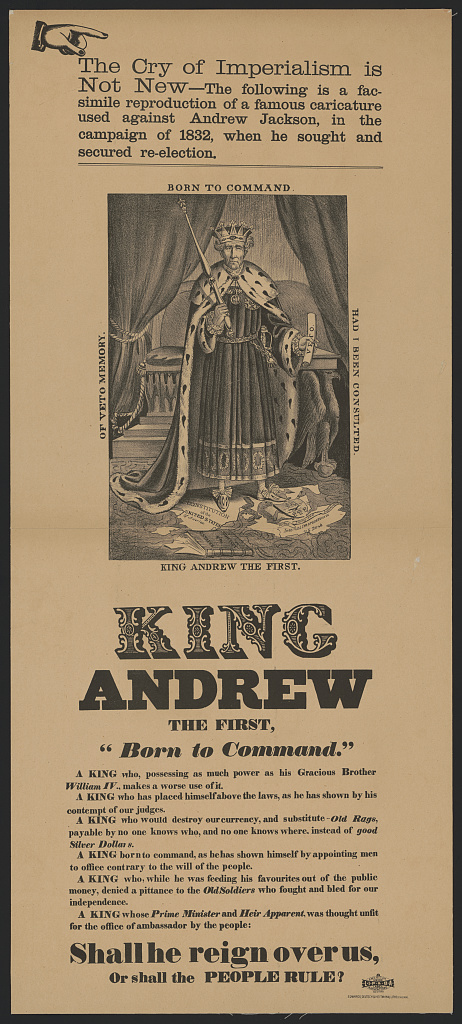
Source: Library of Congress, Prints and Photographs Division — “King Andrew the First” — https://www.loc.gov/item/2018695419/
After winning reelection that same year, Jackson went further, directing the removal of federal deposits from the Bank into a group of selected state-chartered banks — a move his supporters saw as completing the destruction of what Jackson regarded as an unconstitutional monopoly, and his critics saw as a dangerous concentration of executive power. A Senate that opposed the move censured Jackson in 1834; the censure was expunged from the record in 1837, after his allies gained control of the chamber.20
The Bank’s president, Nicholas Biddle, responded by restricting credit, helping intensify the political and economic conflict; historians continue to debate the relationship among the Bank War, federal fiscal policy, international finance, and the Panic of 1837, which began after Jackson left office.21
The Nullification Crisis
In 1832, South Carolina, acting on arguments advanced by Jackson’s own vice president, John C. Calhoun, declared federal tariff laws null and void within the state and threatened to resist their collection by force. Jackson, himself a slaveholder with deep political ties to the South, rejected the doctrine of nullification outright, issuing a proclamation on December 10, 1832, that declared “disunion by armed force is treason,” and urging Congress to authorize federal enforcement if necessary.22 Congress passed both a compromise tariff, negotiated chiefly by Henry Clay, that gradually reduced the disputed rates, and a Force Bill authorizing Jackson to use the military if necessary; South Carolina repealed its tariff-nullification ordinance while symbolically nullifying the Force Bill in turn. Jackson’s response affirmed federal supremacy and his willingness to use federal power to enforce federal law, while historians continue to debate the constitutional and political implications of his approach.23
The Spoils System
Jackson also reshaped the federal workforce, removing and replacing hundreds of federal officeholders with his own political supporters — far fewer than popular accounts of a wholesale purge sometimes imply, though still an unprecedented use of the practice he defended as democratic “rotation in office” meant to break the hold of an entrenched governing class.24 Critics at the time and since have called it a major early example of the political patronage system later known as the “spoils system,” and pointed to cases such as that of Samuel Swartwout, whom Jackson had appointed collector of the Port of New York in 1829, and who later fled in 1838 — after Jackson had left office — once investigators uncovered a customs-house defalcation exceeding $1 million, as evidence of the practice’s risks.25
Retirement, Final Years, and Death
Jackson left office in March 1837 and returned to the Hermitage, his estate outside Nashville, hoping for a quiet retirement that never fully materialized. He remained deeply engaged in national politics for the rest of his life, corresponding heavily with his chosen successor, Martin Van Buren, and later using his considerable influence to support James K. Polk’s 1844 Democratic nomination — a fellow Tennessean who championed the annexation of Texas.26 Jackson’s health, fragile for decades from old wounds and chronic illness, continued to decline; he continued to receive visitors, correspond with political allies, and oversee affairs at the Hermitage until the end of his life.27 Andrew Jackson died there on June 8, 1845, at age seventy-eight, and was buried in the estate’s garden beside Rachel.

Source: Library of Congress, Prints and Photographs Division — “The hermitage / drawn by T. Birch, from a description funished by a friend at Washington, D.C. ; engraved by J.W. Steel.” — https://www.loc.gov/item/2012649669/
A Contested Legacy
Few American presidents have been remembered in such sharply different ways. For generations, Jackson was celebrated in popular history as the champion of the “common man,” the general who saved New Orleans, and the president who challenged concentrated financial power and defended the Union against nullification — a legacy visible in monuments, place names, and his long appearance on the $20 bill.28 In recent decades, public commemoration and historical scholarship have increasingly emphasized the other side of that record: Jackson’s expansion of executive power, his lifelong enslavement of people at the Hermitage, and the human cost of Indian removal, a policy that displaced tens of thousands of people and whose consequences the companion article to this piece examines directly.29
The major events of Jackson’s life are extensively documented. Their meaning, moral weight, and place in the nation’s history remain contested — among historians, and among Americans more broadly. This article has tried to lay out that record for readers to weigh for themselves, rather than to resolve the argument on their behalf.
Explore more in The Indian Removal Act and Its Consequences.
Footnotes
- Andrew Jackson’s birth, March 15, 1767, in the Waxhaws settlement on the North Carolina–South Carolina border; the exact birthplace within the Waxhaws has never been conclusively established, and Jackson himself maintained he was born on the South Carolina side. Miller Center, “Andrew Jackson: Life Before the Presidency”; Andrew Jackson’s Hermitage, “Early Life.”
- Jackson’s capture and imprisonment during the Revolutionary War, and the British officer’s saber attack, are recounted in Jackson’s own later retellings and in early biographies; Miller Center, “Andrew Jackson: Life Before the Presidency”; Andrew Jackson’s Hermitage, “Early Life.”
- Jackson’s legal training, admission to the bar (1787), and relocation to Nashville (1788); Miller Center, “Andrew Jackson: Life Before the Presidency.”
- Jackson and Rachel Donelson Robards’s 1791 marriage, the incomplete status of her prior divorce, and their formal 1794 remarriage; Miller Center, “Andrew Jackson: Life Before the Presidency”; Andrew Jackson’s Hermitage.
- The 1806 duel between Jackson and Charles Dickinson; Andrew Jackson’s Hermitage, “Duel with Charles Dickinson”; Andrew Burstein, The Passions of Andrew Jackson (Knopf, 2003).
- Jackson’s early Tennessee political offices: delegate to the 1796 constitutional convention, U.S. congressman, U.S. senator, and judge of the Tennessee superior court; Miller Center, “Andrew Jackson: Life Before the Presidency.”
- Battle of Horseshoe Bend, March 27, 1814, and Jackson’s U.S. Army major-general commission later that year; National Park Service, Horseshoe Bend National Military Park; Miller Center.
- Treaty of Fort Jackson, August 9, 1814, and its cession of approximately 23 million acres from both Red Stick opponents and Creek allies; National Park Service, Horseshoe Bend National Military Park; U.S. Department of State, Office of the Historian.
- Battle of New Orleans, January 8, 1815; American Battlefield Trust, “Andrew Jackson.”
- Jackson’s postwar treaty commission service securing land cessions from the Chickasaw, Choctaw, Cherokee, and other southeastern nations, including the U.S. Department of State Office of the Historian’s characterization of Jackson as having helped negotiate roughly nine of the eleven major U.S. treaties securing Native land in the Southeast during this period; Library of Congress Andrew Jackson Papers finding aids; Robert V. Remini, Andrew Jackson and His Indian Wars (Viking, 2001).
- The First Seminole War (1817–18), Jackson’s seizure of Pensacola, and the international controversy following his execution of two British subjects, Alexander Arbuthnot and Robert Ambrister, accused of aiding Seminole resistance — a controversy debated in Congress and within Monroe’s cabinet over whether Jackson had exceeded his orders and U.S. authority on Spanish territory; U.S. Department of State, Office of the Historian; Robert V. Remini, Andrew Jackson and His Indian Wars (Viking, 2001).
- Results of the 1824 presidential election (Jackson 99 electoral votes, Adams 84, Crawford 41, Clay 37, of 261 total); Miller Center, “Andrew Jackson: Campaigns and Elections.”
- The House contingent election deciding the 1824 race and the “corrupt bargain” accusation; Miller Center, “Andrew Jackson: Campaigns and Elections”; Andrew Jackson’s Hermitage, “Corrupt Bargain”; Library of Congress, Andrew Jackson Papers (1824–25 correspondence).
- The tone and central issues of the 1828 campaign, including attacks on Jackson’s marriage; Miller Center, “Andrew Jackson: Campaigns and Elections.”
- Results of the 1828 election and the death of Rachel Jackson on December 22, 1828; Miller Center, “Andrew Jackson: Campaigns and Elections.”
- Andrew Jackson, First Annual Message to Congress, December 8, 1829; Indian Removal Act, ch. 148, 4 Stat. 411 (May 28, 1830); National Archives; Miller Center.
- On the congressional vote: U.S. Senate Journal, 21st Cong., 1st sess., April 24, 1830 (recording passage by a vote of 28–19); U.S. House Journal, 21st Cong., 1st sess., May 26, 1830 (recording passage as 101–97).
- Andrew Jackson, Second Annual Message to Congress, December 6, 1830; National Archives, “President Andrew Jackson’s Message to Congress on Indian Removal,” Milestone Documents.
- Andrew Jackson, Veto Message Regarding the Bank of the United States, July 10, 1832; Miller Center, “Andrew Jackson: Domestic Affairs.”
- Removal of federal deposits from the Second Bank, 1833; Senate censure of Jackson adopted March 28, 1834, and expunged January 16, 1837; U.S. Senate Historical Office; Miller Center, “Andrew Jackson: Domestic Affairs.”
- Nicholas Biddle’s credit contraction and the contested relationship between the Bank War and the Panic of 1837; Robert V. Remini, Andrew Jackson and the Bank War (W. W. Norton, 1967); Miller Center, “Andrew Jackson: Domestic Affairs.”
- Andrew Jackson, Proclamation Regarding Nullification, December 10, 1832; Miller Center, “Andrew Jackson: Domestic Affairs.”
- Historians’ assessment of the Nullification Crisis and Jackson’s use of executive and military authority; Richard E. Ellis, The Union at Risk: Jacksonian Democracy, States’ Rights, and the Nullification Crisis (Oxford University Press, 1987); Miller Center, “Andrew Jackson: Domestic Affairs.”
- The scale of Jackson’s removals from federal office — generally described by historians as in the hundreds rather than a wholesale purge — and his “rotation in office” rationale; Daniel Feller, The Jacksonian Promise: America, 1815–1840 (Johns Hopkins University Press, 1995); Miller Center, “Andrew Jackson: Domestic Affairs.”
- Samuel Swartwout’s 1838 flight and the customs-house shortfall discovered afterward; Miller Center, “Andrew Jackson: Domestic Affairs.”
- Jackson’s retirement activities, including his correspondence with Van Buren and support for Polk’s 1844 nomination; Miller Center, “Andrew Jackson: Life After the Presidency.”
- Jackson’s declining health in retirement and his death on June 8, 1845; Miller Center, “Andrew Jackson: Life After the Presidency”; Britannica, “The Rise of Andrew Jackson — Final Years and Death.”
- Jackson’s long-standing popular and historiographical reputation as a champion of the “common man,” and his historical appearance on U.S. currency; White House Historical Association, “Andrew Jackson.”
- Unworthy Republic: The Dispossession of Native Americans and the Road to Indian Territory (W. W. Norton, 2020); Andrew Jackson’s Hermitage, “Enslaved People at The Hermitage”; National Park Service, Trail of Tears National Historic Trail resources.