

Henry Clay and the Art of Buying Time
He was called the “Great Pacificator” and the “Great Compromiser.” His bargains repeatedly deferred the conflicts — over slavery, economic policy, and federal authority — that the Union had not yet learned how to resolve.
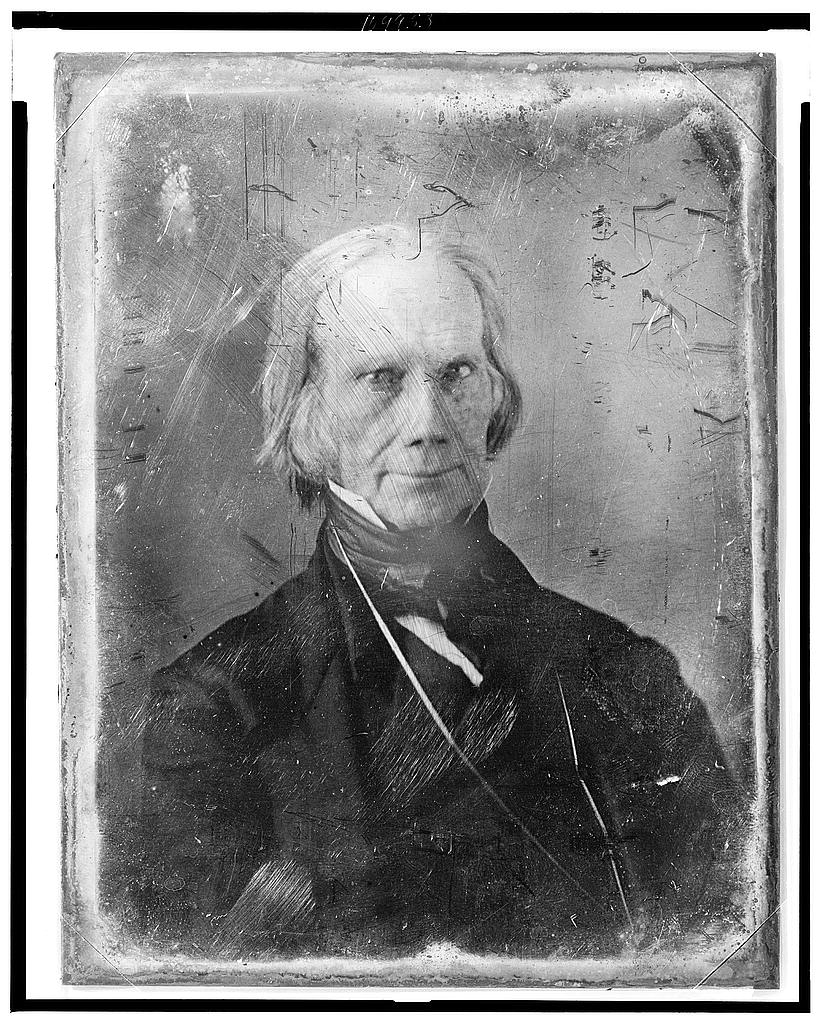
On January 29, 1850, a 72-year-old senator from Kentucky rose in the Old Senate Chamber, showing the effects of age and tuberculosis, to introduce eight resolutions meant to settle a crisis that threatened to break the Union apart. It was not the first time Henry Clay had done something like this. Thirty years earlier, as a much younger Speaker of the House, he had helped engineer a deal admitting Missouri as a slave state and Maine as a free one. Thirteen years later, as a senator, he worked with John C. Calhoun on a tariff compromise that helped end South Carolina’s nullification crisis. By 1850, Clay had spent nearly four decades building a reputation as the man Congress turned to when the Union itself seemed to be the thing at stake.1
Later admirers called Clay the “Great Compromiser” and the “Great Pacificator,” titles associated with his efforts to manage the Missouri Compromise, nullification, and the 1850 crises.2 The shorthand legacy is familiar: Clay’s bargains are often credited with preserving the Union in moments of acute danger.
The fuller story is more complicated, and more instructive. Clay did not single-handedly save anything — each of his three great compromises required Congress, other senators willing to deal, and sometimes a rival’s legislative skill to actually pass. And each compromise addressed the specific dispute in front of Congress without resolving the deeper conflict beneath it — over slavery’s expansion in 1820 and 1850, and over federal authority and states’ rights in 1833 — postponing a reckoning rather than avoiding one. This article looks at what each of those three settlements did, what each left unresolved, and who bore the cost of their terms.
Source: Library of Congress, Prints and Photographs Division.
From Frontier Lawyer to War Hawk
Henry Clay was born on April 12, 1777, in Hanover County, Virginia, the son of a planter father who died when Clay was four years old. He received only a few years of formal schooling before studying law and, in 1797, moving to Lexington, Kentucky, then still very much a frontier settlement.3 There he built a successful legal practice and, with it, a political career that would keep him in national office for most of the next five decades.
Rise to the Speakership
Clay served in the Kentucky legislature, which twice chose him to fill unexpired U.S. Senate terms, in 1806 and again in 1810.4 At his first appointment, he was 29, below the Constitution’s minimum age of 30 for the office. In 1811 he moved to the House of Representatives, where his colleagues elected him Speaker on his very first day — an unusual honor that reflected both his ambition and his talent for building coalitions. As Speaker, Clay became a leading voice among the “War Hawks,” a group of younger nationalist congressmen who pushed the country toward war with Britain in 1812.3
The American System
After the war, Clay became the chief architect of what he called the “American System”: a program of protective tariffs to shield domestic manufacturing, a national bank to stabilize currency and credit, and federally funded roads and canals to knit the country’s regions together economically. The American System was Clay’s vision for a Union bound by shared economic interest — a vision that would inform his approach to nearly every crisis he later helped manage.3 It also made him, for most of his career, a divisive and only partially successful figure: he ran for president three times, in 1824, 1832, and 1844, and lost every time.3
1820: Managing Slavery’s Expansion
By 1819, Clay was one of the most powerful men in Washington, and Congress was consumed by a crisis he had not created but would help manage. Missouri had applied for admission to the Union as a slave state, and the request set off a bitter debate over whether Congress had the authority to restrict slavery in new states at all. The dispute threatened to upend the fragile balance between free and slave states in the Senate, where each region held eleven states apiece.5
The deal that emerged, and that Clay helped steer through the House, admitted Missouri as a slave state and Maine — recently separated from Massachusetts — as a free state, preserving the sectional balance in the Senate. A separate provision drew a line at 36°30′ north latitude across the remaining Louisiana Purchase territory, prohibiting slavery north of the line, except in Missouri, while permitting it south of the line.5 Clay was not the sole author of this arrangement, but as Speaker he used considerable procedural skill to secure final passage through a divided House. In a maneuver one biographer called “the neatest and cleverest parliamentary trick ever sprung in the House,” Clay delayed a reconsideration motion until the bill had already been forwarded to the Senate, leaving opponents no chance to reopen the debate.5
It is worth being precise about what the Missouri Compromise actually did. It did not end the dispute over slavery, and it did not end the constitutional dispute over Congress’s authority to regulate slavery in federal territories — a question that would resurface, more explosively, in the 1850s. What it did was manage a specific, immediate congressional standoff by trading one slave state for one free state and by drawing a temporary geographic line through unorganized territory. It settled the immediate question and set a territorial rule that stood for thirty-four years, until Congress repealed the 36°30′ line in the Kansas-Nebraska Act of 1854.
1833: Union, Tariffs, and Nullification
Clay’s method of compromise was not limited to slavery. South Carolina’s Ordinance of Nullification, passed in 1832, declared the tariff acts of 1828 and 1832 null and void within the state. President Andrew Jackson responded with a proclamation calling nullification incompatible with the Union’s existence. Congress paired the Force Bill with negotiation, authorizing the president to use federal force if necessary to enforce tariff collection. The country seemed to be moving toward armed confrontation between a state and the federal government.6
Clay worked with his sometime rival John C. Calhoun of South Carolina and other senators on the Compromise Tariff of 1833 — over the opposition of Daniel Webster, who backed the Force Bill but opposed the tariff reduction as a concession to the nullifiers — gradually reducing duties over the following decade and giving South Carolina an economic off-ramp without forcing Congress to concede that a state could nullify federal law, while Jackson’s threat to enforce federal law remained in the background. South Carolina repealed its ordinance against the tariffs in March 1833 and, in a symbolic gesture, nullified the Force Bill; the immediate crisis passed.6 As with Missouri, the 1833 compromise addressed the specific dispute in front of Congress — the tariff rate — without resolving the underlying constitutional argument over whether a state could defy federal authority — an argument that returned with secession a generation later.
Together, the Missouri Compromise and the Tariff of 1833 established the pattern that would define Clay’s reputation: gradualism over confrontation, carefully built coalitions over ideological victory, and specific, negotiated fixes over binding constitutional resolution. It was a method suited to holding together a fractious, sectional Congress. It was less suited to answering the questions that kept forcing Congress back to the negotiating table.
1850: The Last Compromise
The Treaty of Guadalupe Hidalgo, which ended the Mexican-American War in 1848, brought a vast new western territory under U.S. control. By 1849, California—swollen by the Gold Rush—was applying for admission as a free state, threatening to upset the long-standing numerical parity between free and slave states in the Senate. Congress also faced disputes over Texas’s boundary claims, the organization of New Mexico and Utah territories, the domestic slave trade in Washington, D.C., and Southern demands for stronger federal enforcement of fugitive-slave claims.
Clay’s Eight Resolutions
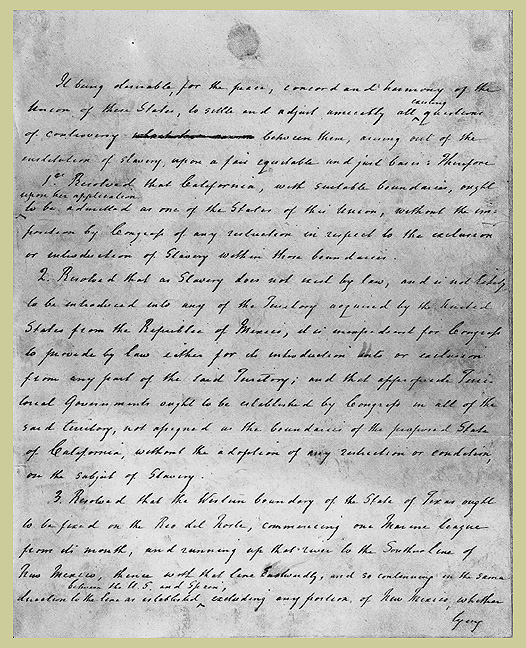
On January 29, 1850, Clay introduced eight resolutions intended to address all of these disputes at once, describing his plan as “an amicable arrangement of all questions in controversy between the free and slave States.” He later folded the resolutions into a single “omnibus” bill, telling the Senate it was “neither southern nor northern. It is equal; it is fair; it is a compromise.” In one of the debate’s most theatrical moments, Clay invoked a fragment of George Washington’s coffin, warning colleagues that it carried “a warning voice, coming from the grave to the Congress . . . to beware, to pause, to reflect before they lend themselves to any purposes which shall destroy the Union.”7
The omnibus strategy failed: bundling every disputed issue into a single bill gave every senator who objected to any provision a reason to vote against the whole package. It took Stephen A. Douglas of Illinois to salvage Clay’s plan by breaking it into five separate statutes, which Congress enacted in September 1850 — admitting California as a free state, organizing New Mexico and Utah without a congressional restriction on slavery, settling the Texas boundary dispute, ending the public slave trade in the District of Columbia, and enacting a substantially strengthened Fugitive Slave Act. Clay, in declining health, played a diminished role in this final stretch; the settlement that passed is properly credited to both men, not to Clay alone.7 Our companion article,
The Compromise of 1850, covers the omnibus’s collapse, Douglas’s strategy, and the five statutes — including the Fugitive Slave Act’s consequences — in full.
Source: National Archives, Milestone Documents. U.S. government record.
The Limits of Compromise
Clay did not live to see how fully the Fugitive Slave Act would reshape Northern politics and resistance. He died in Washington on June 29, 1852, roughly two years after his last great compromise passed. The U.S. Senate Historical Office describes the Compromise of 1850 as having helped “stave off civil war for another decade, but only by allowing for the continuation of slavery.”8 The Civil War began in April 1861, not quite nine years after Clay’s death and a little more than a decade after the compromise legislation passed.
Legacy and Civic Relevance
Henry Clay’s career offers a useful case study for understanding how Congress manages—and sometimes merely postpones—its most difficult conflicts. Three times, Clay helped assemble a coalition broad enough to avert an immediate crisis: sectional deadlock over Missouri in 1820, a state’s defiance of federal tariff law in 1833, and a territorial dispute entangled with slavery’s future in 1850. Each time, the deal required other people—Daniel Webster, John C. Calhoun, Stephen Douglas, and majorities in both chambers willing to bargain. Each settlement left major underlying conflicts unsettled, and later crises exposed the limits of the political bargains.
“Great Compromiser” and “Great Pacificator” describe Clay’s skill at building coalitions under pressure. The arrangements he helped broker held the Union together for a time without resolving the conflicts beneath them, and the 1850 settlement included a law that extended federal enforcement of slaveholders’ claims into the free states. Each compromise delayed disunion; each left the hardest questions to the next generation.
This article is the second in a Civics for Life series tracing Congress’s attempts to manage the sectional conflict over slavery, following our companion piece on Missouri Statehood and the Missouri Compromise. Our companion article on the Compromise of 1850 covers the collapse of Clay’s omnibus bill, Stephen Douglas’s role in passing five separate laws, and the Fugitive Slave Act’s consequences for the decade that followed.
Explore more stories about people and events from history on Civics for Life.
Footnotes
- Library of Congress, “Henry Clay: A Resource Guide,” https://guides.loc.gov/henry-clay
- Robert V. Remini, Henry Clay: Statesman for the Union (W. W. Norton, 1991); David S. Heidler and Jeanne T. Heidler, Henry Clay: The Essential American (Random House, 2010): https://search.worldcat.org/title/Henry-Clay-:-statesman-for-the-Union/oclc/23140589
- American Battlefield Trust, “Henry Clay,” https://www.battlefields.org/learn/biographies/henry-clay
- U.S. Department of State, Office of the Historian, “Henry Clay (1777–1852).”: https://history.state.gov/departmenthistory/people/clay-henry
- U.S. Senate Historical Office, “The Missouri Compromise,” for the terms of the 1820 compromise and Clay’s parliamentary maneuvering as Speaker; Robert Pierce Forbes, The Missouri Compromise and Its Aftermath: Slavery and the Meaning of America (University of North Carolina Press, 2007), for the precise 36°30′ north latitude line and its exception for Missouri: https://www.senate.gov/artandhistory/history/minute/Missouri_Compromise.htm
- Andrew Jackson’s Hermitage, “The Nullification Crisis,” for the 1832 Ordinance of Nullification, Jackson’s proclamation, and the Force Bill; Richard E. Ellis, The Union at Risk: Jacksonian Democracy, States’ Rights, and the Nullification Crisis (Oxford University Press, 1987), for scholarly context on the crisis and Clay’s negotiation of the 1833 compromise tariff: https://thehermitage.com/andrew-jackson-the-nullification-crisis
- U.S. Senate Historical Office, “Clay’s Last Compromise,” for the January 29, 1850, resolutions, Clay’s Senate speech and the Washington’s-coffin anecdote, the omnibus bill’s collapse, and Stephen Douglas’s role in passing five separate bills. For direct quotations and legislative detail, see also The Papers of Henry Clay, ed. Robert Seager II, Melba Porter Hay, James C. Klotter, et al. (University Press of Kentucky), and the Congressional Globe, 31st Congress, 1st session, via the Library of Congress’s A Century of Lawmaking collection: https://www.senate.gov/artandhistory/history/minute/Clays_Last_Compromise.htm
- U.S. Senate Historical Office, “Clay’s Last Compromise.” Used for the characterization of the 1850 settlement as having “stave[d] off civil war for another decade,” and for the timing of Clay’s 1852 death relative to the 1861 outbreak of the Civil War: https://www.senate.gov/artandhistory/history/minute/Clays_Last_Compromise.htm