

The Compromise of 1850: Five Laws, One Unraveling Peace
With the Compromise of 1850, Congress converted a crisis over slavery’s expansion into five separate laws. The most consequential of them — a strengthened Fugitive Slave Act — nationalized the enforcement of slavery and deepened the sectional divide it was meant to ease.
A Union Under Strain
In 1848, the Treaty of Guadalupe Hidalgo ended the Mexican-American War. Mexico recognized the Rio Grande as Texas’s boundary and ceded a vast expanse that included present-day California, Nevada, Utah, and parts of several other western states.1 Congress had not settled whether, or how, slavery could be permitted in the newly acquired western territories — a question it had already begun fighting over in 1846, when Pennsylvania congressman David Wilmot proposed barring slavery from any land won from Mexico.1
The problem became urgent faster than anyone expected. Gold was discovered at Sutter’s Mill on January 24, 1848. The migration surge that followed, especially in 1849, helped California move rapidly toward statehood: its residents drafted a state constitution banning slavery and petitioned Congress for immediate admission as a free state.2 That request threatened to tip the Senate’s careful sectional balance, still nominally maintained at fifteen free and fifteen slave states. Texas, meanwhile, claimed a large portion of present-day New Mexico, where Mexican law had abolished slavery and where Texas’s claimed authority was fiercely contested. The dispute carried a real risk of armed confrontation, as Texas contemplated asserting its claim while the federal government moved troops to protect New Mexico. Congress also faced pressure to organize governments for the rest of the Mexican Cession, to address the continued sale of enslaved people in the nation’s capital, and, from southern members, to strengthen federal enforcement of slaveholders’ claims to people who had escaped into free states.1
President Zachary Taylor, a Louisiana slaveholder himself, urged California and New Mexico to seek prompt statehood, a position that angered many slaveholding politicians and did not produce a workable congressional settlement.1

Source: Library of Congress, Prints and Photographs Division.
Clay’s Eight Resolutions
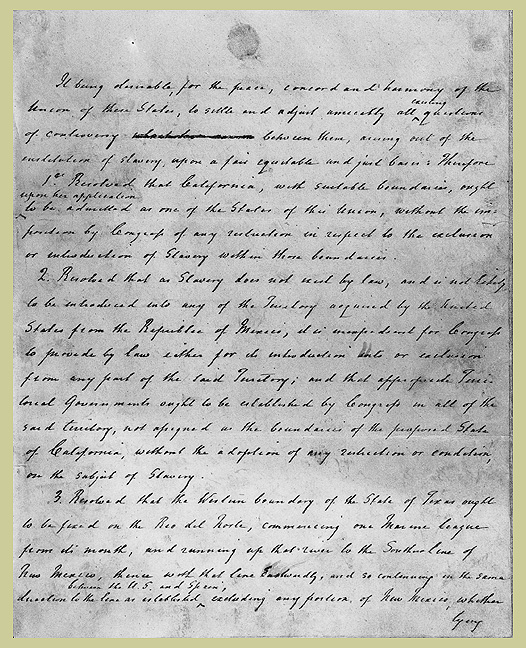
On January 29, 1850, Senator Henry Clay of Kentucky — already, at 72, a veteran of the Missouri Compromise of 1820 and the tariff compromise of 1833 — introduced eight resolutions intended to address the crisis’s interconnected disputes. Clay proposed admitting California as a free state; organizing New Mexico and Utah without a congressional restriction on slavery, while providing that they could later enter the Union with or without slavery; resolving the Texas boundary dispute by having the federal government assume Texas’s public debt, in an amount Clay left blank; ending the sale of enslaved people, though not slavery itself, in the District of Columbia; and calling for more effectual enforcement of the return of people who had escaped slavery. Congress ultimately enacted a related — but not identical — five-statute settlement.3 Clay described his package as “an amicable arrangement of all questions in controversy between the free and slave States.”
It is worth being precise about what Clay’s resolutions were and were not. They were a proposed framework, not a finished bill, and Congress did not simply enact them as written. Clay later combined most of his proposals into a single “omnibus” bill, which he defended to the Senate as being “neither southern nor northern. It is equal; it is fair; it is a compromise.” In one of the debate’s most theatrical moments, Clay invoked a fragment of George Washington’s coffin, warning colleagues that it carried “a warning voice, coming from the grave to the Congress . . . to beware, to pause, to reflect before they lend themselves to any purposes which shall destroy the Union.”3 The eventual statutes differed in structure from Clay’s resolutions; Congress’s new fugitive-slave legislation supplied a far more stringent enforcement regime than the general call for “more effectual” enforcement in Clay’s original resolution on the subject.
How the Omnibus Failed
Clay’s strategy of bundling every disputed issue into one bill ran into a structural problem: it gave every senator who objected to any single provision a reason to vote against the whole package. The package divided both sections: many southern senators rejected California’s admission as a free state, while many northern senators rejected a stronger fugitive-slave law. The debate stretched across much of 1850 and drew out the Senate’s most formidable voices.
Source: National Archives, Milestone Documents. U.S. government record.
The Senate’s Great Voices: Calhoun, Webster, and Seward
On March 4, 1850, John C. Calhoun of South Carolina — too ill to deliver his own remarks — had his final major speech read to the Senate by Senator James M. Mason of Virginia. Calhoun rejected Clay’s plan, arguing that the Union could endure only if the South received durable constitutional protections and its lost sectional balance was restored. He died less than a month later, on March 31, 1850.4 Three days after Calhoun’s speech, on March 7, Daniel Webster of Massachusetts rose to answer him with a three-and-a-half-hour address urging his fellow Northerners to accept compromise, including the Fugitive Slave Act, for the sake of the Union. Webster regarded the speech as a defining defense of the Union; many critics in New England viewed it instead as a capitulation to slaveholding power.5 On March 11, William H. Seward of New York took the opposite position, arguing that a “higher law than the Constitution” governed the territories and that Congress had no business protecting slavery’s expansion at all.6
Taylor’s Death and Douglas’s Strategy
In the middle of this debate, the political ground shifted again. Taylor died on July 9, 1850, and Vice President Millard Fillmore succeeded him. Unlike Taylor, Fillmore favored Clay’s compromise approach, and his support helped create room for a deal — but it did not, by itself, revive the omnibus bill.1 By the end of July, Senate defeats and amendments had dismantled the omnibus; its Utah territorial provision survived, while the settlement’s other elements required separate legislation.
It fell to Stephen A. Douglas of Illinois, a far more junior senator than Clay, to salvage the substance of the plan. Douglas led the effort to move the principal measures separately, assembling different coalitions for different bills — Southern votes for some, Northern votes for others — over the following weeks. Clay, in declining health, played a diminished role in this final stretch. The settlement that ultimately passed belongs as much to Douglas’s legislative skill, and to the many senators who assembled each coalition, as to Clay’s original framework.3
Five Laws, Unequal Consequences
Congress enacted five statutes between September 9 and September 20, 1850. One law settled the Texas boundary dispute and established New Mexico Territory; the remaining four admitted California, organized Utah Territory, prohibited the public slave trade in the District of Columbia, and created a stringent new Fugitive Slave Act. The measures formed a connected political settlement, but they did not have identical purposes — or identical consequences.
California Admission Act
Admitted California to the Union as a free state, giving free states a Senate majority the slave states had no realistic prospect of restoring.1
Texas Boundary Settlement and New Mexico Territory Act
Texas relinquished its disputed claims to New Mexico in exchange for $10 million in federal bonds; the same statute established New Mexico Territory, which could later seek statehood “with or without slavery.”1
Utah Territory Act
Created Utah Territory without a congressional ban on slavery and likewise allowed eventual statehood with or without slavery — an arrangement commonly summarized, then and since, as popular sovereignty, though the act itself set out no procedure for a territorial vote on the question.1
District of Columbia Slave-Trade Ban
Prohibited the public slave trade in the District — including bringing enslaved people into Washington for sale or transport to other markets — while leaving slavery itself legal there, effective January 1, 1851.1
Fugitive Slave Act
Built a new federal machinery for the capture and return of people accused of escaping slavery, denying those accused a jury trial and the right to testify in their own defense.1
The first four measures addressed distinct territorial, statehood, boundary, and District issues, and their effects were contested in their own right — especially because the Utah and New Mexico acts left slavery’s future status in those territories unresolved. The fifth measure did something categorically different, and it deserves a closer look.
The Fugitive Slave Act: A Peace That Intensified Conflict
The Law’s New Machinery
The Fugitive Slave Act of 1850 built on and substantially strengthened the Fugitive Slave Act of 1793. It allowed commissioners to issue certificates of removal without a jury trial and barred alleged fugitives from testifying in their own defense, relying instead on claimants’ affidavits and documentary proof. The law paid commissioners a higher fee — ten dollars rather than five — when they ruled in the claimant’s favor than when they ruled against it. It also authorized commissioners and federal officials to summon bystanders to assist in enforcement, making refusal potentially punishable, and imposed fines and, for certain offenses, imprisonment on anyone who helped a person escape or obstructed enforcement.1
The practical effect was to make slavery’s enforcement a national responsibility rather than a Southern one. Northerners who had never encountered slavery directly could now be legally compelled to participate in returning a person to bondage, whether or not they believed slavery was just. According to the National Archives, the law “soon began to threaten sectional peace,” straining the very settlement it was meant to secure almost as soon as it took effect.1
Resistance at Christiana
Resistance followed quickly. On September 11, 1851 — barely a year after the law’s passage — an armed confrontation in Christiana, Pennsylvania, erupted when a Maryland slaveholder, Edward Gorsuch, and a federal posse attempted to recapture several men who had escaped slavery and were sheltering in the free Black community there. Gorsuch was killed in the ensuing gunfire, and federal prosecutors charged dozens of participants with treason. A federal jury acquitted Castner Hanway, the first defendant tried, and prosecutors then abandoned the remaining treason cases.7 The episode was one of the most visible early instances of organized Northern defiance of the new law, and an early sign of how directly the Fugitive Slave Act’s federal reach could provoke violent confrontation.
None of this was incidental to the enslaved people and free Black communities most directly affected. People who had escaped slavery, the free Black communities that sheltered them, and the abolitionist legal networks that contested fugitive-slave hearings in court were not bystanders to a congressional debate — they were its most immediate stakes, and their resistance to the law shaped how the sectional conflict unfolded over the following decade at least as much as anything said on the Senate floor.
A Peace That Postponed, Rather Than Resolved
The settlement helped postpone secession and civil war for roughly a decade. The U.S. Senate’s own historical office describes it as having helped “stave off civil war for another decade, but only by allowing for the continuation of slavery.”3 It credits the compromise with delaying disunion, not preventing it, and it does not claim the settlement resolved the conflict over slavery. It simply allowed slavery to continue, under a newly nationalized enforcement regime, while deferring the larger constitutional and moral reckoning to a Congress a decade further down the road.
Henry Clay died on June 29, 1852, less than two years after his final compromise passed, and did not live to see how the Fugitive Slave Act reshaped Northern politics. Daniel Webster died a few months later, on October 24, 1852, his reputation in the North still marked by his March 7 speech. Douglas led the Kansas-Nebraska Act of 1854, which reopened the territorial slavery question the 1850 settlement had tried to manage through popular sovereignty — and which, in doing so, helped destroy the fragile coalition that had passed the Compromise of 1850 in the first place.
The Civil War began in April 1861, roughly a decade after the Compromise of 1850 and not quite nine years after Clay’s death. The settlement did prevent an immediate rupture in 1850. The Fugitive Slave Act was its most consequential concession to slaveholding interests, and the provision that did the most to intensify northern resistance in the years that followed.
This article is the third in a Civics for Life series tracing Congress’s attempts to manage the sectional conflict over slavery, following our companion pieces on Missouri Statehood and the Missouri Compromise and Henry Clay and the Art of Buying Time.
Footnotes
- National Archives, “Compromise of 1850.”: https://www.archives.gov/milestone-documents/compromise-of-1850
- California Secretary of State, California State Archives, “Constitutional Convention of 1849.”: https://www.sos.ca.gov/archives/collections/constitutions/1849
- U.S. Senate Historical Office, “Clay’s Last Compromise.”: https://www.senate.gov/artandhistory/history/minute/Clays_Last_Compromise.htm
- U.S. Capitol Visitor Center, “Senator John C. Calhoun’s Speech to the Senate, March 4, 1850.”: https://www.visitthecapitol.gov/artifact/senator-john-c-calhouns-speech-senate-march-4-1850
- U.S. Senate Historical Office, “Speech Costs Senator His Seat” (on Daniel Webster’s Seventh of March speech): https://www.senate.gov/artandhistory/history/minute/Speech_Costs_Senator_His_Seat.htm
- Library of Congress, “Compromise of 1850: Primary Documents in American History.” https://guides.loc.gov/compromise-1850
- Thomas P. Slaughter, Bloody Dawn: The Christiana Riot and Racial Violence in the Antebellum North (Oxford University Press, 1991): https://global.oup.com/academic/product/bloody-dawn-9780195071666