

Missouri Statehood and the Missouri Compromise of 1820
On August 10, 1821, Missouri became the 24th state. Getting there required one of the most consequential — and fragile — political bargains in American history.
On August 10, 1821, President James Monroe issued the proclamation formally admitting Missouri into the Union as the twenty-fourth state. It was a moment years in the making, and it very nearly did not happen at all. What stood between Missouri and statehood was not geography, population, or governance. It was a question that had become increasingly difficult for the young republic to manage: whether slavery would be permitted to expand as the United States moved westward.5
The Missouri crisis of 1819 to 1821 was far more than a dispute over one state’s admission to the Union. It brought into the open a set of questions about slavery, congressional power, the equality of new states, and the political balance between North and South that would shape national politics for decades. The arguments made on the floor of Congress, the lines drawn on the map, and the compromises hammered together by some of the most talented political minds of the early republic produced a settlement that endured for thirty-four years.1
On August 10, Missourians mark the anniversary of their state’s birth. Understanding the difficult path Missouri traveled to statehood offers one of the most revealing windows into the politics, expansion, and constitutional debates of the American Pioneer era.5
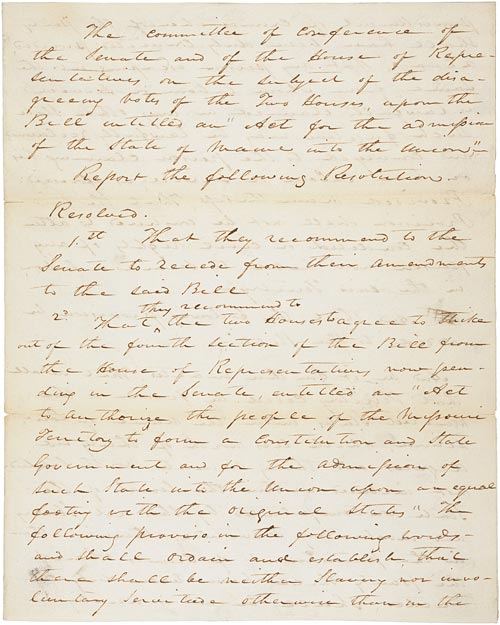
Missouri Territory on the Edge of Statehood
Missouri had been on the path toward statehood for years before the crisis erupted. The territory had grown rapidly since the Louisiana Purchase of 1803 brought its vast western lands into the United States. By 1818, St. Louis, founded by French fur traders in 1764, had evolved from a frontier trading post into a busy commercial center with banks, mills, distilleries, and retail shops. Missouri’s population was growing quickly, and its residents believed the territory was ready for statehood.5
Missouri also permitted slavery. Thousands of enslaved people lived in the territory, many brought west by settlers from Kentucky, Tennessee, Virginia, and other states. Slavery had become part of Missouri’s agricultural economy and legal system. When Missouri applied for statehood, its residents had reason to expect that Congress would set the process in motion. Instead, the application ignited a national political dispute.2
The Tallmadge Amendment and the Fire It Lit
On February 13, 1819, a congressman from New York named James Tallmadge Jr. rose in the House of Representatives and proposed an amendment to Missouri’s statehood enabling bill. The amendment would prohibit the further introduction of enslaved people into Missouri after statehood and would provide for the gradual emancipation of enslaved people born in Missouri after statehood at age twenty-five.4
Northern supporters of the amendment offered several arguments. Some opposed the further expansion of slavery. Others worried about the political consequences of admitting additional slave states, particularly because representation in the House was affected by the Constitution’s three-fifths clause. They also argued that Congress possessed authority to place conditions on the admission of a state created from federal territory.4
Southern representatives answered with an equally forceful constitutional argument. They contended that Missouri should enter the Union on the same footing as existing states and that Congress should not use the admission process to dictate a state’s domestic institutions.2
The disagreement quickly became sectional. On the House floor, Representative Thomas W. Cobb of Georgia turned to Tallmadge with an ominous warning: “You have kindled a fire which all the waters of the ocean cannot put out….” The House approved Tallmadge’s prohibition on the further introduction of enslaved people by 87 to 76, and his gradual-emancipation provision by 82 to 78. On the latter vote, Northern representatives supported the measure 80 to 14, while Southern representatives opposed it 64 to 2. The Senate rejected the restrictions, and Congress adjourned with Missouri’s statehood unresolved.4
Congress at the Breaking Point
When the 16th Congress convened in December 1819, the Missouri question awaited it. The dispute had grown from a legislative question into a national debate over the future of slavery and the balance of political power between the sections.2
As of December 1819, the United States had 22 states, divided evenly between free and slave states. The balance mattered especially in the Senate, where each state had equal representation. The possibility of admitting Missouri as a slave state therefore raised broader questions about the political balance of the Union.2
Maine’s Statehood: The Key That Unlocked Missouri
The solution came from an unexpected direction. The District of Maine, which had sought separation from Massachusetts for years, formally applied for statehood in 1819, just as Congress was searching for a way out of the Missouri deadlock.3
Lawmakers linked the two applications. Maine could enter as a free state while Missouri entered as a slave state, preserving the existing balance in the Senate. The arrangement increased pressure on both sides to reach a settlement rather than risk blocking the admission of both states.3
Then Senator Jesse B. Thomas of Illinois supplied the third and decisive piece: a geographic boundary at latitude 36°30′ north, Missouri’s southern border. In the remaining Louisiana Purchase territory north of that line, except Missouri itself, slavery would be prohibited. The Thomas Amendment, combined with the paired admission of Maine and Missouri, became the core of the Missouri Compromise.1

Henry Clay and the Art of the Impossible Deal
The 36°30′ Line: A Boundary Across the West
To understand the compromise, it helps to look at the map. The 36°30′ parallel followed Missouri’s southern boundary westward through the Louisiana Purchase. Under the agreement, slavery would be prohibited in the remaining Louisiana Purchase territory north of that line, with Missouri itself excepted.1
The geographic division was the bargain that made the larger settlement possible. Missouri would enter the Union without being required to prohibit slavery. At the same time, Congress established a restriction on slavery across a substantial portion of the remaining Louisiana Purchase.1
Both sides accepted something they opposed in order to secure something they considered important. That tradeoff was the heart of the Missouri Compromise.6
Henry Clay and the Parliamentary Maneuver
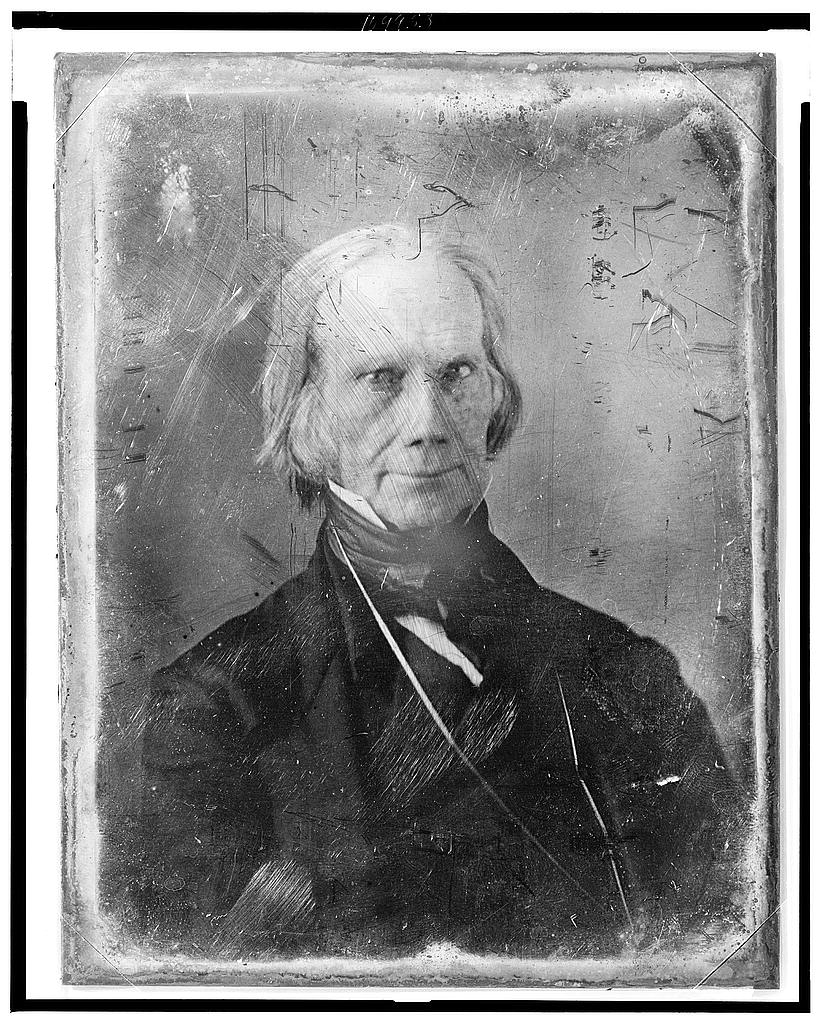
Moving the compromise through the House required more than good arguments. It required Henry Clay. By 1820, Clay was one of the country’s most skilled legislative tacticians and was serving as Speaker of the House.3
Clay’s challenge was to break a stubborn deadlock. The House had approved restrictions on slavery that the Senate rejected. The Senate had approved a compromise that the House rejected. When the settlement finally came to a vote on March 2, 1820, Clay watched the floor with the attention of a chess player studying the final moves of a game.3
The next day, opponents of the compromise moved to reconsider the vote, a procedural challenge that could have reopened the entire dispute. What happened next was described by one of Clay’s biographers as “the neatest and cleverest parliamentary trick ever sprung in the House.” Clay ruled the motion out of order until routine business had been completed. During the interlude, he quietly signed the Missouri bill and sent it to the Senate. When opponents renewed their motion later in the day, the legislation had already moved on.1
The maneuver worked. President Monroe signed the legislation on March 6, 1820. The crisis, for the moment, appeared to be over.2
The Second Missouri Compromise
If the Missouri Compromise of 1820 was a hard-fought political bargain, the crisis that followed its passage came close to unraveling everything. Missouri’s constitutional convention, tasked with drafting the new state’s founding document, soon created another problem. The constitution directed the state legislature to adopt measures preventing certain free Black people from entering Missouri.2
Northern members of Congress objected. Article IV of the U.S. Constitution provided that citizens of each state were entitled to the “Privileges and Immunities of Citizens in the several States.” Because free Black Americans were recognized as citizens in some Northern states, critics argued that Missouri’s provision conflicted with that constitutional guarantee.5
Enough members objected that Missouri once again faced the possibility of being denied admission. Henry Clay was called upon again.5
Congress ultimately stipulated that Missouri’s admission would proceed only with an assurance that the constitutional provision would not be construed or applied in a way that abridged the constitutional rights of U.S. citizens. Missouri agreed to the condition, and the standoff ended in 1821.5
Missouri Becomes a State
On August 10, 1821, President James Monroe issued the proclamation formally admitting Missouri into the Union as the twenty-fourth state.2
After two years of congressional debate, two major compromises, and repeated uncertainty over whether statehood would happen at all, Missouri had finally joined the Union.2
Its admission marked another milestone in the westward growth of the United States. Missouri was the first state admitted to the Union lying entirely west of the Mississippi River, evidence of how rapidly the American republic was expanding beyond its original eastern boundaries.2
The new state’s first capital was established temporarily in St. Charles, and Alexander McNair became its first governor. On December 31, 1821, McNair signed legislation designating the site of Jefferson City as Missouri’s permanent seat of government.2
Missouri was open for business.3
A Line That Could Not Hold: The Compromise’s Legacy
Jefferson’s Firebell and Adams’ Warning
Even as Congress completed the Missouri settlement, two of the most experienced members of the founding generation were watching the sectional dispute with concern.5
Thomas Jefferson, seventy-seven years old and living in retirement at Monticello, wrote to Congressman John Holmes of Maine in April 1820. The Missouri question, Jefferson wrote, “like a firebell in the night, awakened and filled me with terror. I considered it at once as the knell of the Union.”2
The compromise had settled the immediate political question, but Jefferson feared that drawing a geographic line between competing sections of the country could have consequences far beyond Missouri.2
John Quincy Adams, then serving as secretary of state, reached a similarly grave conclusion. In his diary, he described the Missouri Compromise as “a mere preamble — a title page to a great, tragic volume.”2
Neither man would live to see how the sectional conflict ultimately ended. But both understood that Missouri had exposed a political dispute unlikely to disappear with a single act of Congress.2
Kansas-Nebraska, Dred Scott, and the Collapse of Compromise
For thirty-four years, the Missouri Compromise remained an important part of the framework governing slavery in the Louisiana Purchase territories. During those decades, the Union continued to expand, and Henry Clay went on to help fashion additional national compromises—notably the Compromise Tariff of 1833 and the Compromise of 1850—that reinforced his reputation as “The Great Compromiser.”1
The 1820 settlement was effectively overturned in 1854 by the Kansas-Nebraska Act. The new law embraced “popular sovereignty,” allowing settlers in Kansas and Nebraska to decide whether slavery would be permitted in their territories even though portions of both lay north of the Missouri Compromise line.3
The consequences came quickly. Rival pro-slavery and free-soil settlers poured into Kansas, where political competition erupted into violence in a period remembered as “Bleeding Kansas.” The controversy also helped reshape the national party system and contributed to the rise of the Republican Party.1
Three years later, the Supreme Court’s decision in Dred Scott v. Sandford struck at the constitutional foundation of congressional restrictions on slavery in the territories. The decision intensified an already severe national dispute.1
By the end of the 1850s, the political framework created in 1820 had disappeared. Lincoln’s election in 1860 was followed by Southern secession, and the Civil War began the following spring.2
Legacy and Civic Relevance
The Missouri crisis of 1819 to 1821 was one of the young republic’s first great sectional tests. A statehood application had forced Congress to confront questions that reached far beyond Missouri: How much authority did Congress possess over new territories and states? Could the Union continue expanding while its different sections maintained sharply different institutions? And how could representatives with fundamentally conflicting interests reach decisions within a shared constitutional system?2
The answer Congress produced was compromise.
Henry Clay emerged from the episode with a growing reputation for finding legislative paths through seemingly impossible disputes. The Missouri Compromise did not end the national disagreement over slavery. What it did was settle the immediate statehood crisis, establish a rule for much of the remaining Louisiana Purchase, and allow Missouri and Maine to enter the Union while preserving the existing balance in the Senate.
That settlement remained federal policy for thirty-four years.
For students of American civics, Missouri’s story is particularly instructive because the people involved were confronting these questions in real time. They faced powerful regional interests, competing constitutional arguments, closely divided legislatures, and a dispute for which no solution commanded national agreement.
The Missouri Compromise shows both what political compromise can accomplish and what it cannot. The agreement resolved an immediate congressional deadlock and established a governing framework that endured for more than a generation. It did not end the underlying sectional disagreement, which returned to the center of national politics in the 1850s.
On August 10, Missourians celebrate the anniversary of their state’s admission to the Union. Behind that anniversary is a remarkable story: a rapidly growing country, an intensely divided Congress, a state waiting to join the Union, and political leaders searching for enough agreement to move forward.
After two years of argument and negotiation, they found it.
Missouri became the twenty-fourth state.
Explore related stories about the key figures and events of this era, including James K. Polk, William Becknell and the Santa Fe Trail, and the California Gold Rush.
Footnotes
- U.S. National Archives and Records Administration — “Missouri Compromise (1820)”, Milestone Documents (primary legislative document, text of the Act, historical context): https://www.archives.gov/milestone-documents/missouri-compromise
- Encyclopedia Britannica — “Missouri Compromise” (Tallmadge amendment, congressional deadlock, second crisis, Jefferson and Adams quotations, Dred Scott): https://www.britannica.com/event/Missouri-Compromise
- U.S. Senate Historical Office — “Missouri Compromise Ushers in New Era for the Senate,” March 3, 1820 (Henry Clay’s parliamentary maneuver, Missouri’s initial application, Senate’s rising prominence): https://www.senate.gov/artandhistory/history/minute/Missouri_Compromise.htm
- American Battlefield Trust — “The Missouri Compromise” (Tallmadge amendment details, three-fifths clause analysis, Northern political motives, sectional vote tallies): https://www.battlefields.org/learn/articles/missouri-compromise
- Missouri Secretary of State, State Archives Division — “Timeline of Missouri History: 1821–1860” (statehood proclamation date, first capital, first governor, Dred Scott case origins, Kansas-Nebraska Act, Missouri state institutions): https://www.sos.mo.gov/archives/history/timeline/2
- PBS Learning Media / KCPT — “The Missouri Compromise”: Henry Clay and the Struggle for the Union (video resource, Clay biography and legislative legacy): https://kcpt.pbslearningmedia.org/resource/the-missouri-compromise-video/henry-clay-and-the-struggle-for-the-union/