

James Monroe: The Last Founding Father President
James Monroe is often remembered for one idea above all others: the Monroe Doctrine. But Monroe’s impact on American history extended far beyond a single foreign policy statement.¹
A Revolutionary War veteran, diplomat, governor, cabinet official, and president, Monroe was among the most experienced statesmen of the founding generation. By the time he entered the White House in 1817, he had spent decades helping build the new nation from its earliest days.²
Historians frequently describe Monroe as the last president of the Founding Fathers’ generation.³ His presidency came during a transformative period when the United States expanded westward, strengthened its national identity, and began defining its role in the wider world.¹
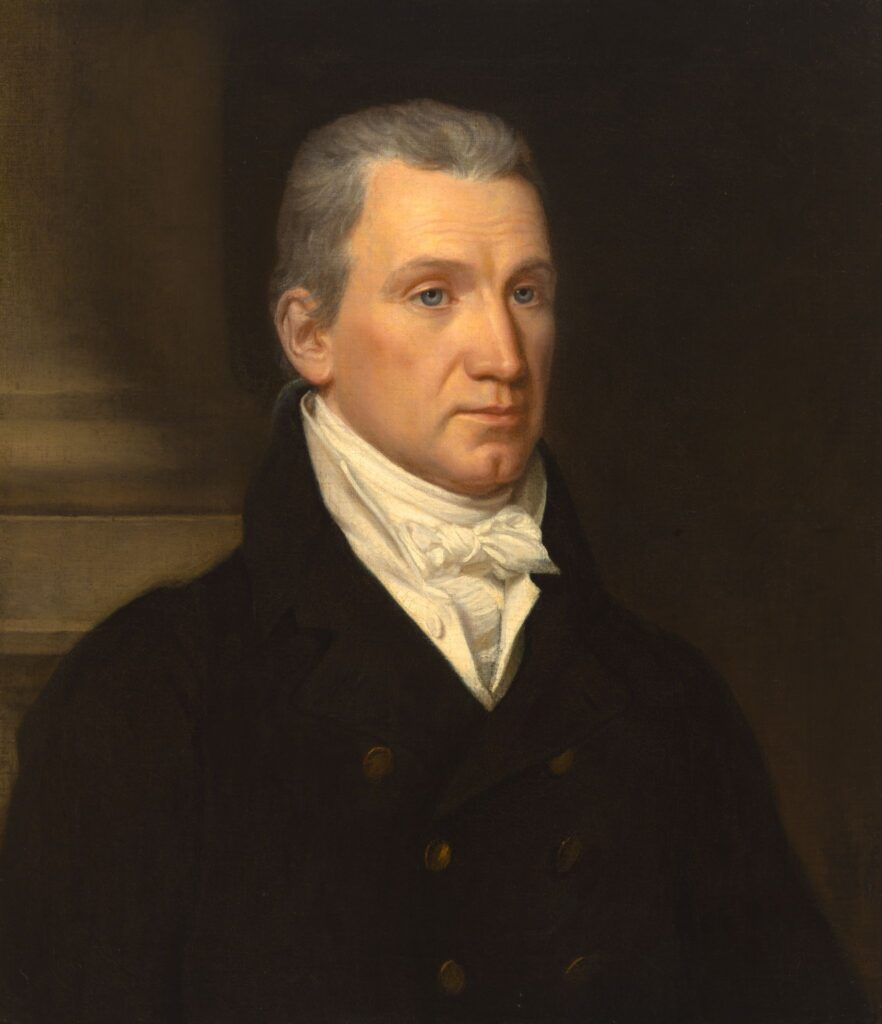
A Young Revolutionary
James Monroe was born on April 28, 1758, in Westmoreland County, Virginia, into a planter family.¹ His early life changed dramatically after both of his parents died while he was still a teenager.² Encouraged by relatives and mentors, Monroe enrolled at the College of William and Mary in Williamsburg.
Like many young Virginians of his generation, however, Monroe soon found himself drawn into the growing conflict with Great Britain.
In 1776, he left college to join the Continental Army and fight in the American Revolution.¹ Monroe participated in several major campaigns and was seriously wounded during the Battle of Trenton after crossing the Delaware River with General George Washington.² The injury nearly killed him and left him with lifelong health complications.
During the war, Monroe developed friendships and political connections that would shape the rest of his career. Most importantly, he became closely associated with Thomas Jefferson, who became both his political mentor and longtime friend.¹
From Revolutionary to Statesman
After the war, Monroe studied law under Jefferson and quickly entered politics.² Over the next several decades, he served in an extraordinary range of positions: member of the Continental Congress, U.S. senator, governor of Virginia, minister to France, minister to Great Britain, secretary of state, and secretary of war.¹
His diplomatic experience proved especially important during a period when the young United States struggled to navigate conflicts between European powers.
In 1803, Monroe helped negotiate the Louisiana Purchase alongside American diplomats in France.¹ The agreement doubled the size of the United States and opened vast new territory for westward expansion.
Monroe also served under President James Madison during the War of 1812. At one point, he simultaneously held the positions of secretary of state and secretary of war — a reflection of the trust placed in him during a difficult moment for the nation.²
The “Era of Good Feelings”
Monroe was elected president in 1816, becoming the fifth president of the United States. His presidency marked the beginning of what became known as the “Era of Good Feelings.”²
The phrase reflected a period of growing national confidence following the War of 1812. The Federalist Party had weakened dramatically, political tensions temporarily eased, and many Americans embraced a stronger sense of national unity.¹
Monroe encouraged this atmosphere by traveling extensively throughout the country. Unlike many earlier presidents, he visited communities across multiple states, hoping to promote national connection and reduce regional divisions.²
Still, major challenges remained beneath the surface.
As the United States expanded westward, debates over slavery intensified. In 1820, Monroe signed the Missouri Compromise, which sought to balance free and slave states and temporarily ease sectional tensions.¹ Although the compromise delayed a larger national conflict, it also revealed the growing divisions that would eventually lead to the Civil War.²
The Monroe Doctrine
Monroe’s most enduring legacy came in 1823.
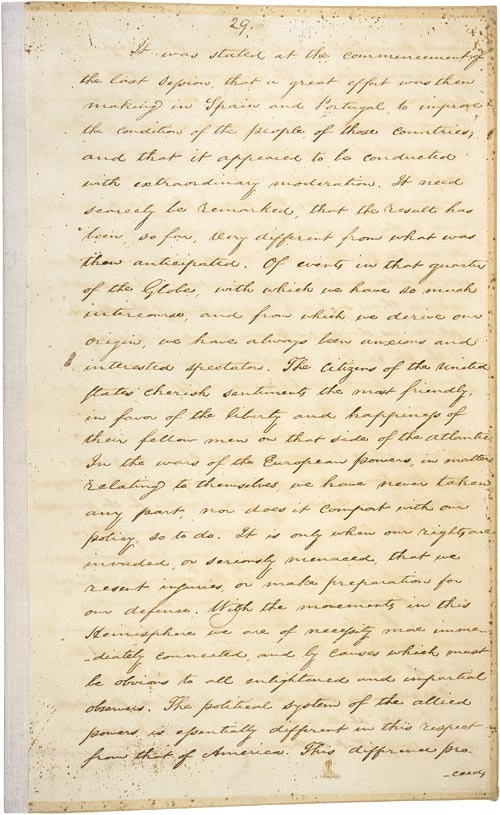
That year, in his annual message to Congress, Monroe declared that European powers should no longer attempt to colonize or interfere in the affairs of nations in the Western Hemisphere.¹ The statement, later known as the Monroe Doctrine, warned that further European intervention in the Americas would be viewed as a threat to the United States.²
Although much of the doctrine’s strategy was shaped by Secretary of State John Quincy Adams, Monroe gave the policy presidential authority and national prominence.²
At the time, the United States lacked the military power to fully enforce such a policy on its own. Historians note that British naval strength also discouraged European intervention in the Americas.² Even so, the Monroe Doctrine became one of the most influential statements in American foreign policy history.
Over time, presidents and policymakers repeatedly invoked the doctrine to justify American involvement throughout the Western Hemisphere.³
Today, the Monroe Doctrine remains one of the defining policies associated with early American diplomacy.
Life After the Presidency

After leaving office in 1825, Monroe faced financial difficulties despite decades of public service.² Like several Founding Fathers, he struggled with debt accumulated through political service and personal expenses.
In his later years, Monroe lived with family members in New York City. He died on July 4, 1831 — becoming the third Founding Father president to die on Independence Day, following Jefferson and Adams five years earlier.³
His death symbolically marked the fading of the Revolutionary generation that had created the United States.
Why James Monroe Still Matters
James Monroe helped guide the United States through a critical transitional era between the Revolution and the nation’s rise as a continental power.
He fought in the Revolution, expanded the nation diplomatically, strengthened American foreign policy, and presided over a period of growing national identity.¹ His presidency also exposed unresolved tensions over slavery, expansion, and federal authority that continued shaping American history long after his death.
Though often overshadowed by Washington and Jefferson, Monroe played a central role in defining what the United States would become, both at home and abroad.