

Sequoyah and the Cherokee Syllabary: Writing a Nation’s Language
Sequoyah did not invent the Cherokee language. He developed a writing system for it, one that Cherokee people rapidly adopted and made their own.
Cherokee people have spoken their language for countless generations, carrying history, law, ceremony, and story from one generation to the next. Today the Cherokee Nation describes its language work as preserving and perpetuating Cherokee “through day to day spoken use.”1 In the early nineteenth century, a Cherokee craftsman and silversmith named Sequoyah set out to give that language a way to be written down
The result was the Cherokee syllabary. It is not an alphabet. According to the Cherokee Nation Language Department, it “contains 85 distinct characters that represent the full spectrum of sounds used to speak Cherokee.”1 Each character represents a syllable or syllabic sound rather than an individual letter, so speakers write their language with a system built from Cherokee speech itself.
Sequoyah’s achievement was extraordinary. But the larger story belongs to the Cherokee people who learned the syllabary, printed it, used it in public life, preserved it through removal, and sustain it today in classrooms and digital tools.

Source: National Portrait Gallery, Smithsonian Institution, NPG.79.174
A Cherokee Life in a Changing World
Sequoyah was probably born in the late eighteenth century at Tuskegee, also rendered Tasgigi, a Cherokee town on the Little Tennessee River in what is now Monroe County, Tennessee.2 The site now lies beneath the waters of Tellico Lake.3
His mother, identified in accounts as Wurteh or Wu-te-he, came from a prominent Cherokee family.2 Many accounts identify his father as a trader named Nathaniel Gist, though Sequoyah’s paternity remains debated.4 In English-language sources, he was also called George Guess or George Gist.4
Accounts generally agree that he did not learn to read or write English.5 During the Creek War of 1813–14, he served in a Cherokee company allied with U.S. forces against Red Stick Creek warriors. The Tennessee Encyclopedia notes that Sequoyah and his fellow Cherokee soldiers “were unable to write letters home, read military orders, or make diaries and journals of events.”2
Twelve Years of Work
Sequoyah had been thinking about writing since around 1809.2 By one account, he became interested after learning to sign his silversmith work, fascinated by the idea of communicating through marks on paper.5
His challenge was enormous. No widely adopted writing system for Cherokee existed, and he did not read English. He worked from the sounds of spoken Cherokee itself. By 1821, according to the Tennessee Encyclopedia, Sequoyah “had isolated eighty-six (later reduced to eighty-five) syllables used in the spoken Cherokee language and assigned written symbols to each.”2
Because the system matches characters to Cherokee syllables, learners could acquire basic reading and writing relatively quickly. Literacy still required practice and access to teachers or texts. But the system did not ask learners to assemble words letter by letter, as English spelling does.

Source: Cherokee Nation Language Department, “Syllabary and Numbers”: https://language.cherokee.gov/posters/syllabary-and-numbers/
From Demonstration to National Institution
Sequoyah taught the syllabary to his daughter, Ayoka, also rendered Ahyokah in some accounts.3 In 1821, accounts describe Sequoyah and his daughter demonstrating the syllabary to Cherokee leaders.2
The demonstration helped win rapid acceptance. The system gained recognition among Cherokee leaders in the early 1820s, and the Cherokee National Council formally adopted it by the middle of the decade. Sources differ on the exact dates.6 In the early 1820s, the Council also honored Sequoyah with a commemorative medal.3
Sequoyah’s own movements in these years are reconstructed differently in different accounts. By the mid-1820s, he was living among Western Cherokee communities in Arkansas.7 These communities were later often called the “Old Settlers.”3
A Nation Writes
The syllabary, according to the New Georgia Encyclopedia, was “rapidly adopted by a large number of Cherokees.”4 Anthropologist Stephen Chrisomalis writes that, “by many accounts,” Cherokee literacy in the syllabary rivaled Anglo-American literacy in English at the time. No reliable population-wide figures survive.8
On February 21, 1828, at New Echota, the Cherokee Nation began publishing the Cherokee Phoenix, a weekly newspaper edited by Elias Boudinot.9 The paper printed English and Cherokee in parallel columns10 and carried, in the Oklahoma Historical Society’s words, “news of the day, laws and public documents of the Cherokee Nation.” The Society describes it as “the Cherokee Nation’s official weekly newspaper and the first published by an American Indian tribe.”11
The Phoenix showed what Sequoyah’s syllabary had made possible. Cherokee citizens could read their nation’s public business in Cherokee and in English.
That flowering of print was part of a broader era of Cherokee institution-building, the same era that produced the Cherokee Nation’s legal challenges to Georgia described in The Indian Removal Act and Its Consequences. The original New Echota run of the Phoenix ended as pressure over removal mounted. According to the Oklahoma Historical Society, “due to the actions of the federal government and lack of financial resources, the last issue of the paper was printed at New Echota on May 31, 1834.”11
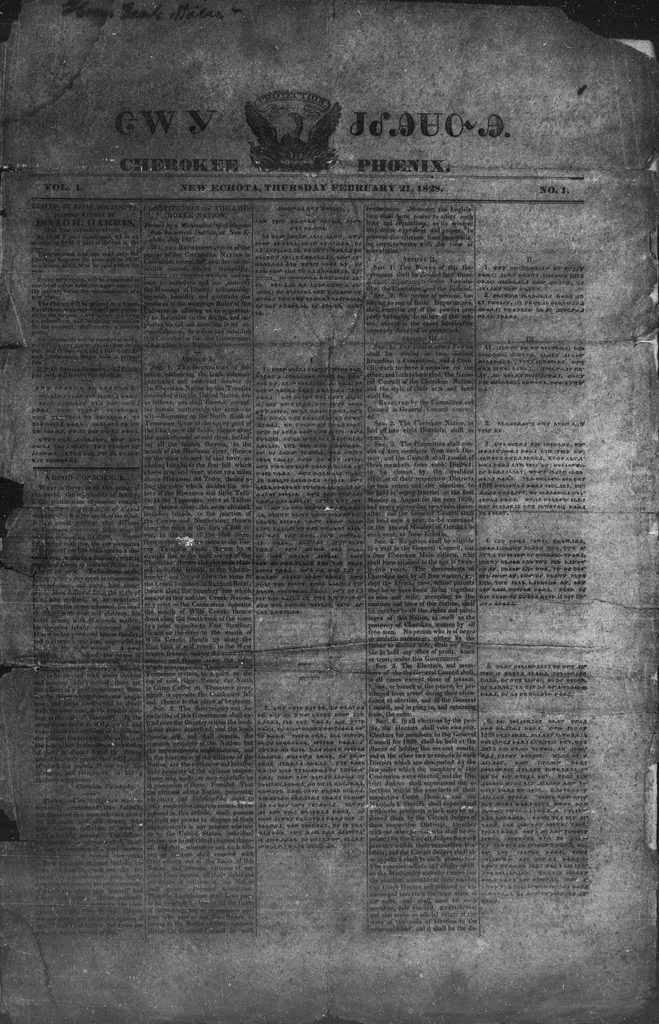
Source: Cherokee Phoenix (New Echota, Ga.), February 21, 1828, p. 1, Georgia Historic Newspapers / Chronicling America
The Numbers That Didn’t Stick
The syllabary was not Sequoyah’s only invention. After his 1828 visit to Washington, he proposed a Cherokee numeral system to the National Council. The familiar numerals most Americans use rely on place value. Sequoyah’s system instead used distinct signs that were combined by addition.8
The Cherokee National Council did not adopt the numeral system, and Arabic numerals became standard in Cherokee public life instead. According to Chrisomalis, outside the papers of the writer John Howard Payne, “there is no further 19th-century direct evidence for their use.”8 The episode is a reminder that the syllabary’s success was not automatic. Cherokee leaders decided which of Sequoyah’s ideas to adopt.
Sequoyah in the West
In 1828, Sequoyah traveled to Washington, D.C., as part of a Western Cherokee delegation. The delegation, according to the Encyclopedia of Arkansas, “was pressured into exchanging its Arkansas lands” for territory farther west, and Sequoyah signed the resulting treaty as George Guess.7 During that visit, the artist Charles Bird King painted his portrait.12

Source: National Park Service, National Trails Office, “The Visitor Center at Sequoyah’s Cabin in Sallisaw, Oklahoma” (2010), NPGallery
In 1829, Sequoyah settled near present-day Sallisaw, in what is now Oklahoma.3 A cabin traditionally associated with him near Sallisaw is preserved by the Cherokee Nation and open to the public.3
Removal and Reunion
Sequoyah’s life complicates the familiar removal story. He had joined Western Cherokee communities years before Congress passed the Indian Removal Act in 1830, and well before most Cherokee people were forced from the Southeast in 1838–39. That history, from the Cherokee Nation’s court fight to the Treaty of New Echota and the Trail of Tears, is told in our companion article, The Indian Removal Act and Its Consequences.
After the forced removal of Cherokee people from the Southeast, the Cherokee Nation faced the difficult task of uniting the Old Settlers with those who had been removed from the East, a people who had been reading and writing in Sequoyah’s syllabary for years. On July 12, 1839, at the Illinois Camp Ground, representatives of both groups signed an Act of Union in which they agreed “to form ourselves into one body politic, under the style and title of the Cherokee Nation.”13
Sequoyah was among the signers. The act lists him under his English name, George Guess, as “President of the Western Cherokees,” beside George Lowrey, president of the Eastern Cherokees. That September, he was also among the dozens of signers of a new Cherokee constitution, adopted at Tahlequah on September 6, 1839.13 According to the Cherokee Phoenix, Sequoyah had worked to bring the Old Settlers into that union.14 His role belongs within a greater effort at reunification, alongside many other leaders on both sides.
A Final Journey
In 1842, Sequoyah set out to find Cherokees who had moved to Mexico.3 He died in 1843 during that journey. The exact location of his grave is unknown.5
A Living Language
Nearly two centuries later, Sequoyah’s syllabary is in daily use. As of 2026, the Cherokee Nation Language Department estimates that there are about 2,000 first-language Cherokee speakers, with several thousand more beginner or proficient speakers in the tribe’s language programs. The department runs a translation office, community and online classes, the Cherokee Language Master Apprentice Program, and language technology services.1
The Cherokee Immersion School opened in 2001 with twenty-six students and four staff members. According to the Cherokee Nation, as of 2026, it serves “well over 100 students in grades pre-K through 8th grade,” and “the Sequoyah syllabary is used for all print materials.”15 In 2026, the Cherokee Nation moved the school from Oklahoma’s state charter system to full tribal oversight.16
In 2019, the Cherokee Nation enacted the Durbin Feeling Language Preservation Act, named for Durbin Feeling, a champion of the Cherokee language. In January 2024, the Council of the Cherokee Nation permanently reauthorized the act. The reauthorized law deems the loss of the Cherokee language “a national emergency for the Cherokee people” and provides at least $18 million a year for language work.17
Durbin Feeling’s name also appears in a federal law. The Durbin Feeling Native American Languages Act of 2022, which became law on January 5, 2023, directs a review of how federal agencies support Native American languages and calls for a survey of how those languages are used across the United States.18
Legacy and Civic Relevance
Sequoyah’s name appears on schools, parks, and monuments, and the sequoia trees of California are widely said to be named in his honor, though the origin of the name is debated.4 Yet the most important part of his legacy may be what happened after 1821. Cherokee leaders adopted the syllabary. Cherokee printers set it in type. Cherokee readers taught one another. Cherokee teachers pass it on today.
His story raises questions about knowledge and public authority: who can create it, teach it, use it in public institutions, and receive recognition for it. A Cherokee man developed the syllabary for the Cherokee language, and the Cherokee Nation’s government adopted it. Its survival through removal and into the present is a story of both invention and self-government.
Continue exploring with our companion article on Harriette J. Cooke, whose career at an Iowa college raised different questions about who could teach and how their work was valued. You can also read The Indian Removal Act and Its Consequences.
Footnotes
- Cherokee Nation Language Department, last updated September 1, 2026: https://language.cherokee.gov/
- Kevin E. Smith, “Sequoyah,” Tennessee Encyclopedia, Tennessee Historical Society: https://tennesseeencyclopedia.net/entries/sequoyah/
- William L. Anderson, “Sequoyah,” The Encyclopedia of Oklahoma History and Culture, Oklahoma Historical Society: https://www.okhistory.org/publications/enc/entry?entry=SE020
- Ted Wadley, “Sequoyah (ca. 1770–ca. 1840),” New Georgia Encyclopedia, last edited October 31, 2025: https://www.georgiaencyclopedia.org/articles/history-archaeology/sequoyah-ca-1770-ca-1840/
- Will Chavez, “Sequoyah: Inventor of Cherokee Syllabary,” Cherokee Phoenix, September 2, 2022: https://www.cherokeephoenix.org/culture/sequoyah-inventor-of-cherokee-syllabary/article_a83c9cc8-1f25-11ed-9329-d3f5b1d9924b.html
- Sources differ on what counts as “adoption.” The Tennessee Encyclopedia and the National Portrait Gallery tie official acceptance to the 1821 demonstration. The Cherokee Phoenix (Chavez, 2022) dates the National Council’s formal acknowledgment to 1823. Stephen Chrisomalis (MIT Press Reader, 2021) describes the syllabary as “accepted by the Cherokee National Council at its national capital in New Echota, Georgia, in 1825.” Sources also differ on the medal: the Encyclopedia of Oklahoma History dates it to 1824, the Cherokee Phoenix to 1823, and the Encyclopedia of Arkansas says it was commissioned in 1824 but not received until 1832.
- Ann M. Early, “Sequoyah (1770?–1843),” CALS Encyclopedia of Arkansas: https://encyclopediaofarkansas.net/entries/sequoyah-566/
- Stephen Chrisomalis, “Sequoyah and the Almost-Forgotten History of Cherokee Numerals,” The MIT Press Reader, March 18, 2021, adapted from Reckonings: Numerals, Cognition, and History (MIT Press, 2020): https://thereader.mitpress.mit.edu/sequoyah-and-the-almost-forgotten-history-of-cherokee-numerals
- Cherokee Phoenix (New Echota, Cherokee Nation), February 21, 1828, p. 1, digitized in Georgia Historic Newspapers / Chronicling America: https://gahistoricnewspapers.galileo.usg.edu/lccn/sn83020866/1828-02-21/ed-1/seq-1/
- Library of Congress, “Cherokee Phoenix (New Echota [Ga.]) 1828–1829,” catalog record, Chronicling America: https://www.loc.gov/item/sn83020866
- James P. Pate, “Cherokee Phoenix,” The Encyclopedia of Oklahoma History and Culture, Oklahoma Historical Society: https://www.okhistory.org/publications/enc/entry?entry=CH022
- National Portrait Gallery, Smithsonian Institution, Sequoyah, Henry Inman, copy after Charles Bird King, c. 1830, oil on canvas, NPG.79.174: https://npg.si.edu/object/npg_NPG.79.174; see also the Gallery’s classroom resource, “Sequoyah (c. 1770–c. 1843)”: https://npg.si.edu/learn/classroom-resource/sequoyah-c-1770%E2%80%93c-1843
- The Constitution and Laws of the Cherokee Nation (Washington: Gales and Seaton, 1840), Act of Union (July 12, 1839) and Constitution (September 6, 1839), Library of Congress: https://tile.loc.gov/storage-services/service/ll/llscd/06021615/06021615.pdf
- Will Chavez, “1839 Cherokee Constitution Born from Act of Union,” Cherokee Phoenix, August 26, 2014: https://www.cherokeephoenix.org/news/1839-cherokee-constitution-born-from-act-of-union/article_5621e3f8-f65c-5990-8af2-c889b21b0abc.html
- Cherokee Nation Language Department, “Cherokee Immersion School”: https://language.cherokee.gov/cherokee-immersion-school
- Chad Hunter and D. Sean Rowley, “Cherokee Nation Language Immersion School Now Independent,” Cherokee Phoenix, June 25, 2026: https://www.cherokeephoenix.org/news/cherokee-nation-language-immersion-school-now-independent/article_d601dec4-1c80-4dc0-a74b-1ba81ab5684b.html
- Cherokee Nation, “Chief Hoskin Signs Permanent Reauthorization of Historic Durbin Feeling Language Preservation Act,” Anadisgoi, January 24, 2024: https://www.anadisgoi.com/index.php/government-stories/chief-hoskin-signs-permanent-reauthorization-of-historic-durbin-feeling-language-preservation-act
- Durbin Feeling Native American Languages Act of 2022, S. 1402, 117th Cong., Pub. L. No. 117-337 (January 5, 2023): https://www.congress.gov/bill/117th-congress/senate-bill/1402/text