

Harriette J. Cooke: A Professor’s Rank and a Professor’s Pay
In 1871, Cornell College promoted a longtime teacher to professor and, by its own account, paid her the same as the men beside her. Her story raises a question worth asking of any “first”: how do we know?
In 1871, Cornell College in Mount Vernon, Iowa, promoted Harriette J. Cooke to professor of German and history. The college says she received pay equal to her male colleagues and describes the decision as “believed to be a first in U.S. higher education.”1
That careful phrase, believed to be, is the heart of Cooke’s story. Her career raises questions about academic rank, pay, coeducation, and historical evidence. What did it mean for a nineteenth-century woman to be called professor? How can historians establish equal pay without surviving payroll records? And how should institutions describe a “first” when other women may have reached similar milestones elsewhere?

Source: Cornell College, A Record of the Celebration of the Fiftieth Anniversary of the Founding of the College (1905), portrait plate facing p. 227, digitized from Cornell University Library via HathiTrust
From New Hampshire to the Iowa Prairie
Harriette Jay Cooke was born on December 1, 1829, in Sandwich, New Hampshire, to Josiah and Jane (Cox) Cooke. In 1853, she graduated from the New Hampshire Conference Seminary, now Tilton School.2
That same year, Methodist leaders in eastern Iowa opened the Iowa Conference Seminary, a school that admitted women and men. Cornell describes it as “the first coeducational college on the Iowa frontier.”1 In 1857, the school was renamed Cornell College, and Cooke arrived to teach Latin in its preparatory school.1 She came that November, at age twenty-seven, and would stay for thirty-three years.2
The next year, Cornell graduated Mary Fellows, whom the college identifies as the first woman to receive a baccalaureate degree from a college west of the Mississippi River.1 Coeducation was still unusual in the 1850s, and many Americans debated whether women should study the same subjects as men, or study alongside them at all. Cooke arrived at a college that had already answered the first part of that question. What remained open was whether a woman could hold the rank of professor on its faculty.
A Quarter Century as Preceptress
In 1866, Cornell elected Cooke preceptress, a position associated with supervising and educating women students.3 When the college celebrated its fiftieth anniversary in 1904, it introduced her as “a teacher in Cornell College from 1857 to 1890, and Preceptress for a quarter of a century.”4
William Fletcher King, who joined the faculty in 1862 and later served for decades as Cornell’s president, left a vivid portrait of his colleague. “Miss Harriette J. Cooke had a commanding presence and excellent health,” he wrote. “As a teacher she had few equals. She regarded a good student with special favor and was correspondingly severe with a worthless one.”3
Cornell remembers her as “tireless in her efforts to bring equal opportunity to her women students in and out of the classroom.” She helped women students form literary societies, insisted on calisthenics for women, and campaigned for funds that led to the building of Bowman Hall.1 A 1995 profile in the Cedar Rapids Gazette adds that she lectured around Iowa for ten years to raise money for the women’s residence, which was completed in 1885.5
The Promotion of 1871
According to Cornell College, in 1871 Cooke was “promoted to full professor of German and history and given pay equal to her male colleagues.”1
King’s memoir agrees on the date. Five years after she became preceptress, he wrote, “there was added the rank of full professor of history and German, which position she held with some modification of subjects taught till her resignation in 1890.”3 A biographical sketch published in 1904 gives the year as 1872 and adds that Cooke took a leave around then to study in Great Britain and on the European continent.2
The promotion gave Cooke the formal rank of professor. If the equal-salary accounts are correct, the decision also put her pay on the same level as her male colleagues. The Gazette profile goes further, reporting that when Cooke was elected professor she “demanded a salary equal to that of her male colleagues.”5 The newspaper does not identify its source. If its account is accurate, the equal salary was something Cooke asked for, not simply something the college offered.
Weighing the Word “First”
The surviving evidence for Cooke’s equal salary is consistent, but it does not include a payroll record. Cornell College’s institutional history states that she received pay equal to male colleagues.1 King, writing in 1915, called her “one of the first, if not the first, women of the country to be elected to a full professorship alongside of men and on the same salary.”3 The 1904 sketch went further, calling her appointment “the first honor of the kind conferred upon a woman in the United States.”2
A revealing account comes from Stephen N. Fellows’s address at Cornell’s quarter-centennial celebration in 1882, as King later reprinted it. Fellows, a former Cornell professor then teaching at the State University of Iowa, spoke just after Cooke herself had addressed the gathering. “A careful investigation made a few years ago,” he said, had revealed to him “that at least two other colleges of Iowa elected lady professors before it was done at Cornell, but did not give to them salaries equal to those paid to the gentlemen.” When equal honor and equal salary were considered together, he declared, “Iowa leads the world, and Cornell leads Iowa.”3
Fellows was speaking at a celebration in Cornell’s honor, and “Iowa leads the world” was celebratory language rather than the result of a survey. Still, his remarks draw an important line. By his account, other Iowa colleges appointed women professors earlier but did not pay them equally. In his telling, what set Cooke’s appointment apart in Iowa was the salary.
These are valuable accounts from people close to the college. They are not independent proof of the college’s payroll. Cornell’s trustee minutes, appointment records, faculty catalogs, and salary ledgers from the 1870s would be the best way to settle the question more fully.
Other nineteenth-century women also held professorial roles. Rebecca Mann Pennell, a founding professor at Antioch College in Ohio in 1853, was another early woman professor whose pay history complicates any simple national “first.” Historians John Rury and Glenn Harper note that Pennell threatened to resign in late 1853 because she was receiving only half the pay of the male faculty.6 Cooke and Pennell are among the early women whose careers complicate claims about a single national “first.”
For readers, the most accurate way to describe Cooke is this: in 1871, Cornell College promoted Harriette J. Cooke to professor and, according to both the college and its longtime president, paid her equally with male colleagues. Cornell describes the appointment as a possible first in American higher education.
Teacher, Organizer, and Advocate
Cooke’s responsibilities changed as the college grew. In 1886, Cornell reassigned her from German to history and the science of government, a field now commonly called political science.2
She also helped shape student life. When compulsory military training began for male students in 1873, women asked for the same. Cooke organized a company of women who at first drilled in skirted uniforms, carrying wooden wands instead of rifles. A formal Ladies Battalion followed in 1889. By 1891 it had 112 members, and senior women were issued rifles. The battalion operated until 1898.1
A Second Career in Service
Cooke resigned from Cornell in 1890.4 According to the Gazette profile, she left after “a serious disagreement with the faculty,” though her students and some faculty members did not want her to go.5 After leaving, she studied the deaconess model at the Mildmay institution in North London, completing what the 1904 sketch calls a “three years’ course.”2 Cooke herself published a history of the institution, Mildmay; or, The Story of the First Deaconess Institution.7
In the spring of 1893, Cooke joined the Hull Street settlement in Boston, where a medical mission for neighborhood residents became her special charge. The 1904 sketch described it as “the first medical mission established in New England.”2 That claim has not been independently verified. Cornell College says the Hull Street work grew into a large social service institution “touching the lives of some 10,000 persons.”1
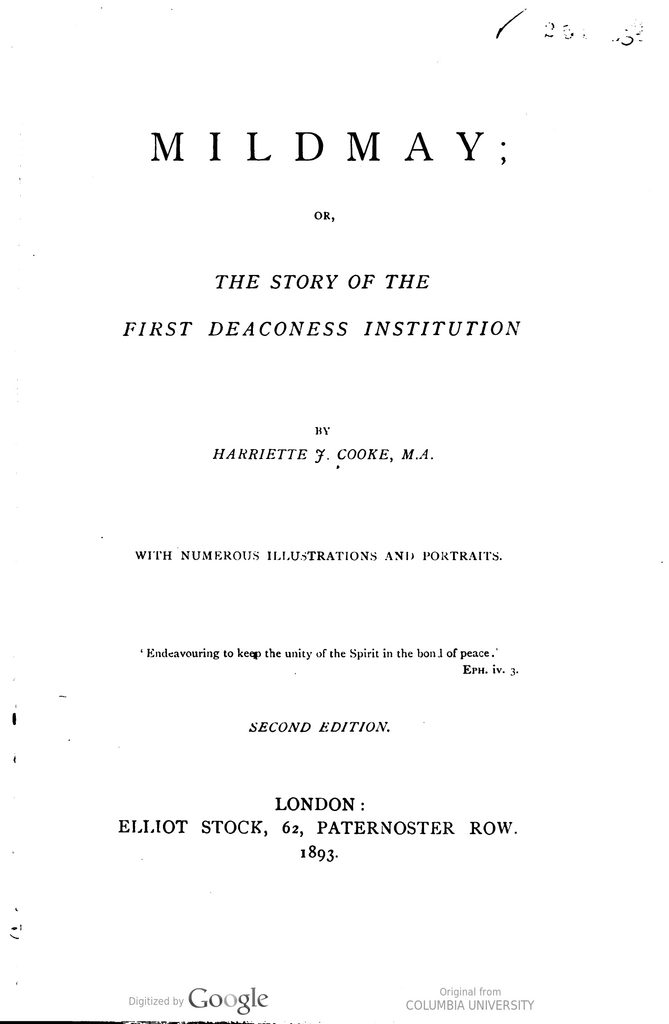
Source: Harriette J. Cooke, Mildmay (London: Elliot Stock, 1893), digitized from Columbia University Libraries
Remembered by Her Students
In June 1904, Cornell College celebrated its fiftieth anniversary. Cooke, by then living in Boston, returned to Mount Vernon for the occasion. When she was introduced, the audience gave her a “Chautauqua salute,” a wave of white handkerchiefs, “in which the vast audience enthusiastically participated.”4
Later that week, alumna Mary A. B. Witter, of the class of 1866, presented the college with a portrait of “Professor Harriette Jay Cooke” on behalf of the alumni of the Northwest. The college’s official record noted that the unveiling “touchingly reminded hundreds of the Alumni of their inspiring teacher of other days.”4
Harriette J. Cooke died on July 27, 1914.3 King, who had worked beside her for nearly three decades, wrote that her “conspicuously useful life was crowned by these benevolent services” in Boston.3
Legacy and Civic Relevance
Cooke’s promotion came nearly a century before Congress passed the Equal Pay Act of 1963. That law prohibits employers from paying workers of one sex less than the other for equal work on jobs that require “equal skill, effort, and responsibility” and are “performed under similar working conditions,” with exceptions for seniority, merit, pay based on quantity or quality of production, or another factor other than sex.8 In 1871, no federal equal-pay law governed Cooke’s salary. Such decisions depended on individual institutions, local practice, contracts, and custom, and the decision Cornell College describes is one it still points to today.
Her story also shows how history gets made twice: first by the people who live it, and again by the institutions that remember it. Colleges, like nations, celebrate their firsts. Checking those claims against the surviving record doesn’t diminish them. It tells us more precisely what happened, and it makes room for others who were part of the same story.
Cooke’s career raises a question that runs through the history of American education: who did a college allow to teach, to hold rank, and to be paid equally, and how did those answers change over time?
Continue exploring with our companion article on Sequoyah and the Cherokee syllabary. Where Cooke’s story asks who an American college allowed to teach, Sequoyah’s asks how a nation creates and carries knowledge in its own language.
Footnotes
- Dee Ann Rexroat, “Pioneering Women: The Top Moments in Women’s History at Cornell College,” Cornell College News Center, February 17, 2021: https://news.cornellcollege.edu/2021/Spring/pioneering-women-top-moments-womens-history-cornell-college.html
- Julia Ward Howe and Mary Hannah Graves, eds., “Harriette J. Cooke,” in Sketches of Representative Women of New England (Boston: New England Historical Publishing Company, 1904), 175–76. Transcription: https://en.wikisource.org/wiki/Representative_women_of_New_England/Harriette_J._Cooke
- William Fletcher King, Reminiscences (New York: Abingdon Press, 1915), 194–96: https://archive.org/details/reminiscences00king
- Cornell College, A Record of the Celebration of the Fiftieth Anniversary of the Founding of the College, Held in Connection with the Annual Commencement, June Tenth to Sixteenth, 1904 (Chicago: R. R. Donnelley & Sons, 1905): https://archive.org/details/cu31924030631547
- Katie Freeman, “A ‘Source of Inspiration’ for Women’s Rights,” The Gazette (Cedar Rapids, Iowa), February 23, 1995: https://www.newspapers.com/article/the-gazette/149245084/
- John Rury and Glenn Harper, “The Trouble with Coeducation: Mann and Women at Antioch, 1853–1860,” History of Education Quarterly 26, no. 4 (1986): 481–502, n. 25: https://www.cambridge.org/core/journals/history-of-education-quarterly/article/abs/trouble-with-coeducation-mann-and-women-at-antioch-18531860/2ED7214744AC267A58080F7F9B3FDC7B
- Harriette J. Cooke, Mildmay (London: Elliot Stock, 1893), digitized from Columbia University Libraries
- U.S. Equal Employment Opportunity Commission, “The Equal Pay Act of 1963”: https://www.eeoc.gov/statutes/equal-pay-act-1963