

Nat Turner and the Southampton Rebellion of 1831
How two nights of violence in a Virginia county reshaped the laws of the American South — and how a single contested pamphlet remains the fullest surviving account of why it happened.
Beginning late on August 21 and continuing into August 23, 1831, an enslaved preacher named Nat Turner led an uprising in Southampton County, Virginia, that is generally regarded as the deadliest revolt by enslaved people in U.S. history, leaving dozens of white residents dead over roughly a day and a half. It stands as one of the most consequential events in the history of American slavery: its aftershocks — new laws, new fears, new arguments about the future of slavery itself — lasted for decades and still shape how Americans understand the era leading up to the Civil War.1
Turner’s rebellion occupies an unusual place in the historical record: it is at once one of the most documented slave revolts in American history and one of the most contested, because the fullest surviving account of Turner’s own reasoning comes from a pamphlet written by a white lawyer who interviewed him in jail while he awaited trial. Understanding what happened in Southampton County means holding those two facts together — a well-documented sequence of events, and genuine uncertainty about how much of the surviving account reflects Turner’s own words.
Historical Context: Slavery in Antebellum Southampton County
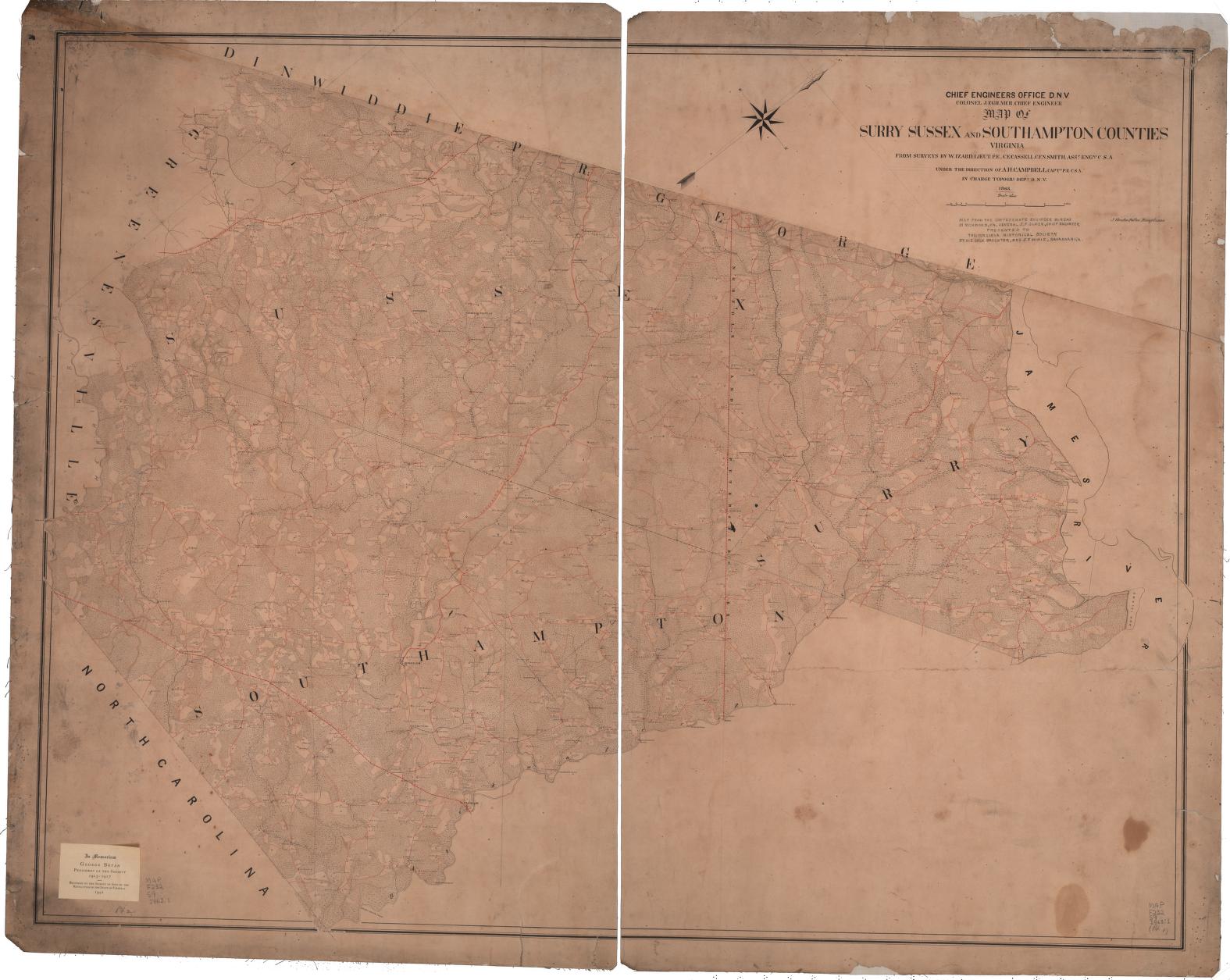
To understand what happened, it helps to understand where it happened. By 1830, Southampton County was a rural, agricultural county in southeastern Virginia, near the North Carolina border, made up mostly of small farms and mid-sized plantations. Unlike the large cotton and sugar plantations of the Deep South, Southampton’s enslaved population often lived and worked in smaller groups, sometimes on farms with only a handful of enslaved people. That meant enslaved and free Black residents frequently interacted with white households, with each other across property lines, and with a modest free Black population nearby.1
Virginia’s slave economy was also changing by this point. Tobacco cultivation had exhausted soils in parts of Virginia, while the expansion of cotton production in the Deep South helped make Virginia a major source for the growing interstate slave trade. The forced sale of enslaved people southward separated families and communities throughout the state. At the same time, religious revivalism was spreading through the region, including among enslaved and free Black residents, who often built their own networks of worship, preaching, and mutual support — sometimes with the tacit or formal permission of enslavers, and sometimes without it.
It was in this setting — a mixed rural economy, a religiously charged atmosphere, and a system of slavery that remained absolute in its legal power even as it varied in its daily texture — that Nat Turner’s life, and his rebellion, took shape.
Nat Turner: Life Before the Rebellion
Early Life and Religious Conviction
According to the account later published by Thomas R. Gray, Nat Turner was born enslaved on October 2, 1800, on a farm owned by Benjamin Turner in Southampton County.4 Over the course of his life, Turner was held by several members of the Turner family and related households. By 1831, he lived under the authority of Joseph Travis, though he was legally owned by Travis’s young stepson, Putnam Moore. Turner’s ability to read and write was unusual for an enslaved person in Southampton County at the time. Virginia had already enacted restrictions on teaching enslaved and free Black people to read or write before the revolt, and lawmakers imposed additional restrictions on Black religious activity, assembly, and education in its aftermath.
According to most surviving accounts, Turner grew up immersed in religious study and came to be recognized in his community as a preacher — a role that gave him a degree of standing and mobility that was unusual for an enslaved man. He described himself, in later accounts, as having experienced visions from an early age that convinced him he had been marked for a special purpose. Historians differ on how to read those visions — as sincere religious conviction, as a framework Turner used to organize and justify a plan of violent resistance, or as some combination of the two — and the surviving record does not resolve the question.2
The Vision and the Call to Action
According to Gray’s Confessions, Turner described religious visions in 1825 and again in 1828, and he came to interpret them as a divine call to violent resistance against slavery.4 He later interpreted the solar eclipse of February 12, 1831, as a signal to begin confiding in the small circle of men he trusted, and he regarded an unusual solar phenomenon reported in mid-August 1831 — often described as an oddly colored sun — as the final sign that the time had come to act.
Turner initially shared his plan with four men he trusted — Henry, Hark, Nelson, and Sam — and other men joined as the revolt got underway. The original plan called for action around the Fourth of July, but Turner reportedly fell ill, and the date got pushed back. The final plan was set in motion in the third week of August.1
The Uprising: August 21–23, 1831
The First Night
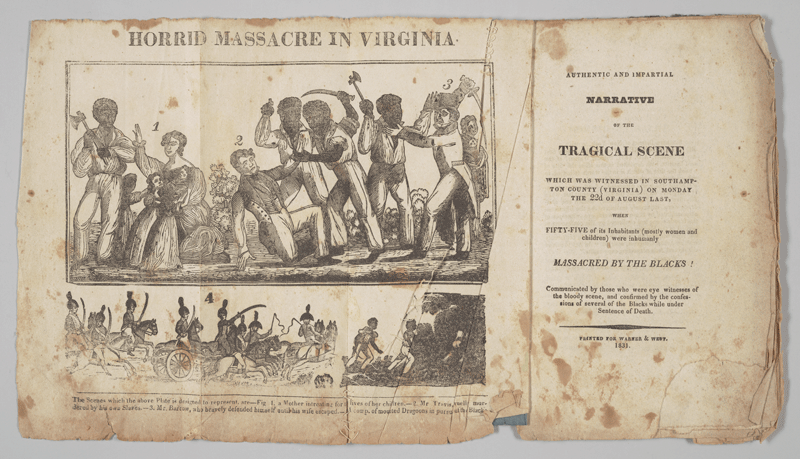
After gathering on the evening of August 21, Turner and his companions began the attack at Joseph Travis’s farm during the night and early hours of August 22, killing Travis, his wife, and other members of the household. That first act set the pattern for what followed: the group moved from farm to farm, on foot and later on horseback, killing white residents they encountered — men, women, children, and, at the Travis household, an infant — while picking up additional recruits, weapons, and horses along the way. Early reports wildly exaggerated the rebels’ numbers, with some accounts claiming as many as 450 participants; the group is generally understood to have grown to somewhere around 40 to 60 men and boys at its height, some of whom may have joined under coercion.1
Spread and Confrontation
Over the next day, the group moved through Southampton County toward the county seat of Jerusalem, Virginia — present-day Courtland — killing at least 55 white people in total, many of them women and children.1 It remains the deadliest revolt by enslaved people in U.S. history. As news spread, local militia, armed volunteers, and other white posses mobilized to confront the group. Turner’s force was turned back while advancing toward Jerusalem after a confrontation at James Parker’s farm. The rebels later regrouped, but another clash at Samuel Blunt’s plantation helped scatter the remaining group by the morning of August 23. Most participants were captured or killed within days. Turner himself remained at large for nearly two months, hidden in the woods and swamps near where the revolt began, until Benjamin Phipps captured him on October 30, 1831.1
The Aftermath
Capture, Trial, and Execution
Turner was held in the Southampton County jail in Jerusalem following his capture. He was tried on November 5, convicted of, in the language of the time, “conspiring to rebel and making insurrection,” and sentenced to death. He was executed by hanging on November 11, 1831.1
In the weeks between the revolt and Turner’s trial, Virginia authorities tried and executed a number of other participants. At the same time, white vigilantes and armed men killed many Black people in and around Southampton County, including people never shown to have taken part in the revolt at all.1
The total number killed in this extralegal violence has never been reliably established, since much of it went formally undocumented at the time. Documented cases number in the dozens, while some later accounts give substantially higher estimates.2

Gray’s Confessions of Nat Turner — A Contested Source
Much of what historians know about Turner’s own account of his motivations comes from a pamphlet published shortly after his execution, under the full title The Confessions of Nat Turner, the Leader of the Late Insurrection in Southampton, Va., as Fully and Voluntarily Made to Thomas R. Gray. Gray, a local lawyer, began interviewing Turner in jail on November 1, 1831; the pamphlet was copyrighted on November 10 and published by the end of that month, after Turner’s execution on November 11.4 It is the closest thing historians have to a first-person narrative from Turner, and it remains an essential source.
Gray claimed that he reproduced Turner’s account with little variation, and contemporary officials certified that Turner acknowledged the account as his own. But the pamphlet was recorded, edited, and published by Gray rather than written by Turner himself, and historians continue to debate how closely its language reflects Turner’s own words.
By his own account, Gray wanted to correct what he saw as public misunderstandings of the revolt’s scale and causes. He claimed to have reproduced Turner’s account with little or no variation, although the pamphlet was ultimately selected, arranged, and published by Gray, who also had a financial interest in its publication. Historians therefore regard the Confessions as indispensable but contested. Some find substantial evidence of Turner’s own voice in the text; others place greater emphasis on Gray’s editorial role and on the circumstances in which an enslaved prisoner awaiting execution gave the account.
Legal and Social Repercussions Across the South
The revolt’s political fallout went well beyond Southampton County. During Virginia’s 1831–1832 legislative session, the General Assembly debated proposals concerning the future of slavery in the state — ranging from gradual emancipation and colonization, meaning resettling free Black Virginians outside the U.S., generally to West Africa, all the way to much harsher restrictions on enslaved and free Black residents alike. In the end, the legislature rejected emancipation and moved toward tighter control instead, imposing additional restrictions on Black preaching and religious gatherings, assembly, education, and the rights and movement of free Black Virginians.2
Other Southern states passed similar measures in the months and years that followed — tightening slave codes, restricting Black literacy and independent Black religious gatherings, and stepping up surveillance of enslaved communities. It is a pattern that shows just how thoroughly this one rebellion unsettled white Southern society’s sense of security, even in a state like Virginia, where enslaved people were a smaller share of the population than in parts of the Deep South.
Governor Floyd’s Response
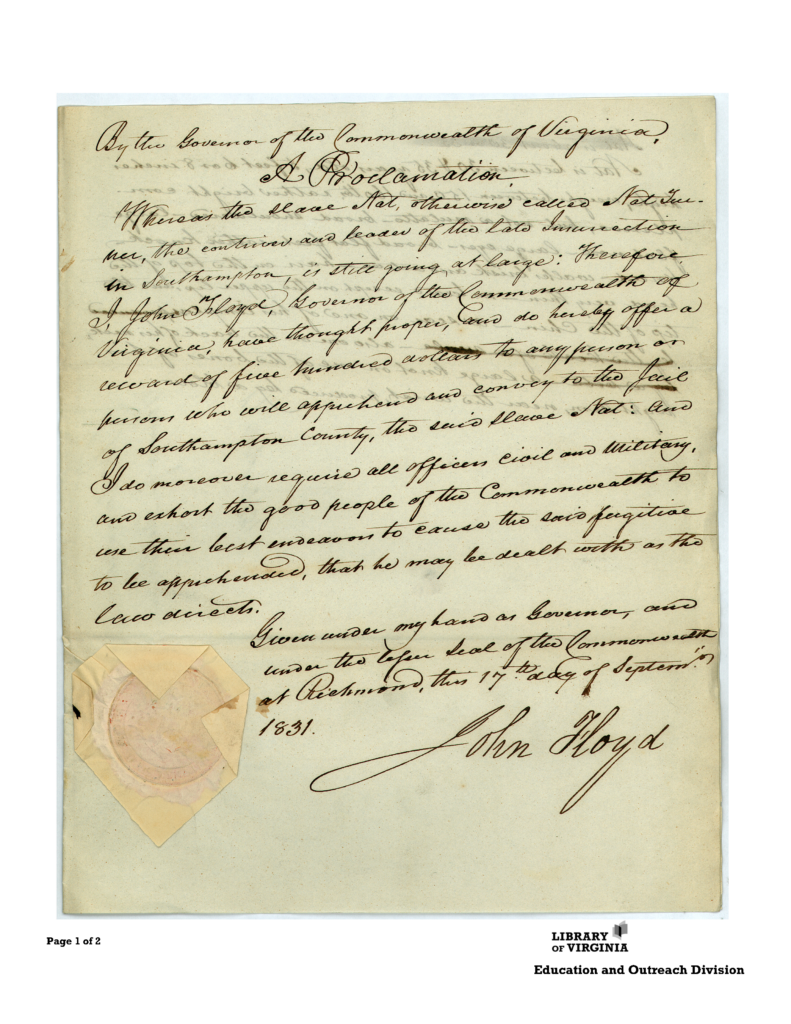
Virginia’s governor at the time, John Floyd, played a direct role in the state’s response. On September 17, 1831, while Turner was still at large, Floyd issued an official proclamation offering a $500 reward for his capture and delivery to the Southampton County jail, and formally describing him as a fugitive responsible for violence against Southampton County residents.3 Floyd’s private correspondence and diary from this period — which historians have examined in detail — show a governor who took the rebellion extremely seriously as a possible sign of broader unrest, and who used the crisis to push for legislative action tightening control over enslaved and free Black Virginians alike.
Voices Often Overlooked: Community, Women, and Resistance in Southampton
Most of the traditional narrative around this rebellion centers on Turner as an individual actor. But more recent scholarship has worked to widen that lens — to look at the Southampton community as a whole: enslaved and free, Black and white, men and women, adults and children.
The historian Vanessa Holden has written the leading study on this. Her book, Surviving Southampton, looks at how enslaved and free Black women, children, and community networks in Southampton shaped, supported, and survived the events of 1831 — in ways that get lost if the focus stays only on Turner and the other men directly involved.5 Holden’s work highlights the roles Black women played in sustaining community life before and after the rebellion, the experiences of free Black Southampton residents navigating suspicion and survival in its aftermath, and the broader, everyday patterns of resistance that existed alongside the more visible violence of August 1831. This is not about replacing the traditional story so much as widening it: the rebellion as one moment within a much longer history of resistance and endurance under slavery.
Legacy and Historical Debate
Nat Turner’s rebellion has been read in strikingly different ways across the nearly two centuries since it happened — and those different readings are themselves part of the history worth understanding.
In the immediate aftermath, most white Southern commentary described the rebellion as an act of savage, unprovoked violence, and used it to argue for tighter control over Black Americans, enslaved and free alike. Some Northern abolitionists, on the other hand, pointed to the rebellion as proof of slavery’s inherent injustice and instability — evidence, in their view, that a system built on total subjugation was always going to provoke violent resistance eventually. Other abolitionists were more cautious, wary of appearing to endorse Turner’s methods even as they sympathized with the underlying grievance.2
In the twentieth and twenty-first centuries, historians, novelists, and filmmakers have kept returning to Turner’s story, usually reflecting the concerns of their own moment. William Styron’s 1967 novel, The Confessions of Nat Turner, stirred real controversy for its imagined version of Turner’s inner life, and a number of Black scholars and writers criticized it — both for historical inaccuracies and for what they saw as a distorted picture of Turner and his motives. More recent work, including Holden’s community-centered history and other document-based research, has continued to revisit the available primary sources while drawing attention to their limits — especially the uncertainties surrounding Gray’s Confessions.6
Real, open questions remain: How much of Gray’s Confessions is actually Turner’s voice, and how much is Gray’s own framing? Should this rebellion be understood mainly through a religious lens, a political one, or some mix of both? And how have historians interpreted the rebels’ killing of men, women, and children within the broader context of slavery and the retaliatory violence that followed? These are not questions with a single settled answer, and readers who consult the sources below will find legitimate disagreement among historians on each one.
Legacy and Civic Relevance
Nat Turner’s rebellion occupies a strange place in American memory. It is simultaneously one of the most documented and most disputed events of the pre-Civil War period. The paper trail — court records, a governor’s proclamation, newspaper accounts from the time, and Gray’s contested Confessions — provides a solid chronological foundation. But questions of motive, meaning, and moral interpretation remain genuinely open, as they do for most consequential historical events.
This rebellion offers a chance to work directly with primary sources of very different reliability, to consider how power, perspective, and self-interest can shape which historical records are created, preserved, and ultimately available today, and to see how a single historical episode can be interpreted differently depending on the questions brought to it. For any student of American civics, Southampton in 1831 is also a reminder that the legal architecture of slavery was not static: it tightened in direct, traceable response to resistance, and the laws written in Virginia’s statehouse that winter shaped the lives of enslaved and free Black Virginians for decades afterward.
Explore more stories about people and events from history on Civics for Life.
Footnotes
- Patrick H. Breen, “Nat Turner’s Revolt (1831),” Encyclopedia Virginia. https://encyclopediavirginia.org/entries/turners-revolt-nat-1831/
- National Museum of African American History and Culture (NMAAHC), “Nat Turner’s Rebellion.” https://nmaahc.si.edu/explore/stories/nat-turners-rebellion
- Library of Virginia, “Proclamation Concerning Nat Turner by Governor Floyd, September 17, 1831.” https://www.lva.virginia.gov/collections/educator-resources/online-classroom/stc/entries/proclamation-concerning-nat-turner-by-governor-floyd-september-17-1831
- Thomas R. Gray, The Confessions of Nat Turner, the Leader of the Late Insurrection in Southampton, Va., as Fully and Voluntarily Made to Thomas R. Gray (Baltimore, 1831). https://docsouth.unc.edu/neh/turner/turner.html
- Vanessa M. Holden, Surviving Southampton: African American Women and Resistance in Nat Turner’s Community (Urbana: University of Illinois Press, 2021). https://www.press.uillinois.edu/books/?id=p085857
- The Nat Turner Project, “A Digital Archive of Historical Sources.” https://www.natturnerproject.org
Image Sources:
Map of Surry, Sussex and Southampton Counties, Virginia (1863): Library of Congress, Geography and Map Division; Virginia Historical Society, Gilmer Map Collection. Record: loc.gov/item/gvhs01.vhs00380.
“Horrid Massacre in Virginia” (1831): Samuel Warner, Authentic and Impartial Narrative of the Tragical Scene Which Was Witnessed in Southampton County (Virginia) on Monday the 22nd, of August Last, 1831. National Museum of African American History and Culture, Smithsonian Institution. Public domain. Record: si.edu — NMAAHC object record.
Title Page, The Confessions of Nat Turner (1832 edition): Thomas R. Gray and Nat Turner, The Confessions of Nat Turner, Richmond, 1832, Library of Congress, Rare Book and Special Collections Division. No known copyright restrictions. Record: loc.gov/resource/rbcmisc.ody0108.
Governor John Floyd’s Proclamation Concerning Nat Turner (September 17, 1831): Governor’s Office, Letters Received, John Floyd, Record Group 3, Library of Virginia. Digital image and transcription provided by the Library of Virginia.