

Catharine Beecher: Schoolroom, Home, and Public Life
How one of antebellum America’s best-known educators expanded what women could learn and earn — while arguing, in print, that women should keep out of public political agitation.
In the decades before the Civil War, American women could not vote, and most formal routes to political power were closed to them. Some women challenged those limits directly by giving public lectures or petitioning lawmakers. Catharine Beecher took a different route. She built schools, wrote best-selling household manuals, and campaigned to send women teachers to the growing West, all while arguing that women’s influence belonged in the home and the schoolroom rather than on the political platform.1
That combination makes Beecher one of the more complicated figures of her era. Her educational work widened opportunities for thousands of women. Her public arguments also drew firm boundaries around how women should use those opportunities. Understanding her means taking both parts of her work seriously, on her own terms and in her own words.
A Minister’s Daughter
Catharine Esther Beecher was born on September 6, 1800, in East Hampton, New York.2 She was the eldest of nine children of Roxana Foote and Lyman Beecher, a Presbyterian minister and evangelist who became one of the best-known preachers of his generation.1

When she was nine, the family moved to Litchfield, Connecticut, where she attended the Litchfield Female Academy.1 Her mother died in 1816, and as the eldest daughter, Catharine took on much of the work of running the household and caring for her younger siblings.2
The Beecher family would become one of the most prominent in nineteenth-century America. Among Catharine’s siblings were the preacher Henry Ward Beecher, the suffrage leader Isabella Beecher Hooker, and Harriet Beecher Stowe, the author of Uncle Tom’s Cabin.1 Those family ties also meant that public debates over slavery, religion, and women’s rights often played out among people who shared a dinner table, and Catharine’s views did not always match those of her siblings.
Turning to Education
Loss and a New Purpose
As a young woman, Beecher became engaged to Alexander Fisher, a professor at Yale College.1 In 1822, Fisher died in the shipwreck of the Albion off the coast of Ireland.3 After his death, Beecher dedicated herself to education. Teaching and writing about education became her life’s work.1
She had already begun teaching before the engagement ended. According to Britannica, she became a schoolteacher in 1821.2
The Hartford Female Seminary
In 1823, Beecher and her sister Mary opened a school for girls in Hartford, Connecticut.1 The school grew into the Hartford Female Seminary, which became one of the best-known schools for young women in the United States.3
What set the school apart was its curriculum. Many schools for girls at the time emphasized manners, fine arts, and modern languages.1 Through her writings and the schools she founded, Beecher advocated that women be taught subjects then associated with men’s education, including history, Latin, rhetoric, algebra, logic, and natural philosophy.3 She also introduced calisthenics as part of a physical education program, a choice that pushed back against the popular belief that women were naturally fragile.2
Beecher’s purpose was not to prepare women for the same roles as men. In her view, men and women had equal importance but different spheres, and she wanted to raise the work done in women’s sphere to the same level of seriousness and skill as the work done in men’s.3 Educating women rigorously, she believed, would prepare them to be better mothers, household managers, and teachers.
Cincinnati and the Western Female Institute
In the early 1830s, Lyman Beecher became president of Lane Theological Seminary in Cincinnati, and Catharine moved west with him.1 In Cincinnati, she opened the Western Female Institute, another school for young women.2
The school struggled financially from the start.1 It closed after about five years, as financial problems and Beecher’s poor health took their toll.2 The economic downturn that followed the Panic of 1837 added to the school’s difficulties.3
The move west did more than close one chapter of her career. It gave Beecher firsthand experience of the rapidly growing communities of the Ohio Valley and the frontier beyond, where schools and teachers were in short supply. That experience would shape her most ambitious plans in the following decade.
The 1837 Debate with Angelina Grimké
Beecher’s Argument
In 1837, Beecher entered one of the defining public debates of her era: whether women should join the organized campaign against slavery. That year, she published An Essay on Slavery and Abolitionism, with Reference to the Duty of American Females.4 The essay was written as an open letter to Angelina Grimké, a South Carolina-born abolitionist who had been urging American women, including Southern women, to take an active part in the antislavery cause.4
Beecher’s essay did not defend slavery. She wrote that she knew of no Christians in the North who would deny that holding human beings as property for gain “is a sin, and ought to be immediately abandoned.”4 She described abolitionists as men “of pure morals, of great honesty of purpose.”4
Her objection was to the methods of the abolitionist societies, and to women’s participation in them. She argued that the character and measures of those societies were “not either peaceful or christian in tendency,” and that campaigns aimed at changing Southern practice from the North were likely to make matters worse.4
The heart of her argument concerned women. Beecher wrote that “Heaven has appointed to one sex the superior, and to the other the subordinate station, and this without any reference to the character or conduct of either.”4 The arrangement did not mean, she added, that woman’s “duties or her influence should be any the less important.”4 Women, she argued, held real influence, but it worked through persuasion, affection, and peace rather than through public conflict.
From that premise, she concluded that her principles were “entirely opposed to the plan of arraying females in any Abolition movement.”4 She warned that joining such societies would draw women into partisan struggle and expose them to mobs and public ridicule.
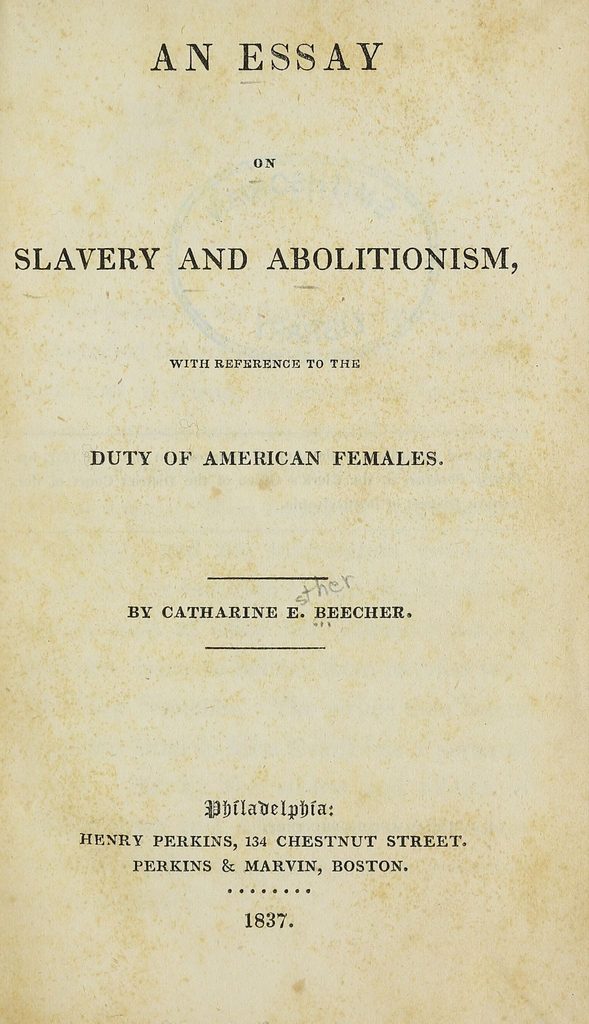
She applied the same reasoning to petitions. Petitions to Congress concerning the official duties of lawmakers, she wrote, “seem, IN ALL CASES, to fall entirely without the sphere of female duty.”4 If women could persuade the men in their families to petition, she argued, the same good would be accomplished without women stepping outside their proper role.
Her objection was not to every form of women’s public activity. She was herself a public author and an organizer of educational causes. She drew the line at contentious political campaigns, petitions to lawmakers, and organized agitation on divisive questions like abolition.
Grimké’s Reply
Angelina Grimké answered in a series of public letters, collected as a book in 1838, Letters to Catherine E. Beecher, in Reply to an Essay on Slavery and Abolitionism.5
Grimké rejected the idea that women’s duties differed from men’s on moral questions. In her twelfth letter, titled “Human Rights Not Founded on Sex,” she wrote: “whatever it is morally right for man to do, it is morally right for woman to do.”6 She stated her position directly: “I recognize no rights but human rights…”6
The exchange between the two women laid out two very different answers to the same question. Both believed women had a moral role to play in the nation’s life. They disagreed sharply about what that role allowed. That disagreement, between women and conducted in print, is itself a reminder that the boundaries of women’s public participation were not simply imposed on women. They were argued over by women, too.
Domestic Economy as a Subject of Study
In 1841, Beecher published A Treatise on Domestic Economy, for the Use of Young Ladies at Home, and at School.2 It became her best-known work and went through many editions. Britannica describes it as the “first American work to deal with all facets of domestic life.”2
The book covered health, food, clothing, household management, the care of children, and the design and upkeep of homes. Beecher’s larger argument was about education. She contended that the skills women would use throughout their lives deserved to be studied in school, just as chemistry or other sciences were.7 The preface to the revised edition calls for placing “domestic economy on an equality with the other sciences in female schools.”8

The Treatise also set out her view of women’s place in a democratic society. Its opening chapter, “The Peculiar Responsibilities of American Women,” argues that “woman has an equal interest in all social and civil concerns.”8 The same chapter states that “in the domestic relation, she take a subordinate station.”8 For Beecher, those two ideas fit together. Women’s influence on the nation, she wrote, came through their role in shaping children, since “the formation of the moral and intellectual character of the young is committed mainly to the female hand.”8
According to Britannica, her writings “did much to introduce domestic science into the American school curriculum.”2 It made household management a subject of systematic instruction for women. The book did not create a credentialed profession, but it treated women’s domestic work as knowledge worth teaching.
The text used here is the revised 1845 Harper & Brothers edition. Earlier and later editions differ, and Beecher’s antebellum views should be read in the editions published before the Civil War.
Teachers for the West
By the 1840s, Beecher had turned her attention to a national problem: the shortage of teachers in the fast-growing communities of the West. Her solution was to recruit, train, and send women from the East to fill those classrooms.
In her 1845 essay The Duty of American Women to Their Country, she argued that women made the “best, as well as the cheapest, guardian and teacher of childhood.”9 The phrase reflects both sides of her argument. Women, she believed, were naturally suited to teaching, and they could be hired for less than men, which made it possible to staff more schools.
Beecher toured Eastern cities to raise support for an organization to recruit and train women teachers for the West.9 Accounts of its early history differ. According to Connecticut Explored, she organized the effort in 1846 as the National Board of Popular Education, and the board hired William Slade, a former governor of Vermont, as its full-time agent.9 The same account reports that classes of trained teachers set out from Hartford beginning in 1847, and that about 600 women went west under the board’s auspices over roughly a decade.9 Britannica gives the name as the Board of National Popular Education and dates Beecher’s work with it to 1847–1848.2
Beecher did not stay with the organization for long. According to Connecticut Explored, she left in 1848, dissatisfied with Slade’s leadership and unwilling to take a secondary role in an effort she had founded.9 In 1852 she founded the American Woman’s Educational Association, which aimed to establish endowed schools to train teachers, especially in the West.9
Beecher was one of several reformers working to expand public education and teacher training in this period. Educational leaders including Horace Mann and Henry Barnard endorsed her plan for sending teachers west.9 Her work contributed to a broader shift in which teaching in American common schools increasingly became women’s work.3
A Complicated Legacy
Beecher’s opposition to women’s political participation continued long after the Civil War. Her antebellum position is clearest in the 1837 Essay, with its argument against women petitioning Congress or joining abolition societies. Later works carry the same view into a new era. In “An Address on Female Suffrage,” delivered in Boston’s Music Hall in December 1870 and reprinted in her 1872 book Woman’s Profession as Mother and Educator, she argued that most American women would regard the ballot “not as a privilege conferred, but as an act of oppression, forcing them to assume responsibilities belonging to man, for which they are not and can not be qualified…”10 That put her at odds with her half sister Isabella Beecher Hooker, a leader in the suffrage movement.1
The Schlesinger Library at Harvard summarizes her lifelong argument as an advocacy of “women’s domestic role as their primary sphere of influence.”11 Yet the institutions she built and the careers she promoted took many women out of their parents’ homes, into classrooms, and across the country to work for wages.
Historians continue to weigh those two sides of her career. Some emphasize the doors she opened for women’s education and employment. Others emphasize the limits she placed on women’s public voice at a moment when other women were testing those limits. Beecher’s own writings support both readings, and neither one alone captures her full influence.
Legacy and Civic Relevance
Catharine Beecher died on May 12, 1878, in Elmira, New York.2 By then, women’s schools and colleges had spread across the country, and women made up a growing share of the nation’s teachers. Beecher had helped shape that change, through her schools, her books, and her campaigns to send teachers west.
Her career also shows that civic influence in antebellum America did not run only through the ballot box or the lecture platform. Beecher worked within the accepted norms of her time and used them to build institutions, raise money, and change school curricula. At the same time, her argument that women should stay out of public political controversy placed her in direct opposition to women like Angelina Grimké who were claiming a public political voice.
Set beside the other women of this week’s episodes, Maria Stewart on the lecture platform and the Lowell mill workers with their petitions, Beecher’s story completes a picture of women who faced the same exclusion and responded in very different ways. Her story also leads forward to her sister Harriet Beecher Stowe, whose novel Uncle Tom’s Cabin would carry a Beecher’s voice into the national debate over slavery in a way Catharine herself had argued against.
Her career leaves a question worth considering: What opportunities did this approach create, and whose participation did it leave constrained?
Continue exploring Women and Public Life in Antebellum America with the companion articles on Maria Stewart and the Lowell Mill Girls, and with Harriette J. Cooke: A Professor’s Rank and a Professor’s Pay, in History Lessons.
Endnotes
1. Debra Michals, ed., “Catharine Beecher,” National Women’s History Museum, 2015. https://www.womenshistory.org/education-resources/biographies/catharine-esther-beecher
2. Britannica Editors, “Catharine Beecher,” Encyclopaedia Britannica. https://www.britannica.com/biography/Catharine-Beecher
3. Michael Sturges, “Catharine Beecher, Champion of Women’s Education,” Connecticut History, CT Humanities, September 5, 2015. https://connecticuthistory.org/catharine-beecher-champion-of-womens-education/
4. Catharine E. Beecher, An Essay on Slavery and Abolitionism, with Reference to the Duty of American Females (Philadelphia: Henry Perkins; Boston: Perkins & Marvin, 1837), Project Gutenberg. https://www.gutenberg.org/files/26123/26123-h/26123-h.htm Page references to the 1837 printing (Smithsonian Libraries scan, https://doi.org/10.5479/sil.406260.39088006768675): “is a sin, and ought to be immediately abandoned,” p. 7; “of pure morals, of great honesty of purpose,” p. 14; “not either peaceful or christian in tendency,” p. 17; “Heaven has appointed…,” p. 99; “entirely opposed to the plan of arraying females…,” p. 102; “seem, IN ALL CASES…,” p. 104.
5. Angelina E. Grimké, Letters to Catherine E. Beecher, in Reply to an Essay on Slavery and Abolitionism, Addressed to A. E. Grimké, revised by the author (Boston: Isaac Knapp, 1838), Project Gutenberg. https://www.gutenberg.org/files/53852/old/53852-h/53852-h.htm
6. Angelina E. Grimké, “Letter XII: Human Rights Not Founded on Sex,” in Letters to Catherine E. Beecher, in Reply to an Essay on Slavery and Abolitionism (Boston: Isaac Knapp, 1838), Project Gutenberg, https://www.gutenberg.org/files/53852/old/53852-h/53852-h.htm; also reprinted in Louise W. Knight, “Voices in Time: Epistolary Activism,” Lapham’s Quarterly, February 22, 2018. https://www.laphamsquarterly.org/node/7957
7. Karen DePauw, “Much Good Might be Accomplished: Catharine Esther Beecher and the Pursuit of Domestic Economy,” Connecticut History, CT Humanities, March 27, 2021. https://connecticuthistory.org/much-good-might-be-accomplished-catharine-esther-beecher-and-the-pursuit-of-domestic-economy/
8. Catharine E. Beecher, A Treatise on Domestic Economy, for the Use of Young Ladies at Home, and at School, revised edition (New York: Harper & Brothers, 1845), Project Gutenberg. https://www.gutenberg.org/files/21829/21829-h/21829-h.htm
9. Allison Speicher, “Catharine Beecher Educates the West,” Connecticut Explored, Winter 2016/17. https://www.ctexplored.org/catharine-beecher-educates-the-west/
10. Catharine E. Beecher, “An Address on Female Suffrage,” delivered in the Music Hall, Boston, December 1870, in Woman’s Profession as Mother and Educator, with Views in Opposition to Woman Suffrage (Philadelphia and Boston: Geo. Maclean, 1872), Project Gutenberg. https://gutenberg.org/cache/epub/56090/pg56090-images.html
11. Schlesinger Library, Radcliffe Institute for Advanced Study, Harvard University, “Catharine Beecher.” https://www.radcliffe.harvard.edu/schlesinger-library/collections/catharine-beecher
Image Sources
Portrait of Catharine E. Beecher holding a book (ca. 1858–1862): Black & Batchelder, albumen print carte de visite. Beecher-Stowe Family Papers, Schlesinger Library, Radcliffe Institute, Harvard University; HOLLIS olvwork20019718. Permalink: id.lib.harvard.edu/images/olvwork20019718/urn-3:RAD.SCHL:186159/catalog.
Title Page, An Essay on Slavery and Abolitionism (1837): Smithsonian Libraries and Archives; No Copyright – United States. DOI: doi.org/10.5479/sil.406260.39088006768675.
“Exercises for the Arms and Hands” (1856): Catharine E. Beecher, Physiology and Calisthenics for Schools and Families (Harper & Brothers, 1856), “Calisthenic Exercises,” p. 15. University of California Libraries / Internet Archive; published 1856, public domain. Record: archive.org/details/physiologycalist00beecrich.