

Henry Knox — The Bookseller Who Became Washington’s Most Trusted General
Few stories from the founding era better capture the promise of the American experiment than Henry Knox’s. Born into poverty in Boston in 1750, forced to leave school at nine to support his widowed mother, Knox taught himself military science from the very books he sold in his shop — and then went on to become one of General George Washington’s most indispensable officers, the architect of America’s first military academy, and the nation’s first Secretary of War. His life is a testament to the power of self-directed learning, civic courage, and the kind of practical genius that wins wars. It is also, at its center, a partnership story — for Knox could not have become the leader he was without the woman who chose him: Lucy Flucker Knox, whose own story of patriot courage and civic influence is told elsewhere in this series.
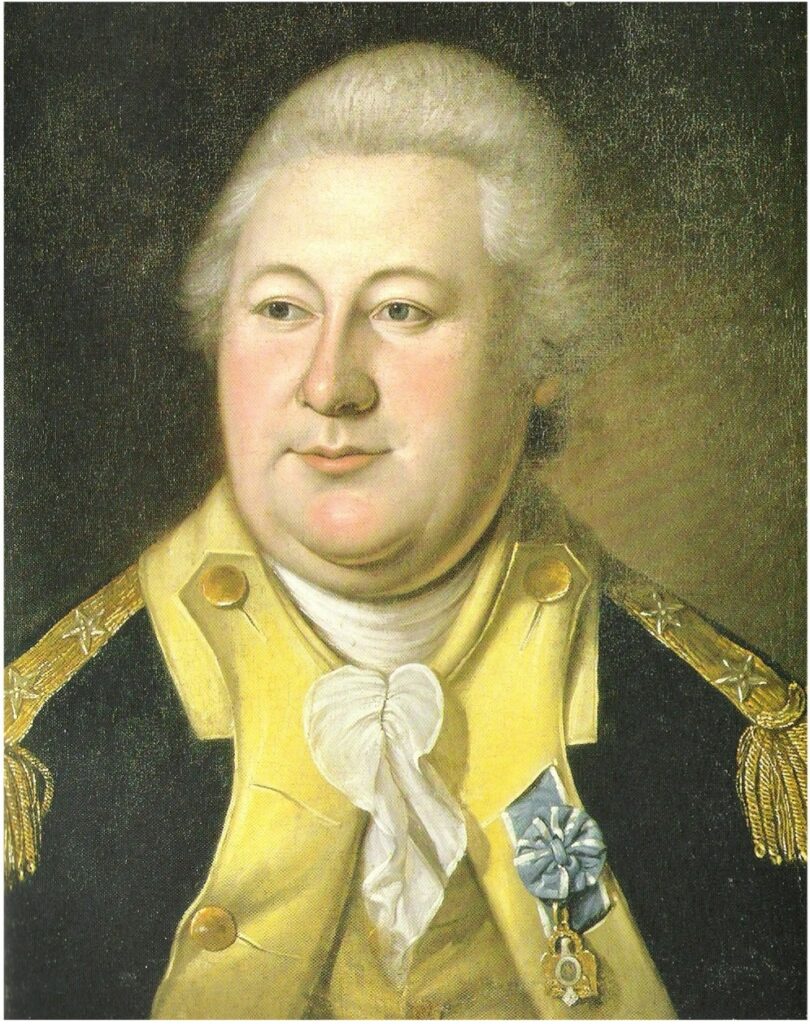
Early Life: Poverty, Books, and Self-Education
Henry Knox was born on July 25, 1750, in Boston, Massachusetts, the son of Scots-Irish immigrants William and Mary Campbell Knox.⁴ He was one of ten children, and his early years were marked by hardship. When his father abandoned the family and departed for the West Indies — dying there of unknown causes — Knox was just nine years old. As the eldest remaining son, he left the Boston Latin School and worked as a bookstore clerk to help support his mother and younger brother.¹
What might have been a story of truncated ambition became instead one of extraordinary self-making. The bookstore’s owner, Nicholas Bowes, became a mentor and father figure, instilling in Knox a love of reading that would never leave him. In between shifts, the young clerk taught himself French, philosophy, and mathematics, and devoured books on military history and the campaigns of the ancient Greeks and Romans.⁴ By the time Knox opened his own establishment — the London Book Store — at the age of twenty-one, he had accumulated a military education that rivaled anything available through formal schooling.
The London Book Store quickly became a gathering place for Boston’s elite, including British officers who frequented it for its extensive stock of military texts. Knox was happy to discuss strategy and artillery with anyone who came through the door — and he was learning from all of them.¹
Love, Loyalty, and a Forbidden Marriage
In 1774, Knox began courting Lucy Flucker, the daughter of Thomas Flucker, the Crown-appointed Secretary of Massachusetts — one of the most powerful Loyalist officials in the colony. The match was, by every social calculation of the time, unsuitable: Knox was a merchant of no particular standing, deeply involved with the patriot movement, while the Fluckers expected their daughter to marry into wealth and loyalty to the Crown.
Knox and Lucy married on June 16, 1774, despite her father’s fierce objections. When war broke out at Lexington and Concord the following spring, the couple fled Boston together — Lucy reportedly sewing Knox’s sword into the lining of her cloak to smuggle it past British sentries. Her family disowned her for her choice. Lucy’s parents remained loyal to the Crown and sailed for England; her brother served in the British army. Lucy stayed with her husband and the patriot cause, and the two would face the war years together.
The Noble Train of Artillery
When General George Washington assumed command of the newly formed Continental Army in the summer of 1775, he immediately recognized Knox’s unusual combination of self-taught expertise and practical engineering skill. Knox had already impressed officers at the Battle of Bunker Hill, where he designed fortifications and directed artillery fire with a confidence that belied his lack of formal military training.² Washington appointed Knox to lead the Continental Regiment of Artillery. At the same time, John Adams — a former patron of the London Book Store — lobbied the Continental Congress to commission him as a colonel.⁴
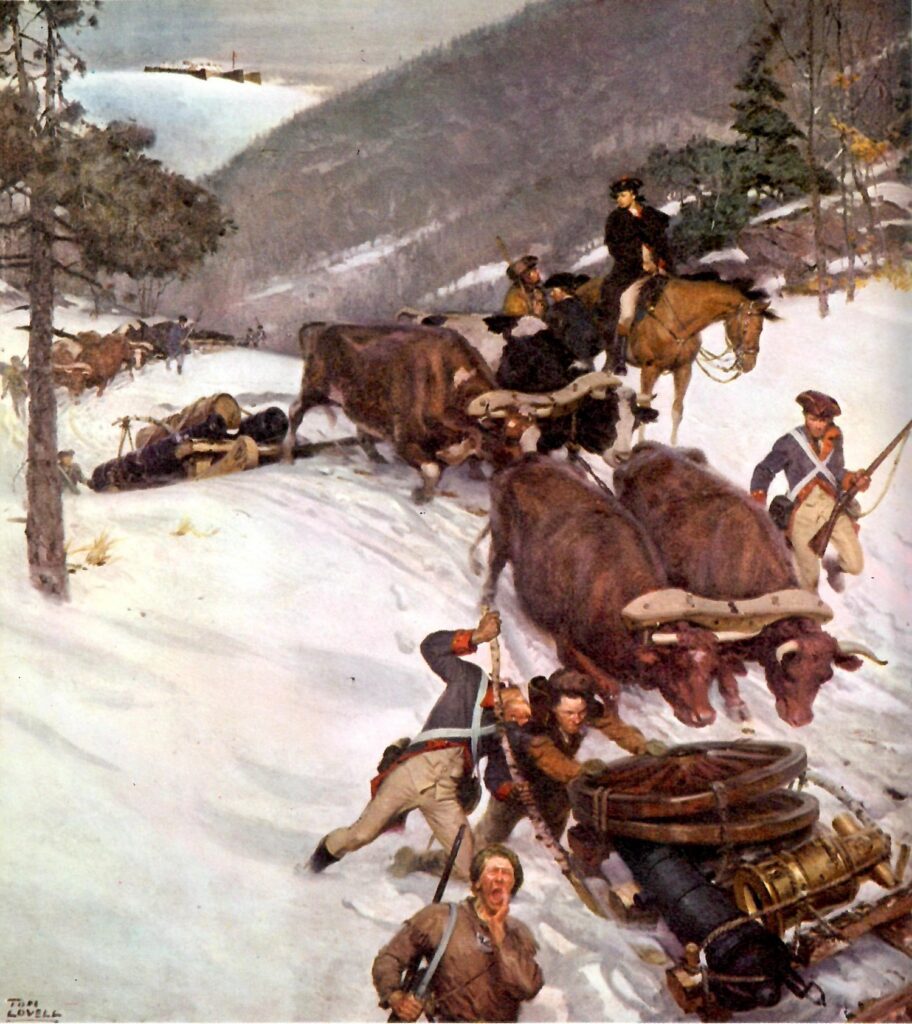
Knox quickly proved his worth with an audacious proposal: he would travel to Fort Ticonderoga in upstate New York, which the British had recently captured, and haul its cannons back to Boston. Washington approved, and Knox set out in November 1775. What followed was one of the most celebrated logistical feats of the Revolutionary War.
Knox and his men collected 59 iron and brass cannons, mortars, and howitzers — roughly 60 tons of artillery — and transported them nearly 300 miles across frozen lakes, the Berkshire Mountains, and the Connecticut River valley using sleds, oxen, and sheer determination in the depths of a New England winter.³ Knox returned to Boston on January 27, 1776. Washington’s army immediately deployed the guns on Dorchester Heights, where their commanding position left the British military with no viable response. Within weeks, British forces evacuated Boston entirely — a decisive early victory that Knox’s ingenuity had made possible.
The U.S. Army’s Fort Knox, Kentucky, now one of the most recognized military installations in the world, bears his name in recognition of this artillery legacy — and it is, notably, the fourth military installation to carry that honor.²
From Trenton to Yorktown
Knox served at Washington’s side through nearly every major campaign of the war. He managed the logistics of the famous Christmas night crossing of the Delaware River in December 1776, ferrying eighteen guns across the icy current before the surprise attack on Hessian forces at Trenton — an action that helped save the Revolution at its lowest moment.⁴ He fought through the New York and New Jersey campaigns, through the winter encampment at Valley Forge — where his wife Lucy joined him when she could, working alongside Martha Washington to sustain morale and manage the camp’s daily life — and through the long campaigns of 1777 and 1778.
During the winter of 1778–79, Knox founded the Continental Army’s first artillery and officer training school, a direct precursor to the United States Military Academy at West Point.⁴ He was promoted to major general in 1782, and at the Siege of Yorktown in 1781, he collaborated with French artillery commanders to position the guns that ultimately forced General Cornwallis to surrender — effectively ending the war.³
Washington called Knox’s artillery performance at the Battle of Monmouth the crucial factor in preventing a catastrophic American defeat. Knox’s own words from 1776 — “We want great men who, when fortune frowns, will not be discouraged” — serve as a fitting motto for his entire military career.²
Builder of the Nation’s Defenses
After the war, Knox did not retire from public life. Washington appointed him commander of the remaining Continental forces as the army demobilized, and in 1783 Knox helped found the Society of the Cincinnati, a fraternal organization of former Revolutionary War officers that continues to this day.⁴
In 1785, the Continental Congress appointed Knox Secretary of War — a position he held through the transition to the new constitutional government, becoming the first Secretary of War under President Washington in 1789.³ In that role, he negotiated with Native American nations, advocating for recognition of their sovereignty even as he struggled to enforce limits on illegal settlements on their lands.⁴ He championed the idea of a standing professional army, proposed what would become the United States Military Academy at West Point, and helped establish the nation’s first naval warships — laying the institutional foundations of American military power that would endure for generations.¹
Knox resigned from Washington’s cabinet in 1795. He retired with Lucy to Montpelier, their nineteen-room estate in what is now Rockland, Maine — built on land from Lucy’s inheritance of the vast Waldo Patent holdings. There, they hosted hundreds of guests, presided over the region’s social life, and built the life they had always imagined. Henry Knox died on October 25, 1806, at the age of fifty-six, after swallowing a chicken bone that caused a fatal infection. Lucy outlived him by eighteen years.⁴
Legacy and Civic Relevance
Henry Knox’s life carries a message that is particularly resonant today. He had no family connections, no formal military training, and no inherited advantage. What he had was curiosity — a bookstore clerk’s insatiable hunger for knowledge — and the civic courage to put that knowledge in service of something larger than himself.
He was, as the U.S. Army has observed, “a shining example of a self-educated leader and officer who sought out professional development wherever he could find it.”² In founding the nation’s first arsenal, proposing its first military academy, and serving as its first Secretary of War, he helped build the institutional architecture of the republic from the ground up. And in his partnership with Lucy — who gave up everything to stand beside him — he modeled a vision of shared commitment to the American cause that the founding generation, at its best, embodied.
His story, and hers, are inseparable. Together, they remind us that the republic was built not only by those born to lead, but by those willing to learn, to sacrifice, and to serve.
Explore more stories from the Revolutionary era in our Founding Generation series.
Footnotes
- George Washington’s Mount Vernon Digital Encyclopedia, “Henry Knox,” https://www.mountvernon.org/library/digitalhistory/digital-encyclopedia/article/henry-knox
- United States Army, “Historic Fort Knox: The Man Behind the Namesake, Henry Knox,” https://www.army.mil/article/283375/historic_fort_knox_the_man_behind_the_namesake_henry_knox
- National Park Service, “Henry Knox,” https://www.nps.gov/people/henry-knox.htm
- National Museum of the United States Army, “Henry Knox,” https://www.thenmusa.org/biographies/henry-knox/