

The Lowell Mill Girls: Turn-Outs, Petitions, and the Price of Cloth
How the young women, known as the Lowell Mill Girls, who powered an early American industrial city tested what people without a vote could do to change the terms of their work.
In the 1830s and 1840s, the textile mills of Lowell, Massachusetts, ran on water power, Southern cotton, and the labor of thousands of young women. Most had grown up on New England farms. Many came to Lowell for wages of their own, a measure of independence, and a few years of city life before returning home or moving on.
Those same women also became some of the earliest American industrial workers to organize. They walked out of the mills in 1834 and again in 1836. In the 1840s, they formed an association, wrote for a labor newspaper, and petitioned the Massachusetts legislature for a shorter workday.
Their story is not one organization with one position. It is a sequence of different efforts, made by different groups of women, with different results. Following that sequence shows how an early American industrial economy was built, and how people who could not vote tried to shape the rules that governed their working lives.
Building an Industrial City
From Waltham to Lowell
The story begins with a group of Boston merchants looking for a new place to put their money. Francis Cabot Lowell, a member of a leading Boston merchant family, turned toward manufacturing at a time when shipping had become uncertain.1 According to the National Park Service, Lowell developed the country’s first working power loom.1
In 1814, Lowell, Patrick Tracy Jackson, and Nathan Appleton established the Boston Manufacturing Company on the Charles River in Waltham, Massachusetts.1 The company was capitalized at $400,000, a sum the Park Service notes “dwarfed its competition.”1 Its key innovation was organizational as much as mechanical: the power loom and related machinery allowed every step of cloth production to take place under one roof.1
The Waltham company also made a choice about who would do the work. Rather than relying on the family labor common in earlier New England mills, it recruited young, single women from the surrounding countryside.1 That combination of an integrated factory and a recruited female workforce became known as the Waltham-Lowell system.
The model soon moved north. In the early 1820s, Boston merchants began developing a mill town along the Merrimack River.2 On March 1, 1826, the town was incorporated as Lowell, named for Francis Cabot Lowell, who had died in 1817 before the town that bears his name was founded.3 The site offered the falls of the Pawtucket on the Merrimack, and more than six miles of canals eventually carried that water to the mills’ waterwheels.2
The Scale of the Enterprise
The investors behind these mills, often called the Boston Associates, expanded from Lowell into other New England towns, including Chicopee, Manchester, and Lawrence.1 By 1850, the Waltham-Lowell system had made the group a major force in the American cotton-textile industry.1 Its members also invested in railroads and Boston financial institutions, supported hospitals and schools, and played a prominent role in the Massachusetts Whig Party.1
By the 1850s, about forty textile mills employing more than ten thousand workers lined roughly a mile of the Merrimack in Lowell.2
That industrial growth was tied directly to the plantation South. Lowell’s mills depended on cotton grown by enslaved people, and the city also made what the Park Service calls “negro cloth,” a period term for fabric produced to be sold to Southern plantations.4 Massachusetts Senator Charles Sumner later described the relationship as an alliance “between the lords of the lash and the lords of the loom.”4 According to the Park Service, many Lowell residents opposed slavery’s extension into the western territories, while many others likely would have accepted a compromise that left slavery in place where it already existed.4

Who the Mill Workers Were
Lowell’s early workforce was made up mostly of young, single “Yankee” women from rural New England.2 Harriet Hanson Robinson, who worked in the mills as a girl, later recalled that “the majority were between the ages of sixteen and twenty-five.”5 They typically worked twelve to fourteen hours a day.2 In Robinson’s recollection, “the working hours of all the girls extended from five o’clock in the morning until seven in the evening.”5
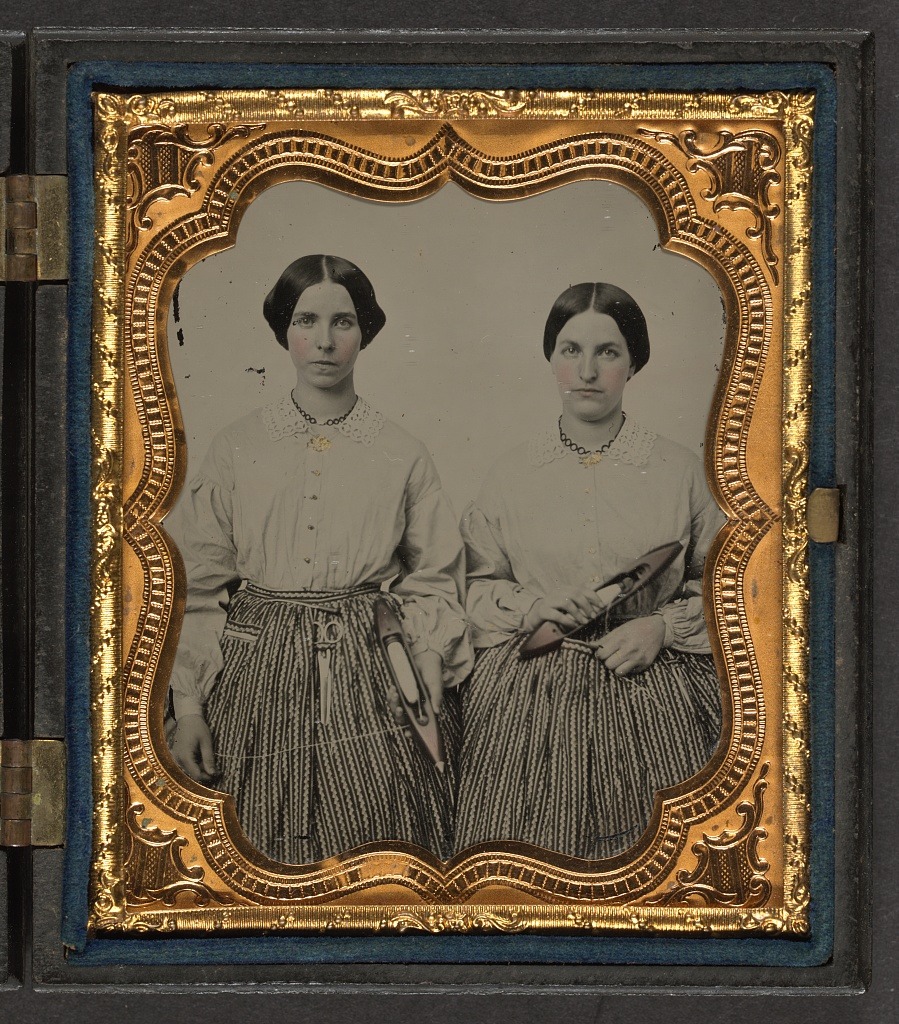
The mills paid wages monthly and provided room and board in company boardinghouses.2 Those boardinghouses were run by women keepers who cooked, cleaned, and supervised residents’ social lives.6 Room and board took about a third of a worker’s pay, which meant that any change in board charges directly affected what a worker actually earned.6
For many of these women, the wages themselves mattered a great deal. Under the legal doctrine of coverture, a married woman’s funds legally became her husband’s.6 Women in Massachusetts also could not vote. A mill job offered something unusual for the period: money a young woman earned and controlled herself.6
That independence helps explain why changes to pay and board became flashpoints. When the mills cut wages or raised charges, workers did not see only a smaller paycheck. Many saw a threat to the independence that had brought them to Lowell in the first place.6
The Turn-Outs of the 1830s
February 1834
Lowell’s mill workers were not the first American textile workers to walk out. In late May 1824, about one hundred women in Pawtucket, Rhode Island, left work after mill owners announced longer hours and lower wages — a walkout the National Park Service describes as “the first wage workers’ strike in the United States.”7 Lowell’s actions belong among the earliest such efforts, not at the very beginning.
In early 1834, textile prices were falling and unsold cloth was piling up in warehouses.6 Mill agents across Lowell responded with a wage reduction, which the Park Service gives as 12.5 percent.6 Workers met in the mills after hours, circulated petitions, and discussed how to restore their pay.6
When the mills fired a worker named Julia Wilson, apparently to break the resistance, she signaled her coworkers to walk out.6 About eight hundred women, roughly a sixth of the city’s mill workforce, left work and paraded through the city, visiting other mills to draw more workers out.6
Period labor actions like this one were called “turn-outs.” The strikers described themselves as “daughters of freemen,” language that echoed the American Revolution and presented their protest as a defense of inherited liberty.6 Mill managers saw it differently, describing the strikers’ conduct as “unseemly” or “unwomanly.” William Austin, chief agent of the Lawrence mills, repeatedly called the strikers “amazons.”6
The 1834 turn-out did not succeed. According to the Park Service, it was rushed and poorly organized, the owners handled it efficiently, and the strikers did not win their demands.6 Many returned to work, and others left Lowell.6
October 1836
Two years later, conditions were different. The economy was booming, inflation was rising, and boardinghouse keepers said they could no longer cover their costs.6 The mills responded by raising the room-and-board charge deducted from workers’ pay, without raising wages.6 Workers treated the increase as a pay cut.
This time, between 1,500 and 2,000 workers turned out.6 They were also better organized. A Factory Girls’ Association formed to help strikers pay for board while they were not earning wages, and the Park Service reports that the strike lasted far longer than the 1834 walkout, leaving the mills running below capacity for an extended period.6
One of the strikers was eleven-year-old Harriet Hanson, whose mother kept a boardinghouse. More than six decades later, writing as Harriet Hanson Robinson, she recalled leading the girls in her room out of the mill: “I don’t care what you do, I am going to turn out, whether any one else does or not.”8 Looking back at the line of girls following her, she wrote that she was “more proud than I have ever been since at any success I may have achieved, and more proud than I shall ever be again until my own beloved State gives to its women citizens the right of suffrage.”8 She also recalled that her mother lost her position as a boardinghouse keeper, after a mill agent blamed her for not controlling her daughter.8
Robinson’s account, published in 1898 in her memoir Loom and Spindle, is a valuable source, but it is a recollection written long after the events, not a record made at the time.8
The outcome of the 1836 turn-out is reported differently in different sources. According to the Park Service, the Hamilton Company removed the increase for workers paid by the day, and the Boott and Merrimack corporations removed it entirely, with many companies giving way “at least to some degree.”6 Robinson, by contrast, remembered that “this strike did no good,” that most strikers returned to work, and that the corporation continued to reduce wages.8 The surviving record supports neither a clean victory nor a simple defeat.
The Lowell Offering: A Different Kind of Voice
Not every mill worker who sought a public voice did so through protest. Beginning in 1840, some Lowell workers wrote for The Lowell Offering, a monthly magazine of poetry, fiction, and essays by women mill workers that ran until 1845.9 It grew out of local “improvement circles,” or literary societies, organized by the Reverend Abel Charles Thomas of Lowell’s Second Universalist Church.9
The Offering aimed to show that mill work and intellectual life could go together. Under editors Harriet Farley and Harriott Curtis, it remained deliberately literary and avoided controversy.10 Farley’s first signed editorial stated plainly, “With wages, board, etc., we have nothing to do.”10
The magazine also became a place to answer critics of the factory system. In 1840, the reformer Orestes Brownson criticized the long hours and harsh conditions that factory workers faced.11 That December, a writer signing herself “A Factory Girl” — probably Harriet Farley, according to the Gilder Lehrman Institute — replied in the Offering, arguing that factory wages were higher than those of most other work open to women.11
The mills had other defenders as well. In 1841, Elisha Bartlett published A Vindication of the Character and Condition of the Females Employed in the Lowell Mills, against the Charges Contained in the Boston Times, and the Boston Quarterly Review, a pamphlet printed in Lowell.12
That stance drew criticism. Sarah G. Bagley and others attacked the magazine, and Farley denied that the corporations supported it.10 Later scholars have noted connections between the magazine and mill interests, including a purchase of $1,000 worth of back issues by the Hamilton Company in the magazine’s final year.10 The Offering lost readers as the ten-hour movement grew, and it ceased publication in December 1845.10
From the Shop Floor to the State House
Sarah Bagley and the Female Labor Reform Association
By the mid-1840s, organizing in Lowell had taken a new form. Sarah G. Bagley, born in Candia, New Hampshire, in 1806, had come to Lowell in 1837 and worked as a weaver at the Hamilton Manufacturing Company and later in a dressing room.13
In 1844, Bagley became president of the newly founded Lowell Female Labor Reform Association.13 The Park Service calls it “one of the earliest successful organizations of working women in the United States.”13 The association worked alongside the New England Workingmen’s Association.13
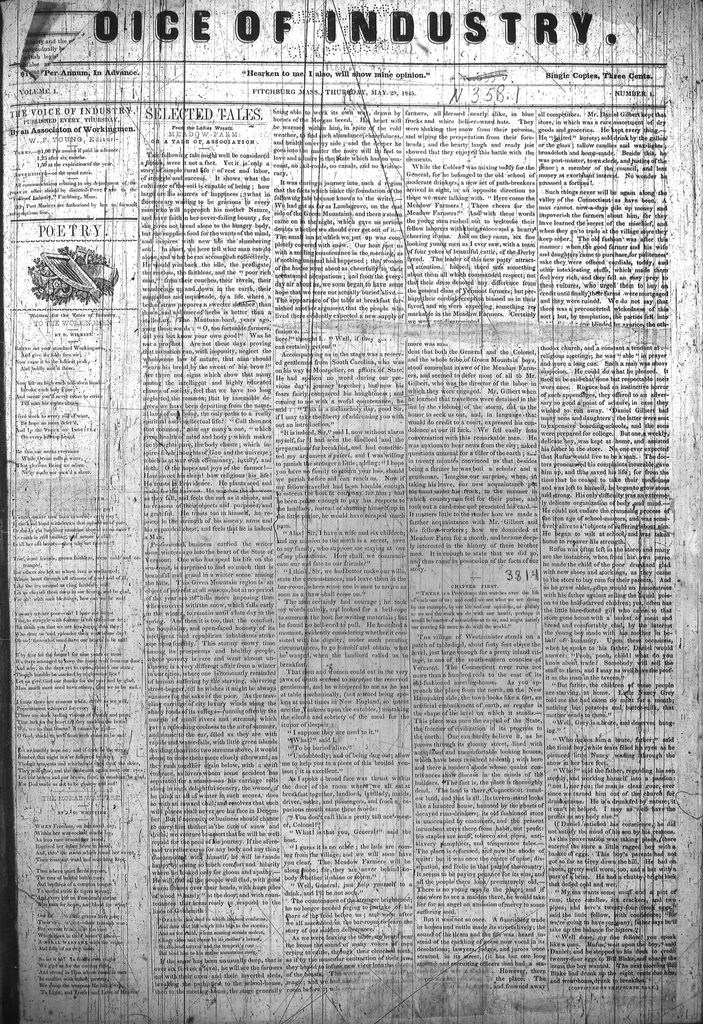
Bagley also took up the pen. She became a writer and editor for the Voice of Industry, a worker-run labor newspaper that began in Fitchburg, Massachusetts, and soon moved to Lowell.14 With Bagley on its publishing committee, the paper served as the association’s voice.14
The Ten-Hour Petitions
The association’s central goal was a shorter workday. In 1845, ten-hour petitions from Lowell, Fall River, and Andover reached the Massachusetts legislature with 2,139 names in total, 1,151 of them from Lowell.15 The petition described workers “toiling from 13 to 14 hours per day, confined in unhealthy apartments,” and asked the legislature “to institute a ten hour working day in all of the factories of the state.”16
Petitioning was one of the few formal political tools available to people who could not vote. The legislature responded by holding a hearing. On February 13, 1845, six women and three men from among the Lowell petitioners appeared before the committee and gave testimony.15 Bagley was among them.13
The special committee that examined the question was chaired by William Schouler, a state representative who also owned and edited the Lowell Courier.16 The committee recommended against a ten-hour law. Its report concluded that “the remedy is not with us” and suggested that the solution lay “in a less love for money, and a more ardent love for social happiness and intellectual superiority.”15
The association answered sharply, describing Schouler in a resolution as “merely a corporation machine, or tool.”16
Bagley also answered the report in print. In an open letter to Schouler, dated January 7, 1846, and published in the Voice of Industry two days later, she charged that the workers’ testimony had been “so changed in its connection or removed from its original position that it was made to say what we never said, or thought of saying.”17
The association also used the Voice of Industry to organize petitioning beyond Lowell. Under the headline “Ten Hours, Ten Hours!!,” it announced: “We have forwarded to some of our friends in different towns in Massachusetts, petitions asking the Legislature to prohibit incorporated companies for employing one set of hands more than ten hours per day.”18 It asked supporters to circulate the petitions for signatures and return them to the newspaper’s office.18
Workers tried again. In 1846, a second petition carrying about 4,500 signatures went to the legislature, and it too was rejected.13
Bagley’s own path continued to change. After a public dispute with the Voice of Industry‘s new editor over women’s role in the paper, her last piece for it appeared in October 1846.13
A Changing Workforce
The ten-hour campaigns did not produce a state law during these years. Meanwhile, the workforce itself was changing. In the 1840s, Irish Catholic immigrants, many fleeing the Great Famine, increasingly replaced the Yankee women who had filled the mills.2 Irish laborers had already helped build Lowell’s canals, mills, and boardinghouses before the first mill workers arrived.2
According to the Park Service, falling profits had already led to wage cuts and worsening conditions, and many of the Yankee workers who protested and saw their demands unmet chose to leave.2 Later generations of French-Canadian, Greek, Polish, Portuguese, Jewish, and Armenian immigrants also worked Lowell’s mills, often facing long hours, low pay, and crowded housing.2
Legacy and Civic Relevance
The Lowell mill workers are often remembered as a single group with a single story. The record shows something more complicated. Some workers turned out in 1834 and lost. Others organized more carefully in 1836 and won at least partial relief, though one participant later remembered the strike as a failure. Some wrote literary essays and steered away from wages altogether, while others built an association, wrote for a labor newspaper, and took their case to the State House.
Their efforts also reveal how an early American industrial economy worked. Lowell joined Boston capital, New England water power, Southern cotton grown by enslaved people, and the labor of young women recruited from farms. Each part of that system carried its own costs, and those costs were felt by different people in different places.
For students of civics, Lowell raises an enduring question about political participation. The women who signed the ten-hour petitions could not vote for the legislators who received them. They used the tools that remained — collective action, the press, and the constitutional right to petition — and the legislature heard them, then declined to act. Whether that outcome showed the limits of those tools, or the start of a longer effort that later generations would continue, is a question readers can weigh for themselves.
What opportunities did this approach create, and whose participation did it leave constrained?
Continue exploring the antebellum economy with The Erie Canal: The Waterway That Connected a Growing Nation, and look for the companion articles on Maria Stewart and Catharine Beecher in History Lessons.
Endnotes
1. National Park Service, “Lowell, Story of an Industrial City: The Waltham-Lowell System.” https://www.nps.gov/articles/lowell-handbook-waltham-lowell-system.htm
2. National Park Service, “Massachusetts: Lowell National Historical Park.” https://www.nps.gov/articles/lowell.htm
3. Pollard Memorial Library, “Local History.” https://lowelllibrary.org/research/local-history/
4. National Park Service, “Lowell, Story of an Industrial City: Lowell’s Southern Connection.” https://home.nps.gov/articles/lowell-handbook-southern-connection.htm
5. Harriet H. Robinson, “Early Factory Labor in New England,” in Massachusetts Bureau of Statistics of Labor, Fourteenth Annual Report (Boston: Wright & Potter, 1883), 380–82, 387–88, 391–92; reprinted as “Primary Source: Lowell Mill Girls (1883),” U.S. History I, Lumen Learning (from the Internet Modern History Sourcebook). https://courses.lumenlearning.com/wm-ushistory1/chapter/primary-source-lowell-mill-girls-1883/
6. National Park Service, Lowell National Historical Park, “Early Strikes in Lowell.” https://www.nps.gov/articles/000/early-strikes-in-lowell.htm
7. National Park Service, Blackstone River Valley National Historical Park, “1824 Strike.” https://home.nps.gov/blrv/learn/historyculture/1824-strike.htm
8. Harriet Hanson Robinson, Loom and Spindle, or Life Among the Early Mill Girls (New York: T. Y. Crowell, 1898), 83–86, excerpted as “The Lowell Mill Girls Go on Strike, 1836,” History Matters, George Mason University. https://historymatters.gmu.edu/d/5714
9. University of Massachusetts Lowell, The Offering, “History.” https://sites.uml.edu/the-offering/?p=25
10. Susan Sutton Smith, “Farley, Harriet,” American Women Writers: A Critical Reference Guide from Colonial Times to the Present, via Encyclopedia.com. https://encyclopedia.com/arts/news-wires-white-papers-and-books/farley-harriet
11. Gilder Lehrman Institute of American History, “Lowell Mill Girls and the Factory System, 1840,” Spotlight on a Primary Source. https://www.gilderlehrman.org/history-resources/spotlight-primary-source/lowell-mill-girls-and-factory-system-1840
12. Elisha Bartlett, A Vindication of the Character and Condition of the Females Employed in the Lowell Mills, against the Charges Contained in the Boston Times, and the Boston Quarterly Review (Lowell: L. Huntress, printer, 1841). Countway Library of Medicine, Harvard University. http://id.lib.harvard.edu/aleph/002635805/catalog
13. National Park Service, “Sarah Bagley.” https://www.nps.gov/people/sarah-bagley.htm
14. University of Massachusetts Lowell Libraries, “Voice of Industry” research guide. https://libguides.uml.edu/voice_of_industry
15. Massachusetts House Document No. 50 (March 1845), report of the special committee on the ten-hour petitions, William Schouler, chairman; reprinted in John R. Commons et al., eds., A Documentary History of American Industrial Society (1910); “Massachusetts Lawmakers Investigate Working Conditions in Lowell,” Teaching American History. https://teachingamericanhistory.org/document/massachusetts-lawmakers-investigate-working-conditions-in-lowell/
16. University of Massachusetts Lowell, Center for Lowell History, “The Health of the Operatives Controversy, 1837 to 1850,” The Town & the City: Lowell Before and After the Civil War. https://libguides.uml.edu/early_lowell/health_of_the_operatives_1837-1850
17. Sarah G. Bagley, letter “To William Schouler, Editor of the ‘Lowell Courier,'” Letter No. 2, dated Lowell, January 7, 1846, Voice of Industry (Lowell), vol. 1, no. 30, January 9, 1846, p. 2. Scan: https://files.libcom.org/files/2023-07/Voice%20of%20Industry%20-%20Vol%201%20No%2030%20-%209%20Jan%201846.pdf. Also transcribed as “Concealing Deformities: What Was Omitted in the Report,” Industrial Revolution, “Petition and Legislature.” https://www.industrialrevolution.org/petition-and-legislature
18. Lowell Female Labor Reform Association, “Ten Hours, Ten Hours!!,” Voice of Industry (n.d.); Mill Girls in Nineteenth-Century Print, American Antiquarian Society. https://collections.americanantiquarian.org/millgirls/items/show/65
Image Sources
View of Lowell (1834): William S. Pendleton, lithograph. Worcester Art Museum, Charles E. Goodspeed Collection, object no. 1910.48.3567. Public domain; courtesy of the Worcester Art Museum. Record: worcester.emuseum.com/objects/12953/view-of-lowell.
Sisters Lucretia Electa and Louisa Ellen Crossett with Weaving Shuttles (1859): Alfred Hall, ambrotype. Library of Congress, Prints and Photographs Division, Liljenquist Family Collection of Civil War Photographs, ppss.00082. Record: loc.gov/pictures/resource/ppss.00082. No known restrictions on publication.
Voice of Industry masthead (May 29, 1845): Public domain (published 1845). Digitized scan: Internet Archive, archive.org/details/VoiceOfIndustry, via the UMass Lowell Libraries Voice of Industry guide.