

Maria W. Stewart: Claiming the Lecture Platform
How a free Black widow in 1830s Boston turned faith, grief, and political conviction into public speech — and why historians still weigh carefully what made her “first.”
On September 21, 1832, a twenty-nine-year-old widow named Maria W. Stewart stood up in Franklin Hall in Boston and began a lecture with a question: “Why sit ye here and die?”2
That question was addressed to Boston’s free Black community. But asking it in public was itself a statement. In 1832, women were excluded from voting in nearly all political settings and faced significant legal and customary barriers to public office. They were also widely expected to keep their opinions out of public assemblies. A Black woman speaking about slavery, racism, and the condition of women before a gathering that included men was rare enough to attract attention and controversy.
Stewart gave four recorded public addresses in Boston between 1832 and 1833.1 Then she left Boston for New York. Her recorded Boston speaking career spanned about a year and a half. Her words, preserved in print, have outlasted it by nearly two centuries.
A Free Childhood Without Family: Hartford and the Clergyman’s House
Stewart told the story of her early life herself, in a few compressed lines. “I was born in Hartford, Connecticut, in 1803; was left an orphan at five years of age; was bound out in a clergyman’s family,” she wrote in the introduction to Religion and the Pure Principles of Morality, her first published work, later reprinted in her collected writings.3
She was born Maria Miller.4 Her parents were free Black residents of Hartford.5 Being “bound out” meant she lived and worked in the minister’s household as a servant, without formal schooling.1 She left that household at fifteen and supported herself through domestic work, while attending Sabbath schools until about the age of twenty.1
That limited education matters to her story. Stewart did not come to the lecture platform through academies or seminaries. She learned what she knew of rhetoric largely from scripture, from church, and from her own reading—and her speeches show it, moving easily between biblical cadence and pointed social criticism.
Boston, Marriage, and Loss
Joining Boston’s Free Black Community
In 1826, she married James W. Stewart, a shipping agent and a veteran of the War of 1812.1 (Her own account spells the name “Steward.”)3 The couple settled among Boston’s free Black community on the north slope of Beacon Hill and attended the African Baptist Church.1
It was a community with its own institutions, debates, and leaders. Among the people the Stewarts knew was David Walker, a clothing dealer whose 1829 Appeal called on Black Americans to resist slavery and would alarm officials across the South.1 The National Park Service notes that Walker influenced Maria Stewart’s thinking, and that when the Walkers moved from 81 Joy Street, the Stewarts moved in.1 One local history adds that James Stewart may have helped carry copies of Walker’s Appeal south along his shipping routes, a possibility it presents as unconfirmed.6
Widowhood and the Lost Estate
James Stewart died in 1829, about three years after the marriage.3 He had left his widow a substantial estate. She did not receive it. Louise C. Hatton, a friend who wrote a biographical sketch late in Stewart’s life, recorded that the white executors “literally robbed and cheated her out of every cent.”8
Within roughly a year, Stewart had lost her husband, her financial security, and, with David Walker’s death soon afterward, an influential friend.1 She described what came next in religious terms. She wrote that she had been “brought to the knowledge of the truth, as it is in Jesus, in 1830,” and “in 1831, made a public profession of my faith in Christ.”3
According to the National Park Service, after these losses, Stewart combined her deepening faith with public action.1
Into Print: The Liberator
In 1831, Stewart brought a manuscript to William Lloyd Garrison, whose newspaper, The Liberator, began publishing in Boston that January.1 The result was Religion and the Pure Principles of Morality, the Sure Foundation on Which We Must Build, which appeared that summer.1
The National Park Service notes that Garrison “eagerly published articles by local Black writers such as Maria Stewart.”7 The relationship gave Stewart something few Black women of her era had: a regular route into print, and a readership that extended well beyond her own congregation. Her later speeches would also reach readers through The Liberator‘s pages.1
Garrison’s own story — and the newspaper that made him one of the most controversial figures of his era — is the subject of a later episode in this season.

Four Addresses in Boston, 1832–1833
Stewart’s public speaking career consisted of four recorded addresses, each delivered in Boston.1
April 1832: The Afric-American Female Intelligence Society
The first, in April 1832, was delivered to an audience of women at the Afric-American Female Intelligence Society.6 The text was later printed under the title “An Address, Delivered Before the Afric-American Female Intelligence Society, of Boston.”3 Speaking to women was a smaller step than what came next — but it was still a woman addressing an organized public gathering on public questions.
September 1832: Franklin Hall
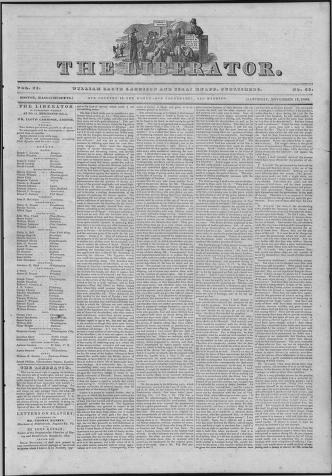
The second address, on September 21, 1832, drew the most attention from historians. Franklin Hall was a meeting place used by the New England Anti-Slavery Society, and Stewart’s audience there included men.6 The Liberator reprinted the lecture on November 17, 1832.4
She opened with the question that would become her signature. “Why sit ye here and die? If we say we will go to a foreign land, the famine and the pestilence are there, and there we shall die. If we sit here, we shall die. Come let us plead our cause before the whites: if they save us alive, we shall live—and if they kill us, we shall but die.”2
That wording comes from the 1835 collected edition. The first printed version, in The Liberator, reads “Why sit we here and die?” — one of several small differences between the newspaper text and the later book.10
The passage carries the cadence of scripture: people with no safe option who choose to act. Stewart’s argument followed from that image. Free Black Bostonians, she said, were trapped by “prejudice, ignorance, and poverty.”2
She focused especially on Black women’s economic prospects. “Let our girls possess what amiable qualities of soul they may,” she said, but “it is impossible for scarce an individual of them to rise above the condition of servants.”2 She compared the condition of Northern free Black workers to Southern slavery itself: “Tell us no more of southern slavery; for with few exceptions, although I may be very erroneous in my opinion, yet I consider our condition but little better than that.”2
She also addressed, directly, why she was the one speaking. “Methinks I heard a spiritual interrogation—’Who shall go forward, and take off the reproach that is cast upon the people of color? Shall it be a woman?'”2 Her answer, in the next line, was framed as religious obedience: “If it is thy will, be it even so, Lord Jesus!”2
And she acknowledged the risk, while claiming her place in the nation: “I can but die for expressing my sentiments; and I am as willing to die by the sword as the pestilence; for I am a true born American; your blood flows in my veins, and your spirit fires my breast.”2
February 1833: The African Masonic Hall
On February 27, 1833, Stewart spoke at the African Masonic Hall in Boston.1 The address, which opens by taking up “African rights and liberty” as its subject, was printed in The Liberator on May 4, 1833.1 In it, she turned her criticism toward Black men as well as white society, urging them to take up leadership and civic action. “It is of no use for us to wait any longer for a generation of well educated men to arise,” she said.3
September 1833: A Farewell
On September 21, 1833 — one year to the day after the Franklin Hall lecture — Stewart delivered a farewell address to her friends in the city of Boston.3
Much of the address defended her right to speak. “What if I am a woman; is not the God of ancient times the God of these modern days?” she asked.3 She pointed to Deborah, Queen Esther, and Mary Magdalene as women who had spoken and acted with divine sanction.3 She acknowledged that “St. Paul declared that it was a shame for a woman to speak in public.”3 But, she argued, if Paul “but know of our wrongs and deprivations, I presume he would make no objections to our pleading in public for our rights.”3
At the time, audiences that mixed women and men were often called “promiscuous,” and many observers considered it improper for a woman to address them.6
The address also explained why she was leaving. Stewart said she had found “it is no use for me as an individual to try to make myself useful among my color in this city,” adding that “it was contempt for my moral and religious opinions in private that drove me thus before a public.”3 The National Park Service notes that controversy over her speeches and writings may have hastened her departure.1 Her own words suggest that at least some of the opposition she felt came from within Boston’s Black community, though she did not name her critics.
The farewell also struck a different note from her earlier addresses. She now advised dropping “all political discussions in our behalf,” which in her view would “sow the seed of discord, and strengthen the cord of prejudice.”3 In their place, she urged her listeners to “cultivate your own minds and morals” and to “turn your attention to industry.”3 Looking back on her time in Boston, she said, “Thus far has my life been almost a life of complete disappointment.”3
The printed version of the farewell, published in 1835, closes with a dateline from New York, April 14, 1834 — a reminder that the text readers have today is the one Stewart prepared for print after she had left Boston.3
Weighing a “First”: What the Sources Actually Say
Maria Stewart is often described as a “first.” The precise claim varies by source, and the differences matter.
The National Park Service describes her as “considered the first African American woman to speak in public on political, religious, and racial issues.”1 It calls the Franklin Hall lecture “one of the first recorded instances of an American woman—of any race—speaking in public.”1 Britannica calls her “the first known American woman to lecture the public on the abolitionist movement.”4 An archive of women’s political speeches at Iowa State University describes her as “one of the first American women of any race to speak to a ‘mixed’ audience of men and women,” and as “the first African American woman to publish a political manifesto.”5
These are not identical statements. Some say “first”; others say “one of the first.” Some specify African American women; some specify abolition; some specify mixed audiences. The qualifiers are doing real work.
One reason for care is that Stewart was not the only woman lecturing in the United States in this period. Frances Wright, a Scottish-born reformer, lectured widely in the United States on abolition and women’s rights before Stewart did.9 The Library of Congress describes Wright as “one of the first American women to speak in public to ‘conspicuous’ (mixed gender) audiences,” and notes that an 1829 cartoon was already mocking her for it.9 That is why some descriptions of Stewart add the qualifier “American-born.”
Taken together, these sources support describing Stewart as one of the earliest documented American women to lecture publicly on political questions before mixed audiences. She is also widely described as the first African American woman to do so. These distinctions depend on how historians define public lecturing, political speech, and the surviving record. Her lectures also have an unusual feature for the period — their texts survive, because she and her supporters put them into print.3

After Boston: Teacher, Matron, Author
Stewart moved to New York in 1834.1 There she joined a Black “Female Literary Society” and began teaching.1 Over the following decades, she lived and taught in Baltimore and then Washington, D.C.1
In Washington, she served as matron of the Freedmen’s Hospital.1
A federal law passed in 1878 made Stewart eligible for a pension based on her late husband’s service in the War of 1812.1 Hatton helped gather the evidence for her claim.1 A letter reprinted in her final book records that the pension, $8 per month, was granted retroactive to March 9, 1878.8 Hatton wrote that without it, Stewart “might have died in ignorance of the existence of her book.”8
Stewart used the pension money to publish a new edition of her work in 1879: Meditations from the Pen of Mrs. Maria W. Stewart.1 The volume included a letter from Garrison, dated April 4, 1879, which told her, “Your whole adult life has been devoted to the noble task of educating and elevating your people.”8
Maria W. Stewart died at the Freedmen’s Hospital on December 17, 1879, shortly after the book appeared.1 She was first buried in Washington’s Graceland Cemetery; after that cemetery closed in 1894, most of its burials were moved, and she now lies in Woodlawn Cemetery.1

Legacy and Civic Relevance
Maria W. Stewart’s public speaking career was brief and controversial. After delivering four recorded addresses in Boston between 1832 and 1833, she left the city and continued her work as a teacher and writer. Her speeches survived in print, preserving arguments that challenged the racial and gender boundaries of public life.
That survival lets historians reconstruct what she argued and how. Her addresses connected issues that later movements would often separate: slavery in the South, discrimination in the North, the economic limits placed on Black workers, and the particular constraints on Black women. Her collected works reached print twice in her lifetime — once in 1835 and again in 1879.1
Her story also raises a durable civic question about public speech itself. Who is permitted to speak in public, and who decides which voices count? The barriers she encountered were often enforced through social expectations and custom — about women, about race, and about which kinds of gatherings were respectable — as well as through wider legal inequalities. Those barriers shaped her career.
Her experience also illustrates why claims about “firsts” deserve careful handling. The record supports calling her one of the earliest documented American women to lecture on political questions before mixed audiences, and many institutions describe her as the first African American woman to do so. Stating the claim precisely does not diminish it. It shows what the evidence can and cannot support.
This episode opens a week examining women in public life in the 1830s and 1840s. Stewart’s route was the lecture platform. Lowell mill workers took a different route: collective action and petitions. Catharine Beecher would argue for yet another — influence through the schoolroom and the home, rather than public political agitation.
What opportunities did this approach create, and whose participation did it leave constrained?
Continue exploring with Sojourner Truth: The Voice That Refused Silence, and with the companion articles on the Lowell Mill Girls and Catharine Beecher, in History Lessons.
Endnotes
1. National Park Service, “Maria W. Stewart.” https://www.nps.gov/people/maria-w-stewart.htm
2. Maria W. Stewart, “Lecture Delivered at Franklin Hall” (September 21, 1832), ed. Sarah A. Morgan Smith, Teaching American History; text from Productions of Mrs. Maria W. Stewart (Boston, 1835), 51–56. https://teachingamericanhistory.org/document/lecture-delivered-at-franklin-hall/
3. Maria W. Stewart, Productions of Mrs. Maria W. Stewart, Presented to the First African Baptist Church & Society of the City of Boston (Boston: Friends of Freedom and Virtue, 1835), introduction to Religion and the Pure Principles of Morality, 3–4; Masonic Hall address, 63–72; farewell address, 72–82; New York Public Library, Digital Schomburg. https://s3.amazonaws.com/nypl-aaww/SCAAWW_book_33_Productions_of_Mrs_Maria_W_Stewart_presented_to_the_First_Africa_Baptist_Church_and_Society_of_the_City_of_Boston.pdf
4. Britannica Editors, “Maria W. Stewart,” Encyclopedia Britannica. https://www.britannica.com/biography/Maria-W-Stewart
5. Iowa State University, Carrie Chapman Catt Center, Archives of Women’s Political Communication, “Maria W. Stewart.” https://awpc.cattcenter.iastate.edu/directory/maria-w-stewart/
6. Adam Tomasi, “Maria Stewart,” The West End Museum (November 18, 2021). https://thewestendmuseum.org/?p=2669
7. National Park Service, “The Liberator.” https://www.nps.gov/articles/000/the-liberator.htm
8. Maria W. Stewart, Meditations from the Pen of Mrs. Maria W. Stewart (Washington, D.C., 1879), including Louise C. Hatton, “Biographical Sketch,” and William Lloyd Garrison to Maria W. Stewart, April 4, 1879; A Celebration of Women Writers, University of Pennsylvania. https://digital.library.upenn.edu/women/stewart-maria/meditations/meditations.html
9. Elizabeth A. Novara and Erika Hope Spencer, “Frances Wright, the Marquis de Lafayette, and Visions of American Equality,” Manuscripts blog, Library of Congress (March 2025). https://blogs.loc.gov/manuscripts/2025/03/frances-wright-the-marquis-de-lafayette-and-visions-of-american-equality/
10. Voices of Democracy: The U.S. Oratory Project, University of Maryland, “Maria W. Miller Stewart, ‘Lecture Delivered at Franklin Hall’ (21 September 1832): Textual Authentication.” https://voicesofdemocracy.umd.edu/stewart-lecture-delivered-textual-authentication/
Image Sources
African Meeting House (Abolition Church), 8 Smith Court, Boston: Historic American Buildings Survey, HABS MA-2-74; photographs by Hutchins Photography and Arthur C. Haskell, documentation compiled after 1933. Library of Congress, Prints and Photographs Division. No known restrictions on images made by the U.S. Government. Record: loc.gov/item/ma0897; photograph: loc.gov/resource/hhh.ma0897.photos/?sp=2.
The Liberator, November 17, 1832: Library of Congress, Chronicling America. Issue record: loc.gov/resource/sn84031524/1832-11-17/ed-1/?sp=1. Front page shown; Stewart’s lecture is on p. 183.
“A Downright Gabbler, or a Goose That Deserves to Be Hissed” (1829): James Akin, lithograph with watercolor. Library of Congress, Prints and Photographs Division, LC-DIG-pga-05109. No known restrictions on publication. Record: loc.gov/pictures/item/2002708975.
Productions of Mrs. Maria W. Stewart (1835), front cover: New York Public Library; public domain. University of Illinois Omeka, “Works by Civil War Authors”: iopn.library.illinois.edu/omeka/s/CivilWarAuthors/media/5970.