

Narcissa Whitman: The Letters That Made Oregon Imaginable
Her 1836 journey and the letters she sent home did not create the Oregon Trail migration by themselves—but they made the overland road thinkable for the families who followed, even as her mission helped intensify the colonial pressures that would end her life.
In early July 1836, Narcissa Whitman and Eliza Spalding crossed South Pass in present-day Wyoming with a small Protestant missionary party bound for Oregon Country. On July 4, near Pacific Springs west of the pass, the missionaries marked Independence Day—an episode recorded most clearly in Eliza Spalding’s diary, since Narcissa’s own surviving diary does not begin until July 18 of that year.1 The crossing made Whitman and Spalding among the first known white women to make the journey overland.2 Whitman’s later diary and letters did not create the Oregon Trail migration, but they gave readers in the East a rare, detailed account of terrain, camp life, river crossings, and the practical demands of traveling west.3
Her story is often compressed into the claim that she was “the first woman to cross the Rockies.” That formulation is misleading. Indigenous women had long lived, traveled, and sustained communities throughout the Rocky Mountains and Columbia Plateau, and fur-trade networks had already used routes through South Pass before 1836. Whitman’s significance lies not in discovering a route but in being among the earliest Euro-American women to leave a substantial written record of an overland journey to the Oregon Country.
A Calling Made Possible by Marriage
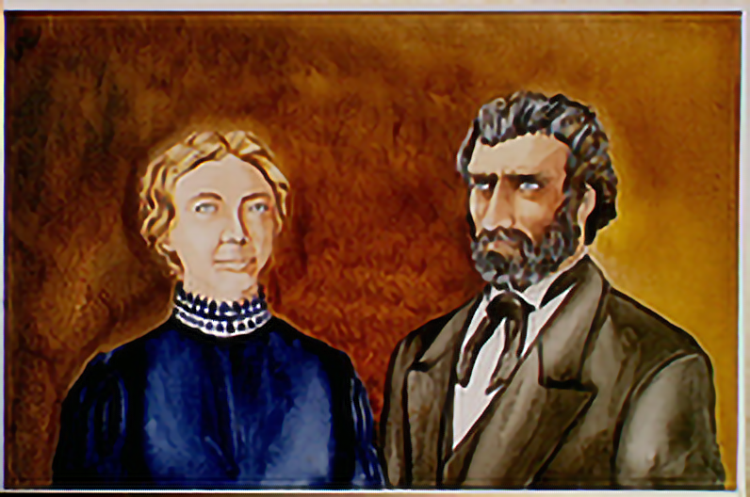
Narcissa Prentiss was born on March 14, 1808, in Prattsburgh, in New York’s rural Finger Lakes region, and by her teenage years had committed herself to missionary work after reading missionary accounts in newspapers.2 The American Board of Commissioners for Foreign Missions, which sponsored missionaries to Indigenous nations in the West, would not send an unmarried woman into the field, and her early applications were turned down for that reason. At an American Board of Commissioners for Foreign Missions meeting in 1834, she was introduced to Dr. Marcus Whitman, a physician with his own ambitions for a mission among the Cayuse people of the Columbia Plateau.2 The marriage that followed solved a practical problem for both of them: it gave Narcissa a sanctioned path into missionary work and gave Marcus a wife willing to share a genuinely dangerous undertaking. They married in February 1836 and departed for Oregon Country the following day, part of the early movement that preceded the much larger overland migrations of the 1840s and 1850s, when an estimated 300,000 to 400,000 people would eventually travel the Oregon Trail system to destinations across the West.4
Over South Pass: The 1836 Journey
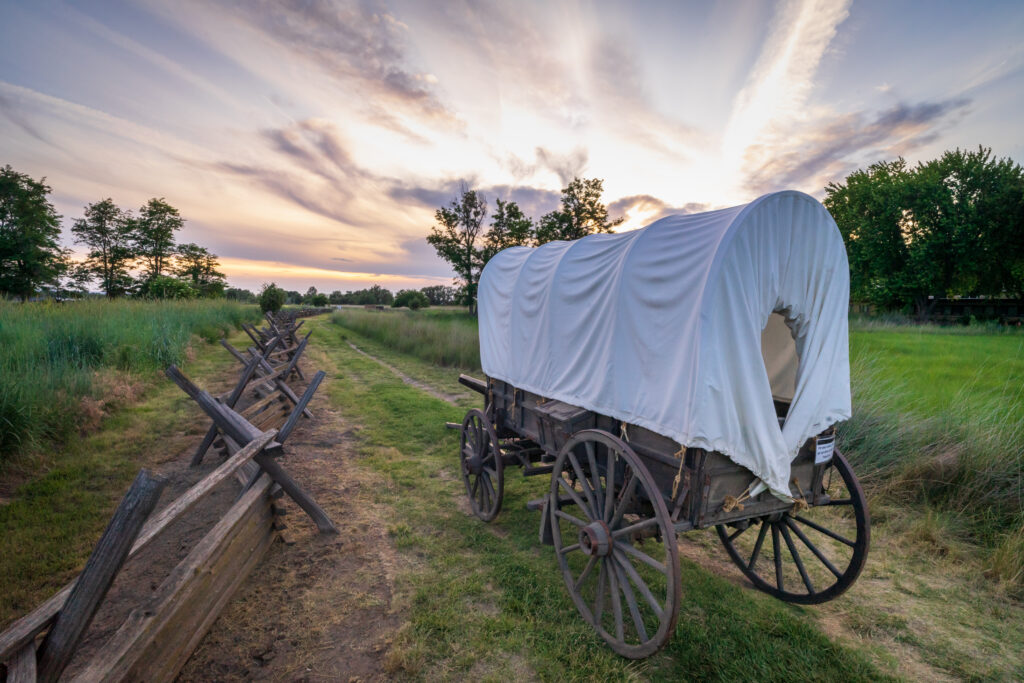
The Whitmans traveled with fellow missionaries Henry and Eliza Spalding and layman William H. Gray, journeying alongside fur traders toward the annual Rocky Mountain rendezvous on the Green River before continuing on toward the Columbia Plateau.3 They brought a light wagon, later altered into a two-wheeled cart, in an early experiment with wheeled travel on the route.2
The National Park Service, which now administers much of the route as the Oregon National Historic Trail, highlights Whitman’s writings from this period for a specific reason: at a time before the Oregon Trail carried significant wagon traffic, her detailed journal and letters gave American readers one of their few firsthand descriptions of what the journey to Oregon actually entailed—the terrain, the river crossings, the daily rhythms of camp life. She wrote home that she had “never was so contented and happy before” and had “never enjoyed such health for years,” a passage that eastern readers, many of them women weighing whether their own families might attempt the trip, would have read as reassurance that the frontier was survivable, even hospitable, for a woman of faith.3
Letters That Traveled Farther Than She Did
This is the heart of Whitman’s influence on later migration, and it deserves a precise description rather than an exaggerated one. Whitman did not build a road, organize a wagon company, or lobby Congress. What she did was write—prolifically and vividly, for an audience she knew extended well beyond her immediate family. Her diary and letters eventually reached family and missionary networks; the diary itself was not published in full until decades later, appearing serialized in her hometown newspaper, the Chronicle-Express of Penn Yan, New York, beginning in 1931.1 Her descriptions often depicted assistance, trade, and sociable encounters with Native peoples along the route, though these accounts reflected a missionary outsider’s perspective rather than a neutral record.3
It would be a mistake, though, to credit Whitman’s letters with causing the migrations that followed. The 1843 migration, commonly estimated at roughly 875 to 1,000 emigrants—including Jesse Applegate and his extended family—made the overland journey with wagons and livestock. It reflected a combination of economic uncertainty, land aspirations, pro-Oregon promotion, and accumulated trail knowledge, not any single cause.5 Whitman’s letters made the journey more imaginable to a specific audience—literate, religious, often female—at a specific early moment. They were an influence among many, not a cause standing alone.
Waiilatpu: Mission, Colonization, and Mounting Strain
The Whitmans settled at Waiilatpu, on Cayuse land near the Walla Walla River, roughly twenty-five miles from the Hudson’s Bay Company’s Fort Walla Walla. Their stated purpose, as the Oregon Encyclopedia summarizes it, was to Christianize and “civilize” the Cayuse—language that reflected the era’s missionary assumptions about the superiority of Euro-American religion, agriculture, and domestic life over Indigenous ways of living.6 From the beginning, the mission’s premise embedded a colonial logic: it treated Cayuse culture not as a different way of organizing a society but as a deficiency to be corrected.
The Cayuse, for their part, initially tolerated and in some cases welcomed the mission, seeing potential value in access to the Whitmans’ knowledge, goods, and trade connections. But the relationship soured steadily over the following decade. Her correspondence and later biographical accounts register frustration with Cayuse cultural and religious practices, including women’s roles and the authority of spiritual leaders.6 Historian Julie Roy Jeffrey’s biography, Converting the West, remains the fullest scholarly treatment of that correspondence and the mission’s unraveling.7
By her final years at Waiilatpu, her letters devoted less attention to the Cayuse themselves and more to the seven orphaned Sager children, whom the Whitmans took in during 1844—a shift later scholars have read as a sign of the mission’s failure on its own terms, even as the surrounding American presence in Oregon Country kept growing.2
It is worth naming plainly what the mission represented in a larger sense. The Whitmans were part of a small but growing wave of Americans establishing a permanent U.S. presence in a region still jointly occupied by the United States and Great Britain and inhabited by sovereign Cayuse, Nez Perce, Umatilla, and other nations. Missionary settlement, however framed by its participants as spiritual work, functioned as a form of colonization: it asserted American religious and cultural authority over Cayuse land and reinforced the broader U.S. claim to the Oregon Country, which would be resolved diplomatically a decade later in the Oregon Treaty of 1846.
Measles, Medicine, and the End at Waiilatpu
By 1847, the pressures on Waiilatpu had compounded. The mission had become an important stopping place for emigrants traveling through Cayuse country, and growing wagon trains passed through the region during the mid-1840s, signaling accelerating U.S. settlement.8 That year, a severe measles epidemic swept through the region. Because the Cayuse had little prior exposure to the disease, mortality was catastrophic; historian Robert Boyd estimates that roughly 40 percent of the Cayuse died, while deaths among the mission’s white population were far lower.9
Marcus Whitman, as the only physician for miles, treated both Cayuse and white patients during the epidemic. The sharply unequal death toll—far greater among Cayuse patients than at the mission—made Marcus vulnerable to suspicion under Cayuse understandings of a healer’s responsibility for his patients’ survival.8 Suspicion of the mission predated the epidemic itself: in a November 25, 1845, letter, Marcus had already reported that the Cayuse leader Young Chief feared “the Americans as having a design to obtain their country and property,” alongside anger over the new diseases white settlement had introduced.8
On November 29, 1847, and in the days that followed, Cayuse men killed Marcus and Narcissa Whitman and twelve other members of the mission community—fourteen deaths in all.8 The event has traditionally been remembered as the “Whitman Massacre,” a label that centers white victims and treats the killings as an inexplicable eruption of violence. Norton and Booss argue for a more accurate framing: “there were two valid perspectives, Cayuse and white,” and the episode is better understood as the “Whitman Tragedy”—a violent culmination of epidemic disease, medical failure understood through two different explanatory systems, and a decade of accumulating colonial pressure, rather than a senseless attack on innocent missionaries.8 Cayuse men then held women and children from the mission captive; Peter Skene Ogden of the Hudson’s Bay Company negotiated their release in the weeks that followed.8 Neither interpretation minimizes the killing of fourteen people. Both are necessary to explain why it happened.
What the Letters Do and Do Not Tell Us
Narcissa Whitman’s letters and diary survive today largely because of institutions like the Oregon Historical Society, whose Marcus and Narcissa Whitman Collection preserves correspondence, journals, and related materials from the mission period, alongside later materials concerning the Whitmans and their legacy.10 Clifford Drury’s earlier documentary history, Marcus and Narcissa Whitman and the Opening of Old Oregon, preserves much of the original correspondence and remains a standard reference, but should be read critically: its framing of Oregon’s “opening” reflects an older, more celebratory view of expansion than most historians hold today.11 That archive is valuable precisely because it lets historians read Whitman’s own words rather than relying on secondhand retellings. But those words need to be read as what they are: a young missionary’s record of her own perceptions, hopes, and frustrations, written to persuade family and supporters back home that the mission—and the broader migration it was part of—was worthwhile. Her letters are strong evidence of how one American woman experienced and described the overland journey and the Cayuse people she lived among. They are not a neutral account of Cayuse life, and they are not proof that she single-handedly opened a trail that Indigenous peoples, fur traders, and missionary parties before her had already been traveling for years.
Legacy and Civic Relevance
Narcissa Whitman occupies an unusual place in the history of the American West: famous enough that her name marks schools, a county, and a mountain, yet frequently reduced to a single, oversimplified claim about being “first.” Her actual significance is more interesting and more complicated than that. She was one of the earliest American women to describe overland travel to Oregon in detail, and her writings, once they reached readers, made that journey more imaginable for the families who would follow in the 1840s. At the same time, her mission at Waiilatpu was itself an instrument of American colonization of Cayuse land, and the tensions that mission generated—compounded by an epidemic her husband could not stop—ended in violence that closed her life at thirty-nine.
Reading Whitman’s story alongside the broader Westward Expansion Era—alongside Jesse Applegate’s search for a safer road, and the diplomatic settlement that gave the United States an internationally recognized claim to the land the Whitmans had settled—helps illustrate a pattern that runs through this whole period of American expansion: individual decisions, personal letters, missionary ambitions, and government treaties were never separate stories. They were threads of the same rope, pulling Oregon Country steadily toward American sovereignty, at a cost that fell overwhelmingly on the Indigenous nations who called it home first.
When Narcissa Whitman crossed into Oregon Country in 1836, the region remained under joint U.S.–British occupation and was home to numerous sovereign Indigenous nations. A decade later, the Oregon Treaty gave the United States internationally recognized sovereignty over Oregon Country south of the 49th parallel—a boundary settlement between two colonial powers, not a grant of unowned land—strengthening the political framework for the migration and territorial expansion already under way, while leaving Indigenous sovereignty and land claims unresolved. Read that story in our companion article, The Oregon Treaty of 1846.
Continue exploring the Pioneer Era in our companion articles on Jesse Applegate and the Applegate Trail, James K. Polk and the Expansion of the United States, and Lewis and Clark’s Corps of Discovery.
Footnotes
- Eliza Hart Spalding, diary, June 15–July 6, 1836, transcription in Dale Morgan, “Rendezvous in the Rocky Mountains” collection. https://user.xmission.com/~drudy/mtman/html/espalding.html; Washington State University Libraries, Manuscripts, Archives, and Special Collections, “Narcissa Prentiss Whitman Diary (Typewritten Transcription),” Archives West. https://archiveswest.orbiscascade.org/ark:80444/xv424132
- National Park Service, “Narcissa Whitman.” https://www.nps.gov/people/narcissa-whitman.htm
- National Park Service, Oregon National Historic Trail, “Narcissa Whitman.” https://www.nps.gov/oreg/learn/historyculture/narcissa-whitman.htm
- William L. Lang, “Oregon Trail,” Oregon Encyclopedia. https://www.oregonencyclopedia.org/articles/oregon_trail/
- Bureau of Land Management, National Historic Oregon Trail Interpretive Center, “Basic Facts about the Oregon Trail.” https://www.blm.gov/learn/interpretive-centers/national-historic-oregon-trail-interpretive-center/explore/facts; Oregon History Project, “The Applegates.” https://www.oregonhistoryproject.org/articles/historical-records/the-applegates/
- “Narcissa Whitman (1808–1847),” Oregon Encyclopedia. https://www.oregonencyclopedia.org/articles/whitman_narcissa_1808_1847_/
- Julie Roy Jeffrey, Converting the West: A Biography of Narcissa Whitman (Norman: University of Oklahoma Press, 1991).
- Melanie J. Norton and John Booss, “Missionaries, Measles, and Manuscripts: Revisiting the Whitman Tragedy,” Journal of the Medical Library Association 107, no. 1 (January 2019): 108–113. https://pmc.ncbi.nlm.nih.gov/articles/PMC6300234/; see also Cameron Addis, “Whitman Murders,” Oregon Encyclopedia. https://oregonencyclopedia.org/articles/whitman_massacre/
- Robert Boyd, “The Pacific Northwest Measles Epidemic of 1847–1848,” Oregon Historical Quarterly 95, no. 1 (Spring 1994): 6–47.
- Jeffrey A. Hayes, “The Marcus and Narcissa Whitman Collection,” Oregon Historical Quarterly 123, no. 4 (Winter 2022). https://www.ohs.org/oregon-historical-quarterly/back-issues/upload/Hayes_Whitman-Collection-Guide_OHQ-123_4_Winter-2022_web.pdf
- Clifford M. Drury, Marcus and Narcissa Whitman and the Opening of Old Oregon, 2 vols. (Glendale, CA: Arthur H. Clark Co., 1973).
Image Sources:
- National Park Service, Harpers Ferry Center Commissioned Art Collection — “Portrait of Narcissa and Marcus Whitman” by Pete Nisbet (1977), Whitman Mission National Historic Site (public domain; government-owned artwork, all reproduction rights held by the U.S. government)
- Adobe Stock, photo by Victor, “Wagon on the Oregon Trail, Whitman Mission,” Image ID 377047275 (licensed for use by the Sandra Day O’Connor Institute)
- National Park Service, Whitman Mission National Historic Site