

John Hancock — The Man Behind the Most Famous Signature in American History
Everyone recognizes the name. Few people, when asked to fill out a form, don’t unconsciously reach for the phrase “just put your John Hancock right here.” His signature, bold, oversized, unmistakable, has become a permanent fixture of the American lexicon. But the man behind that signature was far more consequential, and far more contradictory, than the legend suggests.
John Hancock (1737–1793) was, by most accounts, the wealthiest man in New England. He should have been a Loyalist. Instead, he became one of the most popular and influential Patriot leaders of the Revolutionary era, elected unanimously as President of the Continental Congress, the first to sign the Declaration of Independence, and a man so beloved by ordinary colonists that British soldiers, fed up with hearing his name shouted as a rallying cry, branded him “King Hancock” in disgust. The colonists, with characteristic Revolutionary defiance, simply adopted the nickname as their own.¹

From Orphaned Boy to the Richest Man in Boston
A Privileged Childhood Built on Loss
John Hancock was born on January 23, 1737, in Braintree, Massachusetts. His father died when Hancock was just seven years old, and the boy was sent to live with his wealthy uncle, Thomas Hancock, who owned the House of Hancock, one of colonial Boston’s most successful import-export merchant firms.² Where many founding-era figures built their fortunes from nothing, Hancock inherited his, a circumstance that shaped both his social standing and, later, the skepticism some fellow Patriots felt toward him.
Hancock was educated at Boston Latin School before graduating from Harvard College at the remarkably young age of seventeen.³ He went to work immediately for his uncle’s firm, traveling to England for roughly a year to cultivate trading relationships and establish new commercial contacts.² When Thomas Hancock died in 1764, John inherited the business in full and with it, quite possibly, the largest individual fortune in all of New England.
A Reluctant Radical
Given his wealth and social position, Hancock was an unlikely candidate for revolutionary leadership. As biographer Brooke Barbier observed in her study of Hancock’s life, men of his class and standing were typically expected to side with the Crown, not against it, and Hancock was, by temperament, no radical. He lacked the ideological fire of men like Samuel Adams and was, in Barbier’s words, “widely considered a traitor to his class” precisely because his sympathies ran toward ordinary colonists rather than fellow elites.⁴ Yet it was that very willingness to break from his class, combined with a genuine talent for connecting with people across social lines, that made him one of the most effective political figures of the era.
When Britain passed the Stamp Act in 1765, Hancock initially had no strong objection to it. But after witnessing the unrest and protest the act provoked throughout Boston, he changed course entirely — joining the boycott of British goods and rapidly becoming one of the most visible faces of colonial resistance.² Samuel Adams, recognizing Hancock’s popularity and the political value of his support, championed his election to the Massachusetts House of Representatives in 1766.²
The Liberty Affair and Boston’s Growing Resistance
A Smuggling Scandal That Made Him a Patriot Icon
Hancock’s standing among Boston’s Patriots was cemented, somewhat unexpectedly, through controversy. In May 1768, British customs officials seized Hancock’s sloop Liberty, alleging it had been used to smuggle wine without paying the required duties under the Townshend Acts. The seizure provoked a riot among Boston’s sailors and townspeople, and the British officials were forced to flee for their own safety before later filing formal charges against Hancock.²
His defense attorney for the case was none other than John Adams, and the charges were ultimately dropped, likely, historians believe, for lack of sufficient evidence.¹ The episode did lasting damage to Hancock’s reputation as a smuggler in some circles, but politically, it transformed him into a Patriot symbol: a wealthy man willing to defy British authority and absorb the consequences. The Liberty Affair is now considered one of the pivotal early flashpoints on the road to revolution.²
“King Hancock” Is Born
It was in the aftermath of the Boston Tea Party in December 1773 that Hancock’s most enduring nickname first entered the historical record. British soldiers, interrogating a captive Bostonian about who had ordered the destruction of the tea, grew furious at the answer “nobody” and shouted back that it was “KING HANCOCK and the damn’d sons of liberty.”⁴ The label was meant as both an insult and a grudging acknowledgment of Hancock’s outsized influence.
The colonists turned the insult into a rallying cry. On April 19, 1775, as exhausted British troops retreated the twenty miles from Concord back toward Boston under fire from colonial militia, men from more than twenty surrounding towns reportedly shouted “King Hancock forever!” as they fired upon the retreating soldiers.⁴ What began as British mockery became, in the hands of the colonists, an expression of genuine popular loyalty.
Hancock did not earn this loyalty through fiery rhetoric; by most accounts, he was never considered an especially gifted public speaker or writer.³ He earned it instead through charisma, generosity, and an unusual willingness, for a man of his wealth, to treat ordinary Bostonians with genuine warmth: extending loans, gifting firewood and alcohol to struggling neighbors, and speaking to working people with a familiarity that elites of his era rarely displayed.⁴ As Barbier put it, Hancock made people “feel like he was one of them,” and in revolutionary Boston, that feeling translated directly into political power.
President of the Continental Congress
A Target for British Arrest
By the time fighting broke out at Lexington and Concord in April 1775, Hancock had become one of the British military’s primary targets, alongside Samuel Adams. Warned that British troops were marching to capture them, and possibly seize stores of militia weapons in the process, Hancock and Adams fled the area the night before fighting began.³ Hancock, who held the rank of colonel in the Massachusetts militia, reportedly wanted to take up arms and fight; Adams and Paul Revere talked him out of it, arguing that his political leadership mattered more to the cause than his presence on a battlefield.²
Elected President — Unanimously
Hancock made his way to Philadelphia, where his reputation preceded him. On May 24, 1775, he was named presiding officer of the Second Continental Congress, and the Congress elected him its President swiftly and unanimously.¹ He held this position, effectively the closest thing the fledgling United States had to a head of state in the years before the Constitution created the presidency, through the drafting and signing of the Declaration of Independence the following year.
As President, Hancock oversaw the formation of several of the Congress’s most consequential early committees, including the Marine Committee, which helped organize the first fleet of the United States Navy. He also presided over the Committee of Five, the group tasked with drafting the Declaration of Independence.²
The Signature That Became a Legend
Setting the Record Straight
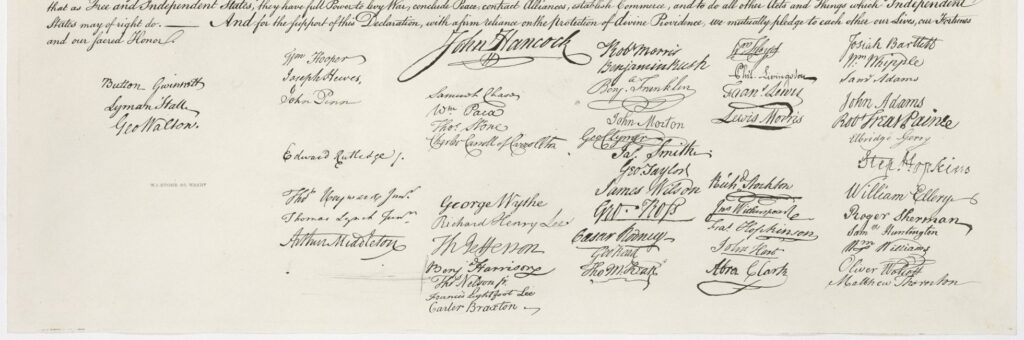
No detail of Hancock’s life has been more thoroughly mythologized than his signature on the Declaration of Independence. The popular legend holds that Hancock signed his name in oversized, theatrical script specifically so that “King George will be able to read that without his spectacles” — a deliberate act of taunting defiance performed before a room full of fellow delegates.
The reality is more measured, though no less significant. As President of the Continental Congress, Hancock was simply the first to sign the engrossed parchment, in a manner befitting his role as the body’s presiding officer, not as a calculated act of mockery. And contrary to the famous Trumbull painting that depicts a crowded room of delegates witnessing the signing, historical evidence suggests that only one other person was present when Hancock actually put pen to parchment.¹
That said, Hancock did take a genuine and serious risk. His was the most prominent, most legible signature on a document that constituted an act of treason against the Crown, and had the Revolution failed, it would have marked him for execution above nearly anyone else.¹ Some accounts do attribute to Hancock a defiant remark along these lines: variations of “there, John Bull can read my name without spectacles” appear in early historical retellings, though the precise wording and context remain difficult to verify with certainty.²
A Name Forever Linked to Independence
Because early public versions of the Declaration of Independence initially circulated bearing only Hancock’s name and that of the Congress’s secretary, Charles Thomson, Hancock’s signature became inseparably linked with the document itself in the public imagination, even though fifty-five other delegates would eventually add their names as well.³ It remains, to this day, the most recognizable signature in American history.
Governor of Massachusetts and Final Years
Stepping Back from Congress
Hancock’s tenure as President of the Continental Congress lasted roughly two and a half years. Citing homesickness and exhaustion, he returned to Massachusetts in 1777, briefly rejoining Congress in 1778 before turning his full attention to his home state.² In 1780, Hancock was elected the first governor of Massachusetts under its new state constitution, a position he would hold, with one brief interruption, for most of the rest of his life.
Popularity That Outlasted Politics
Hancock served as governor from 1780 to 1785, stepped down briefly, and then returned to the office in 1787, serving until his death in 1793.³ He was, by every account, immensely popular in Massachusetts, a popularity rooted in the same personal warmth and generosity that had defined his rise during the resistance movement decades earlier. Though absent from the 1787 Constitutional Convention in Philadelphia due to declining health, Hancock played a decisive role in Massachusetts’s ratification of the U.S. Constitution, ultimately setting aside his own reservations about the document’s lack of a Bill of Rights to help secure its passage.¹
John Hancock died on October 8, 1793, at the age of fifty-six. His funeral was among the largest the city of Boston had ever seen, organized in part by his longtime friend and sometimes-rival Samuel Adams, who succeeded him as governor.² He was laid to rest at the Granary Burying Ground in Boston, the same hallowed ground where Samuel Adams, Paul Revere, and the victims of the Boston Massacre are also buried.
Legacy and Civic Relevance
John Hancock’s life resists the simple narratives we often attach to the Founding Fathers. He was not a radical theorist like Samuel Adams, nor a reluctant convert to independence like so many of his fellow signers. He was something different: a man of extraordinary privilege who chose, again and again, to align himself with people who had far less to lose than he did, and who built genuine, lasting popularity not through ideology but through personal connection and generosity.
As historian Brooke Barbier has argued, Hancock’s career offers a lesson often missing from our discussion of the founding generation: that lasting political change requires not only radicals willing to provoke and agitate but also moderates capable of building broad coalitions of trust.⁴ Samuel Adams supplied the ideological urgency of the Revolution; John Hancock supplied much of its popular legitimacy. Neither could have succeeded alone.
John Hancock’s signature endures as shorthand for boldness and commitment, but the fuller story behind that signature, of a wealthy man who staked his fortune and his life on a cause that was never inevitable, deserves to be remembered just as vividly as the famous flourish of his pen.
Footnotes
- National Constitution Center, “10 fascinating facts about John Hancock,” May 24, 2021, https://constitutioncenter.org/blog/10-fascinating-facts-about-john-hancock
- American Battlefield Trust, “John Hancock,” https://www.battlefields.org/learn/biographies/john-hancock
- National Park Service, “John Hancock,” https://www.nps.gov/people/john-hancock.htm
- Harvard University Press, “John Hancock: A Patriot of Fascinating Contradictions,” interview with Brooke Barbier, October 4, 2023, https://www.hup.harvard.edu/features/john-hancock-a-patriot-of-fascinating-contradictions