

Antietam: The Bloodiest Day and a Turning Point Toward Emancipation
How a brutal tactical draw in a Maryland cornfield halted Robert E. Lee’s first invasion of the North and gave Abraham Lincoln room to change what the Civil War was fought over.
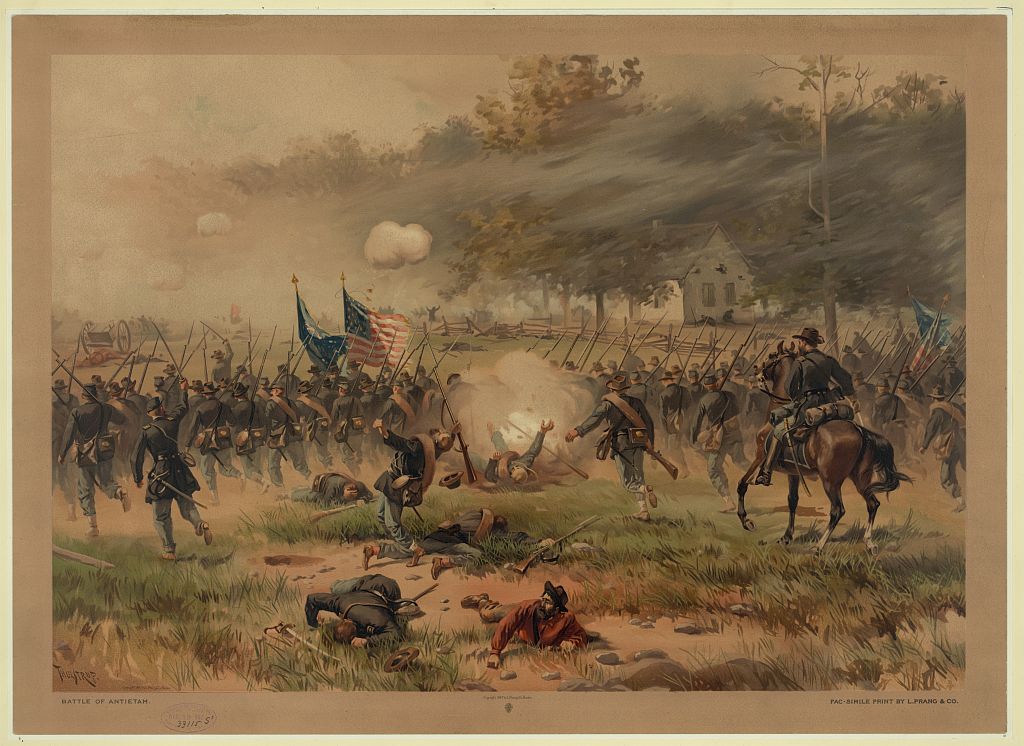
Dawn broke over the fields north of Sharpsburg, Maryland, on September 17, 1862. By evening, after roughly twelve hours of combat, more than 23,000 Union and Confederate soldiers had been killed, wounded, or reported missing, the highest toll of any single day in U.S. military history.1
The Battle of Antietam did not destroy either army. But it ended Robert E. Lee’s first invasion of the North and gave Abraham Lincoln the military opening he had been waiting for to announce a policy he had already been considering: transforming the Union war effort into a war against slavery.2
The Civil War had entered its second year. Confederate General Robert E. Lee had crossed the Potomac River into Maryland that September. Lee hoped the campaign could relieve pressure on war-torn Virginia, let his army gather supplies from Maryland’s untouched farmland, and influence Northern politics ahead of the fall elections; he also hoped Maryland, a slaveholding state kept in the Union chiefly by federal troops, would rally to the Confederate cause.13
Lee himself was skeptical that a Northern invasion alone would win Britain or France’s formal recognition of the Confederacy, though other Confederate leaders held out that hope.13 Union General George B. McClellan’s Army of the Potomac moved to intercept him, and the two armies met near Antietam Creek, outside Sharpsburg, after a discovery gave McClellan unusually detailed intelligence about Lee’s army — intelligence he did not fully exploit.
The Road to Sharpsburg
The Lost Order
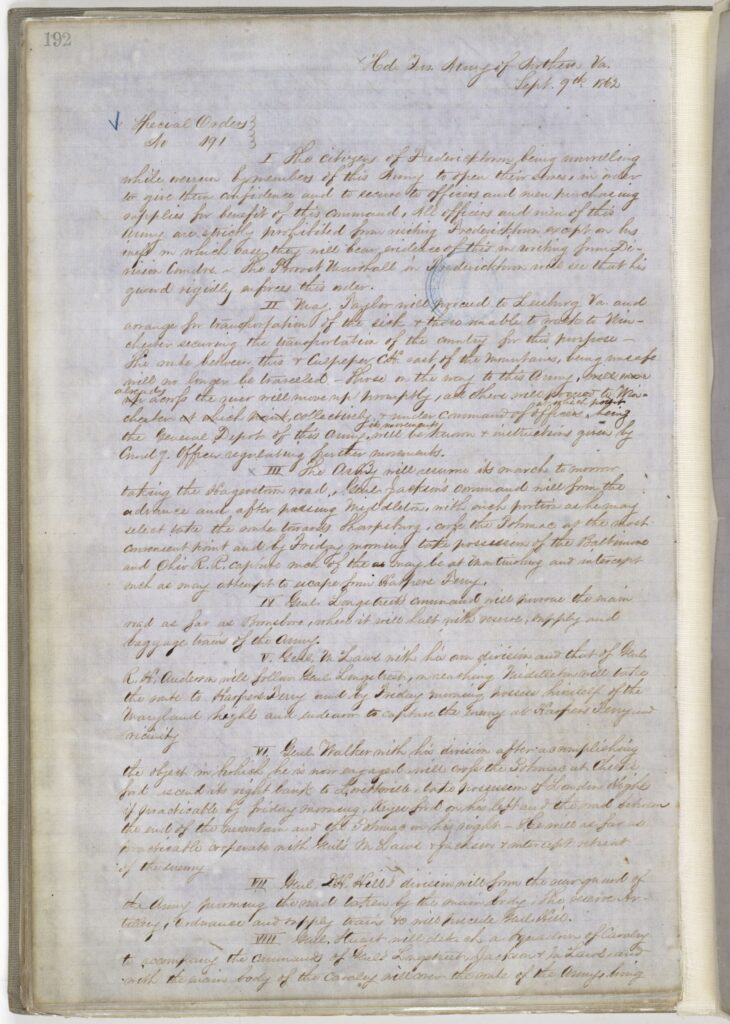
On September 9, 1862, Lee issued Special Order No. 191, directing his army’s separate columns during the Maryland Campaign. The order sent Thomas J. “Stonewall” Jackson toward Harpers Ferry while other Confederate forces moved through western Maryland.3 A copy, wrapped around three cigars, was found on September 13 by soldiers of the 27th Indiana Volunteer Infantry near Frederick and reached McClellan that afternoon.4
The discovery gave McClellan unusually detailed intelligence about Lee’s scattered army. It did not guarantee Union success. McClellan did not exploit the intelligence quickly enough to prevent Lee from concentrating much of his army before Antietam; McClellan’s own movements, Lee’s defensive stand at South Mountain, the capture of Harpers Ferry, and the Confederates’ ability to concentrate near Sharpsburg all shaped what followed.4 The Library of Congress holds an extensive collection of McClellan’s wartime correspondence and reports, a starting point for readers who want to trace his own account of those days in his own words.10
Three Phases of One Day
For a battle fought by tens of thousands of men across several square miles, Antietam is easier to follow not brigade by brigade, but through three phases that moved from north to south over the course of a single day.
| Phase | Location | What Happened | Why It Matters |
| Morning | The Cornfield and Dunker Church | Union and Confederate troops attacked and fell back over the same ground repeatedly; the Cornfield changed hands roughly six times in about three hours.1 | Shows the scale, confusion, and repetition of nineteenth-century infantry combat. |
| Midday | The Sunken Road (“Bloody Lane”) | Union forces captured the Confederate position along the Sunken Road, later called Bloody Lane, but did not exploit the opening before a new Confederate line formed nearby.1 | Illustrates how a real tactical success could still be lost to delay and gaps in command. |
| Afternoon | Burnside Bridge and the southern field | Union troops crossed a narrow stone bridge over Antietam Creek after nearly three hours of fighting, then were checked by Confederate reinforcements arriving from Harpers Ferry under A. P. Hill.1 | Explains why the day ended without a decisive breakthrough on either flank. |
None of this tells us what any individual soldier was fighting for that day. Soldiers’ letters and diaries from the Antietam campaign show a range of motivations: duty, comradeship, family, faith, Union, Confederate nationalism, and, in different ways, the war’s relationship to slavery.12 The Confederate state was founded to protect slavery — Confederate Vice President Alexander Stephens said as much directly in his March 1861 “Cornerstone Speech” — while individual Confederate soldiers’ own motives varied, and the Union’s war aims were still evolving that fall, a point taken up further below.14 Without soldiers’ own words, their individual motivations should not be assumed.
What the Day Cost
More than 23,000 soldiers were killed, wounded, or listed as missing on September 17, 1862; a precise total has never been possible, since accounts vary by how the missing and later deaths from wounds were counted.2 It remains the deadliest single day in American military history. Medical staff on both sides were overwhelmed by the scale of the wounded. In a letter to his wife dated September 22, 1862, Major William Child, a surgeon with the 5th New Hampshire Volunteers, wrote that he had “dressed the wounds of 64 different men — some having two or three each” — one physician’s account among thousands of individual stories the battle left behind.12
Setting the Record Straight
Not a Simple Union Victory
Antietam was not a simple Union victory. Lee’s army remained on the field through September 18 before withdrawing across the Potomac that night, and McClellan did not mount the aggressive pursuit Lincoln wanted.7 Yet Lee’s withdrawal ended the Confederate army’s first invasion of the North.2 For that reason, historians generally describe Antietam as a tactical draw or inconclusive battle with a major strategic result for the Union — not a clean battlefield victory for either side.
Emancipation Did Not Begin at Antietam
Lincoln had been weighing some form of emancipation for months before the battle and had already discussed a draft proclamation with his cabinet that summer.6 What Antietam supplied was not the idea, but the moment: a battlefield outcome substantial enough that Lincoln could announce his intentions from a position of relative strength rather than apparent desperation. In a later recollection, Lincoln said: “Things looked darker than ever. Finally, came the week of the battle of Antietam. I determined to wait no longer.”7
The Bloodiest Day, Not the Bloodiest Battle
Antietam is correctly described as the bloodiest single day in American military history — not the bloodiest battle of the Civil War overall. Multi-day engagements such as Gettysburg produced higher total casualties across their full length. The distinction matters: it is the concentration of loss into a single day, not the largest overall toll, that sets September 17, 1862, apart.2
Antietam and the Path to Emancipation

The Preliminary Proclamation
Five days after the battle, on September 22, 1862, Lincoln issued the preliminary Emancipation Proclamation. It announced that enslaved people in areas still in rebellion on January 1, 1863, would be declared “then, thenceforward, and forever free.”5 The preliminary order did not immediately free anyone. The National Park Service, which administers the battlefield today, directly links the end of Lee’s invasion to Lincoln’s decision to move forward with the proclamation at that moment.2
What the Proclamation Did — and Did Not — Do
When the final proclamation took effect on January 1, 1863, it applied to Confederate areas designated as still in rebellion. It excluded the loyal border states of Delaware, Maryland, Kentucky, and Missouri, along with several specifically named Union-occupied regions, including 48 Virginia counties and thirteen Louisiana parishes.15 Those exclusions reflected the proclamation’s legal basis as a wartime measure, as well as Lincoln’s political and military need to retain loyal slave states.6 The proclamation nevertheless made the destruction of slavery a formal Union war aim, and the final proclamation also authorized the enlistment of Black men in the United States armed forces — a change with enormous consequences for the rest of the war.6
Consequence and Uncertainty
Lee’s army survived Antietam and withdrew into Virginia to fight for another two and a half years. Lincoln visited McClellan’s army near Antietam on October 3, 1862, as his impatience with the lack of pursuit was growing.8 Photographer Alexander Gardner recorded that visit, including a now-well-known image of Lincoln and McClellan together outside the general’s tent.9 Lincoln removed McClellan from command on November 7, 1862.7
The battle’s outcome also mattered well beyond the immediate campaign. Antietam and the proclamation that followed are generally counted among the factors that made British or French recognition of the Confederacy less likely — never the only factor, and not something Antietam alone determined; as one federal historical account of Civil War diplomacy puts it, “the most important factor still rises from the battlefields on American soil,” since European governments were reluctant to recognize a government that could not sustain consistent military success.11
None of this resolves into a single, tidy verdict. Lee, McClellan, Lincoln, enslaved people who had already been fleeing to Union lines and who saw new possibility in Lincoln’s announcement, civilians in Sharpsburg whose homes and fields became a battlefield, and European observers all read the events of September 1862 differently at the time — and historians still do not agree on every point today.

Legacy and Civic Relevance
Antietam is a useful case for anyone thinking about how democratic governments make decisions under pressure. A single day of fighting reshaped a presidential decision, a war’s stated purpose, international diplomacy, and, eventually, the legal status of millions of people — without any of that being settled on the battlefield itself. Military outcomes and political consequences were connected, but neither fully determined the other. That gap between what happened on the ground near Sharpsburg and what it came to mean is itself part of the history worth understanding.
This is the first entry in a growing Civics for Life collection on the antebellum era and the Civil War. Continue exploring related pieces on the Compromise of 1850, Henry Clay and the Art of Buying Time, and Nat Turner and the Southampton Rebellion of 1831 at More To Learn.
Endnotes
- National Park Service, “A Short Overview of the Battle of Antietam,” https://www.nps.gov/articles/a-short-overview-of-the-battle-of-antietam.htm
- National Park Service, Antietam National Battlefield Foundation Document, https://www.nps.gov/anti/learn/management/upload/ANTI_OV_FINAL.pdf
- National Archives, DocsTeach, “Special Order No. 191 from General Robert E. Lee,” https://docsteach.org/document/lee-lost-order/
- National Park Service, Monocacy National Battlefield, “Special Orders No. 191,” https://home.nps.gov/mono/learn/historyculture/so191.htm
- Abraham Lincoln, Preliminary Emancipation Proclamation, September 22, 1862, reproduced by the National Park Service, Antietam National Battlefield, https://www.nps.gov/anti/learn/historyculture/prelimemanproc.htm
- National Park Service, “Freedom at Antietam,” https://www.nps.gov/anti/learn/historyculture/freedom-at-antietam.htm
- National Park Service, “The Legacy of the Maryland Campaign,” https://www.nps.gov/articles/the-legacy-of-the-maryland-campaign.htm
- National Archives, DocsTeach, “Maryland, Antietam, President Lincoln on the Battlefield,” https://docsteach.org/document/lincoln-antietam/
- Alexander Gardner, “President Lincoln on Battle-field of Antietam,” photograph taken October 3, 1862, Library of Congress, Prints and Photographs Division, https://www.loc.gov/pictures/item/2013646606/
- Library of Congress, George Brinton McClellan Papers, https://www.loc.gov/collections/george-brinton-mcclellan-papers/
- Office of the Historian, U.S. Department of State, “The Union and Confederate States and the Question of Recognition,” https://history.state.gov/milestones/1861-1865/confederacy
- Major William Child to his wife, September 22, 1862, reproduced in National Park Service, “Antietam: Letters and Diaries of Soldiers and Civilians,” https://www.nps.gov/anti/learn/education/classrooms/antietam-letters-and-diaries-of-soldiers-and-civilians.htm
- American Battlefield Trust, “Robert E. Lee’s Decision to Invade the North in September 1862,” https://www.battlefields.org/learn/articles/robert-e-lees-decision-invade-north-september-1862
- American Battlefield Trust, “Cornerstone Speech” (Alexander H. Stephens, March 21, 1861), https://www.battlefields.org/learn/primary-sources/cornerstone-speech
- National Archives, “Documented Rights: Emancipation Proclamation Transcript,” https://www.archives.gov/exhibits/documented-rights/exhibit/section1/detail/emancipation-proclamation-transcript.html
Image Sources
Special Order No. 191, Lee’s “Lost Order” (September 9, 1862): War Department Collection of Confederate Records, National Archives Identifier 5752155, presented via National Archives DocsTeach.
Record: docsteach.org — Special Order No. 191
“Battle of Antietam” (circa 1887): Thure de Thulstrup, published by L. Prang & Co., Library of Congress, Prints and Photographs Division. No known restrictions on publication.
Record: loc.gov — Battle of Antietam (Thulstrup, 1887)
Preliminary Emancipation Proclamation (September 22, 1862): Presidential Proclamations, 1791–2016; General Records of the United States Government, Record Group 11, National Archives, presented via National Archives DocsTeach.
Record: docsteach.org — Preliminary Emancipation Proclamation
President Lincoln on the Battlefield of Antietam (photograph taken October 3, 1862): Alexander Gardner, albumen print, Library of Congress, Prints and Photographs Division (LC-DIG-ppmsca-35519). No known restrictions on publication.
Record: loc.gov — President Lincoln on battle-field of Antietam