

Elias Howe, the Lockstitch, and the Sewing Machine War
How a patent granted in 1846 became a test of how the law should reward an inventor while still letting useful technology spread.
On September 10, 1846, the United States Patent Office granted Patent No. 4,750 to Elias Howe Jr. of Cambridge, Massachusetts, for a new kind of sewing machine.1 The machine combined a needle with its eye near the point and a shuttle carrying a second thread, so that the two threads locked together through the fabric. The two threads interlocked to form a lockstitch. Repeated along the cloth, those stitches produced a seam.
Howe did not invent the idea of a sewing machine, and he was not the first person to build a machine that formed a lockstitch. He secured a patent on his design and then fought for years to enforce it. His story is less about a single flash of invention than about the legal system that decided who would profit from an invention. It raises a question at the heart of the Constitution’s patent clause: how should the law reward an inventor, and what happens when patents, money, and manufacturing collide?
A Machinist in Hard Times
From Spencer to Lowell
Elias Howe was born in 1819 in Spencer, Massachusetts.2 As a young man, he worked at the Lowell Machine Shop, which designed and built machinery for the city’s textile mills. He lost that job during the Panic of 1837, the financial crisis examined in the previous article in this series. Howe then found work in Boston, in the Cornhill shop of Ari Davis, who made instruments for mariners and scientists.
A well-known story places the idea for Howe’s invention in that shop. The Cambridge Historical Society calls it “local legend”: when a customer brought in a knitting machine, Davis supposedly told him to stop wasting his time and “make a sewing machine.”3 The customer answered that it could not be done. Howe was not so sure.
Watching the Work

Money was scarce for the Howe family. The Cambridge Historical Society reports that a physical disability made some of Howe’s work painful and difficult, and that when it forced him from work for a time in 1843, his wife took in sewing to pay the bills.3 According to the Smithsonian’s National Museum of American History, which holds his patent model, Howe watched her sew by hand and “visualized ways to mechanize the process.”1
Howe needed money and space to build a working model. His father had opened a factory in Cambridge, where Howe set up his workshop, but it burned not long after it opened. A friend, George Fisher, then took in Howe and his family and, according to the Cambridge Historical Society, agreed to invest $500 in return for a half interest in any patent.3
By May 1845, Howe had a machine that sewed seams. In a public demonstration, he raced five seamstresses, and his machine finished five seams before any of them finished one. The crowd was not won over. Local tailors protested, and the Cambridge Historical Society reports that Howe did not receive a single order.
The Patent
What Howe Claimed
Howe soon built an improved model and took it to the Patent Office in Washington. The Smithsonian identifies his as the fifth U.S. patent issued for a sewing machine.1 What made it valuable was a specific combination. The museum describes Howe’s key claim as control of “the combination of the eye-pointed needle with a shuttle to form a lockstitch.”

The Constitution gives Congress the power “To promote the Progress of Science and useful Arts, by securing for limited Times to Authors and Inventors the exclusive Right to their respective Writings and Discoveries.”4
Under the patent laws of the period, a patent gave its owner the right to prevent others from making, using, or selling the claimed invention without permission. But owning one patent did not necessarily authorize someone to build an entire machine, because other inventors might hold patents on other necessary parts. That distinction became central to the sewing machine disputes. Publication of the patent also disclosed how the invention worked. When its protection expired, the invention could be used without permission under that patent, although other unexpired patents might still apply.
How a Lockstitch Works
The idea behind Howe’s machine is easier to picture than it sounds. A hand sewer pulls a single thread through the cloth with every stitch. Howe’s machine worked differently. In the Smithsonian’s description, it used “a grooved and curved eye-pointed needle carried by a vibrating arm,” and the loops of thread it pushed through the cloth “were locked by a second thread carried by a shuttle.”1 The shuttle carried its thread through the needle-thread loop, interlocking the two threads to form the stitch.
The first machine had real limits. The cloth hung vertically, pinned to a metal “baster plate” that moved it past the needle. Only straight seams could be sewn, and when the plate reached the end of its travel, the cloth had to be taken off, repositioned, and pinned again.1 The Smithsonian calls the result “an imperfect way to sew,” but one that “marked the beginning of successful mechanized sewing.”
No Buyers at Home
A patent did not guarantee a market. According to the Science Museum Group in London, Howe’s machine was priced at 300 dollars and considered too expensive, and it did not sell.5 Howe’s brother Amasa took one of the machines to England, where it became “the first practical sewing machine to be brought to England from America.”6 Amasa sold it to William Thomas, a London manufacturer, who took out a British patent on the design. The machine, made in Lowell around 1846, is now in the Science Museum Group’s collection.
Howe himself went to England to adapt a machine for Thomas’s corset business but never finished it. By the Cambridge Historical Society’s account, he was left broke, and after learning that his wife was gravely ill, he pawned his remaining machine and patent papers to pay for the voyage home.3 She died soon after he returned.
The Sewing Machine War
Rivals and Infringers
Howe returned to the United States in 1849, poorer than when he had left, according to legal scholar Adam Mossoff.7 He found that sewing machines were being built and sold by others, and that many used the combination his patent covered. The best known of these manufacturers was Isaac Merritt Singer. Singer did not invent the sewing machine, but he improved on earlier designs, patented his own version in 1851, and founded I. M. Singer & Co.8
Howe demanded royalties, and when manufacturers refused, he went to court. Mossoff told the U.S. Senate that one historian described Howe’s “main occupation” in the early 1850s as “suing the infringers of his patent for royalties.”9
The Courts Decide
The first case to reach trial was Howe’s suit against the firm of Lerow & Blodgett. On July 12, 1852, after a three-week trial, Judge Sprague ruled in Howe’s favor.7 Howe quickly won preliminary injunctions against Singer and other defendants, and manufacturers began to settle. On May 18, 1853, Wheeler, Wilson & Co. became the first firm to take a license. That July, Howe advertised in the newspapers, warning buyers that if they purchased machines from anyone but him or his licensees, “the law will compel you to pay twice over.”
Singer fought back by finding an earlier inventor. Walter Hunt had built a machine using an eye-pointed needle and a shuttle in 1833 or 1834 but had never patented it. According to Mossoff, Singer bankrolled Hunt’s efforts beginning in 1852 to reconstruct his old machine and claim priority.7
Two decisions in 1854 went in Howe’s favor. In February, in Howe v. Underwood, Judge Sprague considered whether Hunt’s earlier machine defeated Howe’s patent and whether the Singer machine infringed it. The proceeding was an application for a preliminary injunction.10 The court held that an earlier machine could defeat a later patent only if it had been “perfected; that is, made so as to be of practical utility.” Hunt’s machine, the court found, had never been perfected and had been laid aside. Judge Sprague granted the injunction, concluding: “The result is, that the plaintiff’s patent is valid, and the defendants’ machine is an infringement.”

The Patent Office reached a related decision on May 24, 1854, when Commissioner of Patents Charles Mason ruled on Hunt’s own application.7 The Commissioner accepted that Hunt had carried his 1830s invention “to the point of patentability.” But Hunt had sold and transferred his interest in the machine to a business associate named Arrowsmith “without reservation,” and the machine had been “repeatedly exhibited and worked in public both in New York and in Baltimore.”
Under the patent laws then in force, that earlier sale and public use, more than two years before Hunt applied, barred him from receiving a patent. In 1855, a federal court in the District of Columbia upheld the Commissioner’s authority to decide the matter.11 The Cambridge Historical Society quotes Mason as also criticizing the long delay, writing that when a first inventor “allows his discovery to slumber for eighteen years,” the presumption should favor “the inventor who has been the means of conferring the real benefit upon the world.”3
Singer’s firm settled with Howe that summer, agreeing to pay $15,000 and a royalty on each machine it made, according to accounts Mossoff considers the most likely.7
Inventor or Licensor?
Howe increasingly earned his money by licensing his patent and pursuing manufacturers and sellers he accused of infringement. Mossoff told the Senate that Howe “engaged in ex post licensing,” demanding royalties from firms already in the market.9 Modern scholars have compared this strategy with that of nonmanufacturing patent owners today, sometimes called “patent trolls.” Mossoff himself calls that an “inflammatory term” and uses Howe’s example to argue that patent licensing and enforcement are longstanding practices, not a modern invention.
The question his example raises is a fair one: did licensing allow an inventor without a successful manufacturing business to earn a return on his invention, or did it impose costs on the businesses bringing machines to the public?
The First Patent Pool
A Thicket of Patents
Howe was not the only inventor with a claim. By the 1850s, several manufacturers held patents on different parts of a working sewing machine, and none could build a complete machine without using someone else’s patent. Mossoff calls this situation the first American “patent thicket.”7 An account in Smithsonian Magazine puts it more plainly: “People were suing each other and burning up their resources.”8
The Combination of 1856
The solution came from Orlando B. Potter, a lawyer and the president of the Grover & Baker company. In October 1856, when most of the leading sewing machine patent holders were in Albany, New York, for a trial, Potter proposed that Howe, Singer, Grover & Baker, and Wheeler, Wilson & Co. combine their patents.7 The three manufacturers agreed. Howe at first refused, and the pool could not work without his patent. He joined only after winning special terms: a royalty of $5 on each machine sold in the United States and $1 on each machine exported.
The result was the Sewing Machine Combination, which the Smithsonian describes as “the first patent pool in American industry.”1 According to the museum, the agreement reduced expensive and time-consuming litigation among its participants, allowing them “to concentrate on manufacturing and marketing their machines.” Smithsonian Magazine reports that the pool merged nine patents, with three considered most crucial: Howe’s lockstitch, Wheeler and Wilson’s four-motion feed, and Singer’s combination of a vertical needle with a horizontal sewing surface.8
Scholars disagree about the pool’s broader effects. Mossoff emphasizes its success as a privately negotiated solution to overlapping patent rights.7 Economists Ryan Lampe and Petra Moser, studying the Combination’s operation from 1856 to 1877, conclude that “contrary to theoretical predictions, the sewing machine pool appears to have discouraged patenting and innovation,” particularly among its members. They also report that innovation slowed among firms outside the pool while it operated. They tested the point with data on how many stitches per minute machines could sew.12 Ending litigation, in other words, did not necessarily mean maximizing competition or invention.
The agreement made Howe a wealthy man. His patent was extended for seven years, and by the time it expired in 1867, Mossoff writes, his royalties totaled more than $2 million.7 Howe died at the age of 48 in October 1867.2
Setting the Record Straight
Who Invented the Sewing Machine?
Howe is often called the inventor of the sewing machine, but that claim needs care. Others had built and even patented sewing machines before him. The Cambridge Historical Society notes that four sewing machine patents were issued before Howe’s, and that the French tailor Barthélemy Thimonnier had a shop with 80 machines making army clothing by 1841 until a mob of tailors destroyed them.3
According to the Smithsonian, Walter Hunt developed a lockstitch machine in the early 1830s but did not patent it.13 When Hunt applied for a patent on that earlier machine on April 2, 1853, the Patent Office recognized that his work came first but did not grant the patent. The dispute did not turn simply on who reached the Patent Office first.
The court asked whether Hunt’s machine had ever been perfected into a practically useful machine, and the Patent Office asked whether his earlier sale and the machine’s public use barred a patent. Neither proceeding allowed Hunt’s earlier work to invalidate Howe’s patent. Hunt separately received Patent No. 11,161 in 1854 for improvements to sewing machine design; that later patent did not displace Howe’s rights under the 1846 patent.
The more accurate claim is that Howe patented a lockstitch sewing machine and won the legal fight over that patent. In the eyes of the law, an earlier machine that was never perfected into a useful product, and whose inventor had sold it off and let it be used in public without seeking a patent, did not defeat a later inventor who patented a working machine.
Did Howe’s Machine Industrialize America?
It is also common to credit Howe with sparking the industrialization of American manufacturing. The record supports a narrower claim. Textile mills like those in Lowell were already producing cloth on an industrial scale before Howe built his machine. His patent victory and the 1856 combination reduced the litigation that had hampered the sewing machine industry’s growth. The sewing machine then transformed the work of turning cloth into clothing. Stitching times reported in an 1861 survey, reproduced by the Cambridge Historical Society, put a gentleman’s shirt at 14 hours and 26 minutes by hand and 1 hour and 16 minutes by machine.3
Business historians also point out that the companies built around the machine mattered as much as the machine itself. Singer’s firm, Smithsonian Magazine notes, adopted a “hire-purchase plan” devised by Singer’s partner Edward Clark, allowing customers to pay over time, along with door-to-door sales and public demonstrations.8 By that account, Singer won the Sewing Machine War in the marketplace, even after losing to Howe in court.
The Lowell Connection
Howe’s story runs through Lowell, Massachusetts, at more than one point. He learned his trade at the Lowell Machine Shop, which built the machinery that powered the city’s textile mills.2 One of his early machines, now in the Science Museum Group’s collection, was made in Lowell.6 The Lowell mills turned raw cotton into cloth on an industrial scale, while sewing that cloth into clothing remained largely hand work. The sewing machine began to change that, linking the factory production described in our companion article on the Lowell Mill Girls to the making of finished garments.
What the Test Revealed
Elias Howe’s story is the fourth test in this series of how a young economy worked out its rules. The Panics of 1819 and 1837 tested how the country handled credit and banking. The tariff of 1828 tested how national policy divided economic costs among regions. Howe’s patent tested how the law should reward an inventor without choking off the spread of useful technology.
The outcome combined public law with private bargaining. Federal patent rights gave Howe and other inventors claims they could enforce, and a federal judge and the Patent Office upheld Howe’s. The 1856 Combination then coordinated those claims through a licensing agreement. It reduced litigation among the participants, but its effects on competition and further invention remain subjects of scholarly debate.
The questions are left for readers to weigh. Who gained from Howe’s patent, and who paid for it? How should patent law weigh earlier experimentation, practical development, public disclosure, and abandonment when inventors make overlapping claims? And what did this test reveal about the role government should play in the economy, in protecting inventors and in making sure their inventions reach the public?
This article is the fourth and final article in the series Building an Economy: Credit, Conflict, and Invention. Begin the series with the Panic of 1819.
Companion articles: The Lowell Mill Girls, the Panic of 1837, and the Tariff of 1828, all in the Antebellum Era series.
Continue exploring the History Lessons.
Endnotes
1. Smithsonian National Museum of American History, “1846 Elias Howe Jr.’s Sewing Machine Patent Model,” object record nmah_630930. https://www.si.edu/object/1846-elias-howe-jrs-sewing-machine-patent-model:nmah_630930
2. University of Massachusetts Lowell Library, “Elias Howe Sewing Machine,” Early Lowell research guide. https://libguides.uml.edu/early_lowell/Elias_Howe_sewing_machine
3. Cambridge Historical Society, “The Sewing Machine,” Cambridge Innovation. https://historycambridge.org/innovation/Sewing%20Machine.html
4. U.S. Constitution, art. I, § 8, cl. 8, transcription, U.S. Senate. https://www.senate.gov/civics/constitution-item/constitution-a-transcription
5. Science Museum Group Collection, “Elias Howe,” people record cp7115. https://collection.sciencemuseumgroup.org.uk/people/cp7115
6. Science Museum Group Collection, “Sewing machine by Elias Howe,” object no. 1919-235. https://collection.sciencemuseumgroup.org.uk/objects/co44744/sewing-machine-by-elias-howe-sewing-machine
7. Adam Mossoff, “The Rise and Fall of the First American Patent Thicket: The Sewing Machine War of the 1850s,” Arizona Law Review 53 (2011): 165–211, esp. 170 (Howe as nonpracticing entity), 177 (return in 1849), 184–85 (1852 ruling, 1853 licenses, advertisement), 187–90 (Hunt priority dispute and Singer settlement), 193 (patent extension and earnings), and 194–95 (Combination terms). https://journals.librarypublishing.arizona.edu/arizlrev/article/id/7205
8. “How Singer Won the Sewing Machine War,” Smithsonian Magazine. https://www.smithsonianmag.com/smithsonian-institution/how-singer-won-sewing-machine-war-180955919/
9. Adam Mossoff, testimony, “Demand Letters and Consumer Protection: Examining Deceptive Practices by Patent Assertion Entities,” U.S. Senate Committee on Commerce, Science, and Transportation, November 7, 2013. https://www.commerce.senate.gov/wp-content/uploads/media/doc/Mossoff%20Testimony.pdf
10. Howe v. Underwood, 12 F. Cas. 678, 1 Fish. Pat. Cas. 160 (C.C.D. Mass. 1854) (No. 6,775), via Public.Resource.Org. https://law.resource.org/pub/us/case/reporter/F.Cas/0012.f.cas/0012.f.cas.0678.3.pdf
11. Hunt v. Howe, 12 F. Cas. 918 (C.C.D.C. 1855) (No. 6,891), via Public.Resource.Org. https://law.resource.org/pub/us/case/reporter/F.Cas/0012.f.cas/0012.f.cas.0918.html
12. Ryan Lampe and Petra Moser, “Do Patent Pools Encourage Innovation? Evidence from the Nineteenth-Century Sewing Machine Industry,” Journal of Economic History 70, no. 4 (December 2010): 898–920. https://www.cambridge.org/core/journals/journal-of-economic-history/article/abs/do-patent-pools-encourage-innovation-evidence-from-the-nineteenthcentury-sewing-machine-industry/7AF4C13A54AEAB376851FCF5AD7D9072
13. Smithsonian National Museum of American History, “1854 Walter Hunt’s Patent Model Sewing Machine,” ID TE.T07781. https://dashboard.si.edu/object/1854-walter-hunts-patent-model-sewing-machine:nmah_1070410
Image Sources
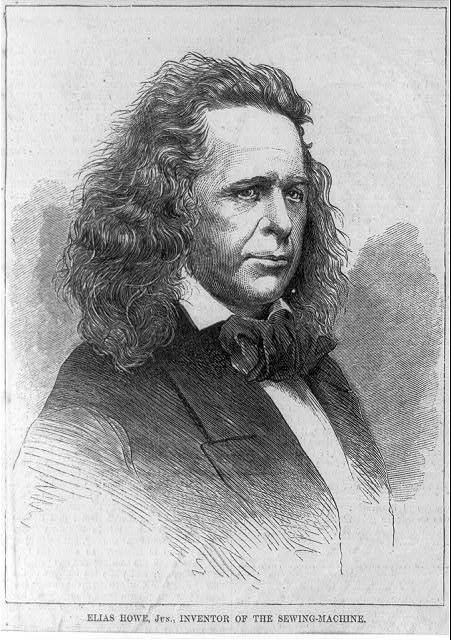
“Elias Howe, Jun., Inventor of the Sewing-Machine” (1867): “Elias Howe,” wood engraving, Harper’s Weekly, 1867, p. 509. Library of Congress, Prints and Photographs Division. No known restrictions on publication. Record: loc.gov/item/2002725175.
Sewing Machine by Elias Howe, Made in Lowell (ca. 1846): Science Museum Group Collection, object no. 1919-235. Licensed under CC BY-NC-SA 4.0. Record: collection.sciencemuseumgroup.org.uk — Sewing machine by Elias Howe.
Elias Howe Jr.’s Sewing Machine Patent Model (1846): Patent model for U.S. Patent No. 4,750, granted September 10, 1846. Smithsonian National Museum of American History. Public domain. Record: si.edu — 1846 Elias Howe Jr.’s Sewing Machine Patent Model.
Walter Hunt’s Patent Model Sewing Machine (1854): Patent model for U.S. Patent No. 11,161, issued June 27, 1854. Smithsonian National Museum of American History, ID TE.T07781. Public domain. Record: si.edu — 1854 Walter Hunt’s Patent Model Sewing Machine.